Qualitative research methods are the ways researchers collect and analyse non-numerical evidence when they want to understand meanings, experiences, practices, interactions, and social contexts. They are used when a study needs more than a count, score, or statistical average. Instead of asking only how often something happens, qualitative research asks how people describe it, how they respond to it, and how it takes shape in real situations.
This article sits within the wider guide to qualitative research. Here, the focus is narrower: the methods, designs, and analysis approaches that help researchers work with interviews, group discussions, observations, documents, field notes, diaries, images, and other forms of qualitative data.
The article explains what qualitative research methods are, which objectives they serve, how they differ from quantitative research, how common designs are structured, which data collection methods are used most often, and how a qualitative study can be planned from the first research question to the final interpretation.
What Are Qualitative Research Methods?
Qualitative research methods are planned procedures for collecting and interpreting data that appear mainly as words, actions, images, sounds, documents, or traces of social life. A researcher may record an interview, observe a classroom, examine policy documents, read diary entries, analyse photographs, or follow how people use language in a meeting. The point is not to turn every observation into a number as quickly as possible. The point is to preserve enough context for meaning to be studied carefully.
A simple example can make the idea easier to follow. Suppose a researcher wants to understand how first-year students experience the move from school to university. A questionnaire with fixed response options could show how many students feel confident, anxious, or supported. A qualitative interview, by contrast, can show what students mean by confidence, which situations make them anxious, how they describe support, and which parts of the transition they did not expect.
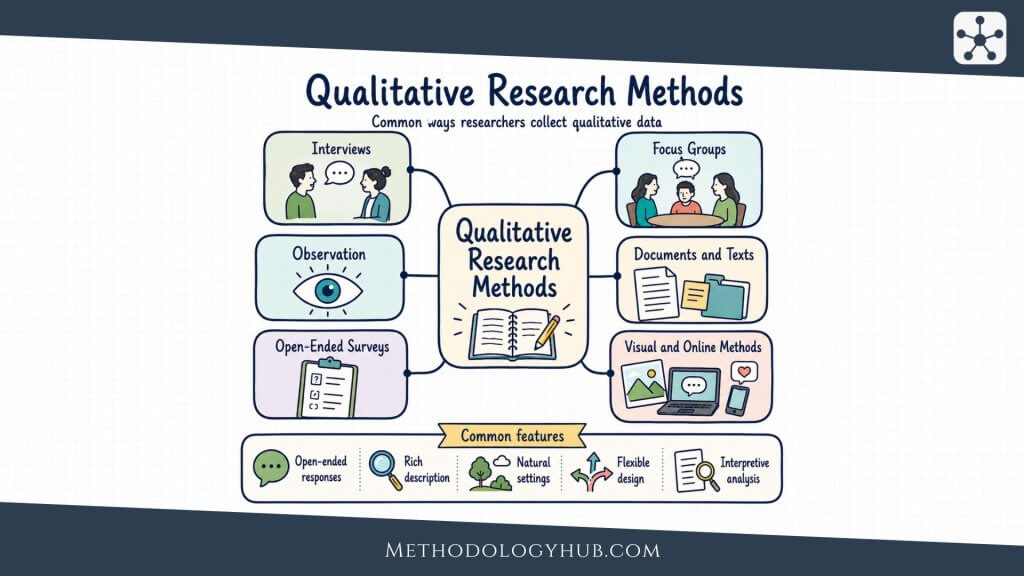
Qualitative research methods definition
Qualitative research methods are systematic ways of collecting, organising, and analysing non-numerical data in order to understand meaning, experience, behaviour, and context. They are systematic because the researcher still makes planned decisions about participants, materials, questions, settings, recording, coding, interpretation, and reporting. They are qualitative because the evidence is interpreted through language, pattern, context, and comparison rather than through statistical measurement alone.
This definition is broad on purpose. Qualitative work can be done in education, sociology, psychology, health research, anthropology, communication studies, history, public policy, and many other fields. The data may come from people speaking in their own words, from actions observed in a setting, or from records that already exist. What links these studies is the attempt to understand how something is experienced, described, organised, or made meaningful.
What counts as qualitative data?
Qualitative data are usually described as non-numerical data, but that phrase can be misleading if it makes the data sound vague. In practice, qualitative data are often very concrete. They may include a participant explaining a childhood memory, a teacher correcting a student during a lesson, a nurse writing a note after a shift, a local newspaper describing a community dispute, or a photograph showing how a public space is used.
Some qualitative projects also include numbers in a limited way. A researcher might report how many interviews were conducted, how many documents were reviewed, or how often a theme appeared during coding. Those numbers can help describe the material, but they do not replace interpretation. A theme that appears only a few times may still be important if it explains a turning point, a conflict, or a hidden assumption in the data.
How qualitative methods produce evidence
Qualitative methods produce evidence by connecting detailed data to careful interpretation. The researcher collects material that is rich enough to show how people speak, act, remember, explain, decide, or disagree. The analysis then looks for patterns, contrasts, meanings, and relationships in that material. Instead of asking whether the average score changed, the researcher may ask which experiences participants shared, which experiences differed, and how those experiences were shaped by setting, role, history, or interaction.
The quality of the evidence depends on the fit between the question and the method. If a study asks how patients describe communication with doctors, interviews may be suitable. If it asks how nurses coordinate work during a shift, observation may be stronger. If it asks how a school policy frames student discipline, document analysis may be more direct. The method should give access to the kind of evidence the question requires.
Objectives of Qualitative Research Methods
The objectives of qualitative research methods usually centre on understanding. A researcher may want to explore a new topic, describe a social setting, interpret lived experience, explain how a process unfolds, compare perspectives, or build concepts from detailed evidence. These objectives are different from estimating prevalence or testing a numerical hypothesis, although qualitative findings can later help design a survey or experiment.
Qualitative objectives are often strongest when the research question contains words such as how, what, in what ways, or how do people experience. A study might ask how families make decisions about elder care, what teachers notice when a new assessment policy is introduced, or in what ways young people describe belonging in a neighbourhood. These questions need data that can carry detail, not only measurement.
Exploring under-researched topics
Qualitative methods are often used when little is known about a topic or when existing categories do not yet fit the situation well. The researcher may begin with a broad question, collect detailed accounts, and allow more specific concepts to develop through analysis. This does not mean the study has no structure. It means the design leaves room for participants, settings, and materials to reveal what the researcher could not fully specify at the beginning.
For example, a researcher studying how students use informal peer support after moving to a new school may not know in advance which forms of support are most important. Interviews and observations can show whether students rely on friends, siblings, online groups, teachers, after-school spaces, or quiet routines that would not appear in a fixed response list.
Understanding experience and meaning
Many qualitative studies focus on how people interpret events in their own lives. The same event can be understood differently depending on age, role, history, language, expectation, and social position. A hospital discharge, a classroom assessment, a family migration story, or a first job can carry different meanings for different participants.
Qualitative research methods allow the researcher to follow those meanings instead of forcing them into pre-set categories too early. A participant can explain why a routine procedure felt reassuring, confusing, embarrassing, or empowering. The researcher can then examine how that interpretation connects to other accounts and to the wider setting.
Describing social processes
Qualitative research is also used to describe processes as they unfold. Some research questions are not about single attitudes or final outcomes, but about sequences. A researcher may study how a support group builds trust, how a classroom discussion shifts from confusion to agreement, how a committee reaches a decision, or how a family adapts to a new caregiving routine.
These questions require attention to order, interaction, and change. Observation, repeated interviews, diaries, and field notes can help show how one moment leads to another. The result is not only a list of themes, but an account of movement: who acts, who responds, what changes, and what stays unresolved.
Note: qualitative methods are especially useful when the answer depends on context, sequence, wording, interaction, or personal interpretation.
Comparing perspectives
A qualitative study can also compare how different groups understand the same situation. In a school study, students, teachers, parents, and administrators may all describe the same policy, but each group may notice different pressures and consequences. In a health study, patients and clinicians may use the same words, such as support or recovery, while attaching different expectations to them.
Comparison in qualitative research does not have to mean statistical comparison. It can mean examining similarities, differences, tensions, and missing voices across accounts. The aim is to build a fuller interpretation of the case or process being studied.
Developing concepts and explanations
Some qualitative studies use data to build concepts or explanations. This is common in grounded theory, but the same general aim can appear in other designs. The researcher does not simply collect quotations and arrange them by topic. The analysis asks what the data suggest about relationships, conditions, actions, and consequences.
For instance, a study of adult learners returning to education may develop a concept such as cautious participation. That concept would need to be grounded in the data: perhaps learners attend regularly but avoid speaking in class until they understand the social rules of the group. The concept helps explain behaviour without reducing it to one isolated attitude.
Key Aspects of Qualitative Research Methods
The key aspects of qualitative research methods are easiest to understand as parts of one study. The researcher begins with a question that needs detailed evidence, selects participants or materials that can speak to that question, collects data in a way that preserves context, and analyses the material through coding, comparison, interpretation, and writing. Each choice affects the next one.
These aspects also explain why qualitative research cannot be judged only by the size of the sample. A study with 20 interviews may be strong if those interviews are carefully selected, well conducted, fully documented, and analysed in depth. A study with 200 short comments may be weak if the data are too thin for the question being asked.
Non-numerical and contextual data
Qualitative research methods work with data that carry meaning through language, action, image, sequence, and setting. A transcript preserves not only what a participant answered, but also how they described events, which examples they chose, where they hesitated, and which distinctions they made. An observation note can show not only that people interacted, but also where they stood, who spoke first, and what was happening around them.
Context does not mean background decoration. It often shapes the interpretation itself. A student who says they feel silent in class may be describing personal shyness, classroom hierarchy, language difficulty, fear of assessment, or a combination of these. The surrounding account helps the researcher avoid choosing an interpretation too quickly.
Flexible but planned design
Qualitative designs are often flexible because the researcher may learn during the study that a question needs to be rephrased, a participant group needs to be broadened, or a theme needs more attention. This flexibility is one of the strengths of qualitative work, but it does not remove the need for planning. A researcher still needs a recruitment strategy, a data collection procedure, a record of decisions, and a clear account of how the analysis was carried out.
A semi-structured interview guide shows this balance well. The researcher prepares questions before the interview, but the conversation can follow important details raised by the participant. If several participants introduce the same unexpected issue, the researcher may add a follow-up question in later interviews and explain that development in the methods section.
Purposive sampling and information-rich cases
Qualitative studies often use purposive sampling, which means participants, cases, or materials are selected because they can provide information relevant to the research question. A researcher studying the experience of rural teachers in multi-grade classrooms would not simply recruit the easiest teachers to contact. The sample should include people who actually work in that setting and, when possible, reflect variation relevant to the question.
Sample size is usually guided by depth, variation, and analytic usefulness rather than by a formula. Some projects need a small number of detailed cases. Others need several groups, sites, or document sets to compare perspectives. The final sample should be large enough to support the analysis, but not so large that the researcher can no longer examine the material carefully.
| Aspect | What it means in a qualitative study |
|---|---|
| Data | Words, actions, documents, images, audio, video, field notes, or other contextual records |
| Sample | Cases selected because they can help answer the research question in depth |
| Design | Planned enough to be transparent, flexible enough to respond to the field |
| Analysis | Coding, comparison, theme development, interpretation, and explanation |
Researcher role and interpretation
In qualitative research, the researcher is often close to the data. They may conduct the interview, observe the setting, write the field note, choose the documents, and make coding decisions. This does not mean the findings are only personal opinion. It means the researcher must show how interpretation was developed from the data.
Good qualitative reporting usually includes enough detail for readers to follow the route from data to finding. The researcher may describe the sample, explain the coding process, show how themes were refined, include short excerpts, and discuss cases that did not fit the first interpretation. Transparency gives readers a way to judge the strength of the account.
Depth over statistical representation
Qualitative research does not usually aim to represent a population in the statistical sense. A small group of participants cannot show how common an experience is across a country. What it can show is how that experience is understood, what forms it takes, which conditions shape it, and how people explain it in their own terms.
This is why qualitative findings should be written with the right kind of claim. A study may say that participants in this sample described three forms of support, or that a particular case shows how policy language was interpreted in practice. It should not claim that 60% of all students share a view unless the design actually supports that kind of estimate.
Core Qualitative Research Methods
Core qualitative research methods are the practical routes researchers use to collect rich, contextual evidence. Some methods bring the researcher close to participants through conversation. Others place the researcher in a setting, a document collection, a diary record, or a visual source. The choice should follow the research question rather than habit.
It is also common to combine methods. A study of school belonging may use interviews to understand students’ accounts, observation to see everyday interaction, and field notes to record what happens around formal data collection. A study of public memory may combine archives, photographs, and documents. The method is strongest when it gives access to the kind of evidence the question actually needs.
The sections below cover the core methods in the qualitative research hub. Each method can stand on its own, but in many projects the clearer design comes from using two or three methods in a deliberate way.
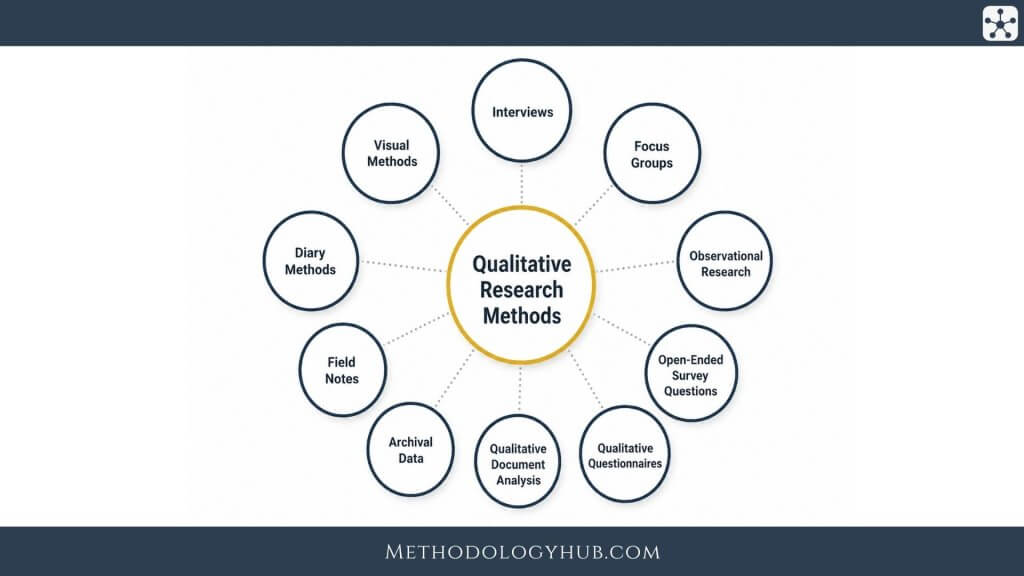
Interviews
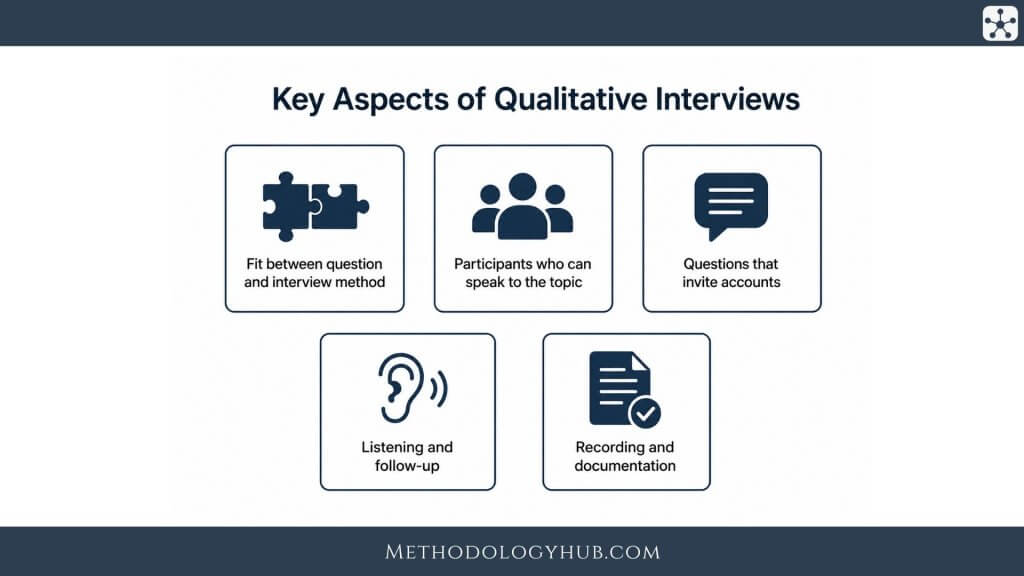
Interviews in qualitative research are used when the researcher needs detailed accounts of experience, interpretation, belief, decision-making, or memory. They work especially well when the topic requires participants to explain how they understand a situation in their own words.
An interview is not simply a spoken questionnaire. Even when the researcher prepares questions in advance, the value often comes from follow-up prompts, examples, pauses, and clarification. Participants may introduce details the researcher did not expect, and those details can change the direction of later interviews.
This method is useful for topics that cannot be observed directly, such as fear, uncertainty, motivation, identity, professional judgement, or remembered experience. It can also help explain patterns found through other methods. For example, an observation study may show that students rarely speak in group work, while interviews can explore how those students interpret silence, confidence, peer pressure, or classroom expectations.
The structure of the interview depends on how much comparison and flexibility the study needs. More structure helps the researcher ask the same questions across participants. More openness gives participants more room to shape the account.
- Structured interviews: use fixed questions in a fixed order, which makes responses easier to compare across participants.
- Semi-structured interviews: use an interview guide while allowing follow-up questions, clarification, and examples.
- Unstructured interviews: follow a more open conversational form, which can be useful when the researcher wants participants to shape the direction of the account.
The main limitation is that interviews show how people describe and interpret events. They do not automatically show what happened in practice. For that reason, interview data are often read alongside observation, documents, diaries, or other sources.
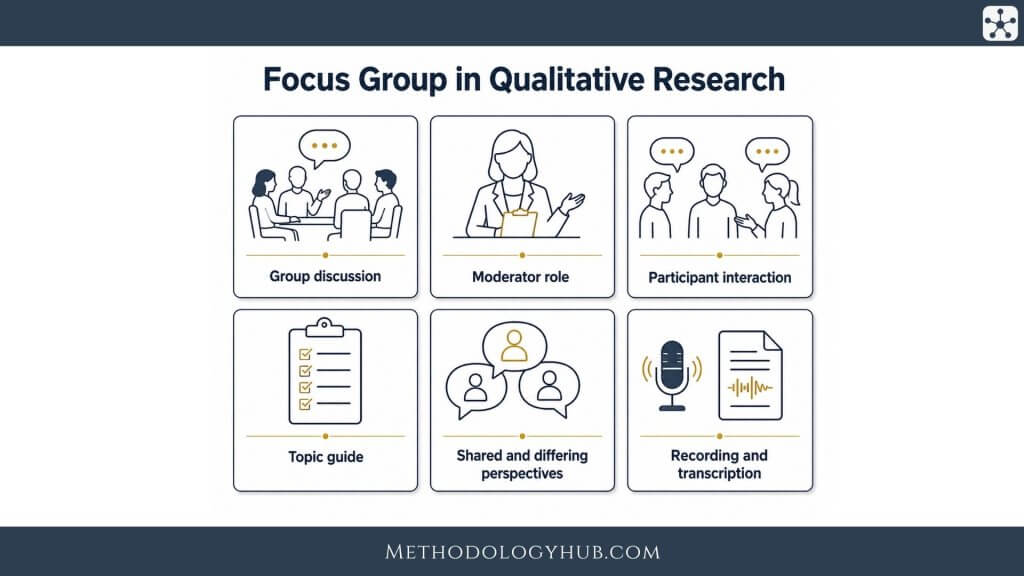
Focus Groups
Focus groups in qualitative research collect data through guided group discussion. The method is useful when the researcher wants to study not only what participants think, but also how ideas are supported, challenged, softened, or developed in interaction.
A focus group can show how people talk about a topic together. Participants may remind one another of examples, disagree about the meaning of an event, or reveal shared language that would be harder to see in one-to-one interviews. This makes the method especially useful for studying group norms, classroom cultures, professional routines, community views, or public attitudes.
The moderator’s role is to keep the discussion open without letting it drift too far from the research question. A strong focus group usually has a small set of prompts, enough time for participants to respond to one another, and a plan for including quieter voices without forcing agreement.
The limitation is also connected to the group setting. Some participants may hold back, especially if the topic is sensitive or if power differences exist within the group. In those cases, interviews or anonymous written responses may be more suitable.
Qualitative Observation
Qualitative observation is used when the researcher needs to study behaviour, interaction, setting, routine, space, timing, or practice as it happens. It can be especially helpful when there is a gap between what people say they do and what can be seen in the setting itself.
Observation is common in classrooms, clinics, meetings, public spaces, workplaces, community settings, and field sites. Instead of relying only on reports after the fact, the researcher records what happens in context: who is present, what people do, how they interact, what routines shape the situation, and which details seem relevant to the research question.
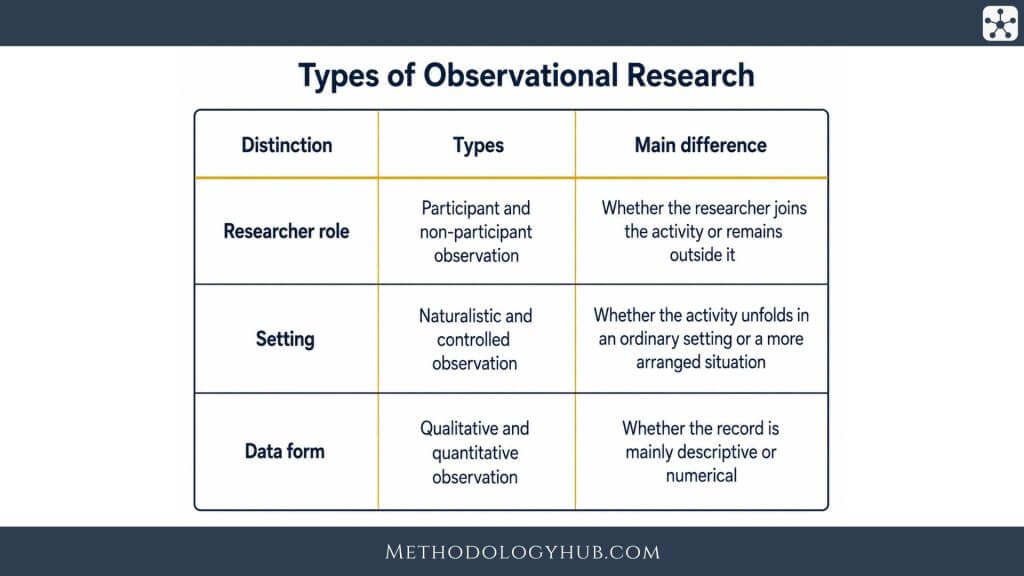
The researcher also needs to decide how visible and involved they will be. In some studies, the researcher participates in the setting and learns from being part of everyday activity. In others, the researcher remains more separate and records the situation from the outside. Neither position is automatically better. The better fit depends on access, the setting, the question, and the kind of interpretation the study needs.
Observation can also vary by setting. A natural setting allows the researcher to study ordinary activity as it unfolds. A more controlled setting allows the researcher to structure what will be observed, which can make comparison easier. The same broad method can therefore look quite different across studies.
The data can be mostly qualitative, mostly quantitative, or a combination of both. A researcher may write rich descriptions of classroom interaction, count how often students ask questions, and record short reflective notes about the atmosphere of the session. The method should make clear which kind of data is being produced.
Several observation subtypes are often distinguished:
- Participant observation: the researcher takes part in the setting or activity to some degree.
- Non-participant observation: the researcher observes without joining the activity directly.
- Naturalistic observation: behaviour is studied in the setting where it normally occurs.
- Controlled observation: the setting or observation procedure is more planned and structured.
The main limitation is that observation can show practice in context, but it may not reveal private meanings. A researcher can see that a participant avoids speaking in a meeting, but not necessarily why. Interviews, informal conversations, or documents can help interpret what observation alone leaves open.
Open-Ended Survey Questions
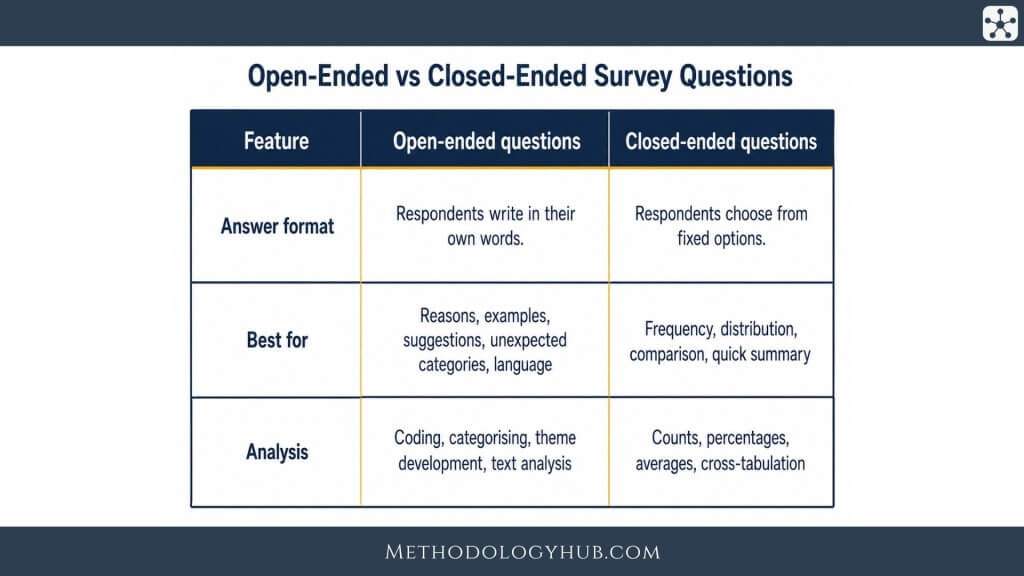
Open-ended survey questions allow participants to answer in their own words instead of selecting a fixed response. They are often used when the researcher wants written qualitative data from more participants than could realistically be interviewed.
This method works well for brief explanations, reflections, or examples. A closed survey item may show that students found a course difficult, while an open-ended question can ask what made it difficult. The written answers may reveal workload, unclear instructions, anxiety, lack of feedback, or problems outside the course itself.
Open-ended questions need careful wording. Very broad prompts can produce scattered answers, while narrow prompts may push participants toward the researcher’s assumptions. Good prompts usually invite description and example, such as asking participants how they experienced something or what helped and hindered a process.
The limitation is that the researcher cannot usually ask follow-up questions. Short or vague answers may be difficult to interpret, so open-ended survey data often work best when the study can handle variation in response length.
Qualitative Questionnaires
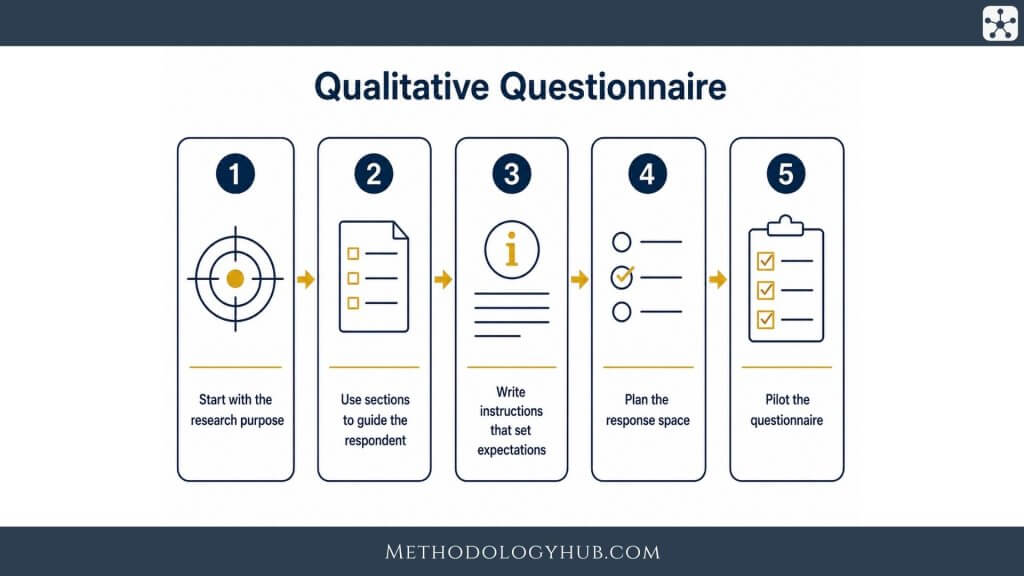
Qualitative questionnaires are questionnaire instruments designed mainly around open written responses. They can be useful when participants need time to think, when interviews are difficult to schedule, or when anonymity helps people answer more openly.
Unlike a questionnaire made mostly of rating scales, a qualitative questionnaire invites participants to explain, describe, compare, or reflect. It may include a small number of focused prompts, space for examples, and questions that move from general experience to more specific details.
This method can be practical for groups spread across different locations. It can also reduce interviewer influence, because every participant receives the same written prompt. At the same time, the researcher loses the chance to clarify unclear answers in the moment.
The quality of the data depends strongly on the prompts. A questionnaire that asks too many open questions may tire participants. A questionnaire that asks only broad questions may return answers that are too general for analysis.
Qualitative Document Analysis
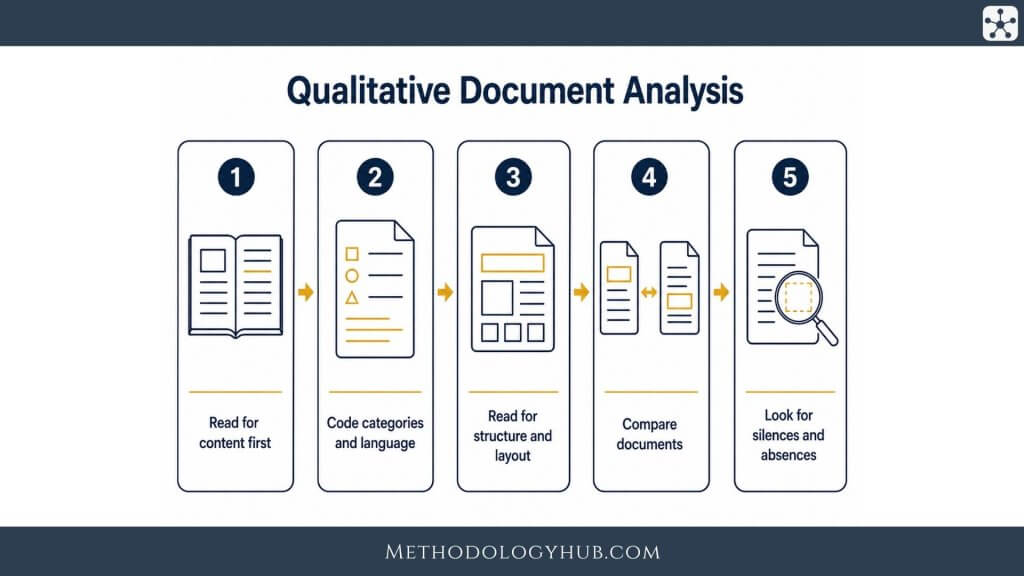
Qualitative document analysis examines existing written, visual, or recorded materials as data. Instead of treating documents as neutral containers of information, the researcher asks how they were produced, what language they use, whose perspective they record, and what role they play in a wider context.
Documents can include policy texts, institutional records, reports, curriculum materials, meeting minutes, letters, media texts, organisational communication, and public statements. These sources can show how an issue is framed, how decisions are recorded, which categories are used, and which voices are included or absent.
A document does not speak for itself. The researcher needs to consider who produced it, for whom, under what conditions, and for what purpose. A school policy, for example, may describe official expectations, but it may not show how teachers, students, or families experience those expectations in daily life.
The limitation is that documents show recorded communication, not the whole process behind that communication. Many studies therefore combine documents with interviews, observation, or archival records.
Archival Data
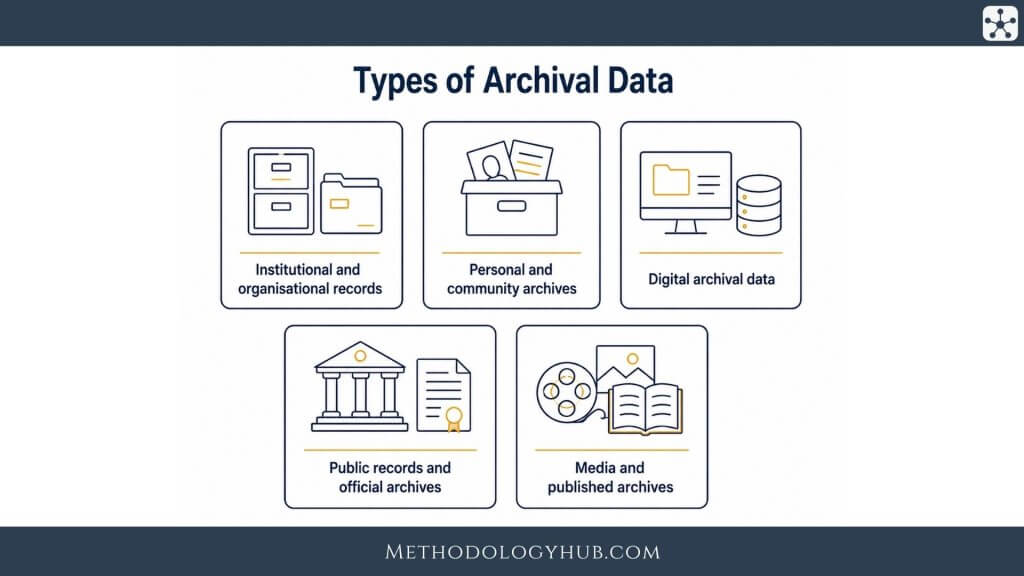
Archival data in qualitative research comes from records preserved for administrative, historical, organisational, personal, or public reasons. These materials can help researchers study past events, institutional decisions, long-term change, and records that were not produced for the current study.
Archival sources may include letters, reports, case files, meeting minutes, photographs, newspapers, maps, administrative records, diaries, and archived digital materials. Their value often comes from the fact that they were created within the period, institution, or community being studied.
Working with archives requires attention to selection. Some records survive because they were considered official. Others are missing because they were lost, excluded, damaged, never collected, or kept outside institutions. The absence of records can be as important as the documents that remain.
The limitation is that archival data are shaped by preservation and access. Researchers need to be careful not to treat an archive as a complete record of the past.
Field Notes
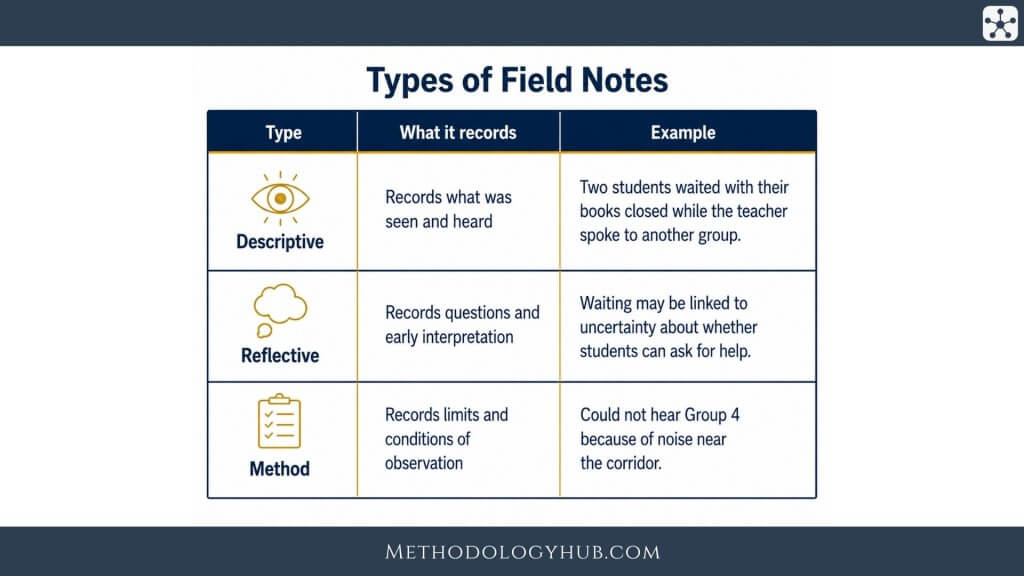
field notes in qualitative research are the researcher’s written record of what was seen, heard, noticed, decided, and reflected on during fieldwork. They are especially important in observation-based studies, but they can also support interviews, focus groups, document work, and informal conversations.
Field notes usually contain more than a simple description of events. A researcher may record the layout of a room, the timing of an interaction, repeated phrases, moments of hesitation, informal comments, questions that emerged, and early analytic thoughts. These notes help preserve context that may not appear in transcripts or official documents.
Good field notes often separate description from interpretation. The researcher may first write what happened, then add a reflective note about possible meaning, uncertainty, or follow-up questions. This makes later analysis more transparent because readers can see the difference between observation and interpretation.
The limitation is that field notes depend on the researcher’s attention, memory, access, and writing discipline. They should usually be written or expanded as soon as possible after fieldwork.
Diary Methods
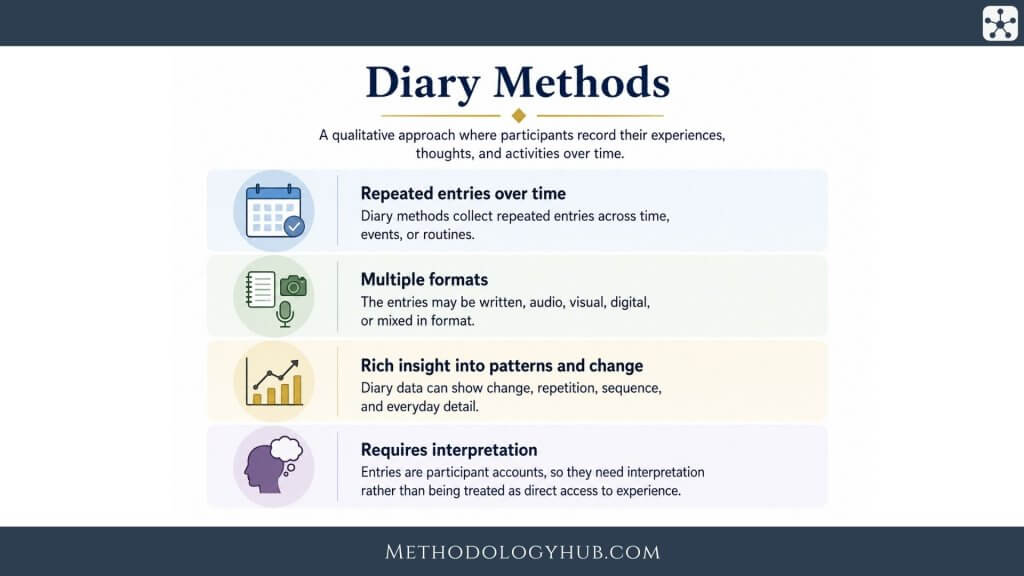
Diary methods in qualitative research ask participants to record experiences close to the time they happen. This makes them useful for studying routines, emotions, transitions, learning, care, symptoms, or repeated events that may be forgotten in a later interview.
A diary study can capture change across time. Instead of asking a participant at the end of a semester how they managed stress, the researcher may ask for weekly entries. Instead of relying on a single interview about a health experience, the researcher may collect short entries across several days or weeks.
Diaries can be written, audio-recorded, digital, visual, or prompted through forms. The prompts should be specific enough to support regular entries but not so restrictive that participants stop recording unexpected details.
The limitation is that participation can be uneven. Some entries may be brief, skipped, or written after a delay. The analysis should account for these differences rather than treating all diary records as equally complete.
Visual Methods
Visual methods in qualitative research use images, drawings, maps, video, photographs, or other visual materials as data or as prompts for discussion. They are useful when part of the experience is spatial, material, embodied, symbolic, or difficult to express through words alone.
Visual materials can be created by participants, collected by researchers, or drawn from existing sources. A participant may photograph places that represent belonging. A researcher may analyse posters, textbook images, social media visuals, classroom displays, or community maps. In some studies, the image itself is the object of analysis. In others, the image helps participants explain an experience.
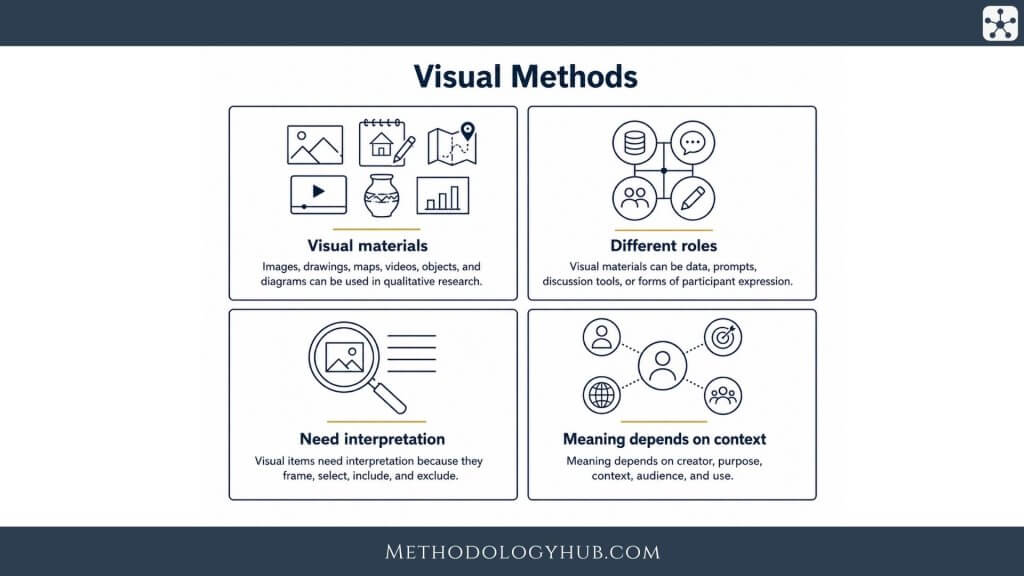
The researcher needs to decide how the visual material will be interpreted. Some studies focus on composition and representation. Others focus on the participant’s explanation of the image. Others connect the visual material to field notes, interviews, or documents.
Several visual approaches are commonly used:
- Photo elicitation: uses photographs during interviews or discussions to prompt reflection, memory, explanation, or comparison.
- Photovoice: asks participants to create or select images that represent their experiences, community, concerns, or perspectives.
- Visual ethnography: studies social and cultural life through visual records, visual practices, and the role of images in everyday settings.
- Visual analysis: examines images as data, paying attention to composition, context, meaning, representation, and use.
The main limitation is that images do not explain themselves. The researcher needs to consider context, production, interpretation, and how participants or audiences understand the visual material.
Visual methods also need careful reporting. Readers should know whether the images were made by participants, selected from an existing collection, produced by the researcher, or used only as prompts during conversation. That distinction changes how the data should be interpreted.
When visual methods are combined with interviews or field notes, the written and visual materials should be analysed together rather than treated as separate pieces. The image may show one part of the meaning, while the participant’s explanation, the setting, and the researcher’s notes give the image its context.
Examples of Qualitative Research Methods
Examples of qualitative research methods show how the same broad topic can be studied from different angles. A researcher may collect spoken accounts, observe behaviour, analyse documents, or ask participants to record experiences over time. The best example depends on what the research question needs to understand.
The four examples below show how qualitative methods can be used in education, health, institutional research, and community studies.
Example 1: Interviews About Student Belonging
A researcher wants to understand how first-year university students experience belonging during their first semester. A survey could show how many students feel connected, but interviews in qualitative research would allow students to explain how belonging is built, lost, or changed in everyday situations.
The researcher might conduct semi-structured interviews with students from different courses, age groups, and living situations. Questions could explore friendships, lectures, group work, commuting, support services, and moments when students felt included or excluded. The analysis may then identify patterns such as the role of peer support, uncertainty during the first weeks, or differences between students who live on campus and those who commute.
Example 2: Focus Groups About Classroom Discussion
A researcher studying classroom discussion may want to know how students talk about participation with one another. In this case, focus groups in qualitative research can be useful because the group interaction becomes part of the data.
The moderator could ask students when discussion feels useful, when it feels uncomfortable, and what teachers do that helps or stops participation. As students respond to one another, the researcher can study agreement, disagreement, hesitation, shared examples, and group language. The analysis might show that students value discussion when expectations are clear, but avoid speaking when they fear public correction.
Example 3: Observation of Teacher-Student Interaction
A researcher wants to understand how teachers support students during group activities. Asking teachers about their approach would provide useful explanations, but a qualitative observation would allow the researcher to study classroom interaction as it happens.
The researcher might observe several lessons and write field notes in qualitative research about classroom layout, teacher movement, student questions, group behaviour, and moments when support is offered. The analysis may show that some groups receive more help because they ask loudly, while quieter groups receive less attention even when they are struggling.
Example 4: Document Analysis of School Policies
A researcher interested in inclusion may analyse how schools describe support for students with additional learning needs. Qualitative document analysis could be used to examine policy documents, handbooks, staff guidance, public statements, and school improvement plans.
The analysis might focus on how students are described, what responsibilities are assigned to teachers, how families are mentioned, and which forms of support are clearly explained or left vague. The study could show whether inclusion is framed as a whole-school responsibility, a specialist service, or mainly an administrative requirement.
Conclusion
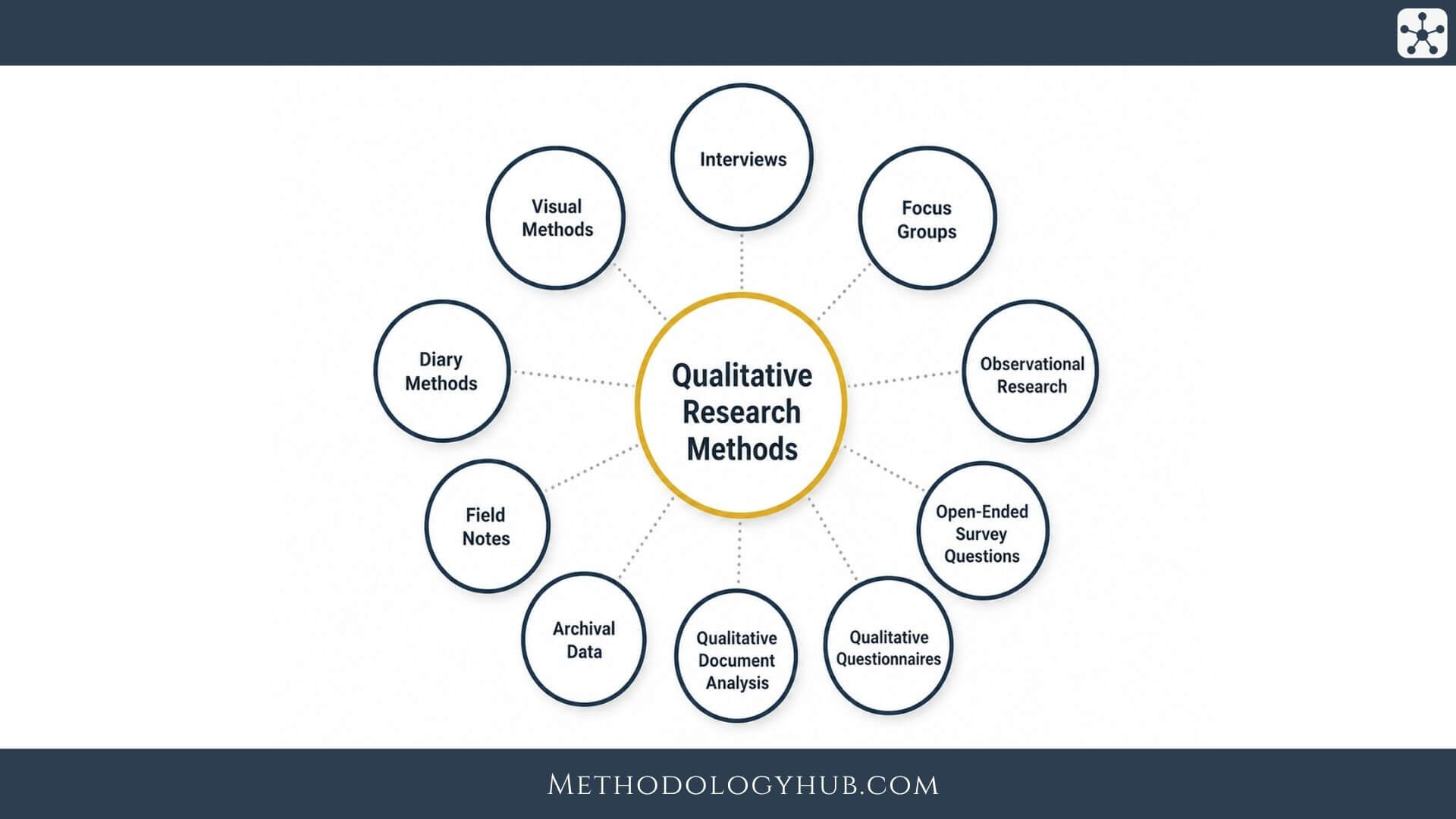
Qualitative research methods help researchers study meanings, experiences, practices, and contexts that cannot be understood well through numbers alone. The choice of method should begin with the research question. Interviews, focus groups, observation, documents, archives, field notes, diaries, questionnaires, open-ended surveys, and visual materials all offer different forms of evidence.
A strong qualitative study does not simply collect rich data. It explains why a particular method was chosen, how the data were produced, how the analysis was conducted, and what kind of interpretation the evidence can support.
FAQs on Qualitative Research Methods
What are qualitative research methods?
Qualitative research methods are systematic ways of collecting and analysing non-numerical data, such as interviews, observations, documents, diaries, images, and field notes. They are used to understand meanings, experiences, behaviours, and contexts.
What are the main qualitative research methods?
The main qualitative research methods include interviews, focus groups, observation, open-ended surveys, document analysis, archival research, diary methods, field notes, and visual methods. The best choice depends on the research question and the kind of evidence needed.
What is the purpose of qualitative research methods?
The purpose of qualitative research methods is to understand how people experience, interpret, describe, and act within particular situations. They are often used to explore new topics, study lived experience, describe social processes, and develop concepts.
What is the difference between qualitative and quantitative research methods?
Qualitative research methods work mainly with words, observations, documents, and other descriptive data. Quantitative research methods work mainly with numbers, measurements, scores, and statistical analysis. Qualitative research is usually used for meaning and context, while quantitative research is usually used for measurement and comparison.
How do you choose a qualitative research method?
Choose a qualitative research method by starting with the research question. Use interviews for detailed accounts, focus groups for group interaction, observation for behaviour in context, documents for recorded language, and diaries for experiences across time.