Structured interviews are interviews in which every participant is asked the same prepared questions in the same order, usually with little or no change in wording. The format gives the researcher a controlled way to collect spoken or written answers while keeping the interview situation as consistent as possible across participants.
In qualitative research, structured interviews are useful when a study needs personal answers but also needs close comparison between participants. They are more controlled than other types of qualitative interviews, because the interviewer follows a fixed guide rather than adapting the conversation freely.
This article explains how structured interviews work as a qualitative research method, what they are used for, how they compare with other interview formats, how to write structured interview questions, and how structured interview data can be analysed.
What Are Structured Interviews?
Structured interviews are interviews guided by a fixed set of questions. The interviewer asks each participant the same questions, usually in the same order, and avoids adding new questions during the interview. This makes the method more standardised than flexible interview formats.
The format can be used in quantitative, qualitative, or mixed studies. In a quantitative study, the questions may have fixed response options that can be counted. In a qualitative study, the questions can still be open, but the structure of the interview remains fixed. For example, every participant may be asked to describe the same kind of event, explain the same decision, or reflect on the same experience.
Structured interview definition
A structured interview is a data collection method in which the interviewer uses a standardised interview schedule and asks predetermined questions in a fixed order. The goal is to reduce variation in how questions are asked so that differences in the answers are more likely to reflect participants’ responses rather than changes in the interview process.
This does not mean the interview has to be cold or mechanical. A structured interview can still be polite, attentive, and respectful. The difference is that the interviewer does not follow new lines of questioning in the way they might during a more flexible interview.
How structured interviews work
A structured interview begins with an interview schedule. This schedule contains the exact wording of each question, the order of questions, instructions for the interviewer, and sometimes rules for recording answers. If the study uses closed questions, the schedule may also include response categories. If the study uses open questions, it may include space for verbatim notes or later transcription.
The interviewer follows the schedule closely. If a participant gives a short answer, the interviewer may be allowed to repeat the question or use a neutral clarification such as “Could you say a little more?” only if the protocol allows it. The key point is that the same rule should apply to all participants.
What counts as structured interview data?
Structured interview data may include short written responses, longer spoken answers, audio recordings, transcripts, field notes about the interview setting, and response sheets. The form of data depends on the study design. Some structured interviews produce answers that can be counted. Others produce comparable qualitative answers that are later coded and interpreted.
A structured interview about students’ use of feedback, for example, might ask each student the same six open questions. One question may ask them to describe the last time they used written feedback to revise work. The answers remain qualitative, but because each participant answered the same question, the researcher can compare the accounts more directly.
Structured interviews as a standardised method
Standardisation is the central feature of structured interviews. The researcher tries to keep the interview situation stable enough that each participant receives the same opportunity to answer. This is useful when the study needs clear comparison between people, groups, sites, or time points.
The cost of standardisation is lower flexibility. If a participant introduces an unexpected but interesting detail, the interviewer may not be able to explore it. This is not always a weakness. It is a trade-off. Structured interviews are designed to protect consistency, even when that means giving up some conversational depth.
Objectives of Structured Interviews
The objectives of structured interviews usually relate to consistency, comparability, and controlled data collection. Researchers use them when they want participant responses, but do not want each interview to develop in a different direction. The method is especially useful when the study includes several participants, several interviewers, or several groups that need to be compared.
Structured interviews are not only a convenient format. They create a particular kind of evidence. Because every participant receives the same questions, the researcher can examine how different people respond to the same prompts. That makes the method useful when the research question depends on comparison.
Collecting comparable responses
The first objective is to collect responses that can be compared. If every participant is asked the same question in the same way, the researcher can look across answers with more confidence. This is useful in studies where the same issue needs to be examined across roles, sites, age groups, programmes, or time periods.
For example, a researcher studying first-year students’ use of academic support may ask all participants the same questions about when they first heard about support, whether they used it, what helped them decide, and what made access easier or harder. The fixed guide helps the researcher compare responses without wondering whether differences came from different questioning.
Reducing interviewer influence
A structured format can reduce some forms of interviewer influence. When interviewers ask questions freely, they may unintentionally prompt some participants more than others, explain terms differently, or pursue one participant’s answer in more depth than another’s. A fixed schedule limits this variation.
This is especially useful when a study has more than one interviewer. The schedule gives each interviewer the same route through the interview. Training is still needed, but the method makes consistency easier to maintain.
Supporting classification and coding
Structured interviews also support coding and classification. Because answers are organised around the same questions, the researcher can create a clear coding framework for each item. This can be helpful when the data set is larger than a small set of in-depth interviews.
In a qualitative study, this does not mean reducing every answer to a number. A researcher can still code meanings, examples, and categories. The structure simply makes it easier to compare how participants addressed each question.
| Objective | How structured interviews support it |
|---|---|
| Comparison | Each participant answers the same prompts, making responses easier to examine side by side. |
| Consistency | The interviewer follows a fixed wording, order, and procedure. |
| Coding | Answers are already organised by question, which helps later classification and analysis. |
Working with several interviewers
Structured interviews are useful when a project requires multiple interviewers. In a large school, hospital, or community study, one person may not be able to conduct every interview. A shared schedule helps each interviewer collect data in the same general way.
The schedule alone is not enough. Interviewers still need training in tone, pacing, recording, clarification rules, and how to avoid changing the meaning of a question. Without that preparation, the interview may look structured on paper but become inconsistent in practice.
Documenting a transparent procedure
Another objective is transparency. A structured interview schedule can be described clearly in a methods section. Readers can see what participants were asked, how the interview was organised, and how much freedom the interviewer had. This makes the route from research question to data easier to follow.
Transparency is useful for student projects, evaluation studies, and any research that needs a clear audit trail. If another researcher wants to understand or repeat part of the procedure, a structured schedule gives more detail than a loose description of conversation topics.
Key Aspects of Structured Interviews
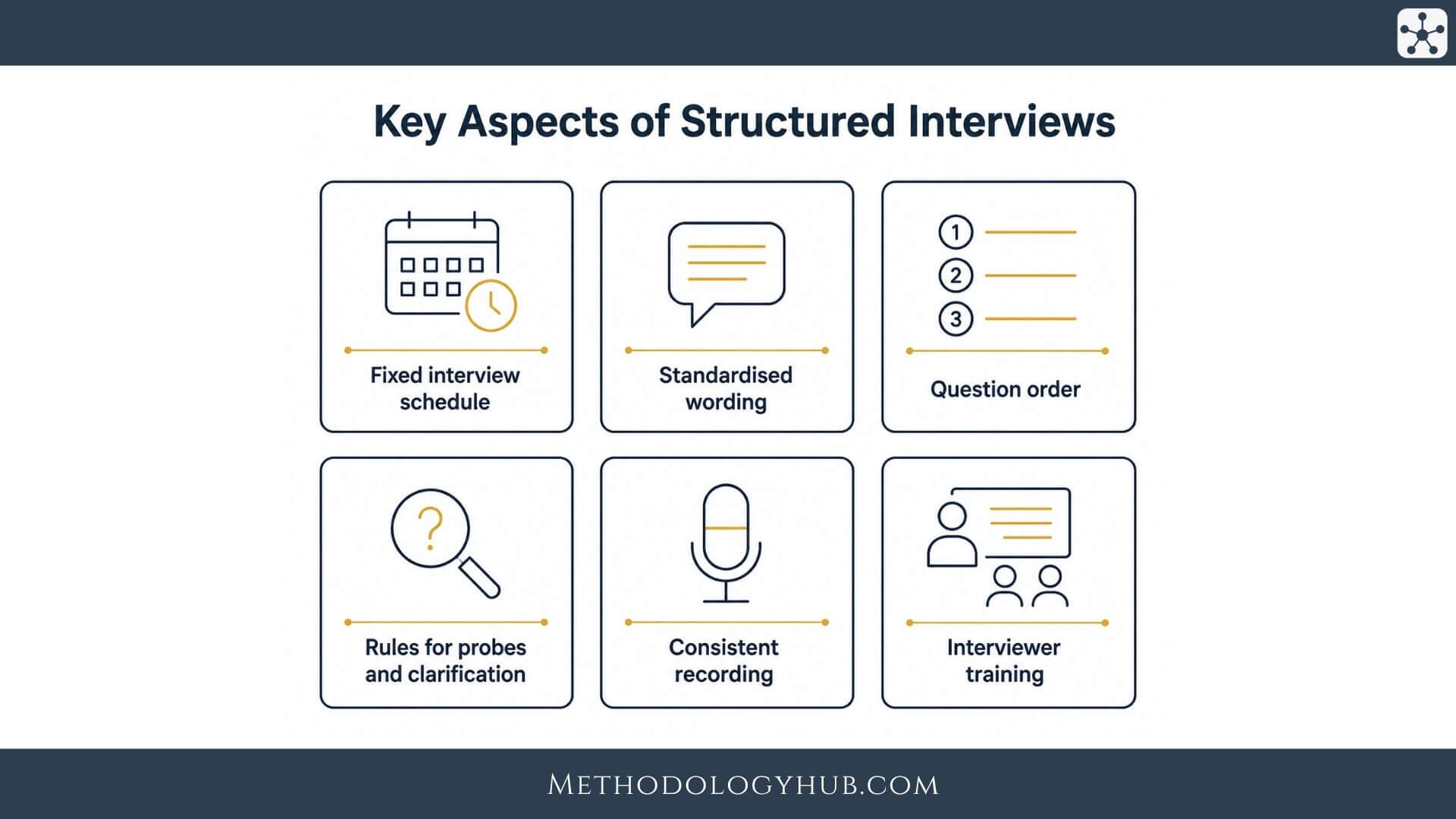
The key aspects of structured interviews are the fixed schedule, standardised wording, controlled order, limited probing, clear recording rules, and consistent interviewer behaviour. These features work together. If the wording is fixed but interviewers improvise extra explanations, the interview becomes less structured than the schedule suggests.
Structured interviews therefore require planning before the first participant is interviewed. The researcher needs to decide what will be asked, how it will be asked, what counts as an acceptable clarification, how answers will be captured, and how deviations from the schedule will be recorded.
Fixed interview schedule
The interview schedule is the central document in a structured interview. It includes the questions, instructions, and sometimes the response categories or recording fields. A good schedule is written for use in the interview, not only for the researcher to read privately.
This means the questions should sound natural when spoken. A sentence that looks precise in a document may feel confusing in conversation. The schedule should be tested aloud before it is used with participants.
Standardised wording
Standardised wording means that each participant hears the same question. This helps protect comparison. A small change in wording can change the answer. “What support did you receive?” is not the same as “Did you receive enough support?” The first asks for description. The second asks for judgement and introduces the idea of enough.
The researcher should also decide how key terms will be handled. If a participant asks what a word means, the interviewer needs a standard explanation or a standard rule for returning the question to the participant.
Note: if changing one word could change the answer, the wording should be fixed in the interview schedule.
Question order
Question order shapes how participants understand the interview. Early questions can frame later answers. Sensitive or difficult questions may be easier after participants have answered simpler questions. A structured schedule should therefore be ordered deliberately, not assembled as a list of interesting questions.
A common order begins with short background questions, moves into the main topic, asks more specific or reflective questions later, and closes with a final opportunity to add information. The exact order depends on the study, but the order should remain the same across interviews.
Rules for probes and clarification
Structured interviews usually limit probing. If probes are allowed, they should be written into the schedule. A neutral probe might ask the participant to repeat, clarify, or give an example. The interviewer should avoid prompts that introduce new ideas or suggest an expected answer.
For instance, after a short answer, “Could you explain that a little more?” is more neutral than “Was that because the instructions were unclear?” The second prompt may be useful in a different interview format, but it adds content that not every participant receives.
Consistent recording
Recording rules are part of the structure. If answers are written during the interview, the interviewer needs to know whether to summarise or record exact wording. If the interview is audio-recorded, the researcher needs a plan for transcription. If some questions use categories, the categories should be applied in the same way each time.
Consistency is important during analysis. When one interviewer records exact phrases and another records brief summaries, the data may not be equally detailed. The research team should agree on recording expectations before data collection begins.
Interviewer training
Training is important because a structured interview can still be affected by tone, pacing, body language, and informal comments. Interviewers should practise reading questions clearly, pausing without rushing, using only approved probes, and handling participant questions consistently.
Training can also include practice interviews. These make it easier to detect awkward wording, unclear instructions, and places where interviewers are tempted to improvise.
Structured vs Semi-Structured Interviews
Structured and semi-structured interviews are often compared because both use prepared questions. The difference is how much freedom the interviewer has once the conversation begins. A structured interview protects consistency. A semi-structured interview protects a shared focus while allowing more responsive follow-up.
Researchers sometimes choose between the two too quickly. The better choice depends on what the study needs more: close comparability or room to explore participant-specific detail.
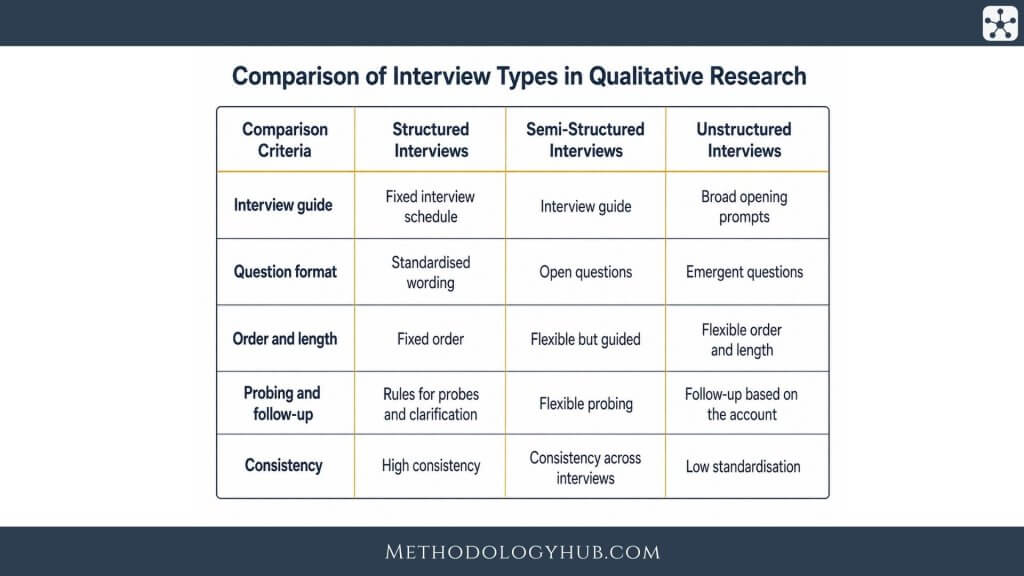
How structured interviews differ
Structured interviews keep wording, order, and procedure stable. The interviewer asks the same questions and usually avoids adding new ones. This makes the answers easier to compare, but it can also make the interview less responsive to unexpected material.
This format works well when the researcher already knows the main areas to ask about and wants all participants to respond to the same prompts. It is also useful when the study has several interviewers or when interviews need to remain short and consistent.
How semi-structured interviews differ
Semi-structured interviews use a guide rather than a strict schedule. The interviewer still covers the main topics, but can change the order, ask follow-up questions, and explore important details raised by the participant.
This format is useful when the researcher needs both comparison and depth. It gives every participant a similar route through the topic while still allowing the interview to respond to their account.
| Feature | Structured interviews | Semi-structured interviews |
|---|---|---|
| Question wording | Fixed | Guided but may vary slightly |
| Question order | Usually fixed | Can change with the conversation |
| Follow-up questions | Limited or pre-written | Flexible and responsive |
| Best fit | Consistency and close comparison | Depth with a shared topic structure |
When structured interviews are a better fit
Structured interviews are usually a better fit when the study needs a high degree of consistency. They are suitable when the researcher wants to compare responses to the same questions, use several interviewers, keep interviews short, or combine open answers with fixed categories.
They also work well when the topic has already been defined clearly. If earlier research or pilot work has identified the main areas of interest, a structured schedule can collect focused responses across a larger group.
When semi-structured interviews are a better fit
Semi-structured interviews are often better when the researcher expects important differences between participants’ experiences. If participants may introduce unexpected issues, the interviewer needs room to follow those issues. A strict schedule may miss details that are central to the participant’s account.
For example, a study of doctoral supervision might begin with shared topics such as meetings, feedback, independence, and support. A semi-structured format would allow the interviewer to explore the particular relationship and history described by each participant.
Structured vs Unstructured Interviews
Structured and unstructured interviews sit at opposite ends of the interview structure continuum. A structured interview follows a fixed schedule. An unstructured interview begins with a broad topic and allows the participant’s account to shape much of the conversation.
The difference affects the kind of knowledge the study can produce. Structured interviews are better for consistency. Unstructured interviews are better when the researcher wants to hear how participants organise the topic without much guidance from the interviewer.

Control over the interview route
In a structured interview, the researcher controls the route. The participant answers within that route, but the order and wording are already set. This can be useful when every participant needs to address the same issues.
In an unstructured interview, the route is more open. The researcher may begin with a broad prompt such as “Tell me about your experience of returning to education.” The participant’s account then leads the conversation, while the interviewer listens and asks follow-up questions.
Depth and comparability
Structured interviews usually provide stronger comparability because the data are organised around shared questions. Unstructured interviews usually provide more room for depth, surprise, and participant-led meaning. Neither method is automatically better.
A study comparing how different staff roles interpret the same workplace change may use structured interviews. A life history study of adults returning to education may use unstructured interviews because the order and meaning of events are part of the data.
Skill and preparation
Both formats require preparation, but in different ways. Structured interviews require a carefully tested schedule and interviewer discipline. Unstructured interviews require skill in listening, timing, and following an account without losing the research purpose.
Unstructured interviews can appear easier because there are fewer written questions. In practice, they can be harder to conduct well. The interviewer must make decisions during the conversation about which details to follow and when to return to the main topic.
Simple comparison: structured interviews protect the same route for every participant. Unstructured interviews protect the participant’s own route through the topic.
How to Conduct Structured Interviews
Conducting structured interviews requires careful preparation because most of the method’s strength comes from what is decided before the interview begins. The researcher needs to design the schedule, test it, train interviewers if needed, and create clear rules for recording answers.
The process below gives a practical sequence. Some studies will be shorter and simpler, while others will need more testing and coordination, especially when several people collect the data.
Step 1: Define the exact purpose of the interview
The first step is to decide what the structured interview must collect. A broad topic such as “student experience” is not enough. The researcher needs to decide which parts of that experience should be asked about in the same way for every participant.
A clear purpose might be: to compare how students in three programmes describe access to academic feedback. That purpose points toward specific questions about receiving feedback, understanding it, using it, and seeking clarification.
Step 2: Choose the participants
The participant group should match the research question. In a structured interview study, the sample may be purposive, convenience-based, or part of a wider sampling plan. The important point is that the researcher can explain why these participants were relevant and how they were reached.
If comparison is part of the study, the sample should include the groups being compared. For example, a study may include first-year and final-year students, or teachers from different departments, because those differences are meaningful for the question.
Step 3: Write the interview schedule
The schedule should include the exact questions, their order, interviewer instructions, allowed clarifications, and answer recording rules. If response options are used, they should be listed clearly. If answers are open-ended, the schedule should show how the interviewer will record them.
The schedule should also include opening and closing wording. Even small parts of the interaction can affect the interview, so a standard introduction can help each participant receive the same explanation of the process.
Step 4: Test the questions aloud
A structured interview schedule should be tested aloud before data collection. Some questions are grammatically correct but difficult to hear, remember, or answer. Testing can show whether the wording is too long, the order feels strange, or a term needs a standard explanation.
A pilot interview can also show whether answers are detailed enough for analysis. If several pilot participants misunderstand the same question, the problem is likely in the schedule rather than in the participants.
Step 5: Train interviewers and set rules
If more than one interviewer is involved, training is essential. Interviewers should practise reading the questions, using approved probes, recording answers, handling participant questions, and avoiding informal explanations that are not in the schedule.
Training should also cover what to do when something unexpected happens. A participant may ask for clarification, answer a later question early, or move into a topic outside the schedule. The protocol should give interviewers a consistent way to respond.
Step 6: Conduct the interviews consistently
During each interview, the interviewer should follow the schedule closely. The tone can be natural, but the wording and order should remain stable. If the interview is recorded, equipment should be checked before the session starts. If answers are written, the interviewer should follow the agreed recording style.
Consistency does not mean ignoring the participant. It means being attentive within the rules of the method. The interviewer can listen carefully, pause, and show respect without adding new questions or changing the meaning of the schedule.
Step 7: Record deviations from the schedule
Real interviews do not always follow the plan perfectly. A participant may skip a question, ask for clarification, misunderstand a term, or give an answer that covers several questions at once. These events should be documented.
Deviation notes help during analysis. They allow the researcher to see whether a particular question caused problems or whether some answers should be interpreted with caution because the procedure changed.
Structured Interview Questions
Structured interview questions should be clear, answerable, and aligned with the research question. They should also work in the same way for different participants. If one participant understands the question as asking about feelings and another understands it as asking about behaviour, comparison becomes difficult.
The wording of structured interview questions deserves careful attention because the interviewer has little room to repair weak wording during the interview. A question that is unclear in a semi-structured interview can sometimes be clarified through follow-up. In a structured interview, that flexibility is limited.
Question wording
Structured interview questions should usually be short and direct. They should avoid double questions, hidden assumptions, and terms that participants may interpret in very different ways. A question such as “How useful and accessible was the service?” asks two things at once. A participant may find it useful but not accessible.
It is often better to split complex questions into two simpler ones. The schedule can first ask how the participant used the service, then ask what made access easy or difficult.
Open and closed questions
Structured interviews can use open questions, closed questions, or both. Closed questions are easier to code because participants choose from set options. Open questions provide more detail because participants answer in their own words.
In qualitative structured interviews, open questions are often central. They allow participants to describe experience while the fixed schedule keeps the interview comparable. A study may also combine closed and open questions by first asking whether an event occurred, then asking the participant to describe it.
| Question type | Example | What it produces |
|---|---|---|
| Closed | Did you attend an academic support session this semester? | A fixed response that can be counted or sorted |
| Open | Can you describe what happened during that session? | A descriptive account in the participant’s own words |
| Follow-up in schedule | What part of the session was most useful to you? | A focused explanation connected to the previous answer |
Neutral wording
Neutral wording avoids suggesting the expected answer. “How helpful was the programme?” implies that help is the main issue. “How would you describe your experience of the programme?” gives the participant more room to answer positively, negatively, or in mixed terms.
Neutral wording is not always easy. Researchers often know what they hope to study, and that interest can slip into the question. Reading the schedule aloud and asking another person to review the wording can help identify leading language.
Question order and flow
Structured interview questions should be ordered in a way that participants can follow. Background questions often come first. Questions about specific experiences can follow. More reflective questions can appear later, after the participant has already described the situation.
Order can also reduce repetition. If a participant is asked to describe a recent experience before being asked to evaluate it, the evaluation has more context. The schedule should feel like a clear route rather than a pile of separate questions.
Testing the schedule
Testing is part of question design. A pilot interview can show whether questions are too long, whether participants understand key terms, whether the order works, and whether the answers are useful for the analysis. Even a small pilot can prevent major problems later.
After testing, the researcher may revise wording, remove duplicate questions, add a standard clarification, or change the order. Once the main data collection begins, changes should be made carefully because they affect comparability.
How to Analyse Structured Interview Data
Analysing structured interview data depends on the type of answers collected. If the interview used fixed response options, the researcher may summarise frequencies or compare categories. If it used open-ended questions, the researcher may code answers, compare patterns, and develop themes or categories across participants.
The structure of the interview can make analysis more organised. Since all participants answered the same questions, the researcher can compare answers question by question. This can be especially useful when the data set is larger than a small number of in-depth interviews.
Prepare responses by question
A practical first step is to organise responses by question. This allows the researcher to see how every participant answered the same prompt. For open-ended answers, this can reveal repeated categories, unusual examples, and differences between groups.
The researcher should still read each participant’s full interview when interpretation depends on context. Question-by-question comparison is useful, but it can split an account into pieces. Both views of the data may be needed.
Code open-ended answers
Open-ended structured interview answers can be coded in much the same way as other qualitative data. The researcher reads the answers, identifies meaningful parts, creates codes, compares examples, and refines categories. Because the questions are fixed, coding can often be done separately for each question before looking across the whole interview.
For example, answers to “What made the support difficult to access?” might be coded as timing, location, embarrassment, unclear information, prior negative experience, or lack of confidence. The codes can then be compared across participants or groups.
Reminder: structured interview data are easier to organise, but open answers still need interpretation. A fixed question does not make the analysis automatic.
Use matrices for comparison
A matrix can help compare answers across participants. The rows may represent participants and the columns may represent questions, codes, or themes. This makes it easier to see patterns across cases while keeping the structure of the interview visible.
Matrices are especially useful when the study compares groups. A researcher may compare first-year and final-year students, or compare staff in different roles. The matrix can show whether certain codes appear more often in one group or whether the meaning of the same code differs across groups.
Combine counts and interpretation carefully
Structured interviews often make counting tempting. The researcher may report how many participants mentioned a category. This can be useful, but it should not replace interpretation. A category mentioned by fewer participants may still be important if it explains a boundary, exception, or conflict.
Counts should be used as descriptions of the data, not as claims about a wider population unless the sampling design supports that kind of inference. In qualitative structured interviews, the meaning of answers remains central.
Write findings from comparison
The findings should explain what the structured comparison shows. Because participants answered the same questions, the writing can move across responses directly. It may show a common pattern, a contrast between groups, or a difference between what participants reported in early and later questions.
Selected quotations can help illustrate open-ended answers. The researcher should choose excerpts that support the interpretation, show variation, or clarify a category. The writing should avoid becoming only a sequence of short answers.
Examples of Structured Interviews
Examples of structured interviews show how the method can be used when every participant should answer the same questions. The examples below use different research settings, but each one depends on a fixed interview schedule.
In each example, the structured format is useful because the researcher wants to compare responses across participants without changing the interview route from one person to another.
Example 1: Student use of academic feedback
A researcher wants to compare how students in different programmes use written feedback. Each student is asked the same questions about receiving feedback, understanding comments, revising work, and asking for clarification. Some questions are closed, while others invite short open explanations.
The structured format helps the researcher compare answers across programmes. It also keeps the interview focused, which is useful if the study includes many participants and each interview must remain short.
Example 2: Teacher views of a new assessment procedure
A school researcher interviews teachers after a new assessment procedure is introduced. Each teacher is asked the same questions about training, workload, clarity, classroom use, and perceived effects on students. The interview schedule includes one neutral clarification rule for any teacher who asks what a term means.
The data can show where teachers’ answers converge and where they differ by subject or year level. Because the wording is fixed, the comparison is easier to follow.
Example 3: Patient understanding of discharge instructions
A health researcher uses structured interviews to study how patients understood discharge instructions after leaving hospital. Each patient is asked the same sequence of questions about medication, follow-up appointments, warning signs, home support, and unanswered questions.
The interview can include both fixed categories and open answers. This allows the researcher to identify common areas of confusion while also preserving short explanations in patients’ own words.
Example 4: Staff experiences of workplace training
A researcher interviews staff members who attended the same workplace training programme. The schedule asks about preparation, clarity of sessions, examples used during training, confidence afterward, and whether staff used any part of the training in practice.
The structured interview makes sense because every participant experienced the same programme. The researcher can compare how people in different roles described the same training elements.
Conclusion
Structured interviews are a useful interview format when a study needs consistency, comparison, and a clear procedure. They allow researchers to collect answers from participants while keeping the wording, order, and recording rules stable across interviews.
The method works best when the research question is already focused and the researcher knows which topics every participant should answer. It is less suitable when the study needs open exploration, long narrative accounts, or flexible follow-up into unexpected details.
FAQs on Structured Interviews
What is a structured interview?
A structured interview is an interview in which every participant is asked the same predetermined questions in the same order. The format is designed to keep the interview process consistent and make responses easier to compare.
What is a structured interview in qualitative research?
A structured interview in qualitative research uses fixed questions but may still collect open-ended answers in participants’ own words. It is useful when the researcher wants qualitative responses that can be compared across participants.
How do you conduct a structured interview?
To conduct a structured interview, define the purpose, choose participants, write a fixed interview schedule, test the questions, train interviewers if needed, ask each question in the same order, record answers consistently, and document any deviations.
What are structured interview questions?
Structured interview questions are predetermined questions written before data collection begins. They should be clear, neutral, and asked in the same wording and order for every participant.
What is the difference between structured and semi-structured interviews?
Structured interviews use fixed wording and order with limited probing. Semi-structured interviews use a guide but allow flexible follow-up questions, changes in order, and more detailed exploration of participant answers.
What is the difference between structured and unstructured interviews?
Structured interviews follow a fixed schedule, while unstructured interviews use a more open format guided by the participant’s account. Structured interviews support comparison, while unstructured interviews support open-ended depth.