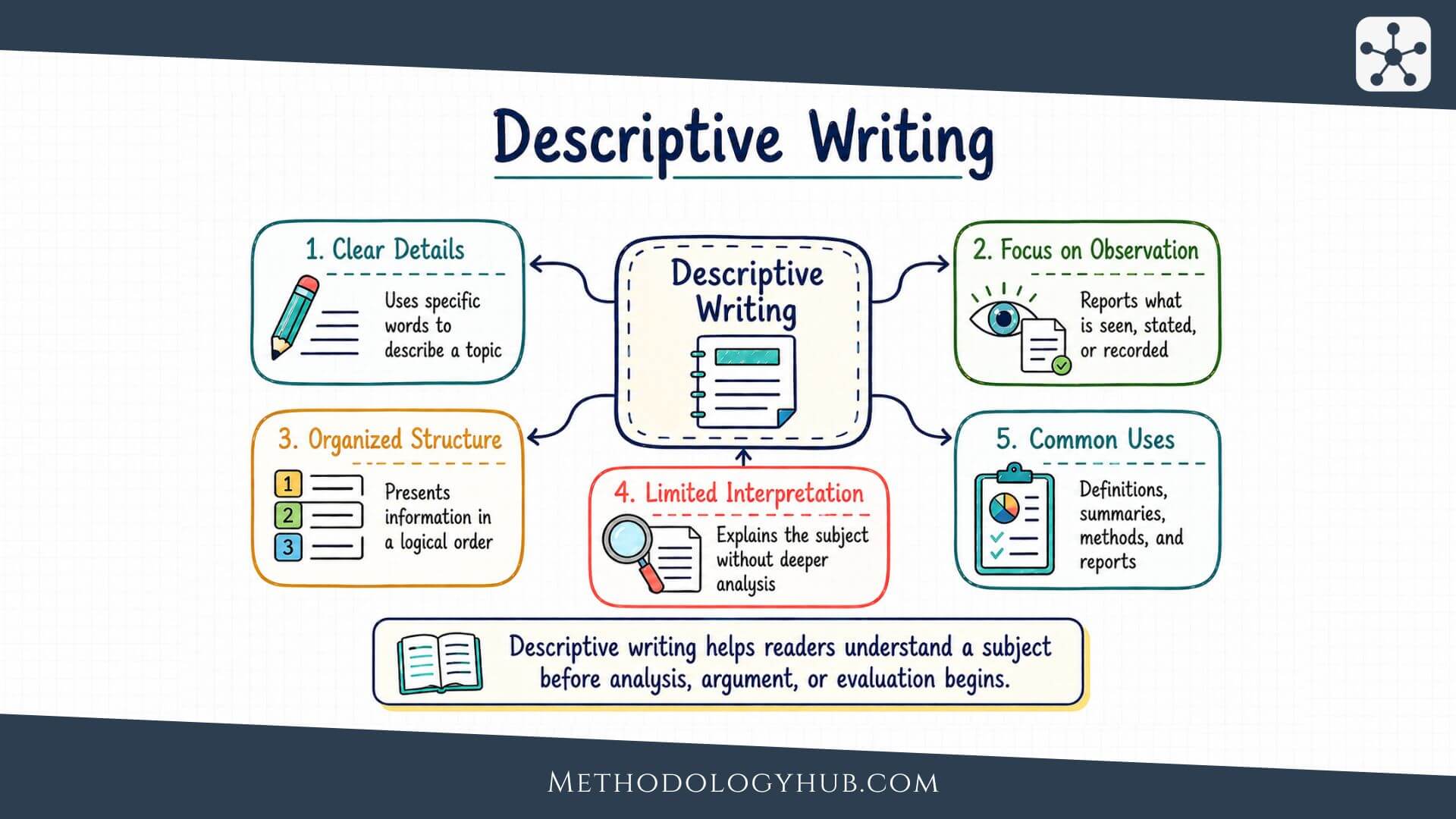
Descriptive writing is a type of academic writing that presents information clearly, accurately, and in an organised way. It helps the reader understand what something is, what happened, what was observed, how a process works, or what the main features of a topic are before deeper analysis or argument begins.
This article explains what descriptive writing is, its features, when to use it, how to structure it, how it differs from analytical, persuasive, and critical writing, and what descriptive writing looks like in practice.
What Is Descriptive Writing?
Descriptive writing presents information in a clear and factual way so that the reader can understand a subject before being asked to interpret, evaluate, or take a position on it. In academic work, it often explains a concept, summarises a source, reports an observation, outlines a method, or gives the background needed for a later point.
Because of that, descriptive writing is usually the first layer of many academic texts. A student cannot analyse a theory until the reader knows what the theory says. A lab report cannot discuss results until it has described the procedure and reported the findings. A literature review cannot compare studies until it has first made their focus, method, and conclusions understandable.
Descriptive writing definition
Descriptive writing means writing that identifies, explains, reports, or summarises the features of a subject without making extended interpretation the main task. It answers questions such as what it is, what happened, what was found, what the parts are, what steps were followed, or what a source says.
This does not mean descriptive writing is simple in a careless sense. Good description requires selection. A writer has to decide which details belong, which order makes the information easiest to follow, and which terms need explanation. A paragraph can be descriptive and still be carefully written.
Descriptive writing in academic work
In academic contexts, descriptive writing usually appears alongside other kinds of writing. It gives the reader enough context to understand the later work of analysis, persuasion, or critique. For example, an essay on school attendance might first describe the policy being discussed, then analyse patterns in attendance data, then argue for a specific interpretation.
The descriptive part is not a filler section. It prepares the reader. If the description is vague, too long, or poorly ordered, the later argument becomes harder to follow. If it is focused and accurate, the rest of the text has firmer ground.
What descriptive writing can and cannot do
Descriptive writing can make a topic clear. It can define terms, report facts, outline steps, and present evidence in a way that is easy to follow. It can also create a shared starting point between writer and reader, which is especially useful when the topic is unfamiliar.
What it cannot usually do on its own is complete a higher-level academic task. Many essays, research papers, and dissertations expect the writer to move beyond reporting. A paragraph that only says what three authors wrote may be accurate, but a stronger academic paragraph usually explains how the authors agree, where they differ, or what their work suggests for the question being answered.
This is why descriptive writing should be understood as a foundation rather than a final destination. It is often necessary. It is rarely the whole assignment.
Features of Descriptive Writing
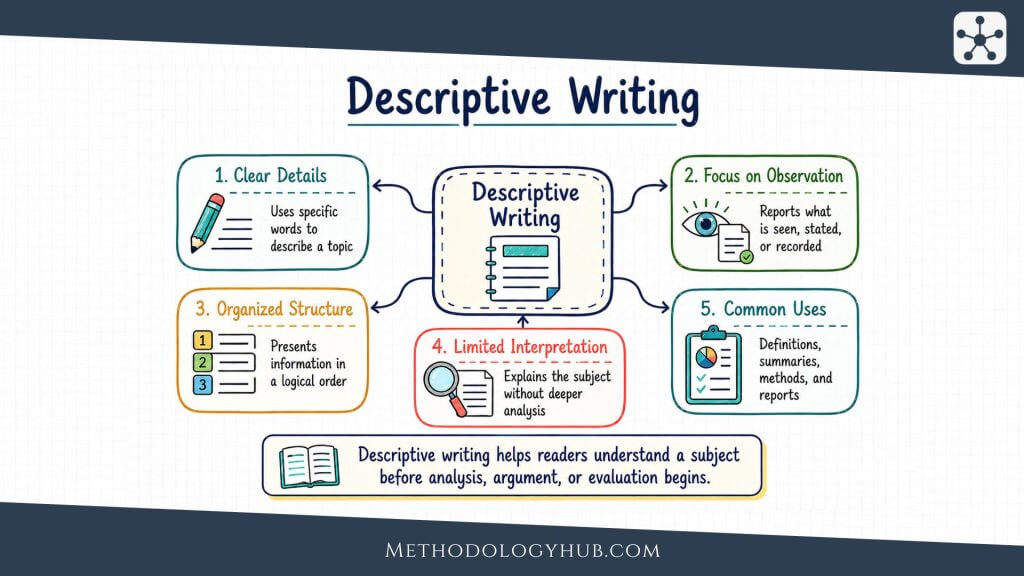
The features of descriptive writing are the qualities that help the reader form a clear picture of the topic without being pushed too quickly into interpretation. A descriptive paragraph should be accurate, specific, ordered, neutral in tone, and connected to the task. It should give enough detail to be useful, but not so much that the reader loses sight of the main point.
These features are especially important in academic writing because description is rarely included for its own sake. It usually supports a larger piece of work. A definition supports an argument. A method description supports the interpretation of results. A source summary supports a literature review. The descriptive section has to fit the purpose of the whole text.
Accuracy
Accurate descriptive writing reports information carefully. It avoids turning a source into something it did not say, exaggerating a result, or using terms loosely. If a study included 48 participants, a descriptive sentence should not call it a large national survey. If an author suggests a possible explanation, the description should not present that suggestion as a proven conclusion.
Accuracy also means keeping the level of certainty under control. Words such as may, suggests, reports, identifies, and describes help the writer match the strength of the claim to the evidence. This is not weak writing. It is careful writing.
Specific detail
Descriptive writing depends on detail, but detail has to be chosen. In academic work, useful detail usually tells the reader something they need for understanding. It may include dates, names, definitions, categories, measurements, stages, settings, sample sizes, or features of a source.
For example, the sentence “The study examined students” is too thin for most academic purposes. A stronger descriptive sentence might say, “The study examined the reading habits of 120 first-year university students through a questionnaire and two follow-up interviews.” The second version gives the reader a clearer view of scope, participants, and method.
Clear order
Description becomes easier to follow when the information is arranged in a sensible order. The right order depends on the subject. A process may need chronological order. A theory may need general explanation before examples. A source summary may begin with the author, topic, method, and finding before moving to finer details.
Good order reduces the reader’s effort. Instead of receiving scattered details, the reader can see how the parts fit together. This is why descriptive writing often uses signposting words such as first, next, after this, in this section, or in the study. These should not be overused, but they can make the movement of information easier to follow.
Neutral academic tone
Descriptive writing usually uses a measured tone. It does not need dramatic language to make the subject sound more impressive. In academic work, description should avoid inflated words, emotional claims, and broad statements that say more than the evidence allows.
For example, “The method completely transformed the classroom” is too strong unless the evidence actually supports that claim. “The method changed the order of classroom activities and placed group discussion before individual writing” is more useful because it tells the reader what changed.
Writing note: Strong descriptive writing usually sounds plain in the best sense. It lets the details do the work instead of trying to inflate them with dramatic wording.
Focus on the task
Not every accurate detail belongs in the text. A descriptive section should be shaped by the question being answered. If an essay asks how a writer defines social class, a full biography of the writer may not be needed. If a report asks how a test was conducted, the procedure should receive more attention than background information that does not affect the result.
This is where students sometimes struggle. They collect information and feel that all of it deserves space. Academic description works better when the writer chooses details according to function. Each detail should help the reader understand the point that follows.
Connection to evidence
Descriptive writing often works with evidence even when it is not yet analysing that evidence. A writer may describe what a source argues, what a table reports, or what an observation recorded. The reader should be able to see where the information comes from and how much of it is reported directly from the source.
In source-based writing, this means avoiding vague phrases such as “many people say” unless the text has already shown who those people are. It is usually better to name the source, report its point fairly, and then continue toward the writer’s own explanation.
| Feature | What it does | Simple academic example |
|---|---|---|
| Accuracy | Reports information without exaggeration. | The article reports interviews with 24 teachers. |
| Specificity | Gives concrete details that help understanding. | The survey asked students about reading time, note-taking, and revision habits. |
| Order | Arranges details so the reader can follow them. | First, participants completed a short questionnaire. They then joined a group discussion. |
| Neutral tone | Keeps claims measured and evidence-based. | The results show an increase in average scores from 62 to 69. |
When to Use Descriptive Writing
Descriptive writing is used when the reader needs information before they can follow the next move in the text. This happens often in school, college, university, and research writing. A writer may need to introduce a topic, define a term, report what a study found, describe a method, present background, or summarise a source before moving into analysis.
The best way to decide whether description is needed is to think about the reader’s starting point. If the reader cannot understand the later argument without first knowing what something is, what happened, or what was observed, descriptive writing has a clear role.
Use it to define a concept
Many academic texts begin by explaining a concept. In a sociology essay, the writer may define social mobility. In a biology report, the writer may describe photosynthesis. In a literature essay, the writer may introduce free indirect discourse before discussing how a novel uses it.
A good definition paragraph usually does more than give a dictionary-style sentence. It places the concept in the context of the task. The writer explains which meaning is being used, which features are relevant, and how the concept will be handled in the rest of the text.
Use it to introduce background
Background description gives readers the information they need to understand the issue being discussed. This might include a brief history, a policy outline, a research context, or the situation in which a text was produced.
The challenge is proportion. Too little background leaves the reader confused. Too much background delays the main work of the assignment. A useful background section gives enough context for the reader to understand the point that comes next.
Use it to summarise sources
Source summary is one of the most common uses of descriptive writing. A writer may need to explain what an article argues, what method it used, what data it collected, or what conclusion it reached. This is especially common in literature reviews, annotated bibliographies, and research papers.
In strong academic writing, source summary usually leads somewhere. After reporting what a source says, the writer often compares it with another source, uses it as evidence, or explains its role in the argument. The description gives the reader a clear view of the source before the writer builds on it.
Use it to describe methods and procedures
Method sections depend heavily on descriptive writing. The writer explains what was done, where it was done, who or what was included, which materials were used, and how the data were collected or analysed. The reader needs this information to judge the later findings.
For example, a lab report might describe the sample, equipment, procedure, and measurement conditions. A qualitative study might describe the interview process, participant group, coding approach, and setting. These descriptions do not have to argue. Their job is to make the research process visible.
Use it to report results before interpreting them
Results sections often begin descriptively. A writer may report means, percentages, themes, categories, observed behaviours, or trends in the data. Interpretation can come later, but the reader first needs to know what was found.
In a research report, this separation can be helpful. A sentence such as “Group A scored an average of 78, while Group B scored an average of 71” describes a result. A later sentence might analyse whether the difference is meaningful in relation to the research question, design, and evidence.
Use it as a bridge toward other types of writing
Descriptive writing often acts as a bridge. It starts with what is known and prepares the way for what the writer will do with that information. In an essay, a paragraph may begin by describing a source, then shift into analysis. In a discussion section, a sentence may report a result, then explain its possible interpretation.
This movement is part of the reason descriptive writing remains useful even in advanced academic work. The writer still needs to orient the reader, but the description becomes shorter, sharper, and more closely tied to analysis.
Structuring Descriptive Writing
Structuring descriptive writing means deciding what the reader should learn first, what details belong together, and how each paragraph prepares for the next. Description may seem straightforward, but without structure it can become a list of facts. The aim is to give information in an order that supports understanding.
A good descriptive structure usually follows the purpose of the paragraph. If the paragraph defines a concept, it may move from a general explanation to features and then to a short example. If it describes a method, it may follow the sequence of the study. If it summarises a source, it may identify the author, topic, method, and finding before explaining how the source will be used.
Begin with the function of the description
Before writing a descriptive paragraph, it helps to ask what the paragraph is supposed to do. Is it defining a term. Introducing a case. Reporting a result. Explaining a procedure. Summarising a source. Once the function is clear, the structure becomes easier to choose.
For example, a paragraph that defines a concept may begin with the broad meaning, then narrow it for the assignment. A paragraph that describes a research method may begin with the design, then explain participants, materials, procedure, and analysis. A paragraph that describes a historical event may follow time order.
Use paragraph focus
Each descriptive paragraph should have a focus. That focus may be a concept, a source, a step in a process, a feature of an object, or a set of findings. When one paragraph tries to describe too many different things, the reader has to work out the structure on their own.
A clear topic sentence can help. It tells the reader what the paragraph will describe and why it appears at this point in the text. The rest of the paragraph then develops that focus with relevant details.
Choose an order that fits the subject
Different subjects require different orders. A process usually works best in chronological order. A concept may work best from general to specific. A comparison may describe one item first and the second item next, or it may describe both item by item. A physical setting may move from the general environment to smaller details.
In academic writing, the order should make the information easier to use later. If the next paragraph analyses a method’s effect on results, the method description should already have given the details needed for that analysis. Structure is not decoration. It prepares the reader for the next move.
Move from description to explanation
Many academic paragraphs need a shift from description to explanation. The writer first tells the reader what the source says or what the data show. Then the writer explains how that information connects to the assignment.
This shift can be small. A paragraph may spend three sentences describing a study and one sentence explaining why the study is relevant. In more advanced work, the shift may be larger, with the description acting as the opening move before a more developed analysis.
Useful transition phrases include:
- This finding suggests…
- This definition is useful because…
- This method affects interpretation because…
- This source provides background for…
- This description prepares the later comparison by…
Keep description proportional
Proportion is one of the main skills in descriptive writing. A short essay cannot spend five paragraphs describing background before answering the question. A research report cannot skip method description and expect the reader to trust the results. The writer has to decide how much space the descriptive work deserves.
A useful test is to look at what the assignment asks for. If the task asks you to describe a process, description will take up much of the text. If the task asks you to evaluate an argument, description should be shorter and should prepare for evaluation rather than replace it.
Structure at sentence level
Descriptive writing also needs sentence-level order. Sentences should not feel like isolated notes. One sentence should set up the next. Repeated nouns can be useful here. Pronouns can help when the reference is clear. Transitional phrases can show sequence, contrast, or continuation.
For example, a method description might move like this: the first sentence identifies the design, the second names the participants, the third explains the procedure, and the fourth states how the data were recorded. The paragraph feels clear because each sentence has a job.
Differences With Other Types of Writing
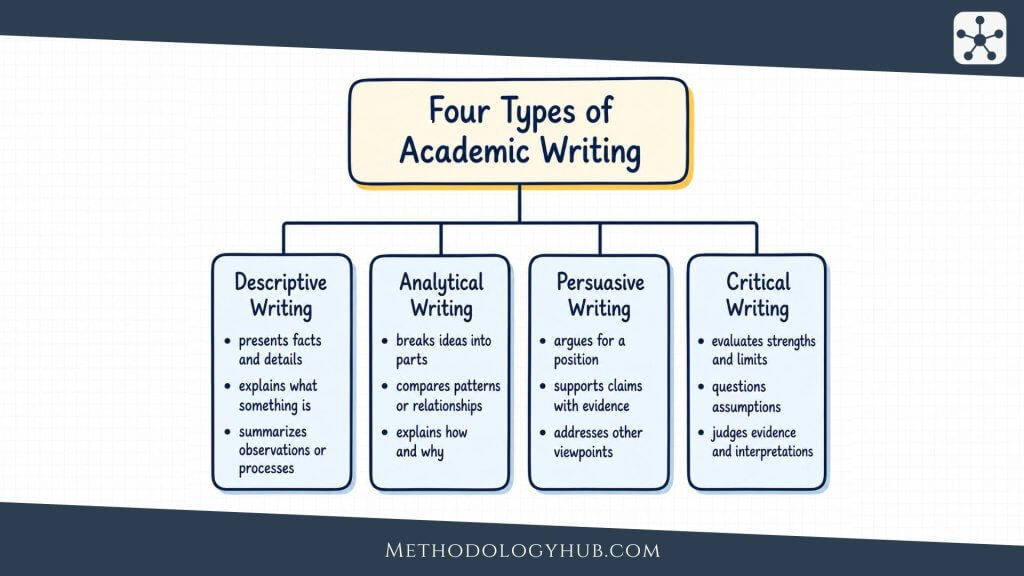
Descriptive writing is one of the main types of academic writing, alongside analytical, persuasive, and critical writing. These categories are useful because they help students recognise what a paragraph is doing. A paragraph may report information, examine relationships, build a position, or evaluate evidence. Each task needs a different kind of thinking.
In real assignments, the types often combine. A strong essay may start with a descriptive paragraph, move into analytical writing, use evidence to support a position, and then evaluate the limits of that position. The difference is not always the topic. It is the kind of work the sentence or paragraph performs.
Descriptive writing vs analytical writing
Descriptive writing reports what something is, what a source says, or what was observed. Analytical writing breaks that information into parts and explains relationships. It asks how the parts work together, how one idea differs from another, or what pattern appears in the material.
For example, a descriptive sentence might say that three studies examined student feedback in online courses. An analytical sentence might group those studies by method and explain that survey-based studies focus on satisfaction, while interview-based studies give more detail about frustration, motivation, and course design.
Descriptive writing vs persuasive writing
Persuasive writing develops a position and supports it with reasons and evidence. Descriptive writing can provide some of that evidence, but it does not usually make the argument by itself.
For example, a descriptive paragraph may report that a school policy requires students to submit weekly reading logs. A persuasive paragraph may argue that the policy should be revised because it records compliance more easily than actual reading quality. The descriptive information gives context, while the persuasive writing takes a position.
Descriptive writing vs critical writing
Critical writing evaluates ideas, sources, evidence, assumptions, and limits. Descriptive writing may explain what a source argues, but critical writing asks how convincing that argument is and where it may need qualification.
A descriptive sentence might state that an author uses interviews with first-year students. A critical sentence might point out that the interview sample is small and drawn from one institution, so the findings may be useful for understanding that setting but should not be treated as a general account of all first-year students.
How the types work together
The four types are often taught separately, but strong academic writing usually moves between them. Description gives the reader a stable starting point. Analysis explains patterns and relationships. Persuasion develops a reasoned position. Critical writing tests the strength of evidence and argument.
The balance changes by assignment. A short report may use more description. A research essay may need more analysis and argument. A literature review may describe sources briefly, then spend more time comparing, grouping, and evaluating them. Recognising this balance helps writers avoid staying descriptive for too long.
| Type of academic writing | Main question it answers | Example move |
|---|---|---|
| Descriptive writing | What is it? What happened? What was found? | Reports the method and results of a study. |
| Analytical writing | How does it work? How are the parts related? | Groups studies by method and explains a pattern. |
| Persuasive writing | What position should the reader accept? | Uses evidence to support a claim about policy or interpretation. |
| Critical writing | How strong is the evidence or argument? | Evaluates the limits of a source or method. |
Assignment verbs as clues
Assignment wording often tells you how much description is expected. Verbs such as describe, outline, define, summarise, and identify usually ask for descriptive writing. Verbs such as analyse, compare, argue, justify, evaluate, and assess usually ask the writer to go further.
These verbs are useful clues, not rigid formulas. A task that asks you to analyse may still need a short descriptive opening. A task that asks you to describe may still require careful selection and organisation. The verb helps you judge the main direction of the answer.
Examples of Descriptive Writing
Examples make descriptive writing easier to recognise. In academic work, description can appear in many forms: a definition, a source summary, a method description, a short report of findings, a background paragraph, or an explanation of a process. The surface topic changes, but the paragraph’s job stays similar. It gives the reader clear information.
The examples below are short on purpose. They show the kind of work descriptive writing does before analysis or argument begins. In a full assignment, each example might be followed by explanation, comparison, or evaluation.
Example 1: Describing a concept
Academic motivation refers to the reasons students engage with school or university tasks. It may include interest in the subject, the wish to achieve a qualification, pressure from family expectations, or confidence gained through earlier success. In education research, motivation is often studied through surveys, interviews, classroom observation, or a combination of these methods.
This example is descriptive because it explains the concept and names features connected to it. It does not yet argue which kind of motivation is strongest or analyse how motivation changes across contexts. It prepares the reader for that later work.
Example 2: Summarising a source
In the study, the researchers examined how first-year students used feedback on their draft essays. Data were collected through written comments, student reflections, and follow-up interviews. The authors report that students often understood grammar corrections more easily than comments about argument or structure.
This is descriptive source writing. It identifies what the study examined, how evidence was collected, and what the authors reported. A later paragraph could analyse why feedback on argument is harder to use or compare the study with another source.
Example 3: Describing a method
The research used a mixed-methods design. First, 180 students completed a questionnaire about reading habits. From this group, 18 students were invited to take part in semi-structured interviews. The questionnaire provided broad patterns, while the interviews gave more detail about how students described their reading routines.
This example describes a research design in a clear sequence. It states the method, sample size, second stage, and purpose of each data source. It does not evaluate whether the design was strong. That would be a critical or analytical move.
Example pattern: A descriptive method paragraph often names the design, participants or materials, procedure, and type of data collected. Interpretation usually comes after that foundation is clear.
Example 4: Reporting results
The average score increased from 64 in the first test to 72 in the second test. The largest increase appeared in the group that received weekly writing feedback. Students in the comparison group also improved, but the average change was smaller.
This example reports findings without yet explaining their meaning. It tells the reader what the data show in basic terms. A later sentence could analyse whether feedback may have contributed to the difference, or it could discuss limits in the design.
Example 5: Describing a process
The peer review activity took place in three stages. Students first exchanged drafts and read them silently. They then completed a feedback sheet with questions about focus, evidence, and paragraph order. In the final stage, each student discussed one suggested revision with their partner before returning to their own draft.
This process description uses time order. The reader can see what happened first, next, and last. If the assignment later asks whether peer review improved writing, this paragraph gives the factual base needed for that discussion.
Example 6: Moving from description to analysis
Descriptive sentence: The article reports that students used the library mainly for quiet study, printing, and access to course books.
Analytical follow-up: This pattern suggests that students in the study treated the library less as a research space and more as a practical study environment connected to everyday coursework.
The first sentence reports what the article says. The second sentence interprets the pattern. Together, they show how descriptive writing can feed into stronger academic explanation without being stretched beyond its role.
Example 7: Descriptive writing in an essay paragraph
The school introduced the reading programme in 2021 for pupils in Years 7 and 8. Each class received two guided reading sessions per week, and pupils kept a short reading record after each session. The programme was designed to increase independent reading time during the school day.
A paragraph like this might appear before analysis of test scores, teacher interviews, or pupil responses. The description tells the reader what the programme involved. It does not yet claim that the programme worked or failed.
Developing Descriptive Writing in Academic Texts
Developing descriptive writing means learning how much information to give, how to arrange it, and how to connect it to the larger purpose of the text. Beginners sometimes treat description as copying information from notes. Stronger writers treat description as a deliberate part of the writing plan.
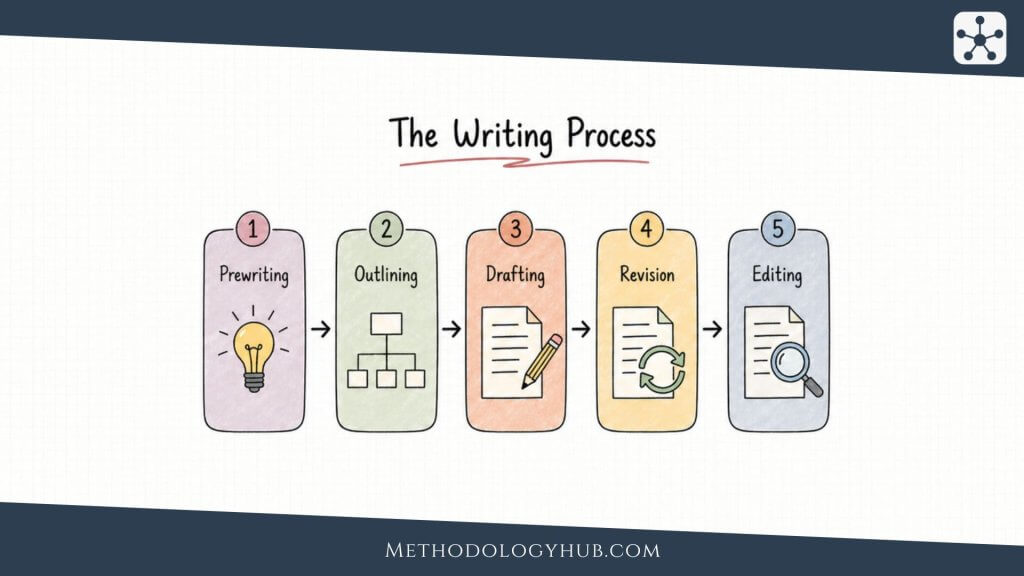
This is where the writing process helps. During planning, the writer decides what the reader needs to know. During drafting, the writer turns that information into paragraphs. During revision, the writer checks whether the description is accurate, focused, and placed where it helps the text move forward.
Plan description before drafting
Planning descriptive writing begins with the assignment question. A writer can mark which parts of the task ask for description and which parts ask for analysis, argument, or evaluation. This prevents the whole essay from becoming descriptive when only one section needs that kind of writing.
A simple planning question can help: what information must the reader know before my main point makes sense. The answer may be one definition, two pieces of background, a source summary, or a brief method description. Once that is clear, the writer can give description enough space without letting it take over.
Use notes without copying their shape
Notes often appear as fragments, bullet points, quotations, or copied phrases from sources. A descriptive paragraph should not simply paste those notes into the draft. The writer has to reorganise them into a sequence that makes sense for the reader.
For example, notes on a study might include the author, sample, method, findings, and limits in no clear order. A descriptive paragraph can turn those notes into a coherent source summary: who did the study, what it examined, how it was conducted, and what it reported.
Use precise verbs
Verbs guide the reader through descriptive writing. Instead of repeating says, a writer can choose verbs that show the source’s action more clearly. A source may define, report, identify, classify, compare, describe, observe, record, or propose.
These verbs should be chosen carefully. “Proves” is usually too strong for most academic sources. “Suggests” may be more accurate when the evidence is limited. “Reports” is useful when the writer is presenting findings without yet evaluating them.
Connect description to the next move
A descriptive paragraph becomes stronger when the reader can see why it has been included. The link may be brief, but it should be visible. After describing a source, the writer can explain how it relates to the research question. After reporting a finding, the writer can explain which pattern will be analysed next.
This connection helps avoid loose description. The reader should not have to ask why a paragraph appeared. The paragraph itself should prepare the next step.
Revise for proportion
Revision is the best time to check whether descriptive writing has the right amount of space. A draft often reveals where a writer has described too little or too much. If the reader cannot understand the analysis, more description may be needed. If the argument appears late, description may need to be shortened.
One useful method is to label each paragraph by function: description, analysis, argument, or evaluation. If an analytical essay has ten descriptive paragraphs before the first analytical paragraph appears, the balance is probably off. If a method section gives almost no detail about what was done, the description may be too thin.
Keep the reader in view
Descriptive writing works best when the writer remembers that the reader may not know the topic yet. This does not mean explaining every basic idea in the field. It means giving enough orientation so the reader can follow the sentence they are currently reading and the point that comes next.
That balance depends on audience. A school essay may need more introductory description than a postgraduate dissertation. A specialist journal article may assume more background knowledge than a first-year assignment. Good description fits the reader and the task.