Research objectives state what a study intends to establish through its investigation. They give a project a defined purpose beyond reading about a subject or collecting information. An objective might be to describe a pattern, examine an explanation, compare evidence, or interpret an experience. Its wording should make the intended contribution clear enough for the researcher to plan the work and for a reader to follow it.
When planning academic research, objectives help determine which parts of an interesting subject belong in the study. They influence the research methods selected, the information gathered, and the analysis used to address the inquiry. Those decisions need to develop together: an objective that cannot be addressed with the available evidence will need revision.
Consider a university project on written feedback in biology. Receiving comments on a laboratory report does not necessarily reveal how a student interprets them or uses them in a revision. A researcher interested in that uncertainty could develop objectives concerning the feedback, students’ interpretations, and changes between successive drafts. The examples below use this hypothetical project to show how a set of objectives takes shape.
What are research objectives?
Research objectives definition
Research objectives are statements of the knowledge or understanding a study seeks to produce. They usually begin with an action verb, often following “To”, so the reader can identify the proposed investigation. “To compare explanations of experimental results in students’ original and revised laboratory reports” specifies a contribution that can be assessed through the reports themselves.
The wording also establishes a boundary. That comparison concerns a particular part of the report, rather than every feature of scientific writing. It directs attention towards how students explain results, which may involve their use of evidence or their treatment of unexpected observations. The researcher still has to decide how these features will be examined, but the objective makes that methodological decision possible.
Objectives in a research proposal
In a proposal, objectives follow from the research problem and the reading used to justify it. They commonly appear towards the end of the introduction or in a separate aims and objectives section. Departmental requirements differ, so the arrangement should suit the assignment, dissertation, or proposed study.
An objective also provides a reference point when writing the findings and discussion. If the study set out to compare report drafts, readers should be able to find that comparison and understand its limits. A result showing little change can still address the objective. Completing the inquiry means examining the evidence adequately; it does not require obtaining a preferred finding.
General objectives vs. specific objectives
A study often needs one statement that captures its overall purpose and several statements that make that purpose workable. General and specific objectives serve these different levels. The distinction becomes easier to see when the same project is expressed first as a whole and then through its connected parts.
The general research objective
For the laboratory-report project, a general objective could be: “To examine how first-year biology students interpret written feedback and use it to revise explanations of experimental results during one semester.” This identifies the students, the process under investigation, and the aspect of writing being examined. It leaves room for several sources of evidence without turning into a complete methods description.
One general objective is often sufficient for a focused project. Some programmes use “research aim” for this broad statement; others distinguish an aim from the general objective. Follow the terminology required in your setting, while making sure the overarching purpose remains clear. Changing the label should not change what the study is trying to establish.
Developing specific research objectives
Specific objectives divide that purpose into contributions that can be examined. In this example, the researcher needs to consider the feedback students receive, how they interpret it, and what revisions appear in their reports. Bringing those sources together is a further task of analysis. A possible set is:
- To identify the types of written feedback provided on explanations of experimental results in the selected laboratory reports.
- To explore how first-year biology students interpret that feedback when deciding what to revise.
- To compare explanations of experimental results in the students’ original and revised reports using an agreed assessment rubric.
- To examine how students’ accounts of feedback use help explain the revisions identified in their reports.
Each statement supplies something the others cannot establish on its own. The comments reveal what guidance was provided, interviews reveal how students interpreted it, and paired drafts reveal the revisions. The final objective connects students’ accounts with the written evidence. Together, they support the general objective without introducing a separate investigation of teaching quality or overall course achievement.
Choosing the number of objectives
Three to five specific objectives can be manageable for many student projects, but this is a planning guide rather than a required total. A short assignment may need fewer, while a larger study may justify more. Keep an objective when it makes a necessary contribution to the inquiry and can be addressed in sufficient depth. Combining two unrelated investigations simply to reduce the count can make the wording harder to use.
Types of research objectives
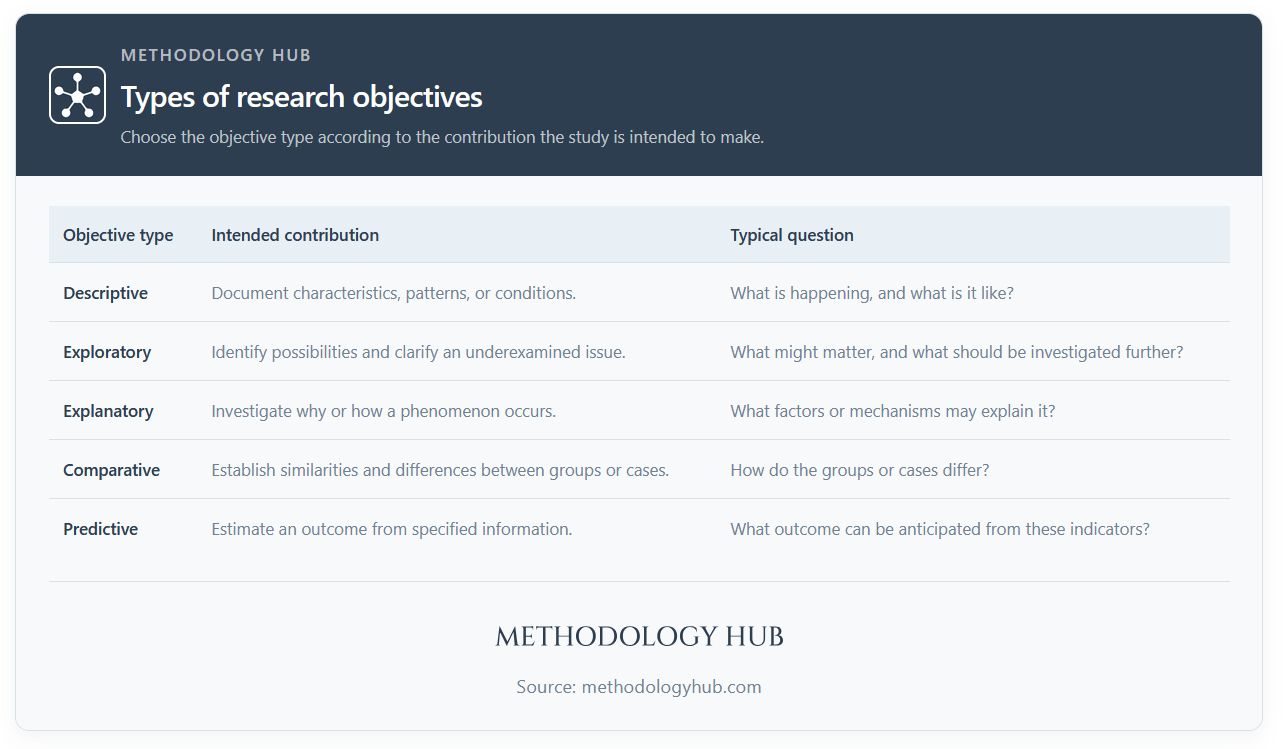
Objectives also differ according to the kind of contribution intended. The categories below describe common purposes rather than separate formats that every study must use. A project may combine description with comparison, or exploration with explanation, when its question requires those contributions.
Descriptive research objectives
A descriptive objective establishes what a phenomenon is like. In the feedback project, identifying the types of comments on laboratory reports could show whether the selected feedback addresses evidence, interpretation, organisation, or presentation. The objective concerns the characteristics of the comments; it does not yet explain how they influence revision. Description may involve counts and distributions, detailed accounts, or a classification of documents.
Exploratory research objectives
Where the relevant experiences or concepts are not sufficiently understood, an exploratory objective leaves room to discover how participants make sense of the situation. Exploring students’ interpretations of feedback might reveal uncertainties the researcher had not anticipated. Interviews could show, for instance, that a comment understood as a request for more detail was intended to question an explanation. The objective identifies the experience to investigate without prescribing the themes that must emerge.
Explanatory research objectives
An explanatory objective seeks to account for a pattern, process, or relationship. The researcher may want to examine how students’ interpretations help explain their revisions, drawing on both interview accounts and drafts. A claim about cause and effect requires a design that can evaluate alternative explanations. Merely choosing a verb such as “determine” or “assess” cannot turn an observed association into evidence that feedback caused a change.
Comparative research objectives
Comparison examines similarities or differences between groups, cases, texts, or conditions. Comparing an original report with its revised version concerns paired documents from the same student. Comparing reports across two courses raises different sampling and interpretation questions because the courses may also differ in their teaching and assessment. A useful comparative objective names both sides of the comparison and the feature being examined.
Predictive research objectives
A predictive objective aims to estimate an outcome using information available before that outcome is known. A different study might seek to predict later laboratory-report performance from earlier writing samples and assessment results. Its analysis would need to evaluate predictions on observations not used to fit the model. Identifying an association in the original data is insufficient evidence that the model will predict accurately for other students or later assignments.
The distinction between explanation and prediction is especially useful when drafting objectives. A model may predict a result without establishing its cause, while an explanatory account may offer insight without producing accurate forecasts. Choose the purpose that reflects the intended conclusion and make sure the analysis can support it.
Research objectives vs. research questions
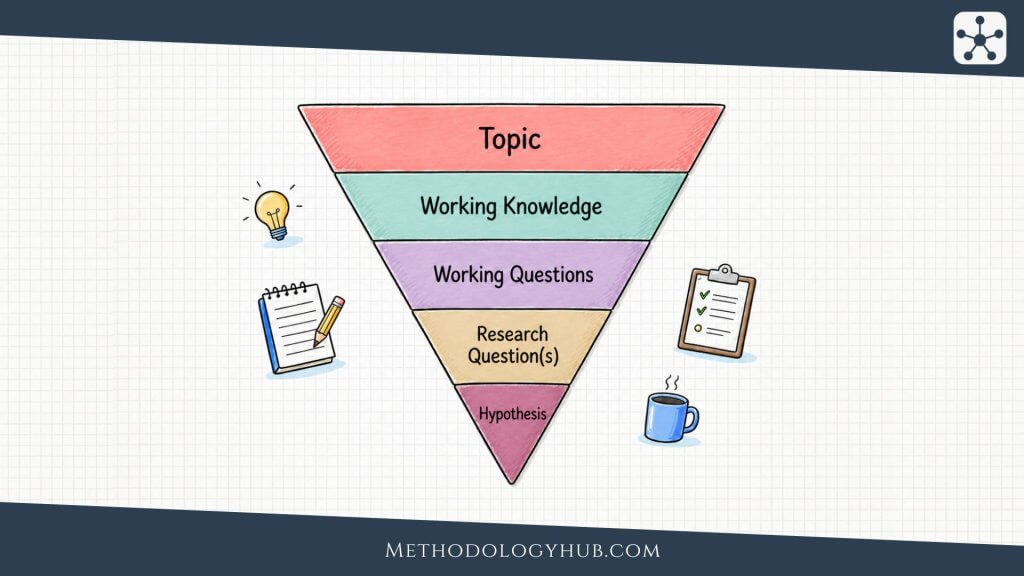
Objectives and questions should describe the same inquiry from different directions. A question makes the uncertainty explicit, while an objective states the contribution the study intends to make towards resolving it. Writing both can reveal a mismatch that is easy to overlook when only one is available.
Turning a question into an objective
A research question for one part of the feedback project might ask: “How do students interpret written comments on their explanations of experimental results?” The corresponding objective is to explore those interpretations. Both concern the meaning students give to the comments, so interviews or discussions around their actual reports could provide relevant evidence.
Replacing the question with an objective to measure satisfaction with feedback would change the inquiry. A satisfaction questionnaire could show whether students liked the comments, but liking them does not establish how they understood them. The question and objective need to match in their subject, scope, and intended conclusion, even when their wording differs.
This relationship extends to the wider plan. The research aim expresses the broad purpose, and a hypothesis may state an expectation about a particular relationship or difference. For a hypothetical comparison of two feedback approaches, these elements could be written as follows. The example illustrates their functions; it does not report an established effect.
| Element | Function | Illustrative statement |
|---|---|---|
| Research aim | Expresses the broad purpose | To investigate the use of written feedback in revising laboratory reports. |
| Research objective | Specifies a contribution the study will make | To compare revision scores for students receiving criterion-based feedback and students receiving the usual comments. |
| Research question | Asks what needs to be established | How do revision scores differ between the two feedback conditions? |
| Research hypothesis | States a testable expectation | Students receiving criterion-based feedback will have higher revision scores than students receiving the usual comments. |
The role of a research hypothesis
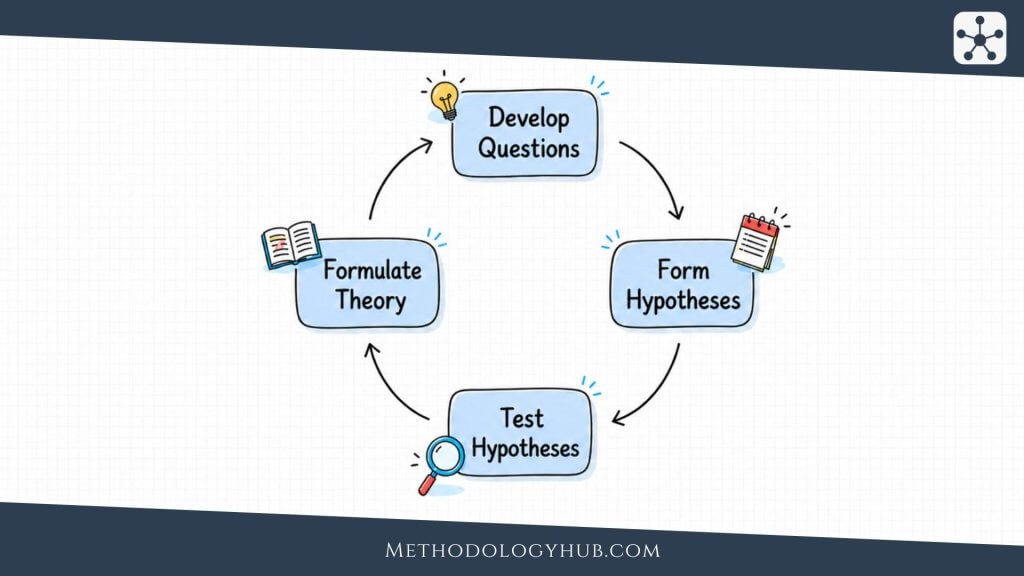
A research hypothesis adds a prediction that the evidence can support or challenge. It should have a rationale in theory or previous research, rather than being added because a proposal is expected to sound confident. In the comparison above, the objective remains to examine the difference whether or not the predicted advantage appears.
Not every objective needs a hypothesis. A project documenting feedback practices or exploring students’ experiences may begin with open questions. Even a quantitative study can have descriptive objectives without predicting an outcome. Where hypotheses are required, they should correspond to the comparisons or relationships the study is designed to examine.
Research objectives and learning objectives
Research objectives also differ from the learning objectives of a course. A learning objective might require students to interpret experimental results accurately. A research objective would investigate how students perform or develop that interpretation. The course seeks an educational outcome; the study seeks evidence about it.
That distinction prevents a proposal from promising changes it cannot deliver. A study may generate information that helps a teacher revise feedback, but investigating students’ interpretations does not itself guarantee better writing. State the contribution the research can establish, then discuss possible educational uses in relation to its findings.
SMART research objectives
SMART offers a way to check whether an objective is sufficiently defined and workable. Here the letters stand for Specific, Measurable, Achievable, Realistic, and Time-bound. Some versions use “Relevant” for the fourth criterion. Relevance to the research problem should be checked alongside whichever version is required for the project.
Specific: define the subject and scope
An objective to “study feedback” leaves too many possible investigations open. Specifying first-year biology students, written comments, and explanations of experimental results makes the intended inquiry recognisable. Include the population, case, materials, or concepts needed to distinguish it. The detailed sampling procedure can remain in the methodology section rather than overloading the objective.
Measurable: identify evidence of completion
The researcher should be able to explain what evidence would show that an objective has been addressed. A comparison of report drafts might use rubric scores, documented textual changes, or both. Exploring students’ interpretations would instead require a supported analysis of their accounts. In qualitative research, assessability does not mean forcing experiences into numerical targets; it means making the proposed inquiry and its evidential basis clear.
Achievable: check access and resources
The objective needs an investigation that can actually be undertaken. Comparing drafts requires access to both versions, while exploring interpretations requires suitable participants and a feasible way to gather their accounts. Check the equipment, permissions, research skills, and time needed before treating the objective as settled. If revised drafts are unavailable, the comparison cannot be completed simply by making its wording more precise.
Realistic: match the intended conclusion to the study
Realistic scope concerns the reach of the proposed contribution as well as the workload. Evidence from one undergraduate course may support a detailed account of that setting, but it will not establish how all university students use feedback. Narrow the objective when its intended conclusion exceeds the design. Ambition can lie in the depth of the analysis rather than the number of populations or outcomes included.
Time-bound: set an appropriate period
A defined period helps determine which evidence belongs in the investigation. “During one semester” could delimit the reports being studied, while a project schedule sets deadlines for recruitment, analysis, and writing. These are different uses of time. A historical objective might specify the years represented in an archive, with the completion deadline stated separately. Not every objective needs to repeat the project’s submission date.
Apply the criteria together. A highly specific objective can still be unachievable if its data are inaccessible, and an achievable objective can still miss the research problem. The check should improve the inquiry itself, rather than produce a sentence filled with details that do not help readers understand its purpose.
How to write research objectives
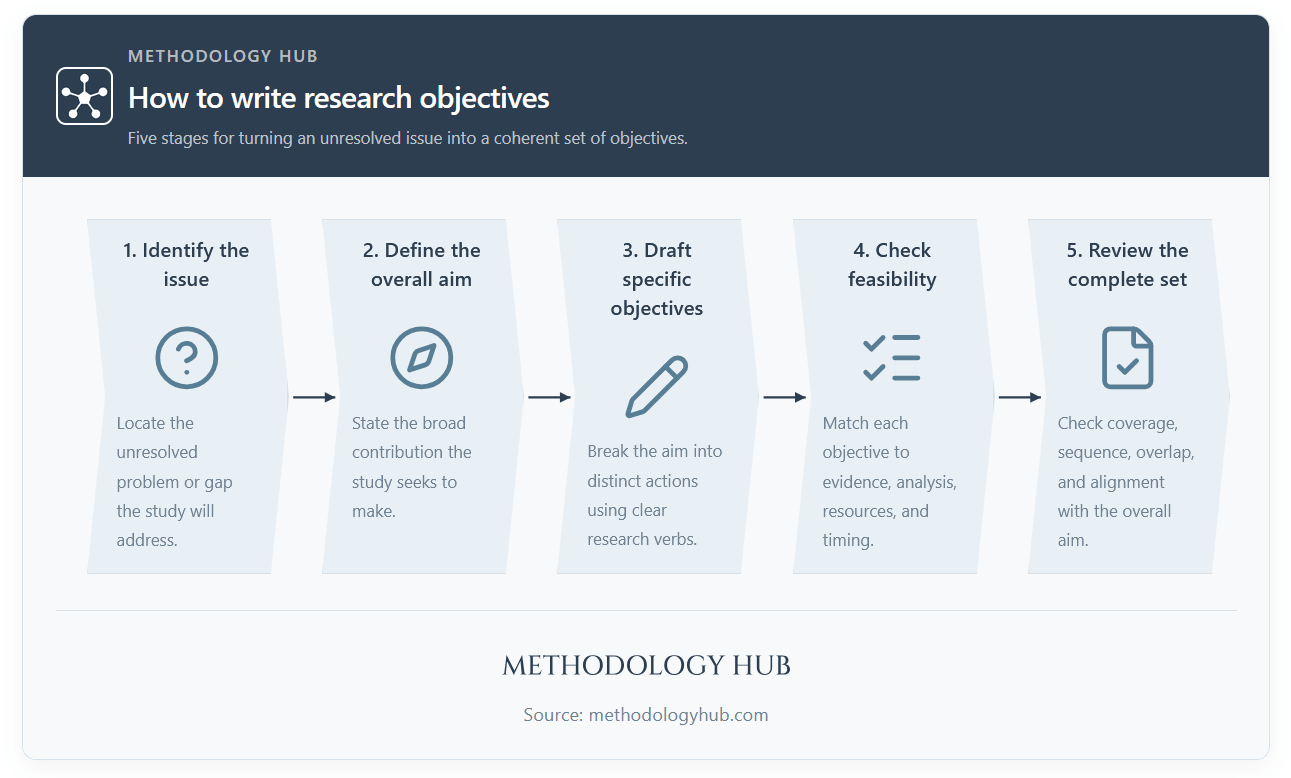
Drafting objectives is easier when the research problem is already clear enough to guide decisions. Write provisional statements, then test them against the literature, possible evidence, and the requirements of the assignment. The wording will often become more precise as the research plan develops.
Start from the unresolved issue
For the feedback project, the preliminary issue concerns how students interpret comments and what they do with them. Reading might show that feedback provision has been examined more extensively than students’ interpretation in the particular course setting. A defensible objective should address the uncertainty established by that reading. It should not rely on an unsupported claim that no one has studied the subject before.
Keep the distinction between the research purpose and the hoped-for benefit visible. Improving students’ writing may be a reason to investigate feedback, but the proposed study needs to state what it can establish about the process. An objective concerned with interpretation is more workable than a promise to solve every difficulty students encounter in laboratory reporting.
Choose an action verb that fits the inquiry
The verb helps indicate the contribution expected from the analysis. “Describe” suggests an account of characteristics, while “compare” directs attention to similarities and differences. “Explore” can suit a qualitative inquiry when the phenomenon and context are defined. The surrounding wording has to do some of the work: “explore feedback” remains broad, whereas exploring how students interpret comments names a recognisable investigation.
Verbs such as “understand”, “appreciate”, or “study” often leave specific objectives difficult to assess because they do not indicate what the researcher will establish. Replace them with the analysis the project requires. The table offers options, but choosing a stronger-sounding verb does not compensate for an unclear subject or an unsuitable design.
| Intended contribution | Useful verbs | What the wording should identify |
|---|---|---|
| Description | Describe, identify, classify | The characteristics or materials to be documented. |
| Exploration | Explore, examine, interpret | The experience, meaning, or process to be investigated. |
| Comparison | Compare, contrast | The cases or conditions and the basis for comparison. |
| Measurement | Measure, estimate, calculate | The variable, quantity, or parameter to be assessed. |
| Evaluation | Assess, evaluate | The object of evaluation and the relevant criteria. |
| Prediction | Predict, develop, validate | The outcome, available predictors, and proposed assessment of accuracy. |
Specify what will be investigated
A useful drafting pattern is: “To [action verb] [phenomenon or relationship] among/in [population, case, or materials] within [relevant context or period].” Use only the elements the reader needs. For document research, naming the archive and period may be more useful than a participant group. For a laboratory experiment, the treatment and outcome may need to be explicit.
An objective to “compare report drafts” becomes clearer when it specifies explanations of experimental results in the original and revised reports of first-year biology students. The revised wording now indicates what must be available for analysis. Details such as the coding procedure or the precise rubric can then be developed in the research design.
Separate research objectives from procedural tasks
“To conduct interviews” describes a data collection method, but does not establish what knowledge the interviews should provide. In this project, exploring students’ interpretations explains their purpose. Recruitment, transcription, and scheduling belong in the work plan supporting that objective.
Some projects do have a methodological objective, such as developing and evaluating a measure of feedback interpretation. In that case, producing the instrument is part of the intended research contribution. The distinction depends on whether the activity itself produces the knowledge being sought or simply enables another investigation.
Review the set before finalising the wording
Read the objectives together and check whether they address the general purpose fully. If two statements would produce essentially the same analysis, consider combining them. If an objective introduces a new population, outcome, or theoretical question, check whether that addition belongs within the proposed study.
Then outline the evidence and analysis needed for each statement. A supervisor or teacher may identify an unavailable source or a comparison that cannot support the proposed conclusion. Revise the objective and the plan together, keeping a record of substantial changes. Once data collection or formal testing begins, changes should remain transparent rather than being used to make the original inquiry appear more successful.
Aligning research objectives with methodology
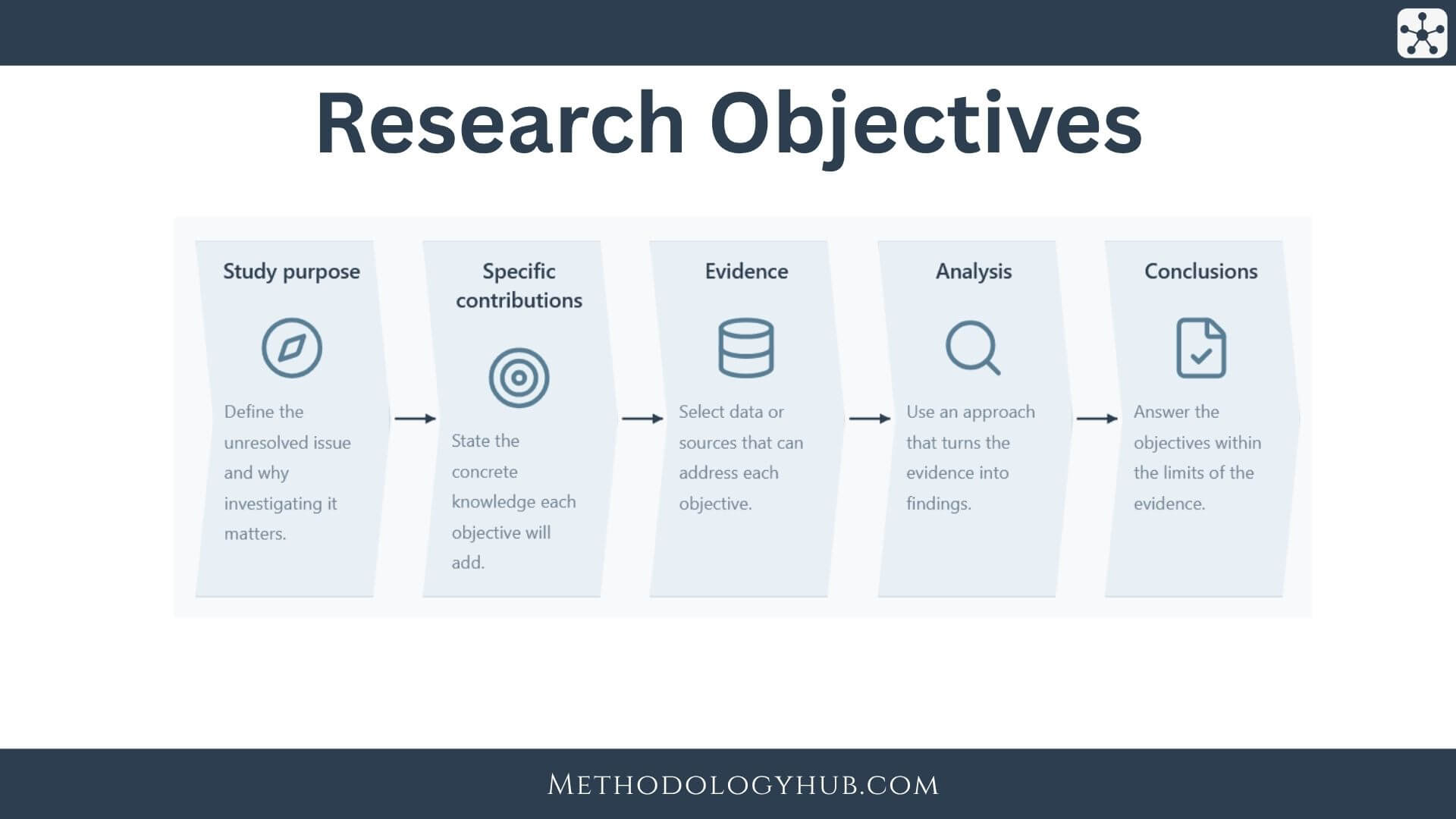
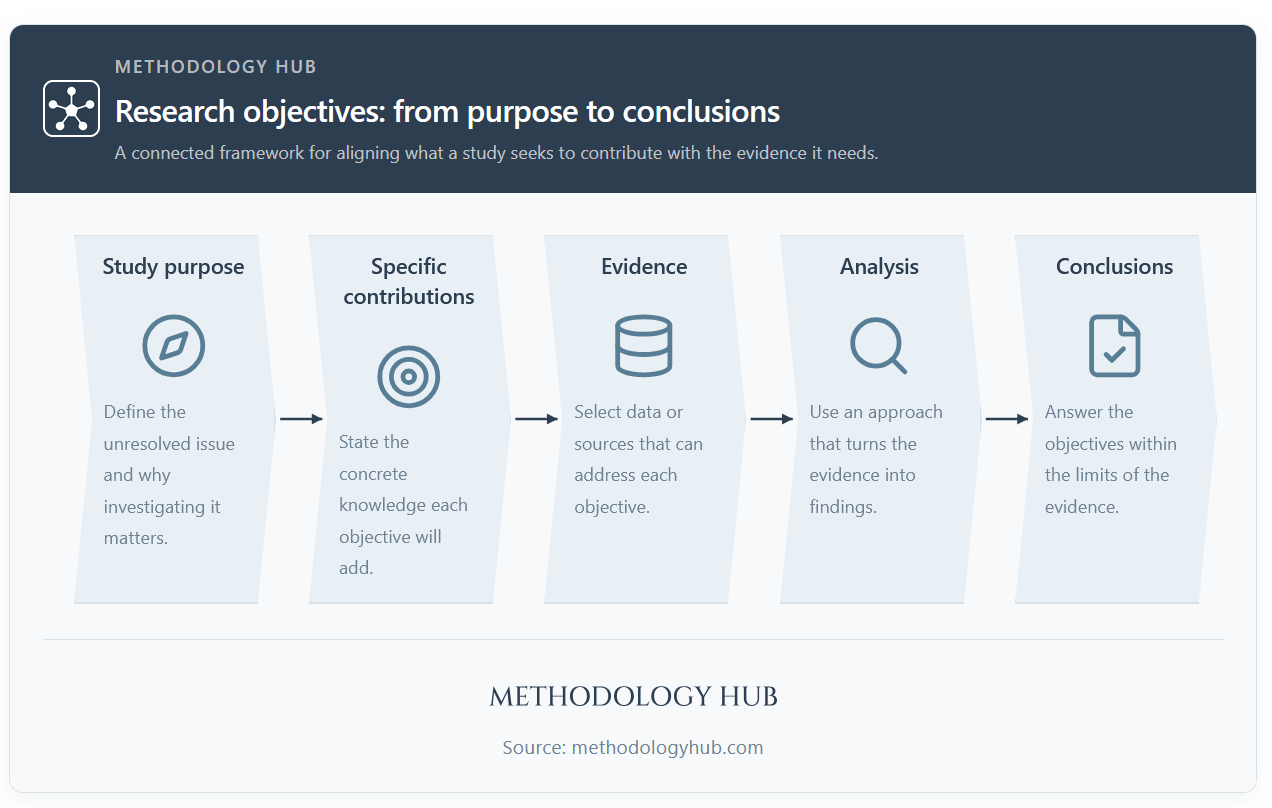
An objective becomes usable when the methodology explains how it will be addressed. This requires more than placing a method name beside the statement. The researcher needs to justify why the selected evidence can establish the proposed contribution, how it will be analysed, and what remains outside its reach.
Choose evidence for each objective
In the feedback project, the comments on reports provide evidence about the guidance students received. Interviews allow students to explain their interpretations, while original and revised drafts show the written changes. Each source has limits. A student’s account of making a revision does not demonstrate that the revision appears in the report, and a changed paragraph does not reveal the student’s reasoning by itself.
Sampling decisions follow from these requirements. The selected students need the kinds of records the comparison requires, and the interviews need to address experiences relevant to the question. If the investigation uses volunteers from one course, its conclusions should reflect that setting and selection. The objective should not quietly imply a representative account of the entire university.
The fourth objective brings the sources together. It examines how students’ accounts help explain the revisions observed in their reports, including instances where the accounts and drafts do not agree. The table outlines possible evidence and analysis for the four specific objectives introduced earlier.
| Objective focus | Possible evidence | Analytical contribution |
|---|---|---|
| Types of feedback | Written comments on selected reports | Classify comments according to the features of explanation they address. |
| Student interpretations | Interviews discussing the actual comments | Analyse recurring interpretations and differences between students' accounts. |
| Changes between drafts | Original and revised reports with an agreed rubric | Compare explanations and document the nature and extent of revisions. |
| Interpretations in relation to revisions | Interview accounts considered alongside paired drafts | Examine where reported feedback use helps explain the written changes or leaves discrepancies. |
Select analysis that matches the intended conclusion
Comparing rubric scores could describe the extent of change between drafts. Close analysis of the paragraphs could then show whether the changes concern evidence, reasoning, or scientific terminology. Before using numerical scores, the researcher needs clear assessment criteria and a consistent scoring procedure. A difference in scores may otherwise reflect how the reports were judged rather than how the explanations changed.
The comparison alone cannot establish that feedback caused improvement. Students may also have received classroom instruction, discussed their work, or spent more time revising. An objective to estimate the causal effect of a particular feedback approach would require additional design decisions to address those alternatives. Keep the wording at the level the proposed evidence can support.
Integrate qualitative and quantitative objectives
When a study uses mixed methods research, its objectives should explain how the numerical and qualitative contributions will be brought together. Collecting scores and interviews in parallel is not enough to show what their combination adds. The feedback project could use interview accounts to interpret why comparable score changes involve different revision processes.
Plan that connection before analysis. The researcher might select contrasting draft patterns for closer discussion, or examine whether accounts of confusing comments correspond to particular kinds of revisions. Disagreements between the sources can be informative. The final interpretation should explain those relationships without treating one source as automatically more accurate than the other.
The objectives can support different arrangements for bringing the evidence together, depending on the inquiry:
- Compare numerical results with qualitative accounts from the same cases to examine agreement and discrepancies.
- Use quantitative findings to select contrasting cases for a later qualitative investigation.
- Use an initial qualitative investigation to develop concepts or questions for subsequent quantitative assessment.
For the feedback project, comparing accounts with draft changes directly addresses the final objective. Choosing a different arrangement would require reconsidering the sequence of the study and possibly revising that objective. The method should follow the intended contribution rather than an assumed requirement to collect both forms of data.
Research objectives examples
The following examples show how objectives change with the subject and available evidence. Each scenario is hypothetical. A real proposal would need to establish its research problem through reading or preliminary evidence before adopting the objectives.
Quantitative research objectives example
An ecology project could investigate plant diversity in sampled campus grassland plots during a spring survey. Its general objective might be to examine how recorded plant diversity differs between frequently mown and less frequently mown areas. Specific objectives could be:
- To estimate plant species richness in the sampled plots during the survey period.
- To compare recorded species richness between the two mowing categories.
- To examine whether the observed comparison changes when differences in shade and soil moisture are considered.
Counting species supplies a numerical outcome, but the sampling plan also has to make the comparison interpretable. Plot size, survey timing, and identification procedures should be consistent. Because mowing categories were not randomly assigned, the findings would need cautious interpretation of other differences between the sites.
Qualitative research objectives example
A classroom study might explore how secondary-school students experience taking part in whole-class discussion. Its general objective would concern those experiences in the selected setting. An objective such as “To explore how students describe the decision to contribute during whole-class discussion” would give interviews an initial focus without assuming that every student approaches participation in the same way.
Those accounts could also address the objective “To identify classroom interactions students experience as encouraging or discouraging participation.” Observations would provide a further perspective, supporting a third objective: “To interpret differences in those accounts in relation to observed discussion practices.” Together, the objectives connect students’ descriptions with what happens in the classroom.
The objectives leave the findings open while giving interviews and observations a common focus. Participation should be clarified in the study design, since speaking frequently is not the only way a student can engage with a discussion. The analysis can then consider the meanings students attach to their involvement rather than assuming that silence always indicates disinterest.
Research objectives example in history
For a document-based history project, the general objective could be to examine how two local newspapers represented public-library access during a defined five-year period. Begin with an objective to identify the arguments about access in the selected articles. That analysis would establish a basis for the next objective: comparing how the newspapers represented readers, library provision, and public responsibility.
A further objective could be “To interpret changes in those representations in relation to documented local events during the period.” The wording connects the textual comparison with historical context. It gives the researcher a reason to examine other records, while keeping the study focused on the newspaper representations rather than attempting a complete history of local library use.
These objectives concern texts and their historical context, so an assessment based only on participant numbers would make little sense. The project instead needs a defensible selection of articles, careful source evaluation, and an explicit approach to interpretation. Newspaper coverage can reveal published representations; it cannot, by itself, establish what every resident believed.
Conclusion
A set of research objectives should let a reader see what the completed investigation will contribute. The general objective captures the purpose, and the specific objectives show the parts of the inquiry needed to address it. Their usefulness depends on the relationship between those statements and the evidence the study can obtain.
When reviewing a proposal, trace each objective through the planned analysis to the conclusion it could support. If that connection is unclear, revise the wording or the design before expanding the project. The final statements should leave the findings open while making the intended investigation sufficiently clear to carry out and assess.
Cite this article
Whether you are preparing course materials, writing an academic paper, or sharing resources with students, we kindly ask that you acknowledge Methodology Hub as the source.
To make referencing easier, you can use the “Cite this page” tool below to automatically generate a citation in your preferred referencing style, including APA, MLA, Chicago, Harvard, and others. Simply select a citation style and click the generated reference to copy it.
When reproducing images, figures, or other materials from this page, please include an appropriate source credit and a link to the original page. Proper attribution helps others locate the original material and supports the continued development of freely accessible educational resources.