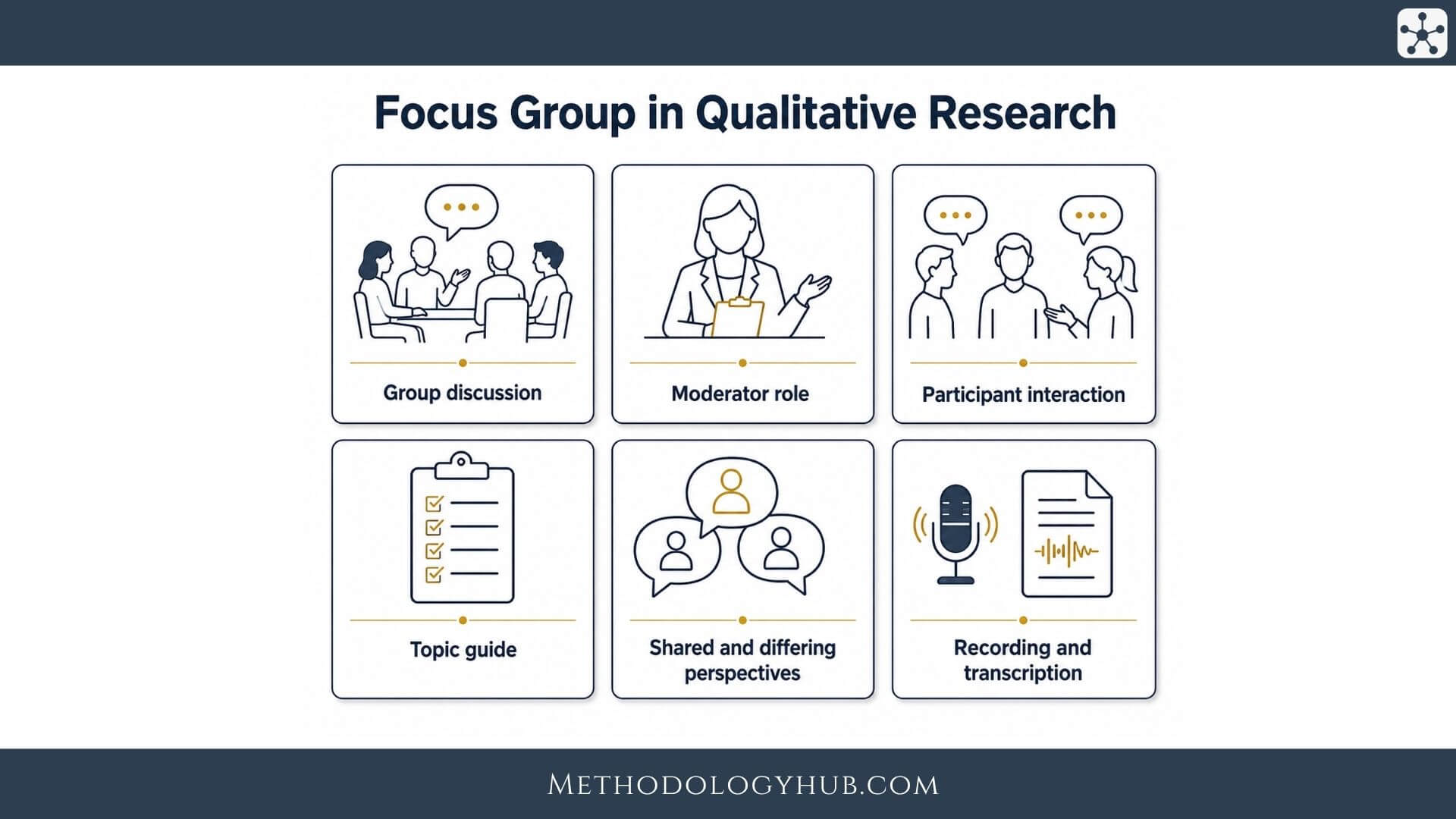
Focus groups in qualitative research are moderated group discussions used to understand how people talk about a topic together. Instead of collecting one private account at a time, a focus group brings several participants into the same conversation so the researcher can study shared views, disagreement, examples, group language, and interaction.
In Qualitative Research, focus groups are useful when the research question depends on social meaning. Participants may remind each other of experiences, challenge an assumption, use familiar phrases, or show how a topic is discussed in a group setting. That interaction is not a side effect of the method. It is part of the data.
This article explains focus groups as one of the main Qualitative Research Methods. It covers what focus groups are, when they are useful, how they differ from interviews, how to plan a group discussion, how to moderate a session, and how to analyse data that comes from several participants speaking with and around one another.
What Is a Focus Group in Qualitative Research?
A focus group is a planned discussion with a small group of participants, guided by a moderator. The moderator introduces the topic, asks open questions, encourages participants to respond to one another, and keeps the discussion close to the research purpose. The data usually come from the group transcript, moderator notes, and observations about the way the discussion developed.
The method is different from simply interviewing several people at the same time. A focus group is designed so that participants hear and respond to each other. One answer may trigger another memory. A disagreement may show where a topic is contested. A shared phrase may reveal how a group talks about an issue in everyday language.
Focus group definition
A focus group in qualitative research is a moderated discussion in which several participants talk about a research topic together. The researcher studies both what participants say and how the discussion develops through agreement, disagreement, examples, silences, jokes, corrections, and shared meanings.
This definition is important because the group setting changes the data. Participants do not speak in isolation. They speak after hearing others, and that can shape what they remember, how strongly they state a view, or whether they choose to disagree.
What focus group data include
Focus group data usually include an audio or video recording, a transcript, moderator notes, and sometimes notes from an assistant moderator. The transcript records spoken contributions, but the notes can capture details that are hard to see in text: who spoke first, who hesitated, when participants laughed, when one participant dominated, or when the group became quiet.
In some studies, the researcher also collects written activities during the session. Participants may rank statements, respond to short prompts, arrange cards, or comment on a scenario before discussion begins. These materials can support the analysis, but the group conversation remains central.
How focus groups produce qualitative evidence
Focus groups produce evidence through interaction. The researcher is not only interested in the final list of opinions. The discussion can show how participants reach those opinions, how they justify them, and which views are treated as obvious, unusual, risky, or shared.
For example, a focus group about school lunch routines may reveal more than food preferences. Students may talk about where they sit, who they avoid, which rules feel fair, how time pressure affects choices, and which parts of the lunch period are socially difficult. The group setting can make these social details easier to see.
| Data source | What it can show |
|---|---|
| Transcript | Spoken answers, examples, disagreements, and shared language |
| Moderator notes | Group energy, silences, dominance, seating, and discussion flow |
| Group activities | Starting points for discussion, rankings, reactions, and comparisons |
What focus groups cannot show well
Focus groups are not ideal for every qualitative question. They are weaker when participants need privacy, when a topic is highly personal, or when power differences may stop honest discussion. The group can encourage rich talk, but it can also make people cautious.
If a study needs a deep personal account, interviews in qualitative research may be a better fit. If the study needs to know how people behave in a setting rather than how they discuss it afterward, observation may be more direct.
When Focus Groups Are Useful
Focus groups are useful when the research question asks how people discuss, negotiate, or react to a topic in the presence of others. They are especially strong when participants share a setting, role, experience, or concern that can become the basis for group discussion.
The method can be used early in a project to explore language and categories. It can also be used later to understand reactions to a programme, service, policy, learning activity, or public message. The group format can show which ideas gain support and which ones produce hesitation or disagreement.
Studying shared language
Groups often have their own language for describing an issue. Teachers may use informal phrases that do not appear in policy documents. Students may describe classroom participation with words that researchers would not choose. Health workers may have practical terms for routines that official forms do not capture.
A focus group can reveal this language because participants respond to one another. A phrase used by one participant may be taken up, corrected, or laughed at by others. The researcher can then see which words are shared and which need explanation.
Recommendation: choose a focus group when the way people talk together is central to the research question.
Exploring agreement and disagreement
Focus groups are useful when disagreement is not a problem but part of the evidence. Participants may challenge a statement, offer a different example, or draw a line between what happens for them and what happens for others. These moments can help the researcher understand variation within a group.
For instance, a focus group about workplace training may show that some staff found the training practical, while others felt it did not fit their daily tasks. The disagreement can reveal different job roles, expectations, and constraints.
Testing reactions to materials or ideas
Researchers may use focus groups to discuss a leaflet, website, lesson activity, service plan, or set of images. Participants can respond to the material and then respond to each other’s interpretations. This can show how a message is understood, misunderstood, resisted, or reworded by the group.
This use is common in education, health communication, service design, and community research. The researcher should be careful not to turn the session into a simple approval test. The value lies in understanding the reasoning behind reactions.
Understanding group norms
A focus group can reveal what a group treats as normal, awkward, desirable, embarrassing, or unacceptable. These norms may not appear in individual interviews because participants may not think to mention them. In discussion, norms can surface when participants agree quickly, correct one another, or avoid a topic.
The researcher should not assume that loud agreement means everyone privately agrees. Group norms can also silence difference. That is why moderator notes and careful analysis of interaction are important.
When another method may be better
Focus groups are not the best choice when participants may feel exposed, judged, or unsafe in a group. A study about personal grief, workplace conflict, academic failure, or health stigma may need one-to-one interviews instead. Group discussion can make some topics harder to discuss honestly.
Focus groups are also weaker when the researcher needs to observe real-time behaviour. Participants can discuss how they act in a classroom, clinic, or workplace, but that is still a discussion. If the study needs practice in context, observational research may be more suitable.
How Focus Groups Differ from Interviews
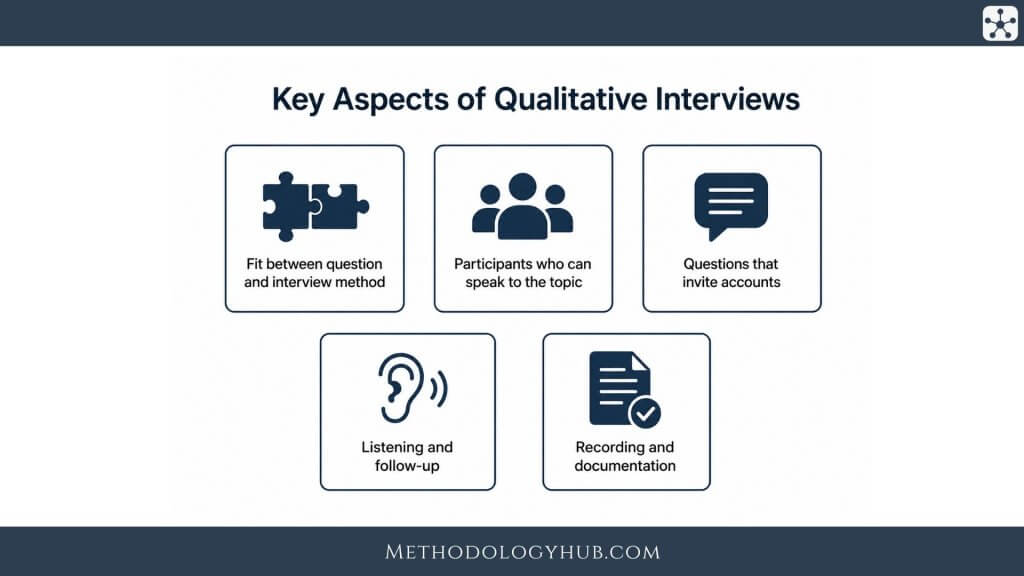
Focus groups and interviews both collect spoken qualitative data, but they create different forms of evidence. An interview gives one participant space to build a detailed account. A focus group brings several accounts into contact with one another.
The choice should not be made only for convenience. A focus group may seem efficient because several people can take part at once, but it also changes what participants say. People may speak differently in front of peers, colleagues, classmates, or strangers. Sometimes that is exactly what the study needs. Sometimes it is a problem.
Individual depth and group interaction
Interviews usually produce deeper individual accounts. The interviewer can follow one person’s story, ask about sensitive details, return to earlier points, and give the participant time to explain a sequence of events. Focus groups produce a different kind of depth: the depth of interaction.
In a focus group, one participant may say, “That never happens,” and another may respond, “It does, but only with certain teachers.” That exchange can be more informative than two separate answers because it shows how participants locate difference within a shared setting.
Privacy and social pressure
Privacy is a major difference. In an interview, the participant speaks to the researcher. In a focus group, the participant speaks in front of others. This can produce energy and shared memory, but it can also create pressure.
A participant may avoid disagreeing with a senior colleague. A student may not want classmates to know they struggled. A patient may not describe confusion in front of others who appear confident. These possibilities should affect the method choice.
How the moderator’s role changes
In an interview, the researcher often asks most of the questions and follows one participant’s account. In a focus group, the moderator also manages turn-taking, encourages quieter participants, limits dominance, and invites participants to speak to one another rather than only to the moderator.
The moderator does not need to force equal speaking time at every moment. Some unevenness is normal. The issue is whether the discussion gives enough room for different views to appear.
| Feature | Focus groups | One-to-one interviews |
|---|---|---|
| Main evidence | Interaction, shared language, agreement, disagreement | Individual account, personal meaning, detailed sequence |
| Best fit | Topics where discussion between participants is useful | Topics needing privacy, depth, or careful personal follow-up |
| Main risk | Dominance, silence, conformity, social pressure | Limited view of how ideas are negotiated socially |
Combining both methods
Some studies use both focus groups and interviews. A researcher may begin with focus groups to understand shared language, then use interviews to explore personal experiences in more depth. Another study may interview participants first and then use a focus group to discuss shared themes.
The combination should be deliberate. Using both methods only because they are available can make the study unfocused. The researcher should explain what each method contributes.
Planning a Focus Group Study
Planning a focus group study means designing the group situation before the discussion begins. The researcher needs to decide who should be in the group, how many groups are needed, what the moderator will ask, how the session will be recorded, and how group dynamics will be handled.
The planning stage is especially important because focus group data are shaped by the group composition. A discussion with close friends will differ from a discussion with strangers. A discussion with managers and junior staff in the same room will differ from a discussion with participants at similar levels of power.
A focus group does not have to include every possible type of participant. It needs participants whose shared or contrasting experiences can help answer the research question.
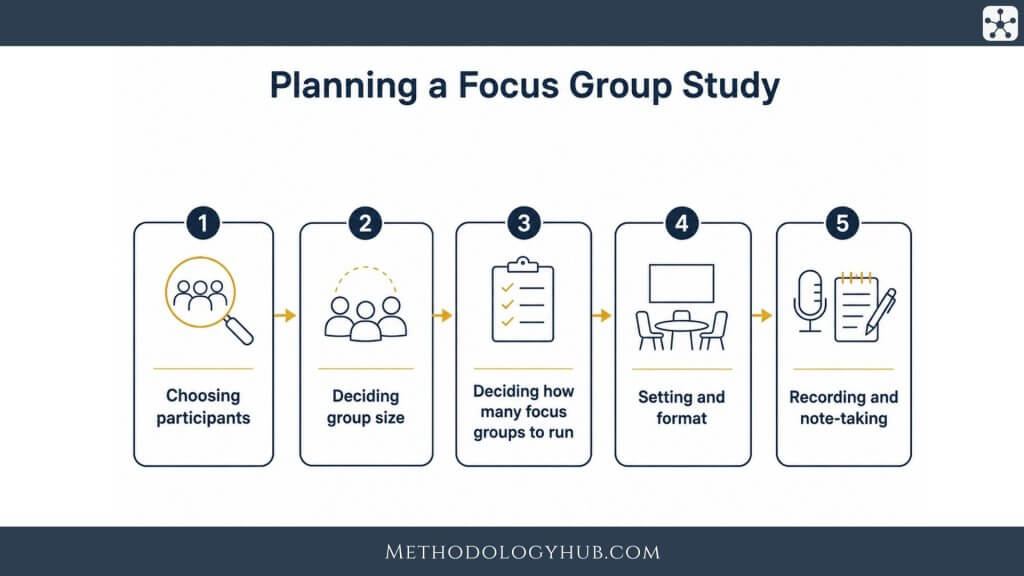
Choosing participants
Participants should be selected because they can discuss the research topic from relevant experience. A study of student feedback might include students from the same year level, or it might separate groups by programme if the researcher expects programme differences to shape discussion.
The researcher should also think about comfort. Participants need enough shared ground to talk to one another, but not so much pressure that they avoid disagreement. In some studies, it is better to separate groups by role, age, experience, or status.
Deciding group size
Many focus groups include around four to eight participants. Smaller groups can make discussion easier to manage and give each person more room. Larger groups can produce more varied interaction but may become difficult to moderate.
The best size depends on the topic and participants. A sensitive topic may need a smaller group. A topic about everyday routines may work with a slightly larger group if participants are comfortable speaking.
Deciding how many focus groups to run
A single focus group can be useful for a small exploratory study, but it gives only one group context. More groups allow the researcher to compare discussions and see whether patterns appear across settings or participant types.
The number of groups should follow the research question, available participants, and depth of analysis planned. A study comparing teachers and students, for example, may need separate groups for each.
Note: group composition affects the data. The same questions can produce different discussions depending on who is in the room together.
Setting and format
Focus groups can be held in person or online. In-person sessions allow the moderator to see more body language and manage group flow directly. Online sessions can make participation easier for people in different locations, but they may change turn-taking and make side reactions harder to notice.
The setting should be comfortable, accessible, and suitable for recording. Participants should be able to hear each other clearly. If the room is noisy or the online platform is unstable, transcription and analysis become harder.
Recording and note-taking
Focus group recording needs more care than one-to-one interview recording because several voices may overlap. Audio should be tested before the session. If possible, an assistant moderator can take notes about speaker order, non-verbal reactions, and group dynamics.
Notes are especially useful when the transcript does not show who nodded, who laughed, who hesitated, or who looked uncomfortable before answering. These details may help interpret the discussion later.
Focus Group Questions and Moderator Guide
Focus group questions should invite discussion rather than short individual answers. The moderator guide is the document that helps the moderator move through the session. It includes the introduction, opening activity or question, main discussion questions, optional prompts, and closing question.
A good guide leaves room for participants to talk to one another. If the guide has too many questions, the moderator may rush from one topic to the next and reduce interaction. If it has too few, the discussion may lose focus.
Opening questions
Opening questions should be easy to answer and connected to the topic. They help participants settle into the group and get used to speaking. The opening should not ask for the most sensitive or complex answer immediately.
For a focus group about student support, an opening question might ask participants to describe where students usually hear about support services. This gives the group a concrete starting point before moving into experience and evaluation.
Main discussion questions
Main questions should be open, clear, and suitable for group discussion. They should invite examples, different views, and responses between participants. A question such as “What makes it easier or harder for students to ask for help?” is likely to produce more discussion than “Do students use support services?”
The moderator can also use scenarios. A short story, image, statement, or card-sorting activity can help participants react to something concrete. This can be useful when the topic is abstract or when participants need a starting point.
| Question type | Example | Purpose |
|---|---|---|
| Opening | Where do people usually hear about this service? | Settles the group into a shared topic. |
| Experience | Can you think of a time when this worked well or badly? | Moves from opinion to concrete examples. |
| Contrast | Do people see this differently in different groups? | Encourages comparison and disagreement. |
| Closing | What is one thing researchers should understand about this topic? | Gives participants a final chance to add or refine points. |
Prompts that encourage interaction
The moderator should not only ask, “What do you think?” They can invite participants to respond to each other. Prompts such as “Does anyone see it differently?” or “Is that similar to what others have seen?” help create group discussion.
These prompts should be used carefully. The moderator should not pressure participants to disagree. The aim is to open space for different views, not to create conflict for its own sake.
Closing the discussion
The closing question should help participants reflect on what has been said and add anything missing. It can also ask whether the discussion changed how anyone thought about the topic. Closing should leave enough time for final comments rather than ending abruptly.
After the session, the moderator should write notes about which questions worked, where discussion was strongest, and where the group struggled. Those notes can improve later groups and support analysis.
Moderating a Focus Group Session
Moderating a focus group is not the same as conducting a one-to-one interview. The moderator has to listen to content, watch interaction, manage time, invite quieter participants, and prevent one or two people from taking over. The moderator also needs to keep the group focused without making the discussion feel controlled.
The best moderation often feels light. Participants should speak to one another, not only to the moderator. At the same time, the moderator is responsible for the research purpose and must keep the conversation useful for analysis.
Starting the session
The beginning of the session should explain the purpose, the general topic, practical details, and the expectation that participants can have different views. The moderator may also remind participants to avoid sharing others’ comments outside the group, while being honest that confidentiality in a group cannot be guaranteed in the same way as in an individual interview.
A short opening question can help participants begin speaking. Once each person has spoken once, later discussion often becomes easier.
Encouraging quieter participants
Some participants need time before speaking. Others may be quiet because the discussion has moved too quickly or because a louder participant has shaped the tone. The moderator can invite quieter voices without putting anyone on the spot.
For example, the moderator might say, “We have heard a few views on this. I wonder whether anyone has had a different experience?” This opens space without naming a participant directly.
Managing dominant participants
Dominant participants can provide useful detail, but they can also reduce the range of views. The moderator can acknowledge their contribution and then redirect the discussion: “That gives us one view of the issue. Let’s hear how others have seen it.”
The goal is not to silence confident participants. The goal is to make sure the discussion does not become one person’s interview with an audience.
Handling disagreement
Disagreement can be valuable in focus groups. It can show boundaries, tensions, and different meanings within the group. The moderator should allow disagreement when it remains respectful and relevant.
If disagreement becomes personal or uncomfortable, the moderator may need to slow the discussion, reframe the question, or move to a less charged prompt. The session should allow difference without letting participants feel attacked.
Recommendation: a good focus group is not one where everyone agrees. It is one where different views can appear clearly enough to be analysed.
Ending and immediate notes
At the end, the moderator should give participants a chance to add final comments. After participants leave, the moderator and any assistant should write notes as soon as possible. These notes can capture group mood, seating, moments of tension, strong agreement, confusing questions, and ideas for later analysis.
Immediate notes are important because some interaction details will not be visible in the transcript. They help the researcher remember how the discussion felt and how the data were produced.
How to Analyse Focus Group Data
Analysing focus group data means studying both content and interaction. The researcher asks what was said, who responded, how views were supported or challenged, and which topics produced agreement, silence, hesitation, or conflict. This makes the analysis different from treating the transcript as a set of individual interview answers.
The transcript is usually the main document, but it should be read with moderator notes. Notes can help explain why a section of transcript feels flat or lively, why one participant’s comment changed the direction of the group, or why a topic was avoided.
Prepare the transcript carefully
Transcription can be more difficult for focus groups because speakers may overlap. The transcript should identify speakers as clearly as possible. It should also mark unclear sections, laughter, long pauses, or overlapping talk when these details are important for analysis.
Researchers do not always need a conversation-analysis level transcript. The level of detail should match the research question. A study about group norms may need more interaction detail than a study mainly focused on shared views.
Code content and interaction
Coding can begin with what participants discuss: support, access, trust, embarrassment, workload, or shared routines. It should also include interaction where relevant. Codes may mark agreement, disagreement, humour, silence, repeated phrases, or moments when one participant shifts the group discussion.
This is where focus group analysis differs from interview analysis. A comment may be important not only because of what it says, but because of how others respond to it.
Compare within and across groups
Analysis often moves at two levels. Within a group, the researcher studies how one discussion developed. Across groups, the researcher compares patterns between different sessions. A topic may produce strong agreement in one group and open disagreement in another.
For example, student groups from different programmes may discuss academic support differently. One group may see support as normal, while another may treat it as something used only when someone is failing. The contrast can be more important than a simple count of comments.
| Analytic focus | Question to ask during analysis |
|---|---|
| Content | What ideas, examples, categories, and concerns appeared? |
| Interaction | How did participants respond to, support, or challenge one another? |
| Group pattern | What seemed shared, contested, avoided, or uncertain in this group? |
| Cross-group comparison | How did this discussion differ from other focus groups in the study? |
Use quotations carefully
Quotations from focus groups should show interaction when interaction is part of the finding. A single quotation can illustrate a view, but a short exchange may better show disagreement, shared language, or how a group reached a point.
The researcher should make clear whether a quotation represents an individual comment, a shared group view, or a contested claim. A focus group transcript can make one strong speaker look like the whole group if the analysis is not careful.
Write findings with group context
Findings should describe the group context when it affects interpretation. The researcher may need to note whether a view appeared in several groups, only in one group, or only after a particular prompt. The writing should not strip the data away from the group situation that produced it.
A strong focus group finding might explain that participants initially agreed with a service message, but later challenged it after one person described a difficult experience. That movement is part of the evidence.
Examples of Focus Groups in Qualitative Research
Examples of focus groups in qualitative research show how the method can be used when interaction between participants helps answer the question. The following examples are different in setting, but each one uses group discussion as part of the evidence.
Example 1: Students discussing academic support
A researcher wants to understand how students talk about academic support services. The focus group includes students from the same year level. The moderator asks where students hear about support, when they would use it, and what makes asking for help feel easy or difficult.
The discussion may show that students do not only think about access. They may talk about embarrassment, fear of seeming unprepared, whether friends use the service, and how teachers describe support. These group comments can reveal norms around help-seeking.
Example 2: Teachers discussing curriculum change
A school researcher uses focus groups to understand how teachers discuss a new curriculum. Separate groups are held for different subject areas so teachers can speak with colleagues who share similar classroom demands.
The discussion may show that teachers agree on the official goals but disagree about how realistic the changes are in daily teaching. One teacher’s example may prompt others to describe similar problems or offer different interpretations.
Example 3: Patients reviewing health information materials
A health researcher asks patients to discuss a new information leaflet. Participants read the leaflet during the session and then talk about clarity, tone, missing information, and which parts they would trust or ignore.
The group discussion may show that a sentence that looks clear to professionals is confusing to patients. Participants may also suggest more familiar wording, explain which terms feel too technical, or disagree about how much detail is useful.
Example 4: Community members discussing public space
A researcher studies how residents discuss a local park. The focus group asks participants to talk about who uses the space, when it feels welcoming, when it feels unsafe, and what changes they would notice first.
The discussion may reveal different experiences by age, mobility, family role, or time of day. Participants may agree about one area of the park but disagree about another. The method is useful because public space is experienced socially as well as individually.
Conclusion
Focus groups in qualitative research are useful when the researcher wants to understand how people discuss a topic together. The method produces data through group interaction, shared language, agreement, disagreement, and the way participants respond to one another.
A strong focus group study depends on careful planning. The researcher needs a clear purpose, suitable group composition, a focused moderator guide, skilled moderation, reliable recording, and analysis that treats interaction as part of the evidence rather than background noise.
FAQs on Focus Groups in Qualitative Research
What is a focus group in qualitative research?
A focus group in qualitative research is a moderated group discussion used to collect data about participants’ views, experiences, language, agreement, disagreement, and interaction around a research topic.
What is the purpose of a focus group?
The purpose of a focus group is to understand how people discuss a topic together. It is useful for studying shared language, group norms, reactions to ideas, disagreement, and how participants build on one another’s comments.
How many participants are in a focus group?
Many focus groups include around four to eight participants, although the best size depends on the topic, setting, and participant group. Smaller groups can give each person more room, while larger groups may produce more varied discussion.
How do you conduct a focus group?
To conduct a focus group, define the research purpose, choose suitable participants, prepare a moderator guide, arrange the setting, record the session, moderate the discussion, invite different views, and write notes after the session.
What are good focus group questions?
Good focus group questions are open, clear, and designed for discussion. They invite examples, comparison, different views, and responses between participants rather than only short individual answers.
What is the difference between focus groups and interviews?
Focus groups collect data through group discussion, while interviews usually collect one participant’s account at a time. Focus groups are useful for interaction and shared views, while interviews are better for privacy and individual depth.
How do you analyse focus group data?
Focus group data are analysed by preparing transcripts, reading moderator notes, coding content and interaction, comparing within and across groups, examining agreement and disagreement, and writing findings that include group context.