Qualitative questionnaires are questionnaires designed to collect written answers in participants’ own words. They use open questions, prompts, and short written tasks to gather descriptions, explanations, examples, views, and experiences without requiring a live interview or group discussion.
Within qualitative research, questionnaires are useful when the researcher wants text-based data from several participants while keeping the process simple for respondents. A questionnaire can ask people to describe a situation, explain a choice, suggest improvements, or reflect on what an experience meant to them.
A qualitative questionnaire is not just a survey with a few comment boxes added at the end. It needs careful question wording, a logical order, enough space for answers, and an analysis plan for the written responses. This article explains how qualitative questionnaires work, when to use them, how they differ from other qualitative research methods, and how their data can be analysed.
What Are Qualitative Questionnaires?
Qualitative questionnaires are research instruments that ask participants to give written answers rather than select only fixed response options. The questionnaire may include several open questions, short prompts, response boxes, and sometimes a small number of background or closed-ended items.
The purpose is to collect written qualitative data. Respondents write what they think, remember, experience, or suggest. The researcher then analyses the answers for patterns, categories, meanings, and examples.
A qualitative questionnaire can be short or detailed. A small study may use five carefully worded questions. A larger project may use sections with prompts about experience, barriers, support, change, and suggestions. The format should follow the research question rather than a fixed template.
Qualitative questionnaire definition
A qualitative questionnaire is a questionnaire that collects written responses for qualitative analysis. It usually uses open-ended questions that invite respondents to describe, explain, compare, reflect, or give examples in their own words.
The word questionnaire does not automatically mean the study is quantitative. A questionnaire becomes qualitative when the data are mainly written responses and the analysis focuses on meaning, categories, themes, or interpretation rather than only numerical summaries.
What counts as questionnaire data?
Questionnaire data may include short written answers, paragraph responses, lists, examples, explanations attached to ratings, or responses to scenarios. It may also include brief demographic or background information that helps the researcher understand the response set.
For example, a questionnaire about student feedback may ask respondents to describe a time when feedback helped them revise work. The answer might be only three sentences, but it can still provide useful qualitative data if it explains the situation clearly.
Simple distinction: a qualitative questionnaire is designed around written meaning. A comment box added to a rating survey may help, but it does not automatically make the whole questionnaire qualitative.
How qualitative questionnaires create evidence
The evidence comes from the wording of responses. The researcher looks at what respondents mention, what they leave out, how they explain events, which categories repeat, and which answers complicate the expected pattern.
Because there is no interviewer present, the written question must do more work. It has to be clear enough for respondents to answer without clarification and focused enough to produce analysable text.
When a Qualitative Questionnaire Is Useful
A qualitative questionnaire is useful when the researcher wants written answers from people who may not be available for interviews, or when the study needs a broader response set than a small number of in-depth conversations can provide.
It can also be a good option when participants may prefer writing. Some people answer more comfortably in their own time than in a live interview. Others may need a simple way to share an experience without arranging a meeting.
Collecting written accounts from many participants
Questionnaires can reach more participants than most interview studies. They can be sent online, completed on paper, distributed after an event, or shared with a defined group. This makes them useful for studies that need many short qualitative responses.
The trade-off is depth. A questionnaire can collect many written accounts, but each response may be brief. The researcher should not expect the same richness that would come from a long semi-structured interview.
Getting answers without scheduling interviews
Some participant groups are hard to schedule. Teachers, health workers, students, parents, volunteers, and shift workers may be willing to write a response but not to join a live interview. A questionnaire can reduce the burden on participants.
This can be helpful in small research projects with limited time. The researcher still needs to design the questionnaire carefully so that the convenience does not lead to weak data.
Exploring a topic before later fieldwork
A qualitative questionnaire can be used early in a project to explore language, concerns, and categories. The responses may help the researcher design later interviews, focus groups, or observation.
For instance, a questionnaire about academic confidence may reveal that students connect confidence with feedback, asking questions, peer comparison, and knowing how to start assignments. Those categories can then shape a later interview guide.
| Research need | Why a qualitative questionnaire can help |
|---|---|
| Many brief written responses | It can reach more people than live qualitative methods. |
| Participant convenience | Respondents can answer in their own time and at their own pace. |
| Early topic exploration | Responses can reveal wording, categories, and concerns for later study. |
When the method is a poor fit
A qualitative questionnaire is a poor fit when the study needs detailed personal narratives, follow-up questions, clarification of vague answers, or observation of behaviour. It also works less well when respondents are unlikely to write more than a few words.
If the research question depends on interaction, a focus group may be better. If the question depends on a deep account of one person’s experience, an interview may be better. If the question depends on what people do in context, observation may be better.
Designing a Qualitative Questionnaire
Designing a qualitative questionnaire means building a set of written questions that respondents can answer clearly and meaningfully. The researcher needs to think about the question order, wording, response space, instructions, and how the answers will be analysed.
A strong questionnaire feels easy to complete but is not casual. Each item should have a purpose. If a question will not be analysed, it should probably be removed.
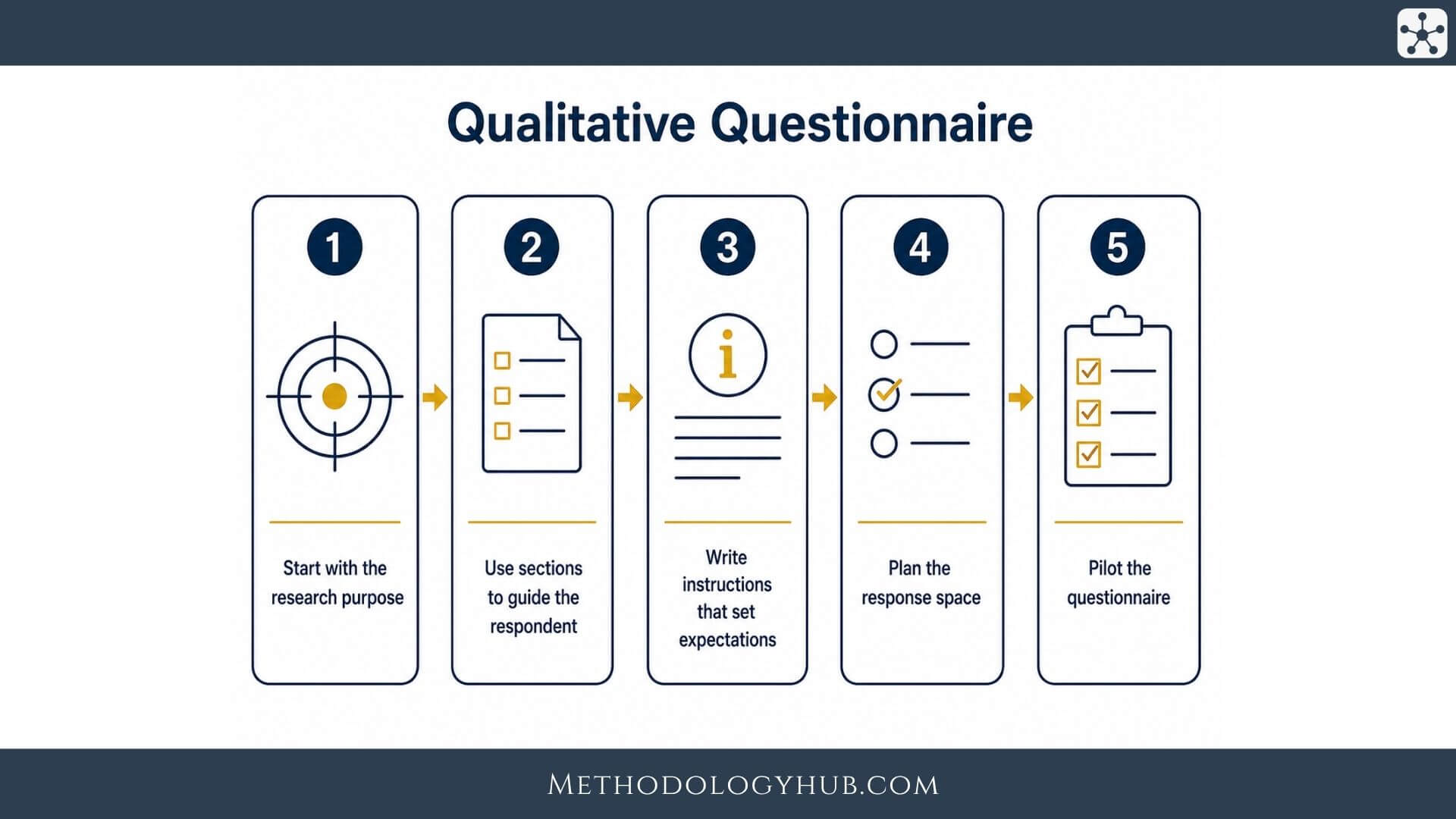
Start with the research purpose
The research purpose should decide the structure. If the study asks how participants experienced a new teaching activity, the questionnaire might move from background context to specific experience, then to examples, difficulties, and suggestions.
A questionnaire without a clear purpose often becomes a list of interesting questions. That can produce scattered answers that are difficult to analyse together.
Use sections to guide the respondent
Sections can make a qualitative questionnaire easier to follow. A questionnaire might have sections such as “Your experience,” “Difficult moments,” “Support,” and “Suggestions.” These headings help respondents understand the direction of the form.
Sections should not be too many. Too much structure can make the questionnaire feel long before respondents begin writing.
Write instructions that set expectations
Respondents may not know how much to write. A short instruction can help. For example, the questionnaire may say, “Please answer in one to three sentences where possible” or “Short examples are welcome.”
Instructions should also tell respondents whether all questions are required. Optional items may reduce pressure, but important questions should not be optional unless there is a strong reason.
Design: before finalising the questionnaire, write down what each question will help you analyse. Remove questions that have no clear analytic role.
Plan the response space
The size of the response box sends a message. A tiny box suggests a short answer. A large box invites more detail. The response space should match the expected depth and the burden placed on participants.
For paper questionnaires, enough blank space should be provided. For online questionnaires, text boxes should be large enough to encourage a written response without making the form look overwhelming.
Pilot the questionnaire
Piloting helps the researcher see whether questions are clear, whether the order feels logical, and whether respondents give useful answers. A pilot may show that one question is too broad, another repeats an earlier item, and another produces one-word answers.
After piloting, the researcher can revise wording, remove unnecessary items, change the order, or add a prompt that asks for an example.
Types of Questions in Qualitative Questionnaires
Qualitative questionnaires usually rely on several question types. Each type invites a different kind of written response. A good questionnaire does not repeat the same question shape from start to finish.
The mix depends on the study. A short questionnaire may use only four or five open questions. A longer one may include experience questions, example questions, comparison prompts, and final suggestions.
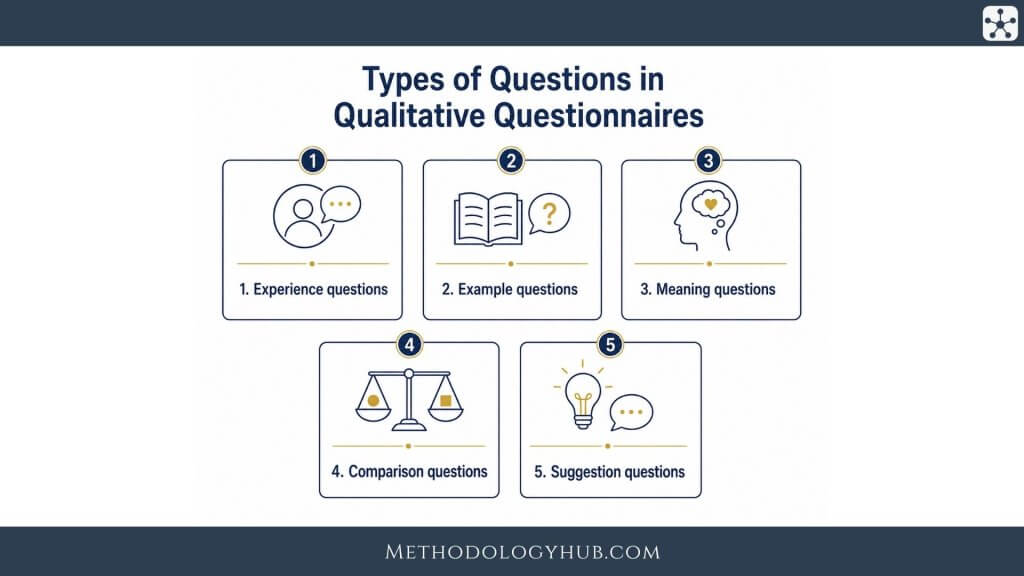
Experience questions
Experience questions ask respondents to describe what happened or how they experienced something. They work best when they are anchored in a concrete situation.
- Can you describe your experience of using this service?
- What happened the last time you needed support with this task?
- Please describe one part of the course that changed how you approached your work.
Example questions
Example questions reduce vague answers by asking respondents to provide a specific case. They are useful when the researcher wants more detail than a general opinion.
- Can you give one example of a time when the process was clear or unclear?
- Please describe one moment when you felt confident asking for help.
- What is one example of feedback that you found useful or difficult to use?
Meaning questions
Meaning questions ask respondents how they understand a word, situation, or experience. They are helpful when the research topic includes terms that may be interpreted differently by different people.
For example, a questionnaire may ask, “What does academic confidence mean to you?” or “How would you describe good support in this context?” These questions help the researcher avoid imposing a single definition too early.
| Question type | What it collects | Example |
|---|---|---|
| Experience | A short account of what happened | Can you describe your experience of the session? |
| Example | A concrete incident or case | Please describe one time when this worked well. |
| Meaning | How respondents define or understand something | What does good support mean to you? |
Comparison questions
Comparison questions ask respondents to explain difference. They may compare before and after, easy and difficult, useful and less useful, or one setting with another. These questions can help the researcher see how respondents sort experiences.
A question such as “How was this experience different from similar sessions you have attended?” can produce more informative answers than a broad satisfaction question.
Suggestion questions
Suggestion questions ask respondents what could be changed, kept, removed, or added. They are common in evaluation, education, services, and community research. They should be specific enough to avoid generic answers.
“What is one change that would make the questionnaire easier to complete?” is clearer than “Any suggestions?” The more specific version gives respondents a manageable written task.
Qualitative Questionnaires vs Interviews and Surveys
Qualitative questionnaires sit between two familiar formats. They are more open than many fixed-response surveys, but usually less interactive and detailed than interviews. Understanding this position helps researchers choose the method carefully.
The method should not be chosen only because it is easier to administer. It should be chosen because written responses are suitable evidence for the research question.
Compared with interviews
Interviews in qualitative research allow follow-up questions, clarification, and long accounts. If a participant gives a vague answer, the interviewer can ask for an example or ask what happened next. A questionnaire cannot do that.
Qualitative questionnaires can still be useful when respondents can provide enough written detail without probing. They can also be easier to distribute to a larger group.
Compared with focus groups
Focus groups in qualitative research collect data through group discussion. Participants respond to each other, agree, disagree, and build shared language. A questionnaire collects individual written responses without live interaction.
This can be an advantage when respondents might be influenced by others in a group. It can be a limitation when the research question depends on discussion and disagreement.
Compared with closed survey questions
Closed survey questions are easier to count because answers are standardised. Qualitative questionnaires are harder to summarise quickly because responses are written in different ways. However, written responses can show explanations that fixed options cannot.
A rating may show that respondents were dissatisfied. A written response may show that the reason was timing, unclear instructions, lack of confidence, or poor fit with their needs.
Method choice: use a qualitative questionnaire when written answers are enough. Use interviews or focus groups when live follow-up or interaction is part of the evidence.
Compared with open-ended survey questions
Open-ended survey questions can appear inside many survey designs. A qualitative questionnaire usually gives open-ended written responses a more central role. In other words, the difference is often the function of the answers in the study.
If the open-ended item only explains a rating, it is part of a wider survey. If the questionnaire is mainly built around written responses that will be analysed qualitatively, it is closer to a qualitative questionnaire.
Analysing Qualitative Questionnaire Responses
Analysing qualitative questionnaire responses involves reading, coding, grouping, comparing, and interpreting written answers. Because the responses may be shorter than interview transcripts, the researcher needs to be careful about how much interpretation each answer can support.
The analysis should respect the form of the data. A two-sentence response may show a category or example, but it may not support a deep claim about the respondent’s whole experience.
Prepare the data
The first step is to organise the responses by question, respondent, section, or case. Online responses may need to be exported and checked. Paper responses may need to be typed up. Identifying details may need to be removed or replaced.
If the questionnaire included background items, the researcher should preserve the connection between those items and the written responses when it is relevant to analysis.
Read across the whole response set
Before coding, the researcher should read all responses to get a sense of range, tone, length, repeated wording, and unexpected answers. This reading helps prevent the researcher from building codes too quickly from the first few responses.
Whole-set reading can also show whether some questions worked better than others. One question may produce detailed answers, while another may produce repeated one-word responses.
Code responses question by question
Coding question by question can help keep the analysis organised. For each question, the researcher can identify repeated ideas, barriers, explanations, examples, and unusual responses. A response may receive more than one code.
For example, a response about difficulty using a service may mention unclear instructions, inconvenient timing, and embarrassment. Each part may need a separate code.
Develop categories or themes
Codes can then be grouped into categories or themes. In a questionnaire about student support, codes such as unclear email, hidden information, not knowing who to ask, and confusing forms may become a broader category about communication barriers.
The researcher should not force every answer into a theme. Some responses may be isolated but still useful as examples of variation or unexpected experience.
| Analysis step | What the researcher does |
|---|---|
| Prepare | Organise, clean, anonymise, and label responses. |
| Read | Review the whole response set before fixing codes. |
| Code | Label ideas, examples, reasons, barriers, and suggestions. |
| Interpret | Connect categories to the research question and data scope. |
Use counts carefully
It can be useful to count how many respondents mentioned a category. For example, the researcher may report that many respondents mentioned timing, several mentioned unclear instructions, and a smaller number mentioned confidence.
Counts should not be treated as the whole finding. Written responses are not the same as a checklist. If a respondent does not mention a category, it does not prove that the issue was absent from their experience.
Use short quotations
Short quotations can show respondent wording and make categories clearer. They should be selected carefully and explained. A quotation should support the analysis, not replace it.
Because questionnaire responses may be brief, the researcher should avoid overloading the report with many short quotes that all say the same thing. A small number of well-chosen examples is usually stronger.
Examples of Qualitative Questionnaires
Examples of qualitative questionnaires show how written prompts can be adapted to different research settings. The examples below focus on the design idea rather than giving a full questionnaire for each study.
Example 1: Student feedback on assessment
A researcher wants to understand how students use written feedback on assignments. The questionnaire asks students to describe a recent feedback experience, explain what made the feedback usable or difficult, and give one suggestion for improving feedback.
The responses may show that students focus on examples, clarity, timing, tone, and confidence. The questionnaire is useful because it can collect short written accounts from many students across different courses.
Example 2: Volunteer experiences in a community project
A community researcher asks volunteers to complete a qualitative questionnaire about joining and staying involved in a local project. Questions ask how they first became involved, what helped them learn their role, what made participation difficult, and what keeps them returning.
The analysis may show patterns around belonging, informal guidance, scheduling, task confidence, and relationships with long-term members.
Example 3: Patient communication after an appointment
A health researcher uses a short questionnaire after appointments to ask patients what information was clear, what remained confusing, and what they wished had been explained differently. The questions are written in plain language and invite short examples.
The responses may identify repeated communication gaps. They may also show terms that patients find unclear or instructions that work better when written differently.
Example: each questionnaire should have a clear response task. “Tell us about your experience” is often less useful than asking for a recent example, a difficulty, and a suggested change.
Example 4: Staff reflections after training
A workplace study asks staff to reflect on a training session. The questionnaire asks what part of the training connected to their daily work, what still feels unclear, and what they would need in order to apply the training later.
The written responses can help the researcher understand whether the training connects to practice. The data may show that staff need examples, time to practise, clearer steps, or support from colleagues.
Conclusion
Qualitative questionnaires are useful when researchers want written answers that can be analysed for meaning, categories, examples, and patterns. They are especially helpful when a study needs more breadth than interviews can provide, but still wants participants to answer in their own words.
The method works best when the questionnaire is designed for qualitative data from the start. Clear prompts, thoughtful order, enough response space, piloting, and a realistic analysis plan all help turn written responses into useful evidence.
FAQs on Qualitative Questionnaires
What is a qualitative questionnaire?
A qualitative questionnaire is a questionnaire that collects written responses for qualitative analysis. It usually uses open-ended questions that ask respondents to describe, explain, compare, reflect, or give examples in their own words.
When should qualitative questionnaires be used?
Qualitative questionnaires should be used when the researcher wants written answers from several respondents and does not need live probing. They are useful for short accounts, explanations, suggestions, participant language, and early topic exploration.
What is the difference between qualitative questionnaires and interviews?
Qualitative questionnaires collect written responses without live follow-up. Interviews allow the researcher to ask follow-up questions, clarify answers, and explore a participant’s account in more depth.
What types of questions are used in qualitative questionnaires?
Qualitative questionnaires can use experience questions, example questions, meaning questions, comparison questions, and suggestion questions. The questions should be clear, focused, neutral, and manageable for written responses.
How do you analyse qualitative questionnaire responses?
Qualitative questionnaire responses are analysed by preparing the data, reading the full response set, coding written answers, grouping codes into categories or themes, using counts carefully, and selecting short quotations when useful.
Are qualitative questionnaires the same as open-ended survey questions?
They are related but not identical. Open-ended survey questions are individual items that collect written responses. A qualitative questionnaire places written responses at the centre of the research design and analysis.