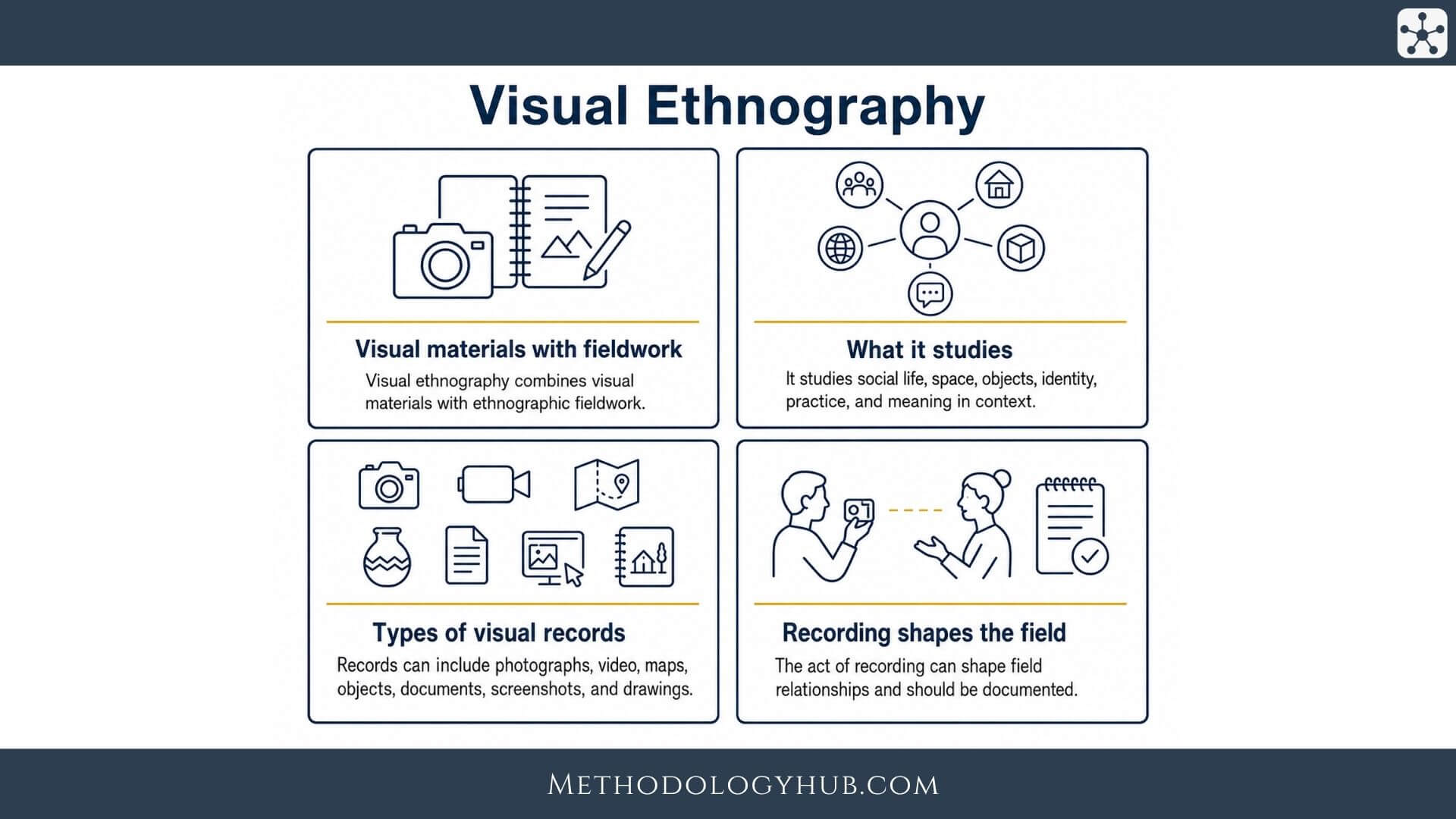
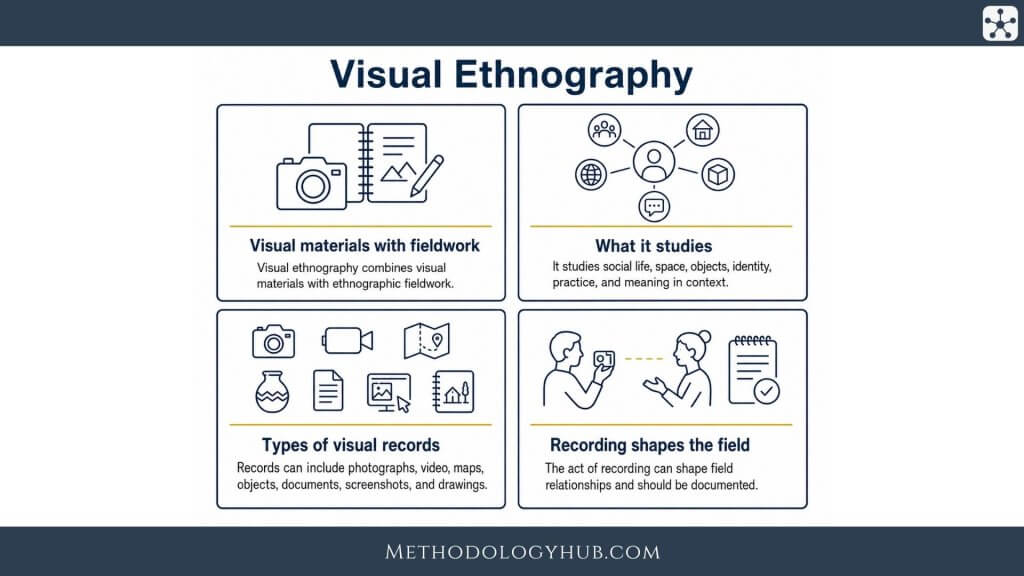
Visual ethnography is a qualitative research approach that studies culture, everyday life, social practice, and meaning through visual materials and ethnographic fieldwork. It may use photographs, video, drawings, maps, objects, screenshots, field notes, interviews, participant-produced images, or researcher-created visual records.
Rather than treating images as decoration, visual ethnography asks what visual materials reveal about how people live, organise space, display identity, remember events, use objects, and make meaning in context. Within long-standing approaches to qualitative research, it brings seeing, showing, recording, and interpreting into the centre of fieldwork.
Researchers who already use visual methods can use visual ethnography when images need to be studied together with participation, observation, field relationships, and context over time. The method can also work alongside interviews, diary work, document analysis, and other qualitative research methods that suit the field setting and participant group.
The guide below explains what visual ethnography means, how it differs from narrower image-based methods, what kinds of visual data are used, how fieldwork is planned, how visual records are analysed, and how findings can be written without flattening lived context into simple image description.
Visual Ethnography as Fieldwork
Visual ethnography is not only the analysis of images. It is ethnographic research that uses visual materials as part of fieldwork, interpretation, and representation. The researcher studies how people live, act, organise meaning, and relate to their environment, while paying close attention to what is visible, made visible, or kept out of view.
A visual ethnographer might spend time in a neighbourhood, school, workplace, online community, clinic, religious setting, arts group, or family context. During fieldwork, they may create photographs, record video, collect visual documents, draw maps, write field notes, and discuss images with participants.
Visual ethnography definition
Visual ethnography is an ethnographic approach that uses visual materials to study social life, culture, everyday practice, identity, space, objects, and meaning in context. It combines visual data with fieldwork methods such as observation, participation, interviews, field notes, and contextual analysis.
The word visual does not mean that words disappear. Interviews, captions, notes, and conversations remain important. The visual material adds another layer to the field record and helps the researcher study practices that may be difficult to capture through speech alone.
Seeing as part of inquiry
Visual ethnography treats seeing as an active part of research. The researcher asks what can be seen in a setting, who is allowed to see it, which images circulate, how people arrange objects, how space is used, and what visual signs guide behaviour.
This makes the method useful for studying classrooms, homes, streets, online spaces, ceremonies, work sites, waiting rooms, community events, shops, and other settings where visual order shapes social life.
Visual records and field relationships
Creating visual records changes field relationships. A camera can invite conversation, create discomfort, mark the researcher as an outsider, or give participants a way to show what they want the researcher to notice.
The researcher should record these effects. A photograph is not only a record of a scene. It is also part of the interaction through which the research was made.
Recommendation: ask what the visual record shows, how it was produced, and how people responded to the act of recording.
What Visual Ethnographers Study
Visual ethnographers study the visible and material parts of social life. They may focus on clothing, objects, gestures, spatial arrangements, signs, images, screens, architecture, tools, ritual objects, home interiors, public displays, workplace layouts, or online profiles.
They also study how people interpret these visual features. A wall poster, a family photograph, a classroom seating pattern, or a smartphone screen can mean different things depending on who is looking, who placed it there, and how it is used.
Space and place
Spaces are never just backgrounds. People move through them, mark them, avoid them, decorate them, claim them, and learn rules from them. Visual ethnography can show how space guides action and how participants understand that guidance.
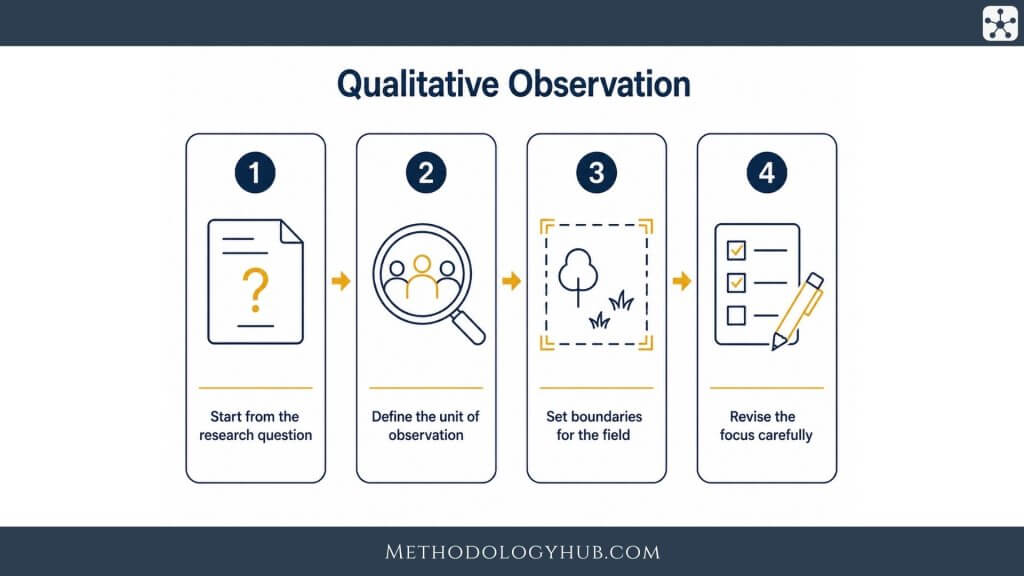
A researcher may map where people sit, photograph signs, record movement through a building, or discuss neighbourhood routes with participants. When combined with Qualitative Observation, this can connect visual records with direct accounts of activity.
Objects and material culture
Objects can organise everyday life. A badge, phone, notebook, cooking tool, work form, religious item, bag, desk, toy, or medicine box may carry practical and symbolic meaning. Visual ethnography helps researchers study these objects as part of social practice.
For example, a researcher studying home learning may photograph study materials, household surfaces, storage spaces, screens, and improvised arrangements. The images can reveal how learning is fitted into everyday space.
| Visual focus | Possible research question |
|---|---|
| Space | How do people move through, avoid, or claim particular places? |
| Objects | Which objects organise daily practice or carry personal meaning? |
| Images in circulation | How does a group represent itself publicly or privately? |
Images and representation
Visual ethnography can study how people represent themselves and others. This may include family albums, classroom displays, social media images, campaign posters, community murals, workplace photographs, or images used in organisational communication.
Representation is not only about what appears. It also concerns what is absent, who is centred, who is placed at the edge, which images are repeated, and which audiences are imagined.
Embodied and sensory practice
Visual data can show posture, gesture, movement, distance, touch, rhythm, and bodily positioning. A video of a workshop, for example, may reveal how participants learn by watching, copying, waiting, or adjusting their bodies to a task.
The visual record should still be interpreted carefully. A gesture can have different meanings across settings. Participant explanation and field notes can help avoid shallow interpretation.
Visual Ethnography and Related Methods
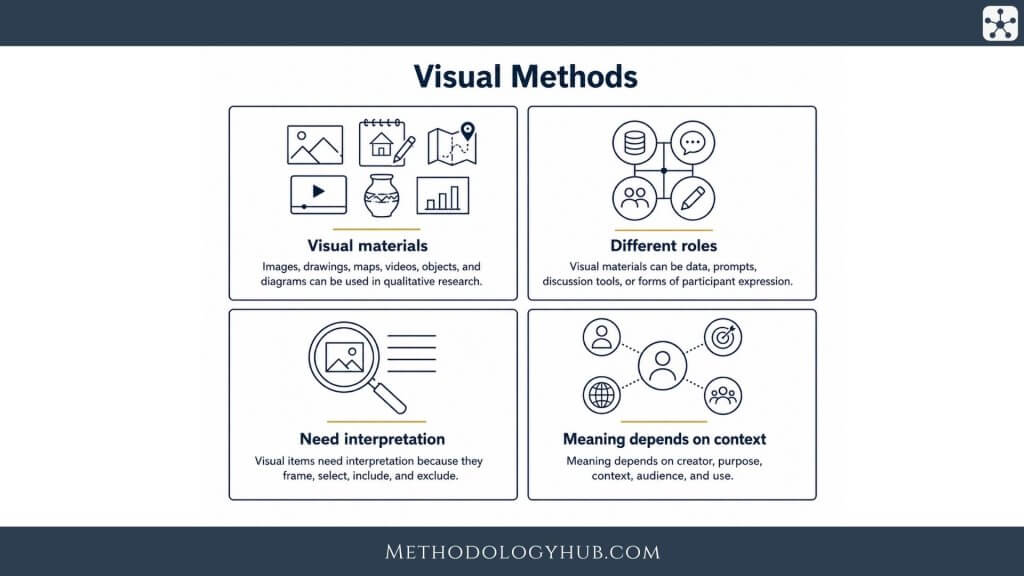
Visual ethnography overlaps with several qualitative methods, but it has its own emphasis. It is not simply photo elicitation, photovoice, or visual document analysis. It brings visual materials into a wider ethnographic study of social life in context.
The distinction helps when writing a methods section. A project may use photo elicitation as one technique within a visual ethnography, or it may use photovoice as a participatory visual project without long ethnographic fieldwork.
Visual ethnography and photo elicitation
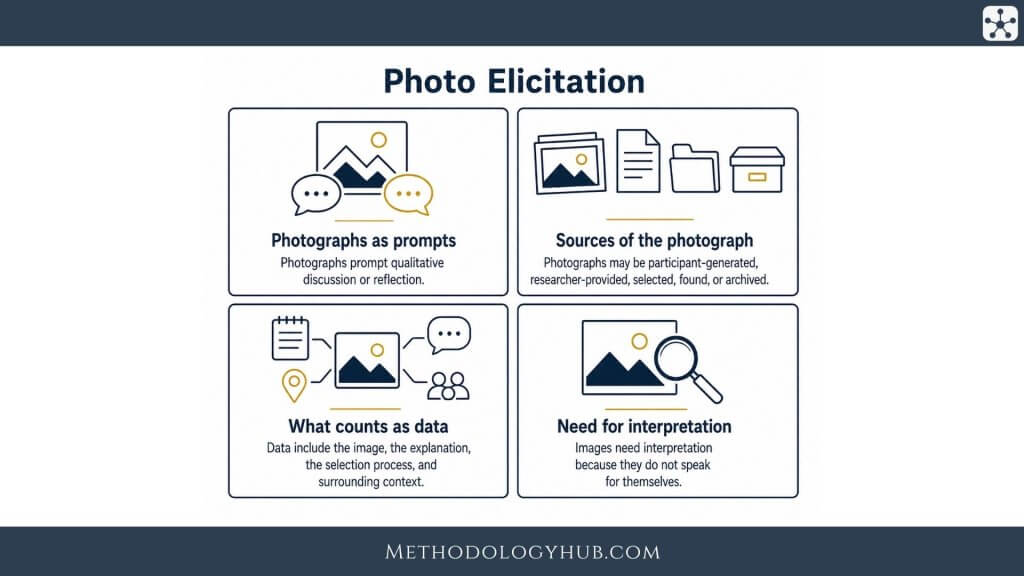
In photo elicitation, photographs support discussion. Participants may take or respond to images, and the image helps structure an interview. Visual ethnography may include this technique, but it usually has a broader fieldwork frame.
For example, a researcher may spend time in a youth centre, write field notes, observe routines, collect posters, photograph rooms, and then conduct image-based interviews. In that project, Photo Elicitation is one part of the visual ethnographic design.
Visual ethnography and photovoice
Photovoice usually gives participants a central role in creating photographs and developing messages. It often has a participatory or community-facing purpose. Visual ethnography may be participatory, but it does not always include public communication or collective action.
A study may combine the two. Participants might create photographs as part of a Photovoice project, while the researcher also conducts long-term fieldwork and observes how the project unfolds in everyday settings.
| Method | Main emphasis | How it can relate to visual ethnography |
|---|---|---|
| Photo elicitation | Images as interview or discussion prompts | Can support visual ethnographic interviews. |
| Photovoice | Participant photography and shared messages | Can become part of a participatory visual ethnography. |
| Document analysis | Existing written or visual materials | Can analyse posters, websites, signs, displays, and archives. |
Visual ethnography and participant observation
Participant observation can be part of visual ethnography when the researcher learns through presence and participation while also producing visual records. A researcher may join activities, take notes, create maps, and discuss visual materials with participants.
When the project includes Participant Observation, the researcher should document how participation affected what could be seen, photographed, recorded, or discussed.

Visual ethnography and document analysis
Visual ethnography can include analysis of existing visual documents such as posters, websites, forms, maps, leaflets, photographs, and signs. These materials may show how a group or institution represents itself.
When a project studies existing visual materials through Qualitative Document Analysis, the researcher should still connect those materials to field context where possible. The poster on a wall may mean something different once its placement and use are observed.
Designing a Visual Ethnography Study
Designing a visual ethnography means deciding how visual data will be produced, collected, stored, interpreted, and connected to fieldwork. The design should explain why visual materials are needed and how they will answer the research question.
A strong design does not begin with the camera. It begins with the field question. Only then should the researcher decide whether photographs, videos, maps, drawings, screenshots, or existing visual documents are suitable.
Define the field and visual focus
The researcher should identify the field setting and the visual focus. The field might be a school, online group, neighbourhood, clinic, workshop, home, workplace, or public event. The visual focus might be space, movement, objects, displays, screens, or images in circulation.
For example, a study of service access might focus on signs, routes, waiting areas, forms, screens, and gestures at reception. This focus helps the researcher avoid collecting visual material without analytic direction.
Decide who creates the visual data
Visual data may be created by the researcher, participants, or both. Researcher-created photographs can support systematic field records. Participant-created images can show what participants consider important. Existing visual materials can show how a setting represents itself.
The design should explain why each source is included. A mixed visual data set can be useful, but only if the researcher can analyse how the sources relate.
Recommendation: write down what each visual source will add before collecting images, videos, maps, or screenshots.
Plan the field record
Visual materials need field notes. A photograph should be linked to date, location, purpose, situation, participants present, field event, and any relevant conversations. A video clip should be linked to the activity and conditions under which it was recorded.
Without this record, visual data can become detached from the field. The same image may be difficult to interpret later if the researcher cannot remember why it was taken or how people responded.
Prepare consent and image boundaries
Visual ethnography can involve identifiable people, private spaces, workplace information, screens, homes, children, health settings, or sensitive objects. Consent procedures should explain what can be recorded, who can see it, how it will be stored, and whether it may be shown in reports or presentations.
Participants should be able to refuse recording, ask for images to be removed, or agree to private analysis without public display. The image boundary should be negotiated before fieldwork begins and revisited if the setting changes.
| Design decision | Why it affects the study |
|---|---|
| Field boundary | Shapes which spaces, interactions, and visual materials can enter the data set. |
| Visual source | Determines whether the researcher, participants, or existing records produce visual evidence. |
| Consent boundary | Controls what can be recorded, analysed, shared, or reproduced. |
Collecting Visual Ethnographic Data
Collecting visual ethnographic data requires patience. The researcher may need to observe before photographing, build trust before recording video, and learn local rules before deciding what visual material is relevant.
Visual recording can be intrusive if it happens too quickly. In some settings, writing notes first and introducing visual recording later may be more appropriate.
Photographs and field photographs
Field photographs can document spaces, objects, signs, arrangements, events, and changes. They can help the researcher remember details that written notes alone may miss. They can also support later interviews by giving participants something specific to discuss.
Photographs should be logged. A file name or record should identify date, place, activity, reason for capture, and any consent limits attached to the image.
Video and movement
Video is useful when sequence, gesture, movement, interaction, timing, or practical skill are central. A video clip may show how people learn a task, pass objects, coordinate movement, or respond to a shared space.
Video also creates more privacy and storage challenges than still photographs. The researcher should record only what is needed and protect files carefully.
Maps, sketches, and diagrams
Maps and sketches can show routes, positions, boundaries, seating, movement, and relationships. They are useful when photography is not possible or when spatial structure is more important than visual detail.
Participants can also create maps. A participant-drawn map may reveal how they understand a place, which routes feel familiar, and which areas feel uncertain or off-limits.
Screenshots and digital settings
Visual ethnography can take place in digital environments. Screenshots, interface maps, profile images, emojis, layouts, posts, and platform features may be part of the field record.
Digital visual data require careful attention to privacy, platform rules, access conditions, and the way images can circulate beyond the original context. A screenshot may capture more information than the researcher intended.
| Visual data type | Useful for | Field note to add |
|---|---|---|
| Photograph | Objects, rooms, signs, events, surfaces, spatial detail | Why it was taken and what was happening nearby |
| Video | Movement, interaction, sequence, practical skill | Activity, timing, participants present, consent limits |
| Map or sketch | Routes, boundaries, position, access, memory | Who created it, during which conversation, and why |
Visual conversations in the field
Visual data collection often leads to conversation. A participant may explain a photograph, correct the researcher’s interpretation, point to something outside the frame, or suggest another image that would show the situation better.
These conversations should be recorded in notes or transcripts. They often contain the key interpretation needed to understand the visual record.
Analysing Visual Ethnographic Data
Analysis in visual ethnography moves between images, field notes, interviews, maps, documents, and the wider field setting. The researcher should not isolate a photograph from the situation that produced it.
A good analysis asks what is visible, how it became visible, what remains outside the frame, how participants interpret it, and how the visual record connects to repeated practice in the field.
Describe the visual material
The first analytic step is often description. What appears in the image or video? What is central, repeated, blurred, hidden, ordered, labelled, or absent? What colours, signs, objects, positions, gestures, and spatial arrangements are visible?
Description should be slow and careful. A quick label such as “crowded room” may miss seating patterns, paths through the space, blocked access, or who occupies central positions.
Connect visuals to field context
Field context gives visual material meaning. A poster may look welcoming, but field notes may show that it is placed behind a locked door. A video may show a routine, but interview discussion may reveal that the routine was performed differently because the researcher was present.
For this reason, well-written field notes in qualitative research are so useful in visual ethnography. They connect visual records to time, place, access, interaction, and researcher role.
Analyse participant interpretation
Participants may interpret visual material differently from the researcher. They may point out a small object, explain a local symbol, name an absent person, or reject the researcher’s first reading of an image.
Participant interpretation should not be treated as an add-on. It is part of the data, especially when visual material was created or selected by participants.
| Analytic layer | Question |
|---|---|
| Visual content | What can be seen, and how is it arranged? |
| Production context | Who made the visual record, when, why, and under what conditions? |
| Field meaning | How does the visual record relate to practice, talk, objects, space, and relationships? |
Compare visual patterns
Comparison can happen across images, field visits, sites, participants, times of day, or types of visual record. The researcher may compare how different participants photograph the same space, how a setting changes over time, or how public signs differ from everyday practice.
Patterns may appear through repetition, contrast, or absence. Repeated photographs of closed doors, improvised signs, hidden entrances, or crowded surfaces may point to wider field conditions.
Write findings with visual context
Visual ethnographic findings should explain how visual evidence was created and interpreted. A finding might include a short description of an image, a participant explanation, a field note, and an analytic interpretation.
Not every visual item needs to be reproduced. Some images can be described rather than shown, especially when privacy or identification is a concern.
Examples of Visual Ethnography
Examples of visual ethnography show how visual materials can be woven into fieldwork. The examples below vary in setting, visual source, and analytic focus.
Example 1: Classroom wall displays and learning culture
A researcher studies how a classroom displays student work, rules, schedules, feedback, and achievement. Field photographs record walls, desks, seating, signs, and changing displays across a term. Observation notes document how students and teachers refer to those displays during lessons.
The analysis may show how the classroom makes certain forms of participation visible while leaving others unmarked. A display that looks decorative may also guide behaviour, reward particular work, or communicate expectations.
Example 2: Market stalls and everyday economic practice
In a street market, a researcher photographs stall arrangements, signs, product placement, payment methods, routes, and interactions around goods. Field notes record conversations, movement, waiting, bargaining, and relationships between sellers.
The visual ethnography can show how trust, pricing, display, and social connection are built into the physical layout of the market.
Example 3: Digital visual ethnography of an online group
A researcher studies an online support group through screenshots, platform layout notes, profile image patterns, post formats, emojis, and participant interviews. The field includes both visual interface and social interaction.
The analysis may show how members signal support, privacy, expertise, or belonging through images, layout, reaction icons, and repeated visual conventions.
Example 4: Home care routines and material objects
A researcher studies care routines in the home using photographs of objects, participant interviews, and field notes. Images may include medication boxes, calendars, kitchen surfaces, mobility aids, written reminders, and storage arrangements.
The findings can show how care is organised through ordinary objects and spaces. They may also show work that is rarely visible in formal care records.
Conclusion
Visual ethnography gives qualitative researchers a way to study social life through images, objects, spaces, screens, gestures, maps, and field relationships. It is useful when visual and material forms are not background details but part of how people organise meaning and practice.
A strong visual ethnography connects visual data with field notes, participant explanations, consent decisions, and careful contextual analysis. Images can make everyday life visible, but they need interpretation within the field that produced them.
FAQs on Visual Ethnography
What is visual ethnography?
Visual ethnography is an ethnographic qualitative approach that uses visual materials such as photographs, video, maps, drawings, screenshots, objects, and visual documents to study social life, culture, everyday practice, and meaning in context.
What types of data are used in visual ethnography?
Visual ethnography can use photographs, video recordings, maps, sketches, diagrams, screenshots, objects, posters, signs, field notes, interviews, participant explanations, and existing visual documents.
How is visual ethnography different from photo elicitation?
Photo elicitation uses photographs to support interviews or discussions. Visual ethnography is broader because it combines visual materials with ethnographic fieldwork, observation, field notes, context, and analysis of everyday practice.
When should visual ethnography be used?
Visual ethnography should be used when the research question concerns visual, spatial, material, embodied, or digital aspects of social life, such as objects, places, images, gestures, displays, screens, or routines.
How do you analyse visual ethnographic data?
Visual ethnographic data are analysed by describing visual material, linking it to field context, reading participant explanations, comparing visual patterns, and connecting images with notes, interviews, observation, and documents.