Semi-structured interviews are qualitative interviews that use a prepared interview guide while still allowing the interviewer to ask follow-up questions, change the order of topics, and explore answers in more depth. They sit between fixed-question interviews and open conversations. The researcher plans the main route, but the participant’s account can still shape how the interview develops.
In qualitative research, semi-structured interviews are often used when a study needs both consistency and depth. Each participant can be asked about the same broad areas, while the interviewer keeps enough flexibility to follow examples, clarify meanings, and explore unexpected details.
This article explains semi-structured interviews as a qualitative research method. It covers what semi-structured interviews are, when they are useful, how they differ from other interview types, how to prepare an interview guide, how to conduct the interview, and how to analyse the data afterward.
What Are Semi-Structured Interviews?
Semi-structured interviews are interviews guided by a set of prepared topics or questions, while still giving the interviewer freedom to ask follow-up questions. The researcher does not enter the interview without a plan, but the conversation is not locked into a script. This makes the method especially useful when the researcher wants comparable data across participants without losing the detail of individual accounts.
A simple example helps show the difference. A researcher studying how students experience academic feedback may prepare questions about receiving feedback, understanding comments, revising work, and asking for clarification. If a student mentions feeling embarrassed about asking for help, the interviewer can explore that answer even if embarrassment was not written as a separate question in the guide.
Semi-structured interview definition
A semi-structured interview is a qualitative data collection method in which the researcher uses an interview guide with planned topics or questions, but can adapt the order, wording, and follow-up prompts during the conversation. The goal is to collect data that are focused enough to compare and open enough to capture participant meaning.
This balance is the defining feature of the method. The guide gives the interview shape, while the follow-up questions give it depth. The participant is not limited to a set of answer choices, and the interviewer is not limited to reading one question after another.
How the interview guide works
The interview guide usually contains key topics, main questions, optional probes, and sometimes reminders about examples or closing questions. It is not the same as a structured interview schedule. The guide supports the interviewer, but it does not require every question to be asked in exactly the same wording or order.
For instance, if a participant answers one later question while responding to an earlier one, the interviewer may skip or rephrase the later question rather than repeat it mechanically. If a participant gives a vague answer, the interviewer may ask for an example, a comparison, or a description of what happened next.
What semi-structured interviews produce
Semi-structured interviews usually produce recordings, transcripts, interviewer notes, and analytic memos. The data often include both shared topics and participant-specific details. This is useful because the researcher can compare answers across participants while still examining the unique way each person explains an experience.
One participant may describe feedback as a way to improve marks. Another may describe it as a sign of whether the teacher took their work seriously. Because both participants were asked about feedback, their accounts can be compared. Because the interview was flexible, each account can also be explored on its own terms.
What semi-structured interviews can show
Semi-structured interviews can show how participants understand events, make decisions, describe relationships, explain routines, and interpret change. They are especially strong when the researcher expects participants to share some common ground but also wants to understand differences between individual experiences.
They cannot show everything by themselves. A participant’s account of classroom practice, for example, is still an account. If the study needs to compare what participants say with what happens in the classroom, the researcher may combine interviews with qualitative observation, documents, or field records.
Objectives of Semi-Structured Interviews
The objectives of semi-structured interviews usually involve understanding experience while keeping the study focused. A researcher may want to explore how participants make sense of a situation, compare accounts across groups, follow a process across time, or develop themes from detailed narratives. The method is well suited to these aims because it gives structure without removing responsiveness.
In many studies, the researcher already knows the broad areas to ask about but does not know how participants will connect them. That is where semi-structured interviews are useful. The guide makes sure that central topics are covered, while the conversation can still follow unexpected links made by the participant.
For example, a study of new teachers may include prepared topics such as classroom planning, discipline, mentoring, and workload. One teacher may connect workload to lesson preparation. Another may connect it to emotional recovery after difficult lessons. The same topic can therefore lead to different analytic insights.
Exploring experiences with enough direction
Semi-structured interviews are often chosen when the researcher wants to explore experience but cannot let the conversation become completely open. The research question sets boundaries. The participant’s account fills those boundaries with detail.
This is useful in student research, evaluation studies, health research, and education research, where the researcher often needs to cover certain topics in every interview. The method gives the participant room to explain, but the guide prevents the interview from drifting too far away from the study.
Comparing participants without forcing identical answers
Another objective is comparison. Because each interview covers similar areas, the researcher can compare how participants describe the same topic. Unlike structured interviews, however, semi-structured interviews do not require answers to fit the same route exactly.
A researcher may ask all participants about support, but one participant may discuss family support, another may focus on institutional support, and another may describe peer support. The shared topic makes comparison possible. The flexible questioning keeps the accounts open enough to show difference.
Reaching detail through follow-up questions
Follow-up questions are central to the method. They allow the interviewer to move from a general statement to a concrete account. If a participant says, “The process was confusing,” the interviewer can ask which part was confusing, when that became clear, who helped, and what the participant did next.
This kind of probing helps the researcher collect richer data than a written questionnaire could usually provide. It also helps prevent the analysis from relying only on broad comments that sound important but remain unclear.
Recommendation: semi-structured interviews are often a good fit when the researcher knows the main topics but still needs participants to explain what those topics mean in practice.
Developing themes across accounts
Semi-structured interviews are also useful when the researcher plans to develop themes across several accounts. The shared guide helps create enough overlap for comparison, while participant-led details help themes grow from the data rather than from the researcher’s assumptions alone.
For instance, a study of doctoral supervision may include a guide section on feedback. Across interviews, the researcher may find that feedback is not only about improving writing. Participants may connect it to confidence, independence, uncertainty, or the supervisory relationship. The theme develops through comparison across guided but flexible conversations.
Key Aspects of Semi-Structured Interviews
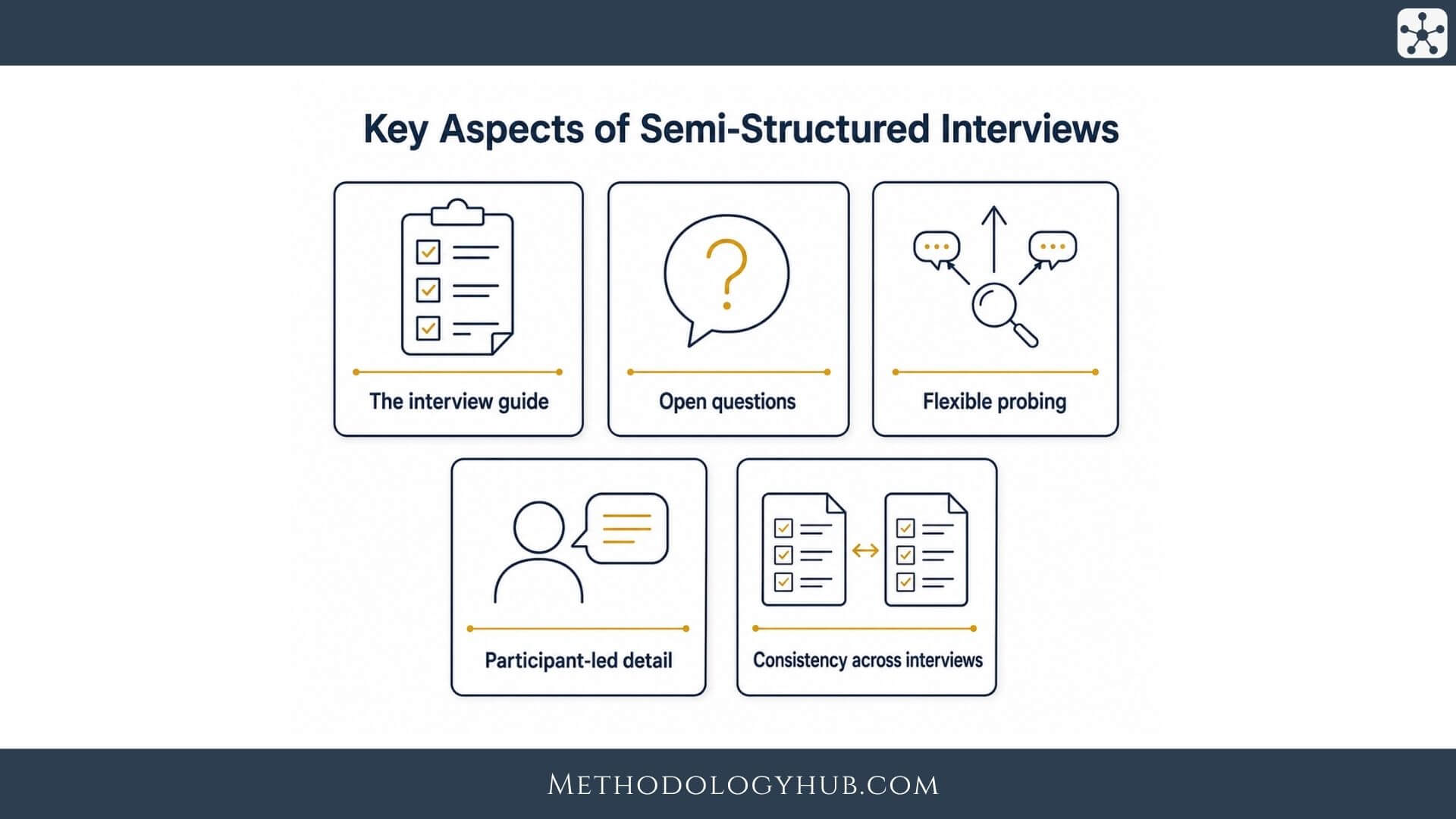
The key aspects of semi-structured interviews include the interview guide, the use of open questions, the interviewer’s follow-up decisions, the participant’s role in shaping the account, and the documentation of changes during data collection. The method depends on balance. Too much control makes the interview feel structured. Too little control can make it difficult to compare interviews later.
A semi-structured interview therefore needs preparation and judgement. The guide should identify what must be covered, while the interviewer decides how to move through the guide during the conversation. The final transcript often reflects both planning and responsiveness.
The interview guide
The interview guide is the main planning tool. It usually contains broad topic areas, main questions, optional probes, and sometimes reminders about examples or transitions. A good guide is clear enough to support the interviewer but not so crowded that it blocks listening.
The guide may be organised into sections. In a study about student belonging, the sections might include arrival, classroom participation, peer relationships, support services, and changes across the semester. The interviewer can move between these sections in a way that fits the participant’s account.
Open questions
Semi-structured interviews rely heavily on open questions. These invite participants to describe events, explain meanings, and give examples. Questions such as “Can you tell me about a time when…” or “How did you experience…” usually produce richer accounts than questions that ask only for agreement or disagreement.
Open questions should still be focused. A question can be open and too vague at the same time. “Tell me about school” gives too little direction. “Can you tell me about a time when you felt supported at school?” gives the participant a clearer starting point.
| Aspect | How it works in a semi-structured interview |
|---|---|
| Guide | Sets the main topics and questions without fixing every move in the conversation. |
| Questions | Invite descriptions, examples, comparison, and interpretation. |
| Probes | Help the interviewer explore unclear, brief, or especially relevant answers. |
| Documentation | Records how the guide was used, revised, and interpreted during analysis. |
Flexible probing
Probing is one of the main skills in semi-structured interviewing. A probe may ask for more detail, an example, a sequence, a comparison, or a clarification. It helps the researcher understand the meaning behind an answer rather than accepting the first short response.
Probes should follow the participant’s account rather than push the researcher’s preferred explanation. “What made that difficult?” is more open than “Was that difficult because the instructions were unclear?” The first lets the participant explain. The second introduces a possible cause.
Participant-led detail
Although the researcher prepares the guide, the participant’s account gives the interview much of its detail. Participants may introduce people, events, settings, or meanings that the researcher did not predict. A good interviewer can recognise when these details are relevant and follow them without losing the main focus.
This is where semi-structured interviews differ from more fixed formats. The guide does not disappear, but it can bend around the account. The interviewer may return to a planned question later if the participant’s answer has already opened a more useful route.
Consistency across interviews
Flexibility does not mean every interview can become completely different. The researcher still needs enough consistency for later comparison. If one participant is asked about family support and another is not, the researcher should be careful when comparing those accounts.
Consistency can be protected by marking essential questions in the guide. Optional prompts can then be used when needed. This allows the study to keep a shared core while still adapting to each participant.
Semi-Structured vs Structured Interviews
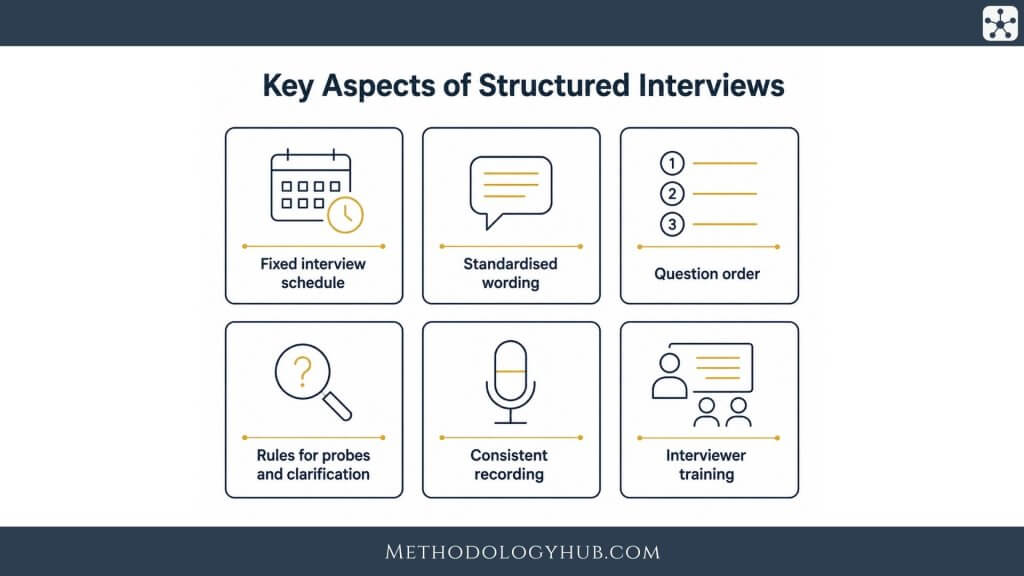
Semi-structured and structured interviews both begin with prepared questions, but they use those questions differently. A structured interview protects a fixed route through the conversation. A semi-structured interview protects the main topics while allowing the interviewer to adapt.
Structured interviews are useful when consistency is the priority. Semi-structured interviews are useful when the researcher needs consistency and detailed exploration at the same time.
Question wording and order
In a structured interview, wording and order are usually fixed. Every participant hears the same questions in the same sequence. In a semi-structured interview, the interviewer may adjust wording slightly, change order, or skip a question if the participant has already answered it.
This flexibility can improve the flow of the interview. It can also create variation that needs to be documented. A researcher using semi-structured interviews should be able to explain how the guide was followed and where interviews differed.
Depth of answers
Semi-structured interviews usually allow more depth because the interviewer can ask follow-up questions. If a participant gives an unexpected answer, the interviewer can explore it. In a structured interview, that same answer may be recorded but not pursued.
For example, a structured interview may ask all participants what support they used. A semi-structured interview can ask how they decided to use it, what made the decision difficult, and how their view of support changed after using it.
| Feature | Semi-structured interviews | Structured interviews |
|---|---|---|
| Guide | Flexible guide with core topics | Fixed schedule with set wording |
| Follow-up | Responsive probes are common | Probes are limited or pre-written |
| Comparison | Possible through shared topics | Stronger through identical questions |
Choosing between the two
Choose semi-structured interviews when the researcher needs guided depth. Choose structured interviews when the researcher needs tighter standardisation. The difference is not about which method is more serious. It is about which kind of evidence the study needs.
A study comparing brief experiences across many participants may use structured interviews. A study trying to understand how participants interpret those experiences in context may use semi-structured interviews.
Comparison: structured interviews keep the same path. Semi-structured interviews keep the same destination but allow different turns along the way.
How the analysis changes
Structured interview analysis often begins question by question because every participant answered the same prompt. Semi-structured interview analysis may begin with whole transcripts, then move into coding across shared topics and participant-specific material.
The semi-structured format can produce richer data, but the researcher must pay attention to what was asked of whom. When one topic was explored deeply with some participants but only briefly with others, the analysis should reflect that difference.
Semi-Structured vs Unstructured Interviews
Semi-structured and unstructured interviews both allow participant detail, but they differ in how much planning shapes the conversation. A semi-structured interview uses a guide. An unstructured interview begins more openly and lets the participant’s account decide much of the route.
Unstructured interviews can be powerful when the researcher wants to understand how participants organise a topic in their own way. Semi-structured interviews are often easier to compare because all participants are usually asked about the same broad areas.
The choice often depends on how much the researcher already knows. If the main areas of interest are known, a semi-structured guide can focus the interview. If even those areas are uncertain, an unstructured format may allow the participant to introduce the field more freely.

Control and openness
Semi-structured interviews share control between researcher and participant. The researcher sets topics, and the participant gives them meaning through examples and explanation. Unstructured interviews give more control to the participant, especially over the order and emphasis of the account.
This makes semi-structured interviews useful in studies where certain areas must be covered. It makes unstructured interviews useful when the ordering of the participant’s story is itself part of the data.
Comparability across interviews
Semi-structured interviews usually produce more comparable data because the guide creates overlap across interviews. Unstructured interviews may produce very different accounts from participant to participant. That can be valuable, but it can also make cross-case comparison harder.
A study of students’ first weeks at university may use a semi-structured guide to ask everyone about arrival, classes, support, friendships, and uncertainty. An unstructured study might instead begin with “Tell me about starting university” and allow each participant to decide which parts of the story come first.
Skill demands
Both methods require skill, but in different ways. Semi-structured interviews require the interviewer to manage the guide without sounding rigid. Unstructured interviews require the interviewer to follow an account without letting the conversation become unrelated to the research purpose.
In practice, semi-structured interviews are often easier for small research projects because the guide provides support. The method still requires training, practice, and careful listening.
How to Conduct Semi-Structured Interviews
Conducting semi-structured interviews means preparing a guide, recruiting suitable participants, testing the questions, and then using the guide flexibly during the interview. The method works best when the researcher enters the conversation with a plan but listens closely enough to adapt.
The process below gives a practical route through the method. Some projects will move through these steps once. Others will revise the guide after early interviews, especially when participants raise important issues that were not expected.
Step 1: Define the interview purpose
The purpose should be specific enough to guide the conversation. “Experiences of online learning” is broad. “How first-year students describe asking for help during online learning” gives the interview clearer boundaries.
A clear purpose helps decide what belongs in the guide and what should be left out. It also helps the interviewer recognise which unexpected details are relevant during the conversation.
Step 2: Select participants
Participants should be selected because they can speak to the research question. A study of early-career nurses, for example, should recruit people who have recent experience of that role. If the study compares settings, the sample should include participants from those settings.
Recruitment should also consider variation. Participants may differ by role, stage, location, age, or experience. Variation is useful when the study needs to understand how the same topic appears across different situations.
Step 3: Build the interview guide
The guide should include a small number of main topics, with questions and optional probes under each topic. It should be long enough to cover the study, but not so long that the interviewer rushes through answers. Many weak guides fail because they contain too many questions.
A useful guide often moves from background to concrete examples, then to interpretation and comparison. This order helps participants settle into the interview before discussing more complex meanings.
Recommendation: if every question feels essential, the guide probably has too many questions. Semi-structured interviewing needs room for answers to develop.
Step 4: Pilot the guide
A pilot interview shows whether the guide works in practice. It can reveal questions that sound awkward, prompts that produce very short answers, and sections that take more time than expected. It can also show whether the order of topics feels natural.
After piloting, the researcher may remove repetitive questions, add a probe, simplify wording, or change the order of sections. These changes should be completed before the main interviews whenever possible.
Step 5: Conduct the interview
During the interview, the researcher should use the guide as support rather than as a script. The interviewer can begin with easier questions, listen for useful details, and decide when to ask follow-up questions. A good follow-up usually asks for an example, a sequence, a comparison, or clarification.
The interviewer should also know when not to probe. If a participant has already answered a question clearly, repeating it may interrupt the flow. If a topic is sensitive, the interviewer should give space and avoid pushing for detail that the study does not need.
Step 6: Write notes after the interview
After the interview, the researcher should record brief notes about the conversation. These may include which sections of the guide worked well, which questions confused the participant, what unexpected topics appeared, and what the researcher may need to ask in later interviews.
These notes can later help with analysis. They show how the interview developed and how the guide changed across the study.
Step 7: Review early data before continuing
Early review helps the researcher see whether the interviews are producing useful data. If participants consistently answer one question vaguely, it may need rewording. If a new topic appears in several interviews, it may need to be added to later guides.
This kind of adjustment should be documented. Flexibility is acceptable in semi-structured interviewing, but the researcher should be able to explain what changed and why.
Semi-Structured Interview Guide
A semi-structured interview guide is the document that helps the interviewer move through the conversation. It does not have to include every possible question. Its job is to keep the interview focused, support follow-up, and make sure the main research areas are covered.
A strong guide is usually shorter than beginners expect. It leaves enough time for participants to answer in depth. If the guide contains too many questions, the interview can become rushed and the data may become thin.
The guide should be written in everyday language. Participants should not need to understand technical research terms in order to answer. If a concept is central to the study, the interviewer can ask participants what that concept means to them rather than defining it too quickly.
Sections of the guide
Many guides are organised into sections. These sections might include introduction, background, main experiences, specific examples, comparisons, reflections, and closing. The sections give shape to the conversation without requiring a rigid order.
For a study of workplace learning, the guide might begin with the participant’s role, move to recent learning experiences, ask about support from colleagues, explore difficult moments, and close with changes over time.
Main questions and probes
Main questions introduce the topic. Probes help the interviewer explore the answer. A main question might ask, “Can you describe a time when you learned something important at work?” A probe might ask, “Who was involved?” or “What made that situation stand out?”
Probes should be prepared, but they do not all need to be used. Their purpose is to support listening. The interviewer chooses them when they help the participant explain something more clearly.
Example guide structure
The following example shows a simple guide structure for a study about students asking for academic help. It is not a full script. It shows how topics, questions, and probes can be arranged.
| Guide section | Possible question | Possible probe |
|---|---|---|
| Background | Can you tell me a little about your current course? | How long have you been studying in this programme? |
| Experience | Can you describe a recent time when you needed help with academic work? | What happened next? |
| Interpretation | How did you decide whether to ask someone? | What made that decision easier or harder? |
| Closing | Is there anything about asking for help that we have not talked about? | Is there anything you wish teachers understood about this? |
Revising the guide
A guide may need revision after piloting or early interviews. The researcher may discover that a question produces general answers, that a topic appears too late, or that participants use a word differently from the researcher. Revision is part of careful interviewing when it is documented.
Once the main interviews are underway, changes should be made thoughtfully. If the guide changes too much, later interviews may no longer be comparable with earlier ones. The researcher should keep notes on what changed and how this affects analysis.
How to Analyse Semi-Structured Interview Data
Analysing semi-structured interview data means working with both shared topics and participant-specific details. The guide creates overlap across interviews, but the flexible conversation often produces material that does not fit neatly under the original questions. The analysis needs to handle both.
A researcher might begin by reading whole transcripts, then coding sections related to the research question, comparing answers across participants, and developing themes. The process is usually iterative rather than mechanical.
Read whole interviews first
Whole-transcript reading helps the researcher understand each participant’s account before breaking it into codes. This is important because a statement may mean something different when read in relation to the participant’s earlier comments or later explanation.
Reading whole interviews also helps the researcher notice which parts of the guide worked well. Some questions may have produced rich accounts. Others may have led to short or repetitive answers. These observations can inform both analysis and future interviewing.
Code both planned and unexpected material
Some codes may follow the guide topics, such as feedback, support, workload, or confidence. Other codes may come from participant accounts, such as avoiding help, waiting for permission, feeling visible, or managing uncertainty. Both kinds of codes can be useful.
The researcher should avoid coding only what was expected. One of the strengths of semi-structured interviews is that participants can introduce new meanings. If the analysis ignores those meanings, the method’s flexibility is wasted.
Compare across participants
Comparison is usually easier than in unstructured interviews because participants discussed similar areas. The researcher can compare how different participants described the same topic, which examples they gave, what language they used, and where accounts diverged.
Comparison can happen across roles, settings, time points, or participant characteristics. A study may compare students in different years, nurses on different wards, or teachers with different levels of experience. The comparison should follow the research question, not simply every difference available in the sample.
Develop themes from patterns
Themes should explain patterns in the data, not only name topics from the guide. A guide topic such as “support” may lead to several themes. One theme may show support as practical direction. Another may show support as emotional reassurance. Another may show support as something participants avoid because it feels like admitting weakness.
The researcher should check whether each theme is supported by enough evidence and whether it accounts for variation. If a theme only repeats the wording of one question, it may need more analytic development.
Recommendation: do not let the interview guide become the findings outline automatically. The data may organise the topic differently from the guide.
Use quotations with context
Quotations should be used to support interpretation, show variation, or illustrate a turning point. They should not replace analysis. A quotation is most useful when the surrounding writing explains what it shows and why it was selected.
Because semi-structured interviews can produce long answers, the researcher may need to choose short excerpts carefully. The excerpt should preserve enough context to be fair to the participant’s account.
Write findings with scope
Findings from semi-structured interviews should make claims that the data can support. The study may show how participants in a particular sample described a process, interpreted an event, or compared experiences. It should not claim population prevalence unless the study design supports that kind of claim.
Good writing often moves between analytic explanation and participant detail. The researcher explains the theme, shows evidence, compares accounts, and connects the finding back to the research question.
Examples of Semi-Structured Interviews
Examples of semi-structured interviews show why the method is useful across different fields. In each example, the researcher has clear topics to cover, but also needs space for participants to describe their own experiences and meanings.
The four examples below are intentionally different in setting. They show how the same interview format can be adapted to education, health, community research, and professional learning.
Example 1: First-year students and academic belonging
A researcher studies how first-year students develop a sense of belonging at university. The guide includes topics such as arrival, classroom participation, peer relationships, staff contact, and support services. Each participant discusses the same broad areas, but the interviewer follows the examples that each student raises.
The analysis may show that belonging is not only about friendship. Some students may connect it to being recognised by a teacher, feeling able to ask questions, finding a study routine, or knowing where to go when they are confused.
Example 2: Nurses and communication during shift changes
A health researcher interviews nurses about communication during shift handovers. The guide includes questions about information transfer, interruptions, unclear instructions, emotional pressure, and examples of effective handovers. Nurses are asked to describe real situations rather than speak only in general terms.
The data may show that handover quality depends on more than the information shared. Participants may describe timing, workload, trust between colleagues, the layout of the ward, and the pressure to appear calm in front of patients.
Example 3: Community mentors and volunteer support
A researcher interviews community mentors about supporting young people. The guide includes topics such as recruitment, first meetings, boundaries, training, difficult conversations, and reasons mentors continue or leave. The interviewer uses probes when participants mention moments of uncertainty.
The analysis may show that mentors stay involved when they feel useful and supported, but struggle when expectations are unclear. Semi-structured interviews are useful here because participants can explain both formal programme rules and informal experiences.
Example 4: Teachers learning a new curriculum
An education researcher interviews teachers after a curriculum change. The guide asks about preparation, classroom planning, subject differences, student responses, and changes in confidence. Teachers can then give examples from their own lessons.
The findings may show that teachers interpret the curriculum through subject knowledge, previous teaching habits, assessment pressure, and the resources available in their school. The guide keeps the interviews comparable, while follow-up questions capture local detail.
Conclusion
Semi-structured interviews are a flexible but planned way to collect qualitative data. They help researchers cover important topics across participants while still making room for examples, meanings, and unexpected details.
The method works best when the researcher prepares a focused guide, selects participants who can speak to the question, listens carefully during the interview, and analyses both the shared topics and the participant-led material. Its strength lies in the balance between direction and openness.
FAQs on Semi-Structured Interviews
What is a semi-structured interview?
A semi-structured interview is a qualitative interview that uses a prepared guide while allowing the interviewer to ask follow-up questions, change the order of topics, and explore participant answers in more depth.
What is a semi-structured interview in qualitative research?
A semi-structured interview in qualitative research is a guided conversation used to collect detailed participant accounts. It covers planned topics but leaves room for participants to explain experiences, meanings, and examples in their own words.
How do you conduct a semi-structured interview?
To conduct a semi-structured interview, define the purpose, select relevant participants, prepare an interview guide, pilot the questions, conduct the interview flexibly, write notes afterward, and review early data before continuing.
What should a semi-structured interview guide include?
A semi-structured interview guide should include main topics, open questions, optional probes, transitions, and closing questions. It should support the conversation without becoming a rigid script.
What is the difference between structured and semi-structured interviews?
Structured interviews use fixed wording and order, while semi-structured interviews use a guide with flexible follow-up questions. Structured interviews support tight comparison, while semi-structured interviews support both comparison and depth.
What is the difference between semi-structured and unstructured interviews?
Semi-structured interviews use a planned guide with flexible probing. Unstructured interviews are more open and allow the participant’s account to shape much of the conversation. Semi-structured interviews are usually easier to compare across participants.
How do you analyse semi-structured interview data?
Semi-structured interview data are analysed by reading whole transcripts, coding planned and unexpected material, comparing accounts across participants, developing themes, using quotations with context, and writing findings with appropriate scope.