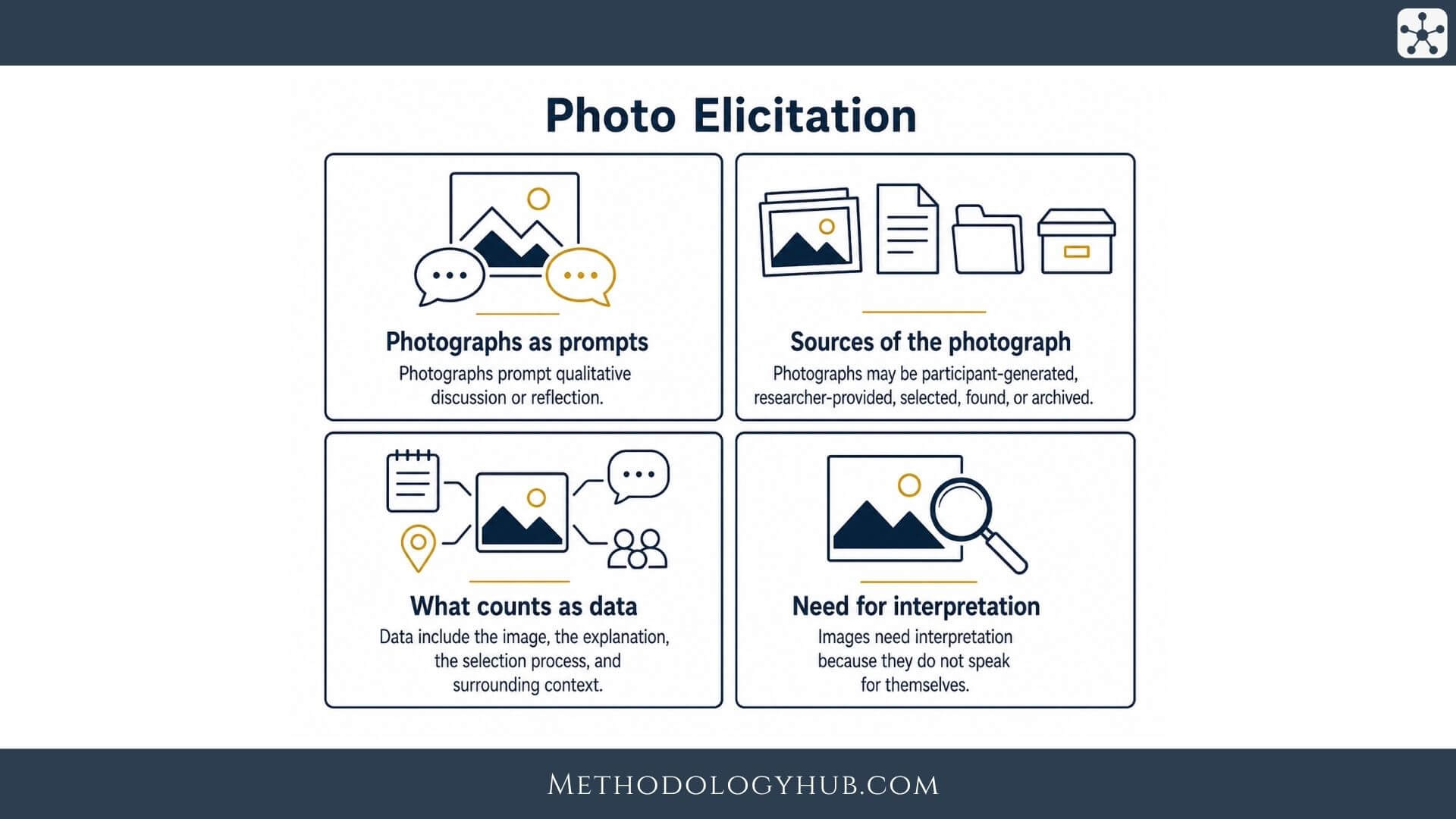
Photo elicitation is a qualitative research method that uses photographs to support interviews, group discussions, diary entries, or other forms of participant reflection. Instead of asking only verbal questions, the researcher introduces images so participants can describe memories, meanings, places, relationships, routines, or experiences connected to what they see.
A photograph may be taken by the participant, selected by the participant, provided by the researcher, or found in an existing collection. The photograph does not replace conversation. It creates a shared object that participant and researcher can look at, question, interpret, and discuss together.
Researchers often use photo elicitation within qualitative research when visual material can help participants talk about experience in a more concrete way. As part of wider qualitative research methods, the technique is especially useful for topics involving place, identity, memory, material surroundings, everyday practice, or change over time.
What is Photo Elicitation
Photo elicitation uses photographs to prompt qualitative data. A participant may look at an image and explain what it means, what happened before or after it was taken, why it was selected, what it leaves out, or how someone else might interpret it differently.
The method works because photographs can make discussion more specific. Instead of asking a broad question such as “How do you experience this place?”, the researcher can ask a participant to talk through a photograph of a doorway, bench, desk, noticeboard, street corner, or room that is connected to that experience.
Photo elicitation definition
Photo elicitation is a qualitative method in which photographs are used to support interviews, focus groups, diaries, or other reflective data collection activities. The photograph may be created by participants, selected from an archive, taken by the researcher, or introduced as a shared visual prompt.
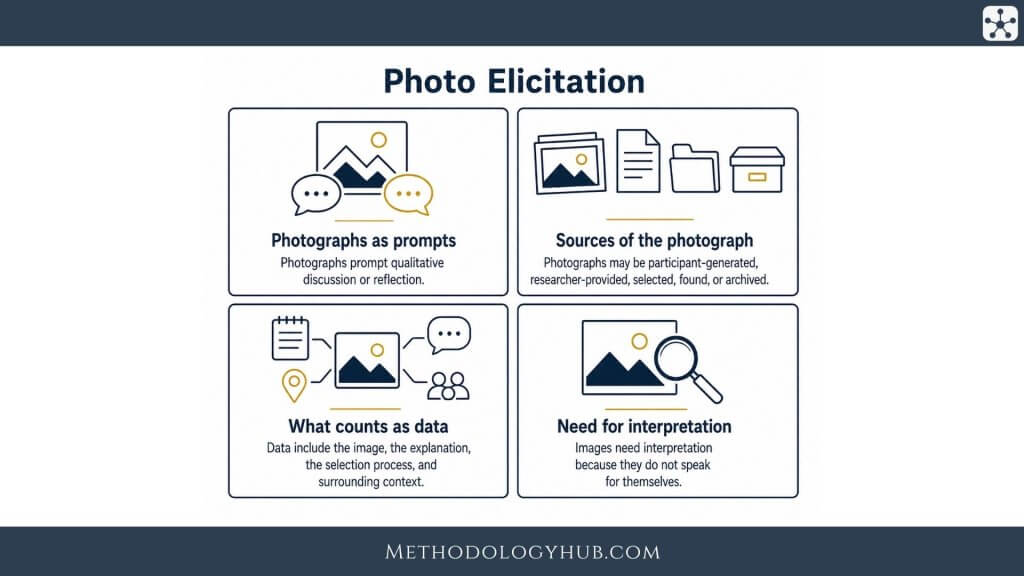
The data usually include more than the photograph itself. The participant’s explanation, the conversation around the image, the selection process, and the researcher’s notes all become part of the analysis.
What the photograph does
The photograph can anchor memory, invite description, reveal detail, support comparison, and help participants talk about material or spatial aspects of experience. It may also challenge an assumption. What looks ordinary to the researcher may carry a strong meaning for the participant.
A photograph of a kitchen table might be discussed as a work space, family space, study space, storage space, or conflict point. The image is not self-explanatory. It becomes meaningful through context and participant interpretation.
What photo elicitation does not guarantee
Photo elicitation does not automatically produce deeper data. A weak photo task can lead to vague images and short explanations. A participant may also take photographs that are difficult to interpret without discussion.
The method requires careful prompts, clear consent procedures, and a plan for analysing both visual and verbal material. Without these, photographs may become illustrations rather than research data.
Different Ways to Use Photographs
Photo elicitation can be designed in several ways. Sometimes participants take photographs before the interview. Sometimes the researcher brings photographs to the session. In other studies, both researcher and participant choose images for comparison.
The choice affects participation, control, comparison, and analysis. A researcher-provided image creates a common prompt across participants. A participant-created image gives participants more influence over what enters the study.
Participant-generated photographs
Participant-generated photographs are taken by participants for the study. The researcher gives a task, such as photographing places that affect learning, objects that support a health routine, or moments that show daily work. Participants then discuss the photographs in an interview or add written captions.
This approach can reveal what participants consider worth showing. It may also bring unexpected topics into the study because participants choose images from their own viewpoint.
Researcher-provided photographs
Researcher-provided photographs are selected or created by the researcher. Every participant may respond to the same image set. This can be useful when the study needs comparison across participants.
For example, a researcher studying public information materials may show the same posters to several participants and ask how each one is understood. This creates a shared visual starting point.
| Photo source | Best suited to | Possible limitation |
|---|---|---|
| Participant-generated | Participant priorities, everyday spaces, personal meaning | Images vary widely and may raise privacy issues. |
| Researcher-provided | Comparison across participants or responses to the same material | The image set may reflect researcher assumptions. |
| Existing or archived | Memory, history, representation, public communication | Context and provenance may be incomplete. |
Existing and archival photographs
Existing photographs may come from family albums, public archives, organisational collections, websites, reports, or historical records. They can be used to prompt memory or analysed as visual documents.
Photo elicitation with older photographs can be useful in studies of community change, identity, organisational memory, migration, neighbourhood history, or public representation. The researcher should still ask how the photograph was produced, preserved, captioned, and selected.
Photo diaries
Photo elicitation can also be paired with diary methods. Participants might take one photograph each day, add a short caption, and later discuss selected images. The repeated images can show rhythm, change, and routine.
This design is useful when the topic changes across time. Studies of study habits, caregiving, health routines, commuting, home working, or public space use can benefit from repeated photographic entries.
When Photo Elicitation Works Well
Photo elicitation works well when images can help participants explain something that is spatial, material, emotional, routine, remembered, or hard to describe abstractly. It can make interview discussion more grounded because the participant is responding to a visible prompt.
The method can also shift some control to participants. When they take or choose images, they decide what aspects of the topic deserve attention. This can bring the research closer to participant perspective.
Place, movement, and everyday environment
Photographs can help participants talk about places. A student may photograph a study spot, a resident may photograph a street corner, and a worker may photograph a shared workspace. The image can support discussion of access, comfort, noise, privacy, route, or boundary.
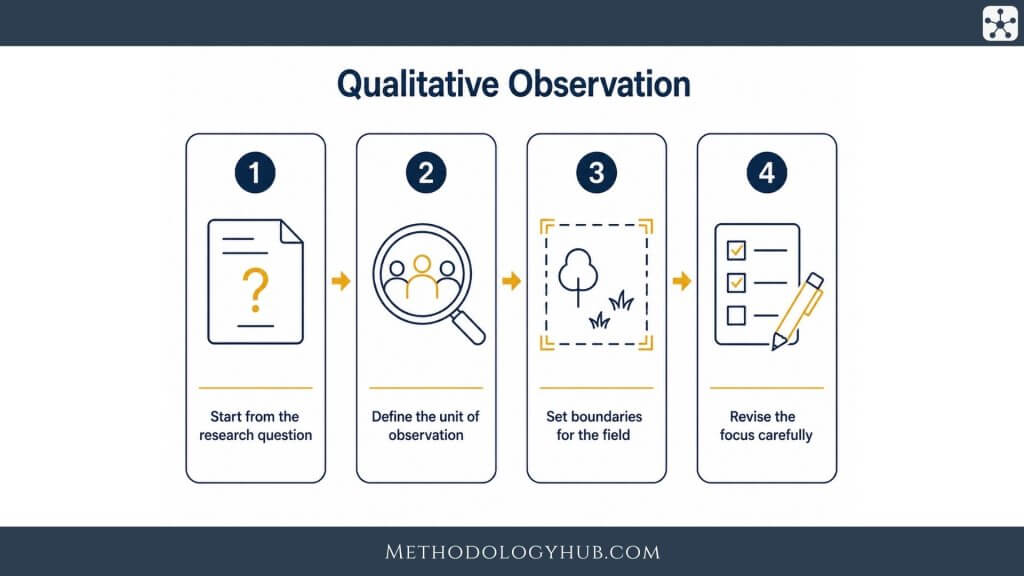
Researchers studying everyday environments often connect photo elicitation with Qualitative Observation when they want to compare participant images with direct field records. The photograph shows what the participant selected, while observation can show wider activity around the scene.
Memory and personal meaning
Photographs can help participants discuss memory. An image may bring back details about an event, relationship, location, or period of life. It may also let participants explain why something ordinary became meaningful.
This use is common in studies of family, migration, community change, education, health, identity, and ageing. The researcher should avoid assuming that an image means the same thing to every viewer.
Objects, routines, and hidden work
Photographs can make everyday objects visible. Participants may photograph tools, forms, medicines, notebooks, bags, meals, workstations, instructions, or spaces where care or coordination happens. These images can reveal the practical organisation of daily life.
In a workplace study, for example, a participant may photograph a handwritten list that coordinates tasks more than the official system does. The photograph can open a discussion about informal work that might otherwise stay unnoticed.
When another method may fit better
Photo elicitation may not fit when visual recording creates privacy risks, when participants are uncomfortable with photography, or when the topic does not benefit from visual prompts. It can also be burdensome if participants are asked to take too many images or explain them in detail.
A standard interview, written diary, questionnaire, or observation may be simpler when images do not add to the research question. The method should earn its place in the design.
Designing a Photo Elicitation Study
A photo elicitation study needs clear decisions before images are collected. The researcher should decide who will take or choose photographs, how many images will be used, what instructions participants will receive, how images will be stored, and how the image discussion will be analysed.
Careful design protects participants and improves data quality. A task that is too vague may produce images that are difficult to analyse. A task that is too narrow may prevent participants from showing what they consider important.
Define the photo task
The task should be specific enough to guide participants. For example, “Take up to five photographs of places that affect how you study during a normal week” is clearer than “Take photos of your student life.”
The task should also explain what not to photograph. Participants may need guidance about avoiding identifiable people, private documents, workplace screens, children, or restricted spaces.
Decide how many photographs to use
The number of photographs should match the time available for discussion. Too many photographs can turn the interview into a rushed review. Too few may limit the range of data.
Many studies ask for a small set of images and then invite participants to choose the most important ones for discussion. This gives the participant a second opportunity to explain priority and meaning.
| Design decision | Question to answer |
|---|---|
| Photo source | Will photographs be taken by participants, selected by the researcher, or found in existing records? |
| Photo number | How many images can be discussed properly within the session? |
| Explanation format | Will participants add captions, diary notes, interview explanations, or group comments? |
Prepare consent and privacy guidance
Photographs can identify people and places even when names are removed. A study may reveal a participant’s home, workplace, school, route, health setting, or personal possessions. The researcher should explain how photographs will be used, stored, anonymised, and reported.
If photographs include other people, additional consent questions may arise. Participants should know whether they can photograph people at all, whether faces should be avoided, and what to do if someone appears unintentionally in an image.
Pilot the task
A pilot can show whether the photo task makes sense. Participants may take images that are too broad, too private, too few, too many, or unrelated to the research question. The researcher can revise the prompt before the full study begins.
Piloting can also reveal whether the follow-up questions invite enough explanation. An image with no explanation may be interesting, but it may not answer the research question.
Conducting a Photo Elicitation Interview
A photo elicitation interview is not just a normal interview with pictures added. The photograph changes the interaction. Participant and researcher can look at the same object, return to it, compare it with other images, and use details in the frame to guide discussion.
The interviewer should let participants explain the image before applying too much interpretation. Participants may choose an image for reasons that are not obvious from looking at it.
Start with the participant’s account
A useful opening question is simple: “Can you tell me about this photograph?” This lets the participant decide where to begin. The researcher can then ask follow-up questions about context, selection, memory, meaning, and what is outside the frame.
Beginning with the participant’s account reduces the risk of the researcher imposing meaning too early. It also allows unexpected explanations to appear.
Ask about selection
Selection is part of the data. The researcher should ask why the participant chose this image and not another one. A photograph may have been selected because it shows a typical situation, an unusual moment, a problem, a source of comfort, or something difficult to explain.
The reason for selection often reveals as much as the visible content. Two participants may photograph a desk, but one may mean focus and the other may mean pressure.
Ask about what is outside the frame
Photographs exclude as much as they include. The interviewer can ask what is not shown, what happened before or after, who was nearby, and whether the image hides anything important.
This question is useful because images can look tidy, quiet, neutral, or simple while the participant’s explanation reveals noise, conflict, effort, or absence around the frame.
Compare images during the conversation
If participants bring several photographs, comparison can be useful. The researcher may ask which image feels most typical, which feels most difficult, which shows change, or which image they would choose first when explaining the topic to someone else.
Comparison can help participants clarify priorities. It can also show contrast between different places, routines, relationships, or moments.
Record both image discussion and image details
The interview transcript should be linked to the image being discussed. Image numbers, captions, file names, or thumbnails can help the researcher connect each explanation to the correct photograph.
Field notes can also record gestures, pointing, pauses, or moments when a participant handles or reorders photographs. These details may be relevant to interpretation.
Analysing Photo Elicitation Data
Analysing photo elicitation data means working with the photograph, the participant’s explanation, the context of selection, and any linked notes or transcripts. The image alone is rarely enough. The conversation around the image usually carries the main interpretive work.
The researcher can analyse within each participant’s image set and across participants. Some studies focus on repeated themes in the discussion. Others focus on visual patterns, selection logic, spatial meanings, or contrasts between images.
Describe the image carefully
Before interpretation, the researcher should describe what is visible: people, objects, places, text, layout, distance, angle, colour, signs, and areas outside clear focus. Description helps slow down assumptions.
This step is especially important when the image seems obvious. A photograph of an empty hallway may look simple, but its meaning may depend on time of day, participant memory, access rules, or what usually happens there.
Analyse the explanation with the image
The participant’s words should be read alongside the image. Captions, interview extracts, diary entries, and field notes can explain why a photograph was taken, what it represents, and how it connects to the research question.
A participant may photograph a closed door and explain that it represents uncertainty, exclusion, privacy, or routine. The visual object is the same, but the explanation changes the interpretation.
| Analytic layer | Questions to ask |
|---|---|
| Visible content | What appears in the image, and how is it arranged? |
| Participant explanation | What does the participant say the image means or shows? |
| Selection context | Why was this photograph taken, selected, shown, or discussed? |
Compare within and across cases
Within a single case, images can be compared as a set. Which photographs did the participant place first? Which seemed difficult to explain? Which images were described as typical or unusual? Which topics appeared across several images?
Across cases, the researcher can compare repeated objects, spaces, routes, absences, captions, themes, or ways of interpreting similar scenes. Comparison should not erase individual meaning. The same object can carry different meanings for different participants.
Link images with other qualitative data
Photo elicitation data may be analysed alongside interviews, diaries, observation, field notes, or documents. A participant’s photograph of a waiting room can be compared with interview discussion, observation records, and public signs in the same setting.
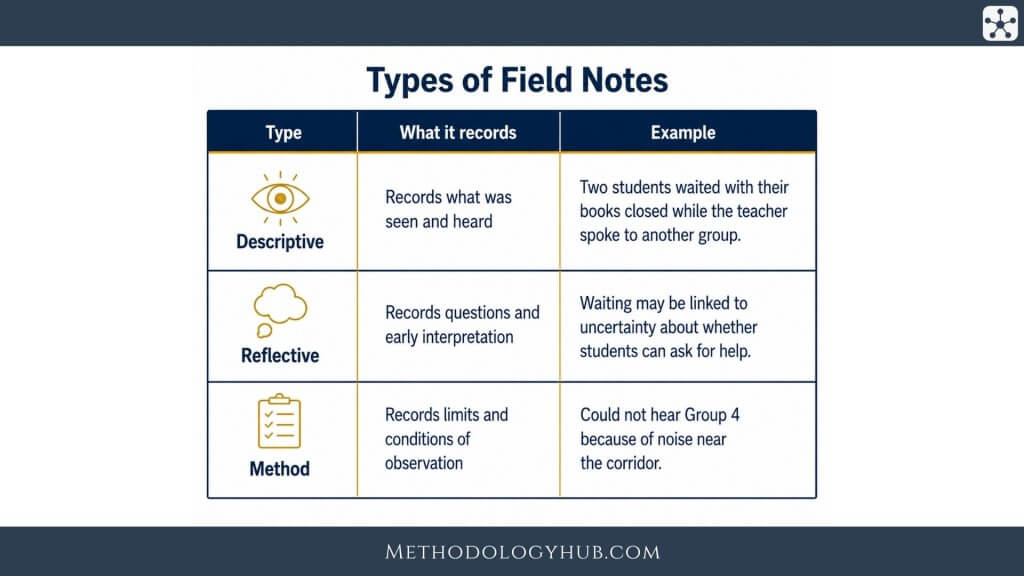
When researchers connect photo elicitation with field notes in qualitative research, the field record can preserve details about the interview setting, participant gestures, image handling, or the researcher’s own observations. Those notes help explain how the visual discussion unfolded.
Report images responsibly
Images included in a report should be selected with care. Some may identify people, homes, workplaces, schools, streets, or health settings. A researcher can describe an image instead of reproducing it when privacy risk is high.
If an image is shown, the report should explain who created or selected it, what context surrounds it, and how it supports the analysis. A photograph should not be used as decoration.
Examples of Photo Elicitation
Examples of photo elicitation show how the same basic method can be adapted to different research questions. Each example below uses photographs to support participant explanation rather than treating images as stand-alone proof.
Example 1: Student learning spaces
A researcher asks students to take up to five photographs of places where they study during a normal week. In the interview, students explain where each place is, what it helps with, what makes it difficult, and why they selected it.
The analysis may show how learning is shaped by noise, shared housing, travel time, access to computers, family responsibilities, or confidence in public study spaces.
Example 2: Health routines at home
Participants photograph objects or places connected to a new health routine. They may show medicine storage, appointment letters, reminder notes, kitchen arrangements, or tools they use to manage care.
The interview can reveal how instructions from a clinic are translated into everyday practice. A photograph of a simple object may open discussion about memory, worry, support, or difficulty.
Example 3: Community change and local memory
A study of neighbourhood change uses old photographs from a community collection and new photographs taken by residents. Participants compare past and present images and discuss what changed, what stayed, and what feels missing.
This design can connect photo elicitation with archival data. The photographs help participants discuss memory, belonging, loss, improvement, and disagreement about change.
Example 4: Work tools and informal practice
Workers photograph objects that help them get tasks done during the day. Some images show official tools, while others show improvised notes, shared folders, informal reminders, or personal systems.
The findings may show that daily work depends on hidden coordination. The photographs help make informal practice visible without relying only on general interview questions.
Conclusion
Photo elicitation helps qualitative researchers use photographs as prompts, data, and conversation tools. It is useful when experience is tied to place, memory, objects, identity, routine, or material environment.
A strong photo elicitation study defines the image source, gives participants a clear task, protects privacy, and analyses photographs together with participant explanations. The method is most useful when images create discussion that would be harder to reach through verbal questions alone.
FAQs on Photo Elicitation
What is photo elicitation?
Photo elicitation is a qualitative research method that uses photographs to support interviews, focus groups, diaries, or reflective discussion. Participants discuss images and explain their meanings, context, and relevance to the research topic.
What is an example of photo elicitation?
An example is asking students to take photographs of places where they study, then interviewing them about what each place makes easier or harder. The photographs become prompts for detailed discussion.
When should photo elicitation be used?
Photo elicitation should be used when images can help participants discuss place, memory, identity, routine, objects, material surroundings, public representation, or experiences that are difficult to describe through words alone.
Who takes the photographs in photo elicitation?
Photographs may be taken by participants, provided by the researcher, selected from existing materials, or drawn from archives. The choice depends on the research question and the role images should play in the study.
How do you analyse photo elicitation data?
Photo elicitation data are analysed by describing the image, examining the participant’s explanation, studying why the image was selected, comparing images within or across cases, and linking visual data with transcripts or notes.
What are the limits of photo elicitation?
Photo elicitation can create privacy risks, participant burden, uneven image quality, and interpretive ambiguity. It needs clear tasks, consent procedures, privacy guidance, and analysis that does not treat images as self-explanatory.