Academic writing is the way students, researchers, and academics turn ideas into clear, structured, evidence-based work. It is not just about sounding formal. It is about thinking carefully, using sources responsibly, and guiding the reader through an argument that makes sense from start to finish.
This article covers what academic writing is, what makes it different from everyday writing, the main types you will come across, and how to improve it step by step.
What Is Academic Writing?
Academic writing is a formal way of communicating knowledge, analysis, and argument in schools, universities, and research settings. Its main purpose is not to impress the reader with complicated language. Its purpose is to present ideas clearly, support them with evidence, and organise them in a way that allows others to follow, question, and build on them.
That is why academic writing matters so much. In academic contexts, your ideas are rarely judged on opinion alone. They are judged on how well you explain them, how carefully you use sources, and how clearly you connect claims to evidence. Writing is not just the final stage of learning. In many cases, writing is part of the thinking itself.
Academic writing definition
At its core, academic writing is writing that follows the conventions of academic work. Those conventions include clarity, structure, evidence, precision, and a tone that fits the subject and audience. The exact form changes across disciplines, but the underlying logic stays surprisingly consistent.
In practice, academic writing usually asks you to do one or more of the following:
- explain a concept accurately
- analyse information or data
- compare different viewpoints
- develop an argument
- evaluate evidence critically
- document sources in a transparent way
That means academic writing is not one single genre. It is a broad category that includes essays, research papers, theses, dissertations, lab reports, literature reviews, research proposals, and more. Each of these forms has its own rules, but all of them are shaped by the same basic expectation: your writing should be reasoned, readable, and grounded in evidence.
Features of Academic Writing
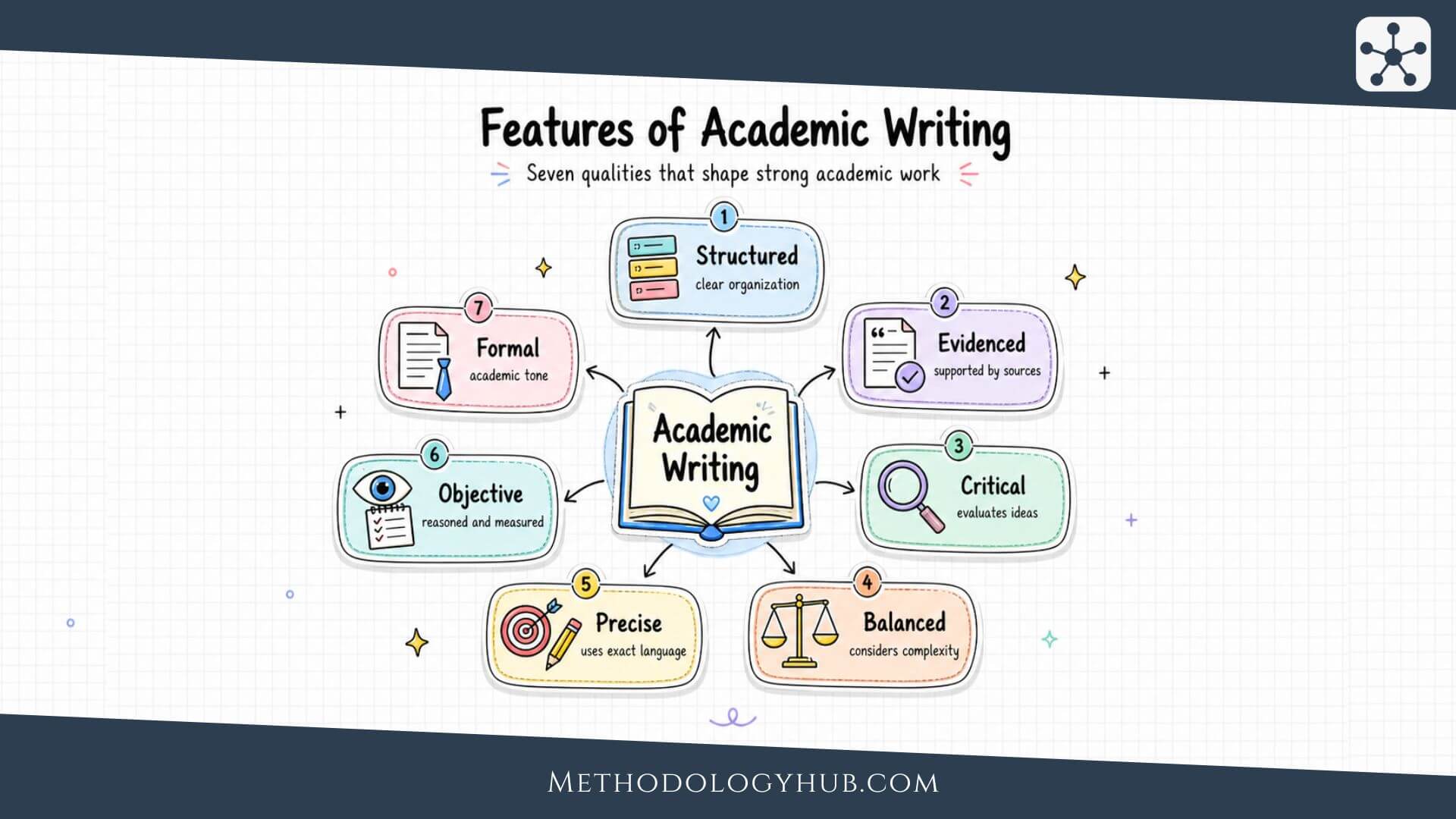
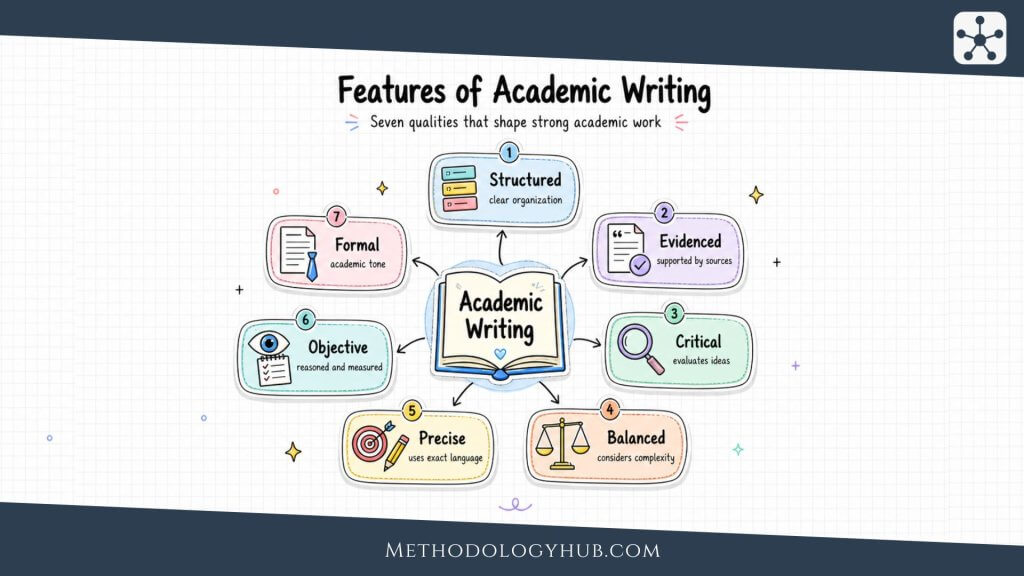
The features of academic writing are the qualities that make a text sound credible, disciplined, and worth taking seriously. When people ask what makes a piece of writing “academic”, they are usually pointing to a mix of habits rather than one single rule. A strong academic text is structured, supported by evidence, precise in language, and careful in the way it handles complexity.
These features matter because academic writing is not only judged by what it says, but also by how it says it. A useful idea can lose force if it is vague, disorganised, overly emotional, or unsupported. By contrast, even a difficult subject becomes easier to follow when the writing is clear and controlled.
This is also where many students get stuck. They are told to “sound more academic”, but what they really need is not a more formal vocabulary list. They need to understand the features that shape strong academic writing on the page.
Structured
Academic writing is structured. That sounds obvious, but it is one of the main differences between average work and strong work. The reader should never feel lost. They should be able to see where the text begins, how the argument develops, and why one paragraph follows another.
A good structure does more than keep the text tidy. It helps your ideas do their job. If you introduce a concept too late, mix several points into one paragraph, or jump between ideas without transitions, the reader has to do extra work to reconstruct your meaning. Academic writing should reduce that burden, not increase it.
Structure exists at several levels:
- whole-text level: introduction, body, and conclusion follow a clear purpose
- section level: each part of the text focuses on one main task
- paragraph level: each paragraph develops one central idea
- sentence level: each sentence connects logically to the next
In practice, structure means the reader can follow your reasoning without having to guess what comes next. It creates momentum. It also makes the writing feel more confident, because the text seems to know where it is going.
Evidenced
Academic writing is based on evidence. Instead of asking the reader to trust your opinion on its own, it shows where claims come from and how they are supported. Evidence may include research findings, data, textual analysis, theory, case studies, historical records, or other relevant sources, depending on the discipline.
This feature is essential because academic knowledge is built collectively. You are not writing into an empty space. You are entering an existing conversation, and your claims become stronger when they are grounded in credible material. Evidence shows that your argument is not just personal preference dressed up as certainty.
Using evidence well does not mean adding citations everywhere and hoping they create authority by themselves. It means selecting relevant sources, interpreting them carefully, and connecting them to your point. Weak academic writing often uses evidence as decoration. Strong academic writing uses evidence as support.
That difference matters. Compare these two moves:
- Weak use of evidence: dropping a quotation into a paragraph without explaining it
- Strong use of evidence: introducing the source, explaining what it shows, and linking it to the claim being made
When evidence is handled well, the reader can see not only that you have read sources, but also how you are thinking with them.
Critical
Academic writing is critical, which means it does more than repeat information. It examines, questions, compares, and evaluates. Critical writing looks beneath the surface. It asks what a source assumes, where an argument is strong, where it is limited, and what alternative interpretations might exist.
This does not mean academic writing has to sound hostile or negative. Being critical is not the same as attacking every source you mention. It means engaging thoughtfully with ideas instead of accepting them too quickly. A critical writer notices differences, tensions, gaps, and implications.
For example, if two scholars interpret the same issue differently, descriptive writing might simply report both positions. Critical writing would go further. It might compare the strength of their evidence, point out where their assumptions differ, or explain why one interpretation is more convincing in a specific context.
One simple way to test whether a paragraph is critical is to ask: does it only tell the reader what others say, or does it also show judgment? If the paragraph only reports, it may still be informative, but it is not yet doing full academic work.
Balanced
Academic writing is balanced. It avoids turning complex questions into easy slogans. In many subjects, the strongest answer is not the most extreme one. It is the one that recognises nuance, addresses counterarguments, and stays proportionate in its claims.
Balance matters because readers in academic contexts expect fairness. They want to see that the writer has considered more than one side of an issue and has not ignored relevant complications. A text that sounds too absolute often feels weak, even when the writer is passionate about the topic.
Balanced writing often includes moves like these:
- recognising limitations in the available evidence
- acknowledging other interpretations
- qualifying claims where certainty is not possible
- showing where an argument applies, and where it may not
This does not make the writing timid. On the contrary, balance often makes a text more persuasive because it shows intellectual honesty. A writer who admits complexity usually sounds more credible than one who pretends every question has a simple answer.
Precise
Precision is one of the most important features of academic writing, and one of the most underrated. Many students think academic style means using longer words, but strong academic writing usually depends on the opposite instinct. It chooses language carefully, defines terms when necessary, and avoids fuzzy statements that could mean almost anything.
Precision helps the reader know exactly what you mean. If you write that something is “bad”, “important”, or “significant”, the reader may still be left wondering in what sense. Bad for whom. Important compared with what. Significant in practical terms, theoretical terms, or statistical terms. Precision closes that gap.
Here is the difference in practice:
- Vague: “Technology has a big impact on education.”
- More precise: “Digital learning platforms have changed how students access course materials, submit work, and communicate with instructors.”
The second sentence is not automatically perfect, but it is more useful because it tells the reader what kind of impact is being discussed. Precision makes writing easier to trust because it reduces ambiguity. It also improves analysis, since clear language usually leads to clearer thought.
Objective
Academic writing is often described as objective. This does not mean writers become emotionless machines, nor does it mean personal perspective disappears completely. It means the writing tries to focus on reasons, evidence, and analysis rather than on personal feeling alone.
Objectivity is partly a matter of tone. Academic texts usually avoid exaggerated claims, loaded language, and sweeping emotional statements. They try to sound measured. But objectivity is also a matter of method. It means showing how a conclusion was reached, not asking the reader to accept it because the writer feels strongly about it.
In some disciplines, first person is acceptable and even useful. In others, it is used more carefully. The key issue is not whether you use “I” or avoid it completely. The real question is whether the writing remains focused on analysis rather than ego.
Objectivity, then, is best understood as controlled judgment. You can still make a strong argument. You can still take a position. What matters is that the position is earned through reasoning.
Formal
Academic writing is formal, but formality is often misunderstood. Formal writing is not about trying to sound stiff, cold, or artificially complicated. It is about choosing a tone that suits serious intellectual work.
A formal style usually avoids slang, casual shortcuts, and overly conversational phrasing. It also tends to prefer complete, well-shaped sentences over fragments and loose remarks. That said, formal writing should still be readable. Many weak academic texts become heavy because the writer mistakes awkwardness for seriousness.
Good formality often includes:
- clear sentence structure
- discipline-specific vocabulary where appropriate
- careful transitions between ideas
- a consistent tone from beginning to end
What it should not include is unnecessary complexity. A sentence does not become more academic simply because it is harder to read. In fact, writing that is needlessly dense can weaken your authority because it hides the argument instead of presenting it.
Types of Academic Writing
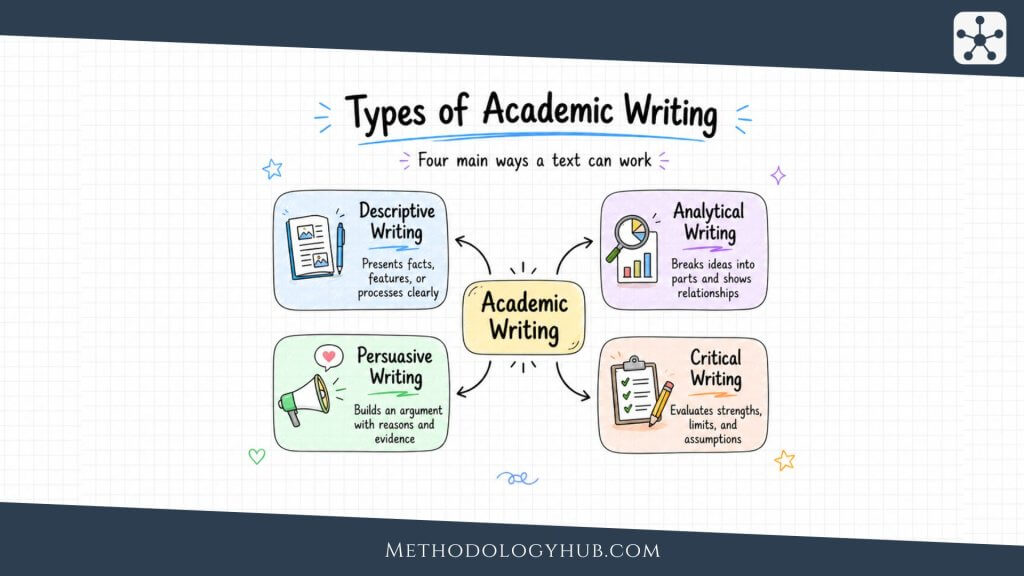
The main types of academic writing are descriptive, analytical, persuasive, and critical. These categories are useful because they show that academic writing is not one single skill used in the same way every time. A lab report, literature review, essay, and dissertation chapter may all be academic, but they do not all ask the writer to do the same thing on the page.
These types also do not exist in isolation. In real academic work, they often overlap. A strong essay may begin with description, move into analysis, develop a persuasive line of argument, and end with critical evaluation. Even so, learning the four types separately helps you recognise what each one is trying to achieve.
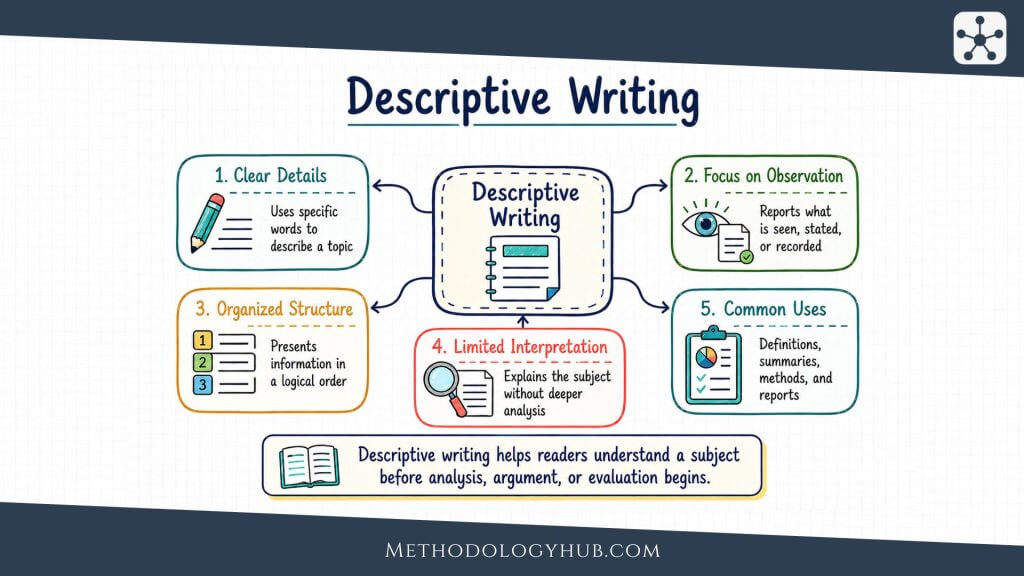
Descriptive writing
Descriptive writing is the most basic type of academic writing. Its job is to present facts, information, processes, events, or characteristics clearly and accurately. It answers questions such as what happened, what something is, what its main features are, or how something works.
This type of writing is common in the early stages of academic work. You might use it when defining a concept, summarising a theory, reporting the steps of a method, outlining the background of a topic, or explaining the results of an experiment before interpreting them. Descriptive writing helps establish a foundation, which is why it appears so often in student assignments.
That said, description alone is rarely enough in higher-level academic work. A text that only reports information may be clear and correct, but still feel limited. In many university tasks, description is expected as a starting point rather than the final goal.
Descriptive writing usually does the following:
- defines terms and concepts
- reports facts or observations
- summarises sources or events
- outlines methods, stages, or processes
- presents information without much interpretation
For example, if you write, “The study surveyed 300 undergraduate students and measured sleep duration, screen time, and self-reported stress levels,” you are writing descriptively. You are telling the reader what the study did, but you are not yet explaining patterns, relationships, or implications.
Analytical writing
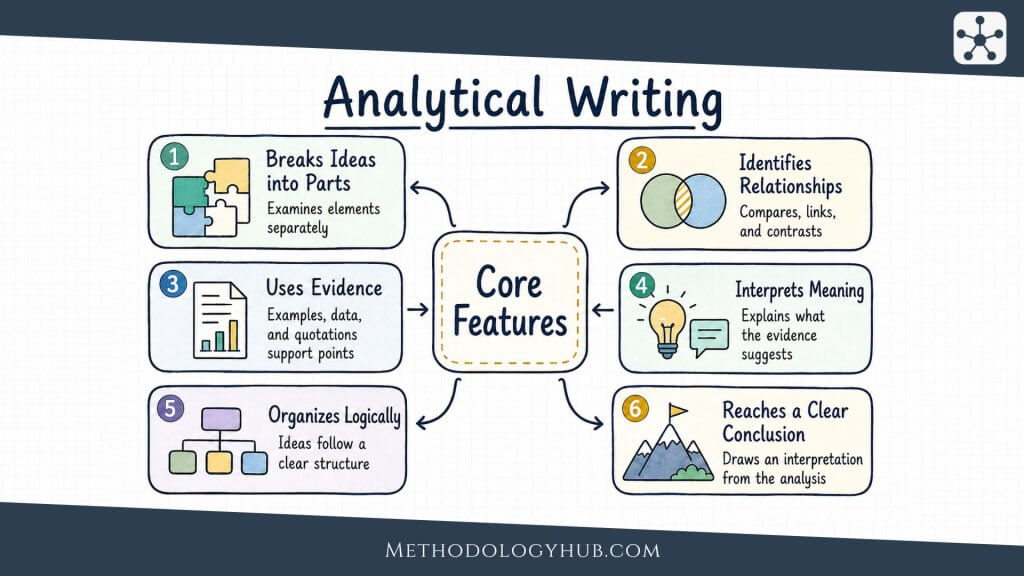
Analytical writing goes a step further. Instead of only presenting information, it breaks that information into parts and examines how those parts relate to one another. It looks for patterns, categories, causes, contrasts, and connections. In simple terms, analysis asks not just what, but how and why.
This is where academic writing begins to show more depth. When you analyse, you are organising information in a meaningful way. You might compare theories, group findings into themes, identify trends in data, or explain the relationship between two variables. The aim is to move beyond reporting and into interpretation.
Analytical writing often includes moves like these:
- comparing similarities and differences
- grouping information into categories
- identifying patterns or trends
- examining causes and effects
- showing how parts contribute to a whole
Imagine the difference between these two sentences:
- Descriptive: “Several studies discuss social media use among university students.”
- Analytical: “Studies on social media use among university students tend to focus on either academic distraction or peer interaction, which reveals two competing ways of framing its role in student life.”
The second sentence is analytical because it does something with the information. It groups the studies into patterns and points toward an interpretation. That is the key shift.
Persuasive writing
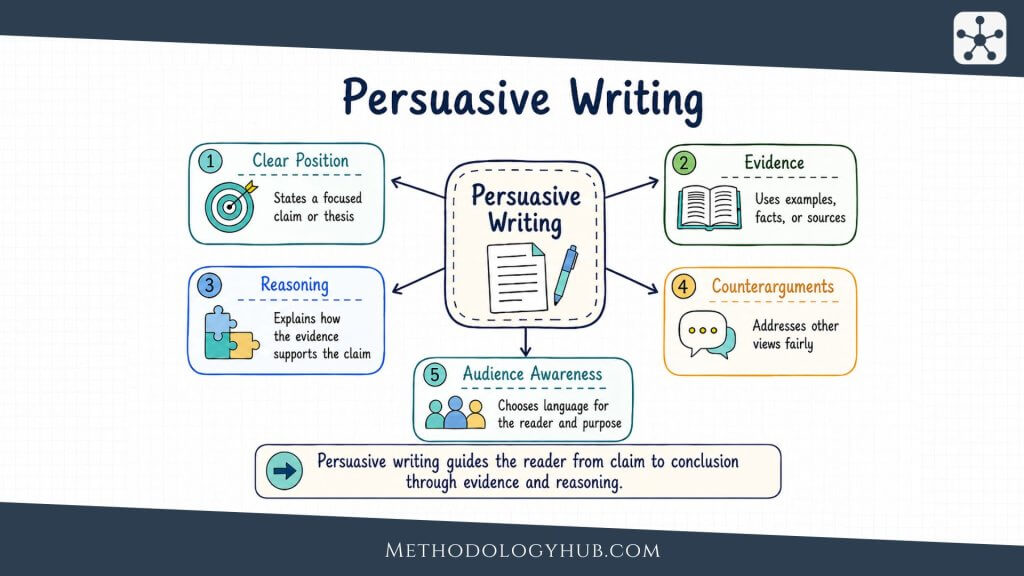
Persuasive writing aims to convince the reader of a particular position. In academic contexts, persuasion is not built on emotion, slogans, or confidence alone. It depends on logic, evidence, structure, and careful reasoning. The writer makes a claim and then supports it in a way that stands up to scrutiny.
This kind of writing is especially common in essays, research papers, position papers, and many discussion sections. Even when an assignment does not explicitly ask you to “persuade”, it often expects you to develop a line of argument. If you are answering a question, taking a stance, or proposing an interpretation, persuasive writing is usually involved.
Academic persuasion tends to include:
- a clear thesis, claim, or central position
- evidence chosen to support that claim
- logical development from one point to the next
- engagement with other viewpoints
- careful wording that avoids overstatement
For example, saying “Online learning is better than classroom learning” is not academic persuasion. It is just an unsupported opinion. A more academic version would identify the context, define the terms, consider limitations, and present evidence for a narrower, defensible claim.
That might look more like this: “For students who need flexible scheduling, online learning can improve access to higher education, although its effectiveness depends heavily on course design, digital support, and learner self-management.” This version is persuasive because it makes an argument, but it does so carefully and with room for nuance.
One reason persuasive academic writing is challenging is that many students treat argument as personal opinion. In academic writing, an argument is something you build. It is not a feeling you announce. The reader should be able to see the steps that lead to your conclusion.
Critical writing
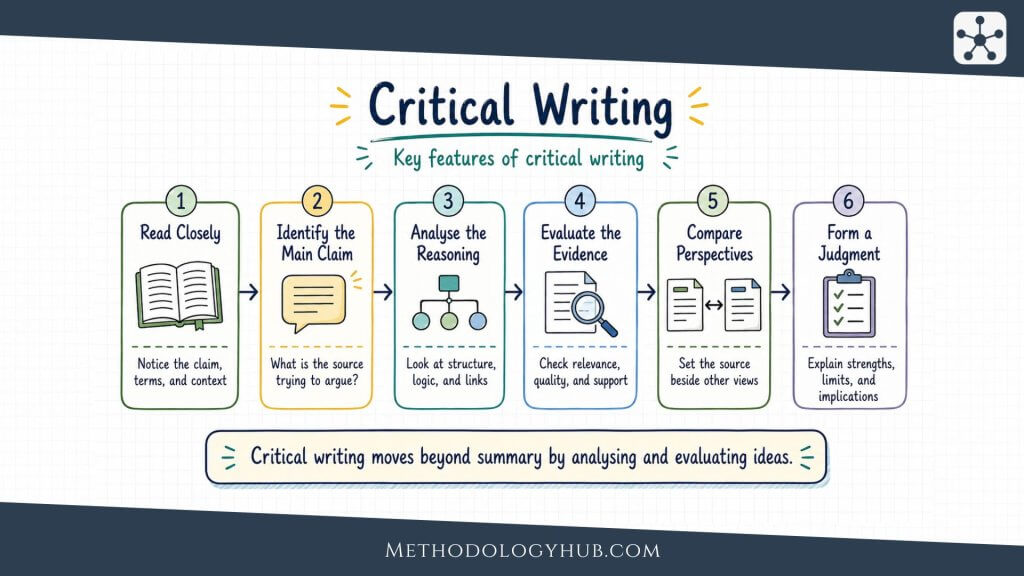
Critical writing is often the most demanding type of academic writing because it combines elements of the others and pushes them further. A critical writer does not stop at describing information, analysing patterns, or arguing for a position. They also evaluate strengths, weaknesses, assumptions, implications, and limitations.
Critical writing asks hard questions. How reliable is this source. What does this theory explain well, and what does it miss. What assumptions shape this argument. Are there alternative interpretations. Does the evidence actually justify the conclusion. These are the kinds of questions that move writing from competent to genuinely thoughtful.
In practice, critical writing often involves:
- evaluating the quality of evidence
- questioning assumptions
- comparing competing arguments
- identifying strengths and limitations
- showing where conclusions are convincing or weak
Here is the difference in simple terms:
- Descriptive writing says what a source argues.
- Analytical writing explains how that argument is structured or how it relates to others.
- Persuasive writing uses the source to support a position.
- Critical writing evaluates how convincing the source really is and why.
Critical writing is especially important in literature reviews, discussion sections, and higher-level essays. It shows academic maturity because it proves the writer can judge material rather than simply absorb it. It also makes arguments more convincing, because readers are more likely to trust a writer who has considered complexity honestly.
How to identify the right type for your assignment
One of the easiest ways to improve academic writing is to look closely at the wording of the task. Assignment instructions usually contain clues about which type of writing is expected. Verbs matter here. They often reveal what the marker wants you to do.
For example:
- Describe, outline, summarise – usually signal descriptive writing
- Analyse, compare, examine – usually signal analytical writing
- Argue, discuss, justify – usually signal persuasive writing
- Evaluate, assess, critique – usually signal critical writing
These verbs are not perfect formulas, but they are helpful. They remind you that different tasks require different kinds of thinking. Before you start writing, it is worth asking: what am I actually being asked to do here. Once that is clear, the structure of the response becomes much easier to plan.
It also helps to remember that higher education usually expects movement toward analysis and critique over time. Early writing tasks may reward accurate description. Later work often expects more interpretation, stronger argumentation, and more confident evaluation. In other words, descriptive writing is necessary, but it is rarely enough on its own for advanced academic work.
Seen this way, the four types of academic writing are not just definitions to memorise. They are tools. The better you understand when to use each one, the easier it becomes to write with control instead of guessing what “academic” is supposed to sound like.
Examples of Academic Writing
Academic writing appears in many different forms, and each one has its own purpose, structure, and expectations. That is why it helps to look at concrete examples of academic writing instead of treating the term as something vague. A research paper does not work like a lab report. A thesis is not the same as a motivation letter. Even when all of them belong to academic writing, they are built for different jobs.
This chapter gives you a practical overview of the most common examples of academic writing students come across. The goal is not to explain every format in full detail. The goal is to show what each type is for, what usually belongs in it, and how it differs from the others. Once that becomes clear, academic writing stops feeling like one giant category and starts becoming a set of recognisable forms.
Research paper
A research paper is one of the clearest examples of academic writing because it brings together many of the features discussed earlier: structure, evidence, analysis, citation, and formal style. Its purpose is usually to investigate a focused question, explore a topic in depth, or present a reasoned argument based on research.
In some cases, a research paper reports original findings. In other cases, it draws on existing literature to develop a new interpretation or answer a specific question. Either way, it asks the writer to move beyond summary. A strong research paper does not simply collect sources. It uses them to build a coherent line of thought.
A typical research paper often includes:
- an introduction with the topic, context, and main question
- a thesis or research aim
- body sections that develop the argument or analysis
- evidence from sources, data, or texts
- a conclusion that answers the main question and reflects on the findings
What makes the research paper such a central example of academic writing is that it demands control. The writer has to narrow the topic, organise material, evaluate evidence, and keep the argument focused. That combination makes it one of the most important academic genres for students to master.
Thesis
A thesis is a substantial piece of academic writing written to complete a degree, usually at undergraduate or master’s level, although the term can be used differently depending on the country or institution. A thesis usually explores a specific question in depth and requires more independence than a standard assignment.
Compared with a research paper, a thesis is usually longer, more sustained, and more formally structured. It often includes a literature review, a method section if research is involved, analysis or findings, and a conclusion. The exact format depends on the discipline, but the central idea remains the same: the thesis shows that the writer can carry out extended academic work in a focused and organised way.
A thesis often asks the student to do more than write well. It asks them to manage a process over time. That includes narrowing a topic, planning chapters, reading selectively, documenting sources carefully, and keeping the argument coherent across a much larger piece of writing.
For many students, the thesis is the first time academic writing becomes a long-form project rather than a short assignment. That shift matters. It requires patience, planning, and a clearer sense of how individual sections contribute to a larger whole.
Dissertation
A dissertation is often used to describe a major final academic project, especially at postgraduate or doctoral level, though the terminology varies by country. In many contexts, a dissertation is more advanced and more original than a thesis, particularly when it involves independent research that contributes something new to the field.
As an example of academic writing, the dissertation represents depth, scale, and research maturity. It usually requires the writer to define a significant research problem, engage deeply with existing scholarship, choose and justify a method, present findings or analysis, and explain the contribution of the work.
Because dissertations are long and complex, they demand a high level of academic discipline. The writer must maintain structure over many chapters, handle a large number of sources, and develop a sustained argument without losing focus. This is one reason dissertations are often seen as a major test of academic writing ability.
At the same time, the basic principles are familiar. Even at this level, academic writing still depends on clarity, logic, evidence, and critical thinking. The scale changes. The foundations do not.
Research proposal
A research proposal is a forward-looking form of academic writing. Instead of presenting completed work, it explains what the writer plans to research, why the topic matters, and how the study will be carried out. It is common in postgraduate applications, thesis preparation, grant applications, and doctoral admissions.
A good research proposal needs to do two things at once. It has to show that the topic is worth studying, and it has to show that the writer has a realistic plan for investigating it. That makes the proposal both persuasive and analytical. It is not enough to say that a topic is interesting. The writer needs to define the question clearly, connect it to existing scholarship, and explain the proposed method in a convincing way.
A research proposal often includes:
- a clear research topic or question
- background and rationale
- a brief review of relevant literature
- proposed methods or approach
- the significance or expected contribution of the project
As a piece of academic writing, the research proposal shows whether the writer can think ahead. It is less about polished final conclusions and more about intellectual direction. The reader wants to see that the project is focused, relevant, and doable.
Lab report
A lab report is a structured form of academic writing used mainly in scientific and technical disciplines. Its purpose is to document an experiment, explain how it was carried out, present the results, and interpret what those results mean.
Lab reports are often more standardised than other academic texts. They usually follow a familiar pattern such as introduction, method, results, discussion, and conclusion. This structure matters because the report has to make the research process visible. Another reader should be able to understand what was done and how the conclusions were reached.
One reason the lab report is a useful example of academic writing is that it shows how structure and precision work together. A vague lab report quickly loses value. If the method is unclear, the results are poorly presented, or the discussion overreaches what the data can support, the writing becomes unreliable.
Good lab reports usually do the following:
- state the purpose of the experiment clearly
- describe materials and procedures accurately
- present results in an organised way
- interpret findings without exaggerating them
- recognise limitations or possible sources of error
Compared with essay writing, lab reports may feel less open in style, but they still rely on the same academic habits. The writer must be clear, precise, evidence-based, and honest about what the findings do or do not show.
Motivation letter
A motivation letter may seem different from the other examples on this list, but it can still fall within academic writing when it is used for university applications, scholarships, research programmes, or postgraduate admission. Its purpose is to explain why the applicant is a strong fit for the opportunity and why the opportunity makes sense for their goals.
Unlike a thesis or lab report, the motivation letter is more personal in tone. Even so, it still benefits from academic writing principles. The strongest letters are focused, specific, well structured, and grounded in evidence rather than empty enthusiasm. A good motivation letter does not simply say, “I am passionate.” It shows what the applicant has studied, done, or achieved, and why that background prepares them for the next step.
Strong motivation letters often include:
- a clear reason for applying
- relevant academic background or experience
- specific interest in the programme, institution, or project
- a realistic sense of future goals
- a professional and purposeful tone
This makes the motivation letter a useful reminder that academic writing is not always impersonal in the same way. Different genres allow different levels of voice and self-reference. What stays constant is the need for clarity, relevance, and credible support.
Essay
The essay is one of the most common examples of academic writing, especially in school and university coursework. Although essays vary by subject, they usually require the writer to answer a question, develop an argument, analyse evidence, and organise ideas into a coherent structure.
Essays are often the form where students first learn academic writing in practice. They are short enough to manage, but flexible enough to reveal whether the writer can do more than summarise material. A good essay introduces a clear position, develops that position through focused paragraphs, and ends with a conclusion that actually follows from the discussion.
Depending on the task, an essay may be descriptive, analytical, persuasive, or critical, and in many cases it will combine all four. That is why essays are so useful for learning. They train the writer to balance content, structure, argument, and evidence within a relatively contained format.
When students ask for academic writing examples, the essay is often the most practical starting point because its lessons transfer so easily to larger forms. If you can plan a clear essay, develop strong paragraphs, and use sources well, you already have the basis for more advanced academic writing later on.
How to Write Academically
Writing academically is not about using longer words or sounding artificially formal. It is about making good decisions from the start of the task to the final edit. Those decisions shape your focus, structure, use of sources, and clarity of argument.
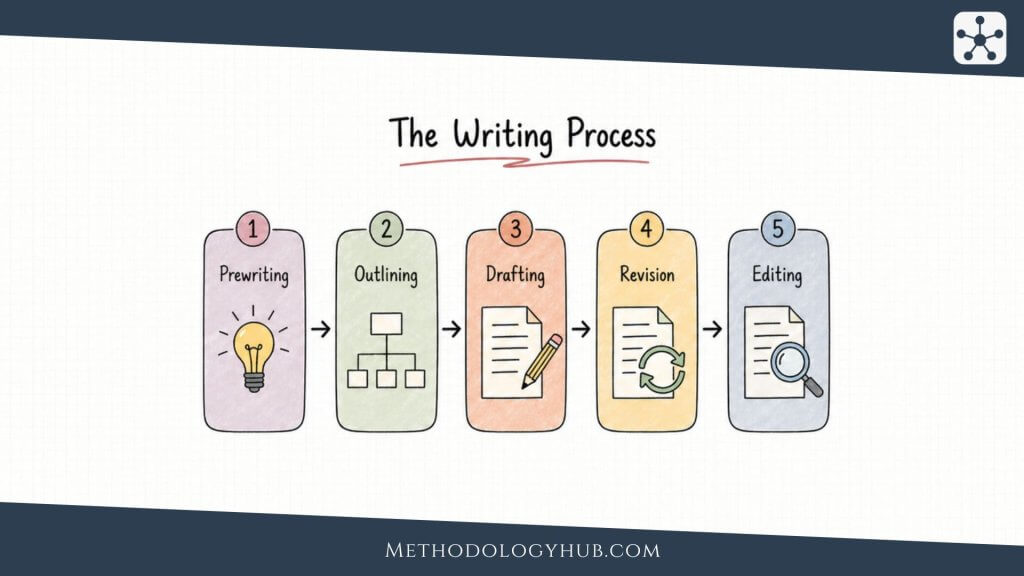
Strong academic writing usually looks calm and natural, but that effect comes from process: understanding the task, researching selectively, planning the structure, drafting with purpose, and revising carefully. It helps to think of writing in stages rather than expecting a perfect paragraph immediately.
Understand the task before you start writing
Many weak assignments go wrong before the first sentence because the task has not been understood properly. Even clear writing can fail if it answers the wrong question or uses the wrong type of response.
Before you begin, look closely at the prompt. Verbs such as analyse, compare, evaluate, discuss, justify, and reflect each ask for something different. They tell you what the reader expects.
- What exact question am I answering?
- What kind of writing does this task require?
- What counts as strong evidence in this subject?
- What are the limits of scope, length, and format?
Spending time here often saves hours of confused drafting later.
Start with a focused question or claim
Academic writing becomes stronger when it is focused. A common problem in student work is trying to cover too much, which makes paragraphs drift and arguments harder to follow.
A strong piece usually grows from a clear question or claim. Broad topics such as “climate change and cities” are only themes. A more useful academic focus narrows the issue, defines the angle, and suggests a purpose.
The more precise your focus, the easier it becomes to choose relevant evidence and cut material that is only loosely related.
Research with purpose, not just volume
Writing academically does not mean collecting as many sources as possible. Stronger work comes from selective, purposeful research.
The goal is to find relevant, credible material that helps answer the question. Instead of asking, “Can I cite this?”, ask, “What role could this source play?” A source might define a concept, provide context, offer a theory, present findings, or show disagreement.
Good note-taking matters here. Strong writers track key ideas, page numbers, and how each source might be used. They also notice where sources agree, differ, or leave gaps. That is often where the argument begins to form.
Plan the structure before drafting
Academic writing usually improves when the structure is planned before the full draft begins. You do not need to know every sentence, but you should know the path the reader will follow.
A simple outline with an introduction, a few main sections, and a conclusion is often enough. What matters is that each section has a purpose. If you cannot explain why a section belongs, it may not belong at all.
At paragraph level, each paragraph should usually do one job: introduce a point, explain evidence, compare views, or evaluate a claim.
- topic sentence: introduces the paragraph’s point
- development: explains the idea
- evidence: provides support
- analysis: shows why it matters
- link: connects back to the argument
A planned structure makes drafting clearer and more controlled.
Write clear paragraphs, not impressive sentences
Academic readers rarely judge a text by one striking sentence. They judge whether the reasoning develops clearly. That is why paragraph control matters more than sentence-level display.
A strong paragraph has a visible point, relevant evidence, and a clear reason for being where it is. Many writing problems come from paragraphs with no main point, unexplained evidence, topic drift, or weak endings.
One simple revision method is to read only the first sentence of each paragraph. If those sentences do not form a logical progression, the structure probably needs work.
Use evidence actively
Writing academically means using sources actively, not dropping them into the paragraph and leaving them unexplained. In strong writing, evidence is introduced, interpreted, and connected to the writer’s point.
The reader should always be able to see why a source is there. Does it define a concept, support a claim, offer an example, or challenge another view? Without that connection, the citation may be correct but still weak.
Quotations are not always necessary. Paraphrasing is often better because it lets you integrate ideas more smoothly. What matters is that the source does real work in the paragraph.
Build an argument, not just a sequence of points
One of the clearest markers of academic writing is argument. Even when a task does not sound obviously argumentative, the reader usually wants more than a list of separate observations. They want to see reasoning develop.
An argument is not aggression or opinion for its own sake. It is a claim supported by reasoning and evidence. In good writing, paragraphs build on one another so that the text gains force over time.
A useful revision question is this: if I removed this paragraph, would the argument lose something necessary? If not, the paragraph may be repeating, drifting, or filling space.
Revise for clarity, precision, and flow
First drafts help you discover what you want to say. Revision is where you make that thinking readable. Good revision goes beyond grammar and asks bigger questions about argument, structure, key terms, evidence, and clarity.
Academic writing becomes stronger when vague phrases are replaced with exact ones, repetition is cut, and long sentences are reduced to what they actually need to say. Flow matters too, but real flow comes from logic. If the structure makes sense, the writing will usually feel smoother.
Proofread last, not first
Proofreading matters, but it should come near the end. Large issues such as focus, argument, and structure should be handled before sentence-level polishing.
Once those larger issues are settled, proofreading helps remove distractions by checking grammar, punctuation, spelling, formatting, and citation consistency. These details matter because mistakes can weaken the reader’s trust.
It often helps to proofread slowly and in a new format, for example by reading aloud or changing the text’s appearance. The aim is to see what is actually on the page, not what you meant to write.
How to Improve Your Academic Writing
Improving academic writing is usually about habits, not hidden tricks. Most students have ideas, but those ideas often appear on the page too broadly, too quickly, or without clear links to evidence. That is encouraging, because habits can be improved.
Writing quality is shaped long before the final draft. It depends on what you read, how you take notes, how you plan, how you revise, and how you use feedback. Stronger academic writing usually comes from a stronger process.
Read strong academic writing with attention
One of the best ways to improve is to notice how strong academic texts are built. Many students read only for content and miss the writing choices that make a text effective.
When reading a strong article or essay, look at how the introduction frames the issue, how paragraphs open, how sources are integrated, and how the writer moves between points. The goal is not to copy the style, but to understand the craft.
- How is the main problem introduced?
- What makes the structure easy to follow?
- How are sources explained rather than dropped in?
- Where does the writing become analytical instead of descriptive?
Reading this way sharpens your judgment and helps you recognise what controlled writing looks like.
Improve clarity before trying to sound advanced
Many students try to sound more academic by using longer words and heavier sentences. In practice, this often weakens the writing. Clarity is a better goal.
Clear academic writing does not oversimplify ideas. It presents them in a way the reader can follow without extra effort. That usually means precise wording, manageable sentence structure, and paragraphs with a visible point.
A useful revision habit is to check for vague words such as “thing”, “aspect”, “factor”, or “significant”. Sentences usually improve when those terms are replaced with something more specific.
Strengthen coherence and cohesion
Many writing problems are not really grammar problems. Sentences may be correct on their own, but the paragraph still feels awkward because the ideas do not connect smoothly.
Coherence means the paragraph makes overall sense and develops logically. Cohesion means the reader can follow the links between sentences. You need both.
Ask simple questions: does the paragraph begin with a clear point, does the evidence support it, and does the ending connect back to the argument? When writing feels choppy, the links between ideas often need to be made more explicit.
Learn to paraphrase and synthesise properly
Academic writing improves when you work with sources more confidently. Weak drafts often rely too much on quotation or stay too close to the source wording, which makes the writing feel borrowed.
Paraphrasing helps because it forces you to process the idea and express it in your own structure. Stronger writing also synthesises sources by showing relationships between them.
Instead of listing Source A, Source B, and Source C separately, stronger paragraphs group sources into a pattern, debate, agreement, or limitation. That shows you are organising knowledge, not just reporting notes.
Revise more than once, and revise for different things
Many students say they revise, but often they only reread once, fix a few awkward phrases, and correct typos. Real improvement usually requires several kinds of revision.
It helps to revise in layers:
- first layer: argument, focus, and structure
- second layer: paragraph development and evidence
- third layer: style, wording, and sentence clarity
- final layer: grammar, punctuation, formatting, and references
This is more efficient because it stops you polishing sentences that may later be cut. A short break between drafting and revising also makes problems easier to spot.
Use feedback as material, not as judgment
Feedback can feel frustrating, but it is one of the best tools for improvement if you read it productively. The aim is not to obey every suggestion blindly. The aim is to spot patterns.
If several comments point to the same issue, that issue probably reflects a habit worth fixing. It also helps to turn feedback into action questions. For example, “needs more analysis” can become: where am I only reporting information instead of explaining its meaning?
Writing improves when feedback becomes part of your process, not just a reaction to one assignment.
Build a repeatable writing routine
Improvement is easier when writing is treated as regular practice rather than a last-minute performance. Waiting until pressure is high can produce work, but it is not a strong long-term system.
A repeatable routine can be simple: one day for notes, another for outlining, focused drafting blocks, and revision later with a fresh mind. The exact schedule matters less than making the process regular.
Routine also reduces fear. When writing becomes a familiar sequence of steps, it becomes easier to begin.
Pay attention to your recurring weak spots
Every writer has patterns. Some overwrite introductions, rely on vague claims, or include evidence without enough analysis. Improvement becomes faster when you identify your own recurring weak spots instead of treating every draft as a new problem.
If you know your common problems, you can edit more intelligently and fix them before the draft leaves your hands. That builds confidence and makes improvement more efficient.
Using Sources Ethically When Writing
Academic writing depends on ideas, evidence, and research, so it also depends on using sources ethically. This is not a minor technical issue. If your analysis is strong but your sources are handled carelessly, the whole piece becomes less credible.
Ethical source use is mainly about honesty and clarity. Readers need to see which ideas are yours, which come from other writers, and how outside research supports your argument. Good academic writing makes that relationship visible.
This involves more than adding citations at the end of sentences. It means paraphrasing carefully, quoting selectively, summarising accurately, and integrating sources into your own thinking rather than pasting them in as decoration.
Paraphrasing, summarising, and quoting
These are three main ways to use sources, and each has a different purpose. Weak source use often happens when writers rely too heavily on one method or choose the wrong one.
Paraphrasing means rewriting an idea in your own words while keeping the original meaning. It is often the most useful method because it lets you fit the source smoothly into your argument.
Summarising means condensing the main point of a source or larger section. This works well when you want to give an overview without too much detail.
Quoting means using the exact words of the source. It is most useful when the wording itself is especially precise, important, or worth analysing closely.
Strong academic writing usually relies most on paraphrasing and summarising, while using quotation more selectively. That keeps the writer’s own voice in control.
Avoiding plagiarism
Plagiarism happens when someone presents another person’s words, ideas, data, or distinctive work as their own without proper acknowledgement. This is serious because academic writing depends on trust.
Some cases are obvious, such as copying text without quotation marks or citation. But plagiarism can also happen when a writer paraphrases too closely, borrows a structure of ideas, or uses source-based information without clear credit.
To avoid plagiarism, it helps to follow a few disciplined habits:
- keep clear notes on which ideas come from which source
- mark direct quotations clearly from the start
- cite borrowed ideas, not only borrowed words
- paraphrase from understanding, not by changing a few words
Intention matters, but so does the result. If a source is not credited properly, the writing becomes misleading whether the mistake was deliberate or careless.
Avoiding patchwriting
Patchwriting is a common source-use problem. It happens when a writer stays too close to the language or sentence structure of the original source, even if some words are changed and a citation is included.
This often happens when the writer only partly understands the source or is drafting under pressure. The result is writing that sounds borrowed and awkward.
Patchwriting matters because it can move close to plagiarism, but it also weakens the paragraph. The source’s phrasing begins to control the writing instead of the writer’s own argument.
A better method is to read the source, step away from it, and then explain the idea from memory as if teaching it to someone else. After that, compare your version with the original and add the citation.
Using AI responsibly in academic writing
AI tools have made source use more complicated because they can generate summaries, paraphrases, and whole blocks of text quickly. That can be tempting under pressure, but responsible academic writing still depends on the same basic rule: your work should honestly reflect what you know, what you wrote, and how you used outside help.
Institutions have different rules on AI use, so the first step is always to check local policy. Some allow limited use for brainstorming or language support, while others restrict it more heavily in assessed work.
There is also a writing issue. AI-generated text may sound smooth, but smoothness is not the same as accuracy. If you rely on AI to paraphrase sources, summarise research, or generate claims you cannot verify, you risk errors, fabricated references, or language you do not fully understand.
Responsible AI use usually means:
- checking whether your institution allows the kind of use you want
- verifying every factual claim, citation, and summary independently
- using AI as support rather than a substitute for your own reasoning
- disclosing AI use where required
A simple rule is this: if you cannot explain, defend, and verify what appears in your paper, it should not be there.
Conclusion
Academic writing is not just a formal way of putting words on a page. It is a way of thinking clearly, organising ideas with purpose, and showing the reader how your conclusions are supported. Once you understand its main features, types, and expectations, the process becomes much less mysterious.
What usually makes the biggest difference is not trying to sound more academic. It is learning how to focus the topic, build stronger paragraphs, use evidence properly, and revise with more honesty. That is where academic writing starts to feel more controlled and more convincing.
If you want one practical takeaway from this guide, let it be this: strong academic writing is built step by step. It improves when you make better decisions before drafting, during drafting, and especially while revising.
- Know what the task is asking.
- Keep the argument focused.
- Use sources carefully and ethically.
- Revise for clarity, structure, and analysis.
Those habits matter more than sounding impressive. Over time, they make your writing easier to trust, easier to read, and much more effective in academic settings.
FAQs on Academic Writing
What is academic writing?
Academic writing is a formal, structured, and evidence-based way of communicating ideas in schools, universities, and research settings. It is used to explain concepts, analyse information, develop arguments, and present research clearly. Good academic writing is not defined by complicated language, but by clarity, logic, precision, and responsible use of sources.
What are the main types of academic writing?
The four main types of academic writing are descriptive, analytical, persuasive, and critical writing. Descriptive writing presents information clearly, analytical writing examines relationships and patterns, persuasive writing builds an argument with evidence, and critical writing evaluates ideas, sources, and limitations. In many assignments, these types of academic writing are combined rather than used completely separately.
What are examples of academic writing?
Common examples of academic writing include essays, research papers, theses, dissertations, research proposals, lab reports, literature reviews, and motivation letters for academic applications. Each example of academic writing has a different purpose, but all of them rely on structure, evidence, formal tone, and clear reasoning.
How do you write academically?
To write academically, start by understanding the task, narrowing the topic, and planning a clear structure. Use credible sources, build focused paragraphs, support claims with evidence, and keep the tone formal but readable. Strong academic writing also depends on revision, because clarity, coherence, and precision usually improve after the first draft.