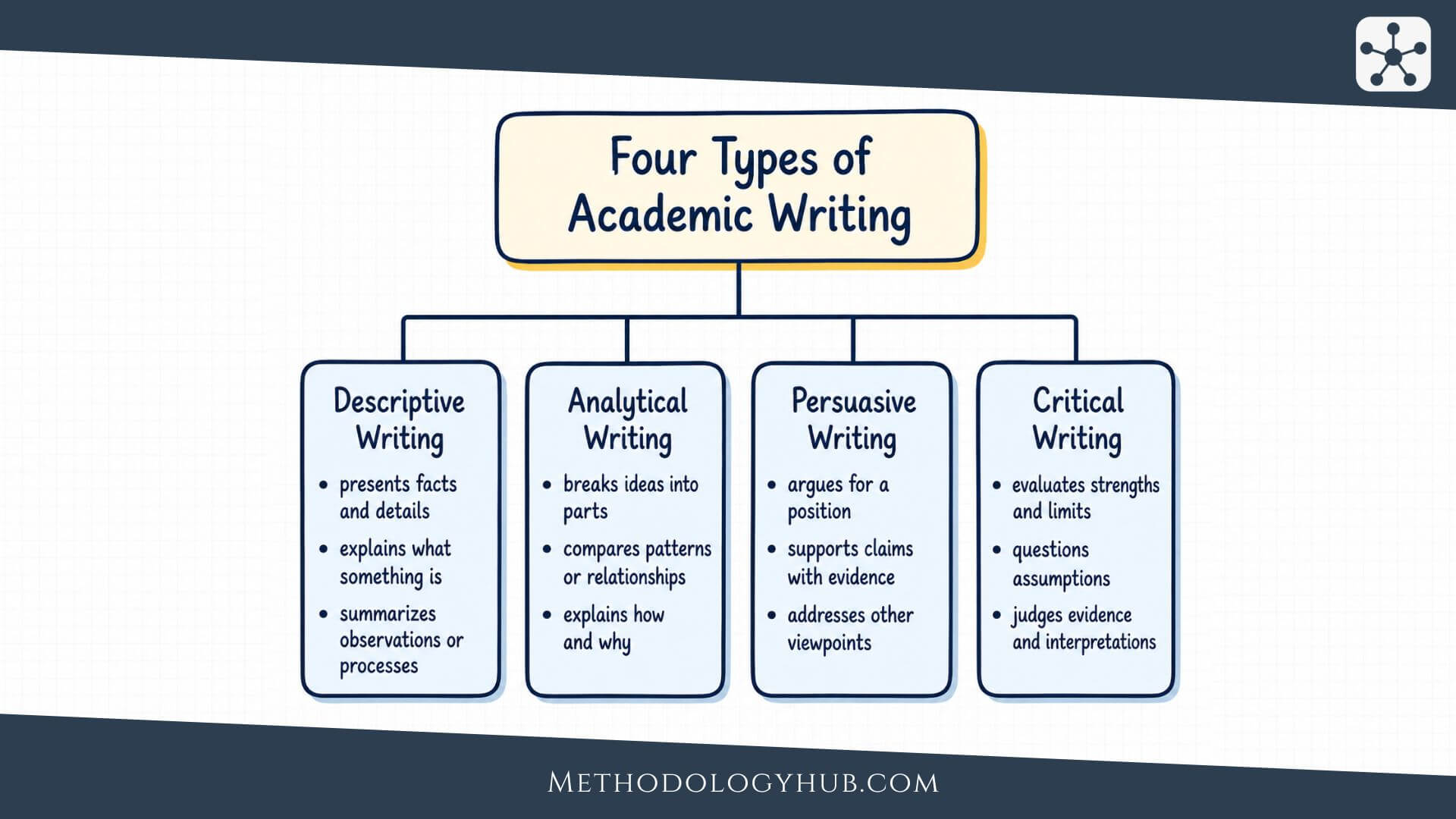
The four types of academic writing describe the different jobs a text can do in a school, university, or research setting. Sometimes academic writing presents information. Sometimes it breaks information apart and explains how the pieces relate. Sometimes it develops a position. Sometimes it judges the strength of evidence, methods, or ideas.
This article will explain the four main types of academic writing, show how they differ, and give examples of how each one appears in real academic work.
What Are the Main Types of Academic Writing?
The main types of academic writing are descriptive, analytical, persuasive, and critical. They are not completely separate genres. They are better understood as writing functions. A research paper, essay, lab report, literature review, thesis, or dissertation may use several of them in the same piece.
That overlap is normal. A literature review may describe a group of studies, analyse patterns across them, argue that one approach gives a stronger explanation, and evaluate gaps in the available evidence. A lab report may describe the method, analyse results, persuade the reader that the interpretation is reasonable, and critically discuss limitations. The type depends less on the document name and more on what the writing is doing at a given moment.
Descriptive writing
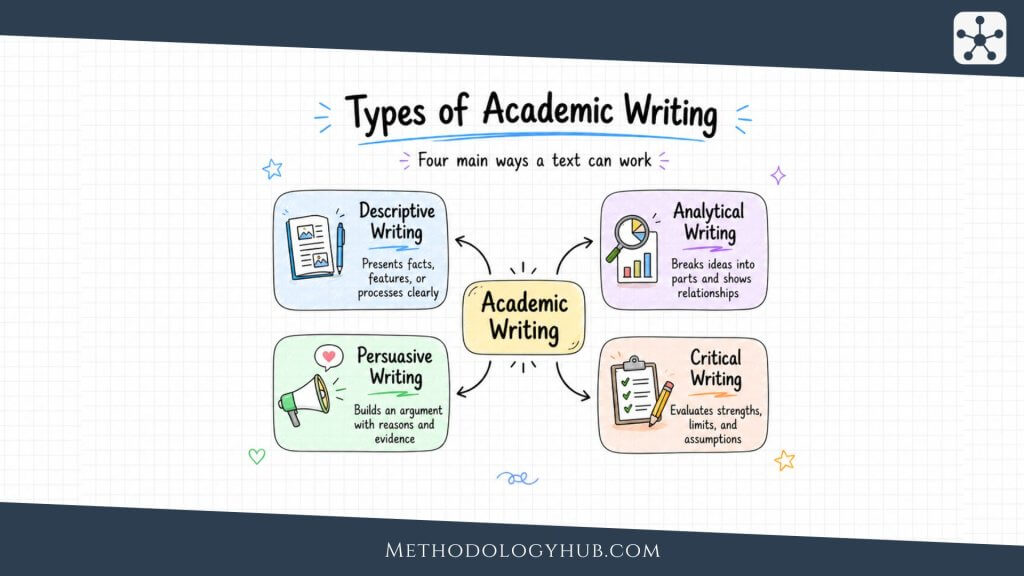
Descriptive writing presents information clearly. It defines terms, reports facts, outlines processes, summarises sources, or records observations. It gives the reader the background needed to understand the topic.
Analytical writing
Analytical writing organises and interprets information. It looks for patterns, categories, relationships, causes, differences, and connections. It moves beyond reporting what exists and begins to explain how ideas or evidence work together.
Persuasive writing
Persuasive writing develops a position. It makes a claim and supports it with reasons, evidence, and careful structure. In academic contexts, persuasion is not loud or emotional. It is a disciplined form of argument.
Critical writing
Critical writing evaluates. It examines the strength of evidence, the logic of arguments, the limits of methods, and the assumptions behind claims. It can agree with a source, but it should explain why that source deserves confidence.
Descriptive Writing
Descriptive writing is the foundation of many academic texts. It tells the reader what something is, what happened, how something works, or what a source says. Without description, academic writing becomes confusing because the reader lacks the basic information needed to follow the discussion.
At the same time, descriptive writing has limits. It can be accurate and useful, but it does not usually carry a higher-level assignment on its own. In many university tasks, description is the starting point. It gives the reader orientation before the writing moves into analysis, argument, or evaluation.

What descriptive writing does
Descriptive writing gives information in a clear, orderly way. It may define a key term, introduce a theory, outline a method, describe a setting, report a finding, or summarise a source. The writer is not yet trying to judge the material in depth. The main task is to make the material understandable.
Descriptive academic writing often does the following:
- defines concepts and technical terms
- summarises the main point of a source
- reports facts, events, or observations
- outlines stages in a process or method
- identifies features, categories, or characteristics
- presents results before interpreting them
For example, a lab report might describe the equipment used in an experiment. A history essay might outline the sequence of events before interpreting their causes. A literature review might summarise a study before comparing it with other work. These descriptive moments are not weak. They become weak only when the whole assignment stays at that level.
Where descriptive writing appears
Descriptive writing appears in almost every academic genre. Introductions often use it to establish the subject. Background sections use it to explain context. Method sections use it to describe procedures. Results sections use it to report what was found. Literature reviews use it to introduce sources before comparing or evaluating them.
In an essay, description might appear in a paragraph that defines a central concept. For example, an education essay on formative assessment may first explain what formative assessment means. Only then can the essay analyse how it is used, argue for its role in a particular learning context, or evaluate the evidence for its effectiveness.
In scientific writing, description is especially visible in methods and results. The method has to be clear enough for the reader to understand what was done. The results have to present findings before the discussion interprets them. A report that skips this descriptive work may leave the reader uncertain about the basis for the later claims.
Examples of descriptive writing
Descriptive writing often sounds direct and factual. It does not hide behind vague phrases or dramatic claims. Its strength comes from accuracy and control.
- Definition example: “A literature review is a structured account of existing research on a focused topic.”
- Source summary example: “The study examines the relationship between sleep duration and self-reported concentration among first-year university students.”
- Method example: “Participants completed a questionnaire at the beginning and end of the semester.”
- Result example: “The survey showed that most respondents used the library database at least once during the research phase.”
These examples give the reader information. They do not yet explain the meaning of the information. That next step belongs to analysis or evaluation.
Strong descriptive writing vs weak descriptive writing
Weak description often gives either too little information or too much. Too little leaves the reader confused. Too much makes the paragraph feel like a pile of notes. Strong description selects what the reader needs and presents it in a logical order.
- Weak descriptive writing: “The study was about students and writing and had many findings about different problems.”
- Stronger descriptive writing: “The study examined undergraduate students’ academic writing difficulties, focusing on topic analysis, use of evidence, sentence control, and confidence with academic conventions.”
The stronger version does not sound more complicated. It sounds clearer. It tells the reader what the study examined and which features were central. That is the goal of description in academic writing: not to fill space, but to prepare the reader for the next step.
How to keep description concise
Many student assignments lose force because descriptive passages become too long. This usually happens when the writer includes every detail from notes instead of selecting details that help the paragraph. A useful test is to ask what role each sentence plays. Does it define a term, provide necessary context, or prepare for interpretation? If not, it may be background that does not need to stay.
Description also becomes stronger when it is placed close to the point it supports. Instead of writing a long background section at the beginning, a writer can introduce descriptive information just before using it. This creates a smoother reading experience because the reader sees why the information is there.
Analytical Writing
Analytical writing begins when the writer does more than present information. It takes the information apart, organises it, and explains the relationship between its parts. If descriptive writing answers “what”, analytical writing begins to answer “how”, “why”, “in what pattern”, and “in what relationship”.
This is the point where academic writing often becomes more interesting. The writer is no longer just showing that sources have been read or facts have been collected. The writer is showing how material can be organised into a meaningful interpretation.

What analytical writing does
Analytical writing breaks material into parts and explains how those parts connect. It may compare theories, group research findings into themes, identify patterns in data, separate causes from effects, or explain how a concept works across different contexts.
Analytical academic writing often does the following:
- compares similarities and differences
- groups evidence into categories or themes
- identifies patterns, trends, or relationships
- explains causes and consequences
- separates a broad issue into smaller parts
- connects examples to a larger interpretation
Analysis is not the same as having an opinion. A paragraph can be analytical without taking a strong position yet. Its main work is to organise and interpret. It gives shape to information that would otherwise remain scattered.
Analysis as a step beyond summary
A summary tells the reader what a source says. Analysis explains what can be seen when sources, facts, or examples are examined together. This distinction is one of the easiest ways to strengthen academic writing.
- Mostly descriptive: “Three studies discuss feedback in undergraduate writing courses.”
- More analytical: “The three studies approach feedback from different angles: one treats feedback as correction, one as dialogue, and one as a way to develop students’ independence as writers.”
The analytical version does not merely name the studies. It groups them into meaningful categories. This gives the reader a clearer sense of the research landscape and prepares the ground for a possible argument or evaluation.
Common analytical moves
Analytical writing can take many forms, but some moves appear again and again. A compare-and-contrast paragraph examines similarities and differences. A classification paragraph groups material into categories. A cause-and-effect paragraph explains how one condition may lead to another. A thematic paragraph gathers several sources around the same idea.
For example, in a literature review, a writer might notice that studies on academic writing support fall into three broad groups: studies of writing centres, studies of disciplinary writing instruction, and studies of peer feedback. That grouping is analytical because it gives structure to a body of research.
In a data-based assignment, analysis might involve noticing that one pattern appears across several interviews. In a humanities essay, it might involve comparing two interpretations of the same text. In a social science paper, it might involve separating individual-level explanations from institutional explanations.
Examples of analytical writing
Analytical writing usually sounds more interpretive than descriptive writing. It often uses language that signals relationships: whereas, by contrast, similarly, this suggests, this pattern shows, these findings can be grouped, or the distinction between.
- Literature review example: “The studies can be divided into two groups: those that treat academic writing as a set of transferable skills, and those that treat it as a social practice shaped by discipline, institution, and identity.”
- Essay example: “Although both authors discuss student agency, the first connects it to classroom participation, while the second links it to control over assessment choices.”
- Research report example: “Responses from first-year students clustered around three concerns: uncertainty about expectations, difficulty integrating sources, and anxiety about formal tone.”
Each example does more than report information. It organises information so that the reader sees a pattern.
From descriptive to analytical: example rewrite
It often helps to see the shift on the page.
- Descriptive version: “The article discusses feedback in academic writing. It says students often have difficulty using comments from tutors. It also mentions peer feedback.”
- Analytical version: “The article presents feedback as a process rather than a single correction. Tutor comments are shown as useful only when students understand how to act on them, while peer feedback is presented as a way to make revision more dialogic and less dependent on one authority figure.”
The analytical version has a stronger shape. It identifies a central idea, separates the parts of the discussion, and explains their relationship. That is what analysis adds.
How to strengthen analytical paragraphs
A useful analytical paragraph usually begins with a point that names the relationship being discussed. The evidence then supports that relationship, and the explanation shows the reader how to understand it. When analytical writing feels weak, the problem is often that the paragraph has examples but no pattern.
To revise, ask what the examples have in common. Do they show a contrast, a sequence, a tension, a repeated problem, or a shift over time? Naming that relationship usually gives the paragraph a clearer purpose.
Persuasive Writing
Persuasive writing in academic contexts means building a reasoned position. It is not the same as trying to win through forceful language. Academic persuasion depends on a clear claim, relevant evidence, logical development, and careful attention to other possible interpretations.
This type of writing is common in essays, research papers, position papers, research proposals, and discussion sections. It also appears in smaller ways throughout academic work whenever a writer needs to convince the reader that a particular interpretation is reasonable.

What persuasive writing does
Persuasive writing makes a claim and supports it. The claim may be a thesis statement, an interpretation, a recommendation, a methodological choice, or a conclusion drawn from evidence. The writer’s job is to guide the reader from the starting point to that claim in a way that feels earned.
Academic persuasive writing usually includes:
- a clear position or central claim
- evidence selected because it supports that position
- reasoning that explains the link between evidence and claim
- attention to alternative viewpoints or limitations
- careful wording that avoids exaggeration
A claim alone is not persuasive. A paragraph that says “this interpretation is correct” without showing why gives the reader very little to trust. Academic persuasion becomes stronger when each step is visible.
Persuasion in academic contexts
Persuasion looks different across disciplines. In literary studies, a writer may persuade the reader that one interpretation of a text is stronger than another. In education, a writer may argue that a teaching method fits a particular learning context. In sociology, a writer may defend one explanation for a pattern in survey data. In a research proposal, a writer may justify the choice of method.
Across these examples, persuasion remains evidence-based. The writer does not ask the reader to accept a claim because it sounds confident. The writer shows why the claim follows from the material presented.
Thesis statements and central claims
A persuasive academic text usually needs a central claim that controls the direction of the writing. This claim does not have to appear in the same form in every discipline, but the reader should be able to identify what the writer is trying to establish.
A weak thesis is often too broad, too obvious, or too absolute.
- Weak claim: “Feedback is good for student writing.”
- Stronger claim: “Feedback improves student writing most clearly when it is specific, connected to revision, and supported by opportunities for students to ask questions about the comments they receive.”
The stronger claim gives the writer a path. It can be developed through sections on specificity, revision, and dialogue. It also avoids pretending that all feedback works in the same way.
Evidence and reasoning
Evidence does not persuade by itself. A quotation, statistic, or study finding needs explanation. The writer has to show what the evidence demonstrates and how it supports the claim.
This is where many persuasive paragraphs become thin. They introduce a source, cite it correctly, and move on too quickly. The result looks academic but feels unfinished. Stronger writing slows down at the right moment and explains the connection.
- Thin use of evidence: “The study found that students used feedback more when it was clear. This proves feedback should be clearer.”
- Stronger use of evidence: “The finding suggests that clarity is not simply a stylistic preference in feedback. It affects whether students can translate comments into revision decisions, which makes clarity part of the learning process rather than an optional feature.”
The stronger version turns evidence into reasoning. That is what persuasive academic writing needs.
Handling other viewpoints
Academic persuasion becomes more credible when it recognises that other interpretations may exist. This does not mean adding a weak sentence that says “some people disagree” and leaving it there. It means engaging with another view in a way that clarifies the writer’s own position.
For example, a writer arguing for peer feedback might acknowledge that students sometimes distrust peer comments. The argument can then become more precise: peer feedback is not automatically useful, but it can be effective when students receive guidance on giving specific, criteria-based comments. The alternative view has not destroyed the argument. It has helped refine it.
Examples of persuasive writing
Persuasive academic writing often uses language such as this suggests, therefore, the evidence supports, this interpretation is stronger because, or a more convincing explanation is. The tone should be firm but measured.
- Essay example: “The second interpretation is more convincing because it accounts for both the speaker’s uncertainty and the repeated shifts in tone across the poem.”
- Research proposal example: “A qualitative interview design is appropriate for this study because the research question focuses on students’ experiences rather than on measuring frequency or distribution.”
- Discussion section example: “The findings support the view that writing confidence develops through repeated revision, not only through direct instruction in grammar.”
In each case, the writer is not merely describing or analysing. The writer is asking the reader to accept a position, and that position is supported with reasons.
Critical Writing
Critical writing is often the most advanced of the four types because it requires judgment. It does not stop at describing information, analysing relationships, or arguing for a position. It asks how strong the evidence is, how convincing the reasoning is, what assumptions are present, and where the limits of a claim may be.
Critical writing is not the same as negative writing. A critical paragraph can agree with a source. It can praise a method, support an interpretation, or accept a conclusion. The difference is that it explains the grounds for that judgment instead of accepting the source too quickly.

What critical writing does
Critical writing evaluates the quality and implications of academic material. It may examine whether a source uses suitable evidence, whether a method fits the research question, whether a conclusion follows from the data, or whether an argument overlooks an alternative explanation.
Critical academic writing often does the following:
- evaluates the strength of evidence
- examines assumptions behind an argument
- identifies limitations in a study or interpretation
- compares the quality of competing explanations
- questions whether conclusions are justified
- explains the implications of a finding or position
This kind of writing shows the reader that the writer can judge material rather than simply collect it. It is especially common in literature reviews, higher-level essays, discussion sections, and dissertation chapters.
Critical does not mean negative
A common misunderstanding is that critical writing has to find fault. That can lead to paragraphs that sound harsh but are not actually well judged. Academic criticism should be fair, specific, and grounded in evidence.
For example, writing “the study is bad” is not critical in an academic sense. It is simply a judgment without support. A stronger critical sentence would explain the basis of the judgment: “The study offers useful insight into students’ experiences, but its small sample and single-institution design limit how far the findings can be generalised.” This sentence recognises both value and limitation.
Critical writing often uses balanced language because the strongest judgment is rarely absolute. Words such as however, although, nevertheless, limited by, more convincing, less clearly supported, and depends on can help the writer express judgment without exaggeration.
Critical writing in different assignments
In a literature review, critical writing may compare the strength of several studies. It might ask whether the research designs are comparable, whether the samples are suitable, or whether the studies define key terms in the same way. The point is not only to report what scholars have said, but to judge the state of the evidence.
In an essay, critical writing may evaluate competing interpretations. A student may explain why one explanation accounts for more evidence than another, or why a theory is helpful in one context but less useful in another.
In a discussion section, critical writing often appears when the writer interprets findings and recognises limits. The writer might explain that a result supports the research question only partly, or that the method cannot show causation. This kind of judgment protects the argument from overreach.
Examples of critical writing
The difference between descriptive, analytical, and critical writing becomes clear when the same topic is handled in three ways.
- Descriptive: “The study interviewed twenty first-year students about academic writing.”
- Analytical: “The interviews show that students’ concerns clustered around three areas: understanding expectations, integrating sources, and managing formal tone.”
- Critical: “Although the interviews give detailed insight into students’ experiences, the study’s focus on one institution means the findings should be read as context-specific rather than broadly representative.”
The critical version evaluates the strength and reach of the evidence. It does not reject the study. It explains how the evidence should be interpreted.
How to write more critically
Critical writing improves when the writer slows down and asks what can be reasonably concluded. This often means looking at the method, scope, definitions, assumptions, and evidence behind a claim.
One practical way to revise is to add a judgment sentence after a descriptive or analytical sentence. After summarising a source, ask: how convincing is this point? After grouping sources, ask: what does this pattern reveal, and where does it remain limited? After making an argument, ask: what could challenge this position?
The goal is not to add criticism everywhere. The goal is to make judgment visible where the task requires it.
How the Four Types of Academic Writing Work Together
The four types of academic writing are easier to understand separately, but they rarely stay separate in real assignments. A strong academic paragraph often moves through more than one type. It may begin with description, shift into analysis, use that analysis to support an argument, and then add a critical qualification.
This movement gives academic writing its depth. A text that only describes can feel flat. A text that argues without enough description can feel rushed. A text that criticises without analysis can feel unsupported. The strongest writing usually knows when to move from one type to another.
Most academic texts combine several types
Consider a literature review. The writer cannot evaluate research without first describing what the studies examine. The writer cannot compare studies without analysing their methods, findings, or assumptions. The writer cannot present a coherent review without persuading the reader that certain patterns are more significant than others. And the writer cannot produce a strong review without critically judging the quality and limits of the evidence.
The same is true of essays. An essay might define a concept, compare two viewpoints, argue for one interpretation, and then recognise where the argument is limited. These shifts are not signs of inconsistency. They show that the writing is doing more than one intellectual job.
One topic written in four ways
Using the same topic makes the difference clearer. Imagine a student writing about feedback in university writing courses.
- Descriptive: “Feedback in university writing courses may come from tutors, peers, or automated writing tools.”
- Analytical: “These feedback sources differ in the kind of support they provide: tutors often address assignment expectations, peers may help writers recognise reader response, and automated tools tend to focus on surface-level patterns.”
- Persuasive: “Tutor and peer feedback should be combined in writing courses because they support different parts of the revision process.”
- Critical: “However, the value of peer feedback depends on guidance; without clear criteria, student comments may remain too general to support meaningful revision.”
Each sentence belongs to the same broad topic, but each performs a different task. A strong paragraph might use all four. It could introduce the forms of feedback, analyse their differences, argue for a combined approach, and qualify that argument by noting a condition for success.
How writing develops across a paragraph
A paragraph does not need to label its type. The reader should feel the movement naturally. For example:
“Feedback in university writing courses may come from tutors, peers, or automated writing tools. These sources support revision in different ways: tutor feedback can clarify assessment expectations, peer feedback can reveal how readers understand a draft, and automated tools can draw attention to repeated language patterns. For this reason, a combination of tutor and peer feedback is often stronger than reliance on a single source. However, peer feedback is most useful when students receive guidance on how to make comments specific, evidence-based, and connected to revision goals.”
The paragraph begins descriptively, becomes analytical, turns persuasive, and ends critically. The movement is smooth because each sentence grows from the previous one. That is the kind of flow students should aim for. The reader is not dragged through separate blocks of explanation. The paragraph develops.
How to Identify Which Type You Need
One of the simplest ways to choose the right type of academic writing is to study the assignment wording. Academic tasks are usually built around verbs, and those verbs tell you what kind of thinking the reader expects. The difference between describe, analyse, justify, and evaluate is not small. Each verb points toward a different kind of response.
Still, assignment verbs are clues rather than mechanical rules. A task that asks you to “evaluate” will usually need some description and analysis before the evaluation can make sense. A task that asks you to “discuss” may require a mixture of analysis, persuasion, and critical judgment. The key is to identify the leading type, then decide which supporting types are needed along the way.
Look at the task verb
The verbs below are common signals:
- Describe, define, identify, outline, summarise: these usually signal descriptive writing.
- Analyse, compare, contrast, examine, classify: these usually signal analytical writing.
- Argue, justify, defend, demonstrate, discuss: these often require persuasive writing.
- Evaluate, assess, critique, appraise, review: these usually require critical writing.
For example, “Describe the stages of the writing process” calls mainly for description. “Analyse how feedback influences revision” calls for analysis. “Argue that peer review should be included in first-year writing courses” calls for persuasion. “Evaluate the effectiveness of peer review in first-year writing courses” calls for critical judgment.
Look at the expected product
The document type also gives clues. A method section in a lab report is usually descriptive, while a discussion section is usually analytical and critical. A research proposal is often persuasive because it has to justify a planned study. A literature review may begin descriptively, but it should become analytical and critical as it compares sources.
Essays are flexible. Some essays ask mainly for argument, while others ask for evaluation. The title or prompt decides the balance. A good essay rarely stays descriptive for long, especially at university level.
Watch for mixed tasks
Many assignments contain more than one task. A prompt such as “Evaluate the extent to which formative feedback improves academic writing” does not ask for only one type. The writer needs to define formative feedback, describe relevant studies, analyse patterns in the evidence, argue for a position, and critically judge the strength of that position.
Mixed tasks can be handled by planning sections according to purpose. One section may establish the concept. Another may analyse evidence. Another may evaluate limitations. This creates a controlled structure instead of a sequence of disconnected points.
When students use the wrong type
Many writing problems come from using the wrong type at the wrong time. A student may describe sources when the prompt asks for evaluation. Another may argue strongly before defining key terms. Another may criticise a study without explaining the method or evidence first.
These problems are easier to fix once you identify the type. If a paragraph only summarises sources, ask what pattern or judgment should be added. If a paragraph argues too quickly, add the necessary description or analysis. If a paragraph criticises vaguely, replace general criticism with specific evaluation.
Examples of the Types of Academic Writing
The types of academic writing become clearer when they are connected to familiar assignment forms. A genre is the kind of document, such as an essay or lab report. A type is the job the writing does inside that document. The two are related, but they are not the same.
Essay writing
Essays often combine all four types. The introduction may describe the topic and define key terms. The body paragraphs may analyse evidence and build a persuasive argument. The strongest sections may also critically evaluate alternative views or limitations in the evidence.
For example, an essay on online learning might begin by describing what asynchronous learning means. It might then analyse differences between synchronous and asynchronous formats. It might argue that asynchronous learning improves access for some students. A critical paragraph could then explain that access alone does not guarantee engagement, especially when students lack support or reliable technology.
Literature review
A literature review is one of the best places to see the difference between description and higher-level academic writing. A weak review often moves source by source: one paragraph on Author A, one on Author B, one on Author C. That can become descriptive and repetitive.
A stronger literature review groups sources by themes, methods, debates, or findings. It analyses relationships across sources and critically evaluates the quality of the evidence. Description is still needed, but it is used in service of a larger synthesis.
Lab report or Research report
A lab report or research report uses different types in different sections. The introduction may describe the research problem and persuade the reader that the question is worth investigating. The method section is mainly descriptive because it explains what was done. The results section may begin descriptively, then become analytical as patterns are identified. The discussion section is usually analytical, persuasive, and critical.
This structure shows why the types are practical tools. A writer who understands them can control the tone of each section more effectively. The method should not sound like an opinion essay. The discussion should not merely repeat the results. Each section has its own task.
Dissertation or thesis chapter
Longer academic projects require more controlled movement between types. A thesis introduction may describe the topic, analyse a research gap, and persuade the reader that the project has a clear purpose. A literature review may analyse and critically evaluate scholarship. A findings chapter may describe data before analysing it. A discussion chapter may persuade the reader of the interpretation while critically recognising limits.
Because these projects are long, transitions become especially important. The writer must guide the reader from background to analysis, from evidence to argument, and from argument to evaluation. Otherwise, the chapter may feel like separate notes placed beside each other.
Conclusion
The main types of academic writing – descriptive, analytical, persuasive, and critical – help explain what academic texts are doing beneath the surface. They are not just labels for a textbook. They are practical tools for reading assignment instructions, planning sections, revising paragraphs, and checking whether the writing has gone far enough.
Descriptive writing gives the reader clear information. Analytical writing explains patterns and relationships. Persuasive writing builds a supported position. Critical writing evaluates the strength and limits of ideas, evidence, and conclusions. Used together, they give academic writing depth, direction, and control.
The strongest academic work rarely depends on one type alone. It moves. It gives the reader enough context, then interprets the material, develops a position, and judges how far that position can reasonably go. Once you understand that movement, academic writing becomes easier to plan and easier to revise.
FAQs on Types of Academic Writing
What are the four main types of academic writing?
The four main types of academic writing are descriptive, analytical, persuasive, and critical writing. Descriptive writing presents information, analytical writing explains relationships, persuasive writing builds a supported position, and critical writing evaluates evidence and ideas.
What is descriptive academic writing?
Descriptive academic writing defines, reports, outlines, or summarises information. It is used to give the reader background and context before the text moves into analysis, argument, or evaluation.
What is analytical academic writing?
Analytical academic writing breaks information into parts and explains relationships between those parts. It may compare sources, identify patterns, classify ideas, or explain causes and effects.
What is persuasive academic writing?
Persuasive academic writing develops a position through evidence and reasoning. It uses a clear claim, relevant support, and careful explanation to convince the reader that a conclusion is reasonable.