Analytical writing is a type of academic writing that explains information by breaking it into parts and showing how those parts relate to one another. Rather than telling the reader only what a topic is, analytical writing asks what the information shows, how patterns can be explained, and why one point leads to another.
This article explains what analytical writing is, how it differs from descriptive, persuasive, and critical writing, when to use it, how to structure it, and how analytical paragraphs work in essays, reports, literature reviews, and other academic tasks.
What Is Analytical Writing?
Analytical writing is writing that examines a topic by separating it into parts, studying the relationships between those parts, and explaining what the relationships reveal. It does not stop at presenting facts. It turns facts, examples, evidence, or source material into an interpretation the reader can follow.
A simple example can show the difference. A descriptive sentence might say that a study measured sleep, screen time, and stress among students. An analytical sentence would go further and explain that the study treats screen time as one possible factor in student stress, while also showing that sleep patterns may shape the relationship. The second sentence names the material and begins to organise it.
Analytical writing definition
Analytical writing means writing that breaks information into meaningful parts and explains patterns, relationships, causes, contrasts, or implications. It is often used when a writer needs to interpret evidence, compare ideas, explain how something works, or show how several pieces of information fit together.
The word analysis comes from the idea of taking something apart so it can be understood more clearly. In academic writing, this does not mean tearing a topic down for the sake of criticism. It means looking closely. A writer may analyse a poem, a research article, a historical event, a set of survey results, or a theory. In each case, the task is to move from surface information to a more careful explanation.
From description to analysis
Analytical writing often begins with description, but it does not remain there for long. Description gives the reader the facts, terms, background, or evidence needed to understand the topic. Analysis then asks what those facts mean in relation to a question.
For example, in a literature essay, description may identify the setting, characters, and central conflict of a novel. Analysis may then explain how the setting creates pressure on the characters, how the conflict develops through repeated images, or how the ending changes the reader’s understanding of earlier scenes. The descriptive material is still useful, but its purpose is to support interpretation.
Analytical writing in academic work
Analytical writing appears across many academic subjects. A history student may analyse causes of political change. A biology student may analyse patterns in experimental results. A sociology student may analyse differences between two theories. A literature student may analyse how language creates meaning in a poem. The subject changes, but the movement is similar: evidence is organised so the reader can understand a relationship or pattern.
This is one reason analytical writing sits near the centre of many university tasks. It helps writers move beyond collecting information. A text that only gathers facts can be useful as background, but it rarely answers a focused academic question. Analytical writing gives the answer shape. It explains why the evidence belongs together and what can be understood from it.
Features of Analytical Writing
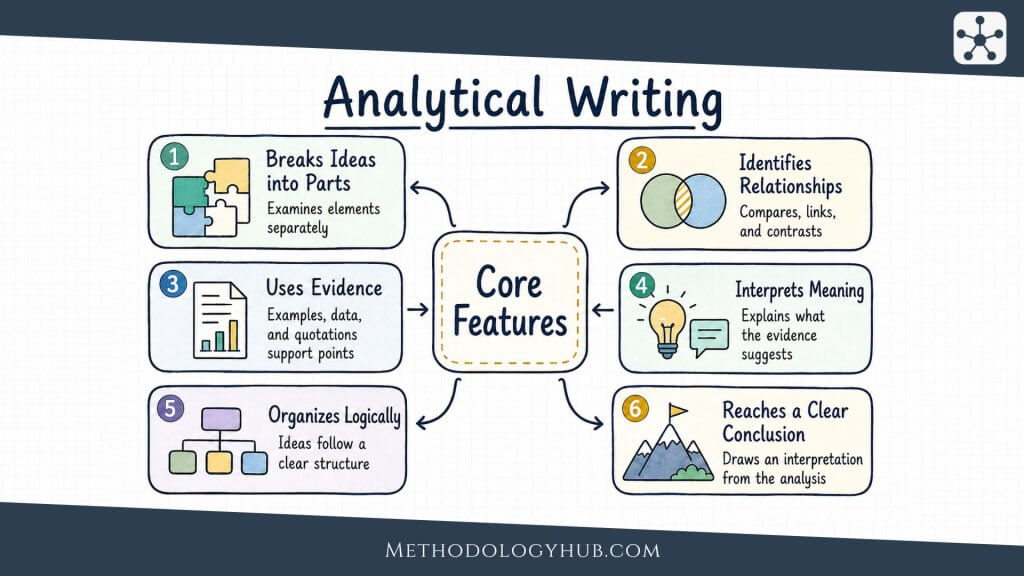
The features of analytical writing are easiest to see on the page. A strong analytical text has a clear focus, uses evidence carefully, separates a topic into meaningful parts, and explains how those parts connect. It does not simply add more information. It chooses, arranges, and interprets information in a controlled way.
This is where many writers begin to feel the shift from summary to analysis. Summary asks you to report what a source says. Analytical writing asks you to decide what role that source plays in your own explanation. The same piece of evidence can be used weakly or strongly depending on whether the writer explains its function.
It breaks the topic into parts
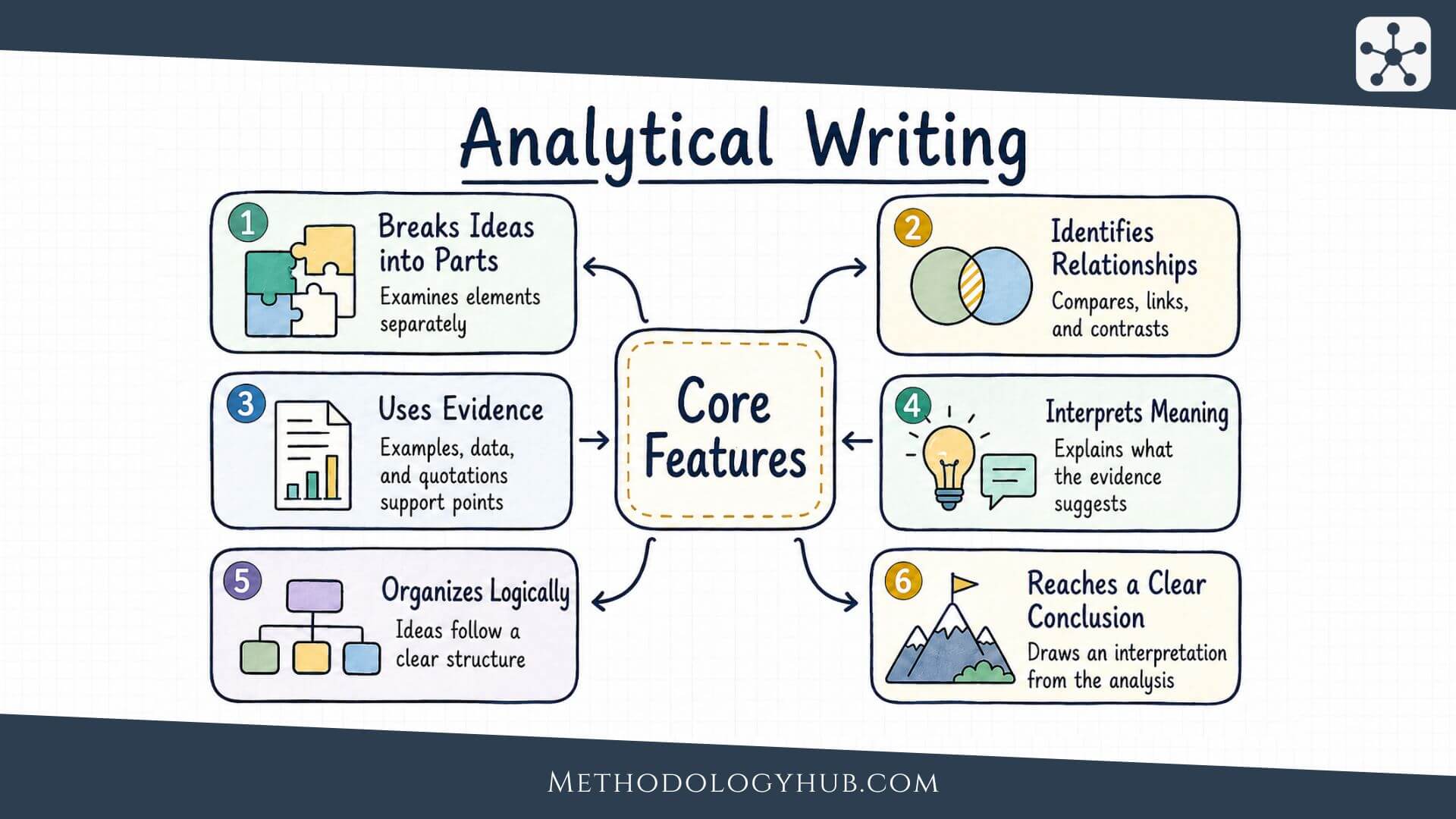
Analytical writing begins by dividing a broad topic into smaller parts that can be examined. These parts may be causes, themes, stages, variables, arguments, methods, examples, or sections of a text. The point is not to fragment the topic randomly. The point is to create a structure that helps the reader understand it.
For instance, a student analysing student motivation might separate the topic into classroom climate, feedback, workload, and peer support. A student analysing a poem might separate the poem into imagery, speaker, rhythm, and tone. The chosen parts should follow from the question being asked, not from a generic template.
It looks for relationships
After the topic has been separated into parts, analytical writing explains how those parts relate. This is the step that turns a list into an analysis. The writer may show that one factor influences another, that two theories interpret the same issue differently, or that a pattern appears across several examples.
Relationships can take many forms. Some are causal, as when a writer explains how limited feedback may affect revision quality. Some are comparative, as when two sources agree on a problem but propose different explanations. Some are structural, as when a research article builds from background to method to findings. Analytical writing makes these relationships visible.
It uses evidence as material for interpretation
Evidence in analytical writing is not decoration. It is the material the analysis works with. A quotation, data point, source finding, scene, table, or historical example should not appear only because it seems relevant. It should be introduced, interpreted, and connected to the writer’s point.
A useful pattern is claim, evidence, explanation. The claim gives the paragraph a direction. The evidence gives the reader something concrete to examine. The explanation shows how the evidence supports the claim. Without the explanation, the reader may understand the evidence but still not understand the writer’s reasoning.
Analytical move: Do not leave evidence alone. After presenting a detail, ask what it shows, how it connects to the question, and what changes in the reader’s understanding because of it.
It organises information into patterns
Analytical writing often groups information so the reader can see a pattern. In a literature review, several studies may be grouped by method, finding, theoretical approach, or limitation. In a history essay, events may be grouped by economic, political, and social causes. In a science report, observations may be grouped by trend or condition.
Grouping is not the same as placing items under labels. The writer also has to explain why the grouping is useful. If three studies are grouped together because they use survey data, the analysis should explain what that shared method allows, what it may miss, or how it affects the interpretation of their findings.
It keeps the claim narrower than the topic
Analytical writing works best when the claim is focused. A broad topic such as climate change, social media, or education is too large to analyse in a useful way without narrowing. A focused claim gives the writing a path.
For example, instead of writing about social media and learning in general, an analytical paragraph might examine how short-form video platforms affect students’ attention during independent study. The narrower claim allows the writer to select evidence more carefully and explain the relationship in more detail.
It uses careful, readable language
Analytical writing does not need to sound heavy. In fact, analysis becomes harder to follow when the prose is overloaded with abstract language. Clear wording helps the reader see the logic. Words such as suggests, contrasts, connects, explains, differs, develops, and supports can be useful because they name relationships without making the writing stiff.
The best analytical style is precise without becoming cold. It gives enough detail for the reader to follow the reasoning, but it avoids unnecessary complexity. A sentence should not sound academic because it is difficult. It should sound academic because it is accurate, controlled, and useful.
When to Use Analytical Writing
Analytical writing is useful whenever a task asks you to explain how something works, compare ideas, interpret evidence, or identify patterns. Many assignment verbs point toward this kind of writing: analyse, examine, compare, explain, interpret, discuss, account for, and investigate. These verbs usually ask for more than description.
It also helps to notice what the reader needs. If the reader only needs to know what happened, description may be enough for that moment. If the reader needs to understand why it happened, how it changed, how it compares, or what it suggests, analytical writing is needed.
Use it when answering an analytical assignment question
Many essay questions are built for analysis. A question such as “How does the author develop the theme of memory in the novel?” cannot be answered by summarising the plot. The writer needs to choose scenes, examine language, and explain how repeated details develop the theme.
The same is true in research-based assignments. A question such as “What factors explain differences in participation between two classrooms?” asks the writer to separate possible factors, compare evidence, and decide which relationships are most convincing. Analytical writing gives the answer its structure.
Use it in literature reviews
A literature review should not read like a sequence of source summaries. It needs analytical writing because the writer has to group studies, compare methods, identify agreements and tensions, and explain how the existing research relates to the new project.
For example, a weak literature review paragraph may describe five studies one after another. A stronger paragraph may explain that the studies fall into two groups: those that measure writing quality through rubrics and those that focus on student language resources. That grouping helps the reader understand the field rather than only remember individual sources.
Use it when interpreting data or findings
Analytical writing is also needed when a text moves from results to interpretation. A results section may report that one group scored higher than another. An analytical discussion asks what might explain the difference, how it relates to earlier research, and what limits the interpretation.
This does not mean inventing a dramatic explanation for every number. It means staying close to the evidence while helping the reader understand its possible meaning. A careful writer shows the pattern, names the limits, and avoids claiming more than the data can support.
Use it when comparing sources or viewpoints
Comparison is one of the most common uses of analytical writing. A writer may compare two theories, two methods, two poems, two historical interpretations, or two sets of findings. The goal is not simply to say that they are similar or different. The goal is to explain what the comparison reveals.
For example, two researchers may both study student feedback, but one may focus on teacher comments while the other focuses on peer review. An analytical comparison would explain how the difference in focus changes the kind of conclusion each study can support.
Use it inside persuasive and critical writing
Analytical writing often works inside other forms of academic writing. A persuasive essay needs analysis because the writer must explain evidence before using it to support a position. A critical essay also needs analysis because evaluation depends on first understanding how an argument is built.
This is why the four types of academic writing often overlap in real assignments. A paragraph may describe a study, analyse its method, use it to support a claim, and then evaluate its limits. Learning analytical writing helps with all of those moves.
Structuring Analytical Writing
Structuring analytical writing means arranging ideas so the reader can follow the movement from question to evidence to interpretation. A strong structure does not simply place points in a tidy order. It shows how each section or paragraph advances the analysis.
The exact structure depends on the task. A short essay, a lab discussion, a history paper, and a literature review will not use the same headings. Even so, most analytical writing follows a similar logic: introduce the focus, divide the topic into parts, examine those parts with evidence, and bring the interpretation back to the main question.
Start with a focused question or claim
Analytical writing needs a focus before it can develop. That focus may be a research question, essay prompt, thesis statement, or working claim. Without it, the writing may drift into background information because there is no clear reason to choose one detail over another.
A focused claim does not have to answer everything at once. It should give the reader a direction. For example, “This essay analyses how feedback timing affects student revision” is more useful than “This essay is about feedback.” The first version tells the reader what relationship will be examined.
Organise sections around analytical tasks
One helpful way to structure a longer analytical text is to let each section perform a different task. One section may define the problem. Another may compare two approaches. Another may examine evidence from a case or dataset. Another may explain what the pattern suggests.
This kind of structure helps avoid repetition. If two sections are doing the same job, they may need to be merged or separated more clearly. Each section should give the reader a new step in the analysis.
Build paragraphs around one analytical move
Analytical paragraphs work best when each paragraph has one main task. A paragraph may explain a cause, compare two sources, interpret one quotation, or connect a finding to a theory. When a paragraph tries to do too many things, the analysis becomes harder to follow.
A useful paragraph structure is topic sentence, context, evidence, explanation, and link. The topic sentence tells the reader the analytical point. The context prepares the evidence. The evidence gives the paragraph substance. The explanation shows how the evidence works. The link connects the paragraph back to the larger claim or forward to the next idea.
Choose an order that fits the analysis
Analytical writing can be organised in several ways. A cause-and-effect structure works when the task asks why something happened. A comparison structure works when the task asks how two ideas differ. A thematic structure works when the evidence falls into repeated patterns. A chronological structure can work when change over time is part of the analysis.
The order should not be chosen only because it is familiar. It should help the reader understand the relationship being explained. If the question asks how an argument develops, chronological order may help. If the question asks which factors explain an outcome, thematic order may be stronger.
Use transitions to explain movement
Transitions in analytical writing should do more than decorate the page. They should tell the reader why the next point appears. Words and phrases such as by contrast, this pattern, as a result, in this context, another factor, and this helps explain can make the movement clearer.
Good transitions often point to relationships. They show whether the paragraph is adding evidence, narrowing a point, contrasting with another source, or moving from observation to interpretation. The reader should not have to guess the connection.
End by bringing the parts together
An analytical conclusion should not simply repeat the introduction. It should bring the parts together and restate what the analysis has shown. This may include explaining the strongest pattern, clarifying the answer to the question, or showing how the interpretation changes the reader’s view of the topic.
In short analytical assignments, the final paragraph may only need a few sentences. In longer papers, the conclusion may need to reconnect several sections. Either way, the ending should make the analysis feel complete rather than merely stopped.
Differences With Other Types of Writing
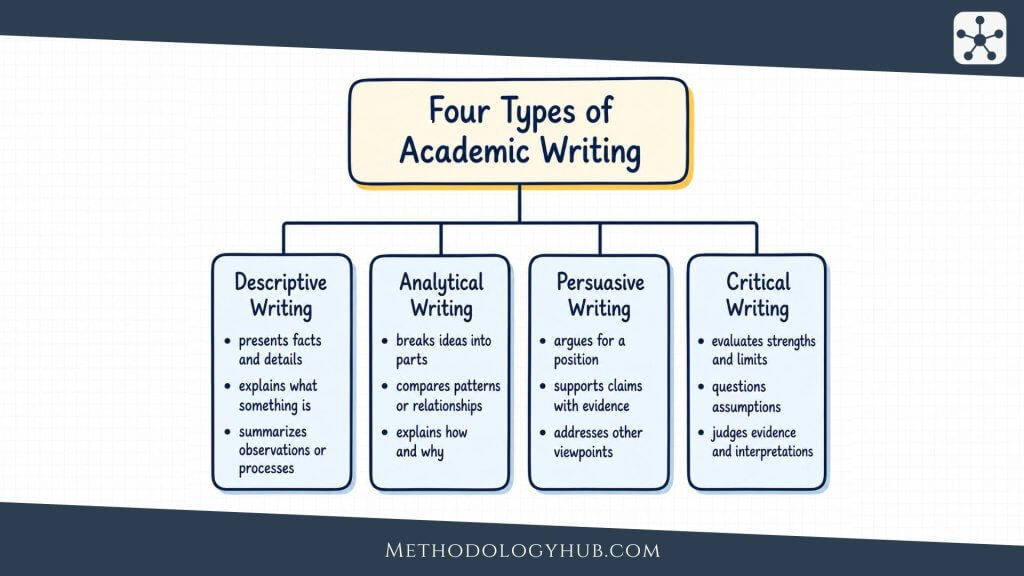
Analytical writing is one of the main types of academic writing, but it is not the only one. It often works beside descriptive writing, persuasive writing, and critical writing. The difference is not always visible from the topic alone. It is visible in what the writer does with the material.
The same subject can be handled in all four ways. A writer may describe a theory, analyse its internal logic, use it to support a position, and then evaluate its limits. These modes often combine, but it still helps to understand the main task of each one.
| Type of writing | Main task | Typical question |
|---|---|---|
| Descriptive writing | Presents facts, events, features, or background. | What is it? What happened? |
| Analytical writing | Breaks information into parts and explains relationships. | How does it work? What does the pattern show? |
| Persuasive writing | Builds a reasoned position and supports it with evidence. | What should the reader accept? |
| Critical writing | Evaluates strengths, limits, assumptions, and evidence. | How convincing is it? |
Analytical writing vs descriptive writing
Descriptive writing gives the reader information. Analytical writing explains the meaning or relationship of that information. A descriptive paragraph might report that three studies found a link between feedback and revision quality. An analytical paragraph might explain that the studies differ in how they define feedback, which affects how their findings can be compared.
Description is not weak by itself. It is necessary when the reader needs background. The problem begins when a text stays descriptive even though the task asks for analysis. In that case, the reader receives information but not enough explanation of what the information shows.
Analytical writing vs persuasive writing
Persuasive writing aims to convince the reader of a position. Analytical writing may support persuasion, but it is not identical to it. Analysis explains how evidence works. Persuasion uses that explanation to build a claim the reader is asked to accept.
For example, a persuasive essay might argue that schools should provide written feedback before final submission. Analytical writing inside that essay would explain how feedback timing affects revision, how students respond to different comment types, and why some forms of feedback may be more useful than others.
Analytical writing vs critical writing
Critical writing evaluates. Analytical writing prepares much of that evaluation by explaining how a source, theory, method, or argument works. Before you can judge whether a theory is convincing, you usually need to analyse its assumptions, evidence, and internal logic.
A critical paragraph may say that a study’s conclusion is limited because its sample is narrow. The analytical work behind that judgment explains how the sample was selected, which group is missing, and how that absence affects the interpretation.
Recognising the shift in your own writing
A useful way to recognise analytical writing is to look for relationship language. If a paragraph mainly says what a source says, it is probably descriptive. If it explains how sources differ, how evidence supports a point, or how a pattern develops, it has moved into analysis.
You can also check the verbs. Descriptive writing often uses verbs such as states, defines, lists, reports, and describes. Analytical writing often uses verbs such as compares, explains, connects, separates, suggests, develops, and accounts for. The verbs are not a formula, but they can reveal what the paragraph is doing.
Writing Analytical Paragraphs
Analytical writing often succeeds or fails at paragraph level. A paper may have a good topic and a reasonable overall structure, but the analysis will still feel thin if individual paragraphs only present evidence without explaining it. Strong analytical paragraphs give the reader a clear sequence of thought.
The paragraph does not need to follow one rigid formula every time. Still, it usually needs five elements: a focused point, enough context, relevant evidence, interpretation of that evidence, and a connection to the wider claim. When one of these elements is missing, the paragraph often feels unfinished.
Begin with an analytical topic sentence
A topic sentence should move beyond announcing a topic. It should make a point about the topic. Instead of writing, “This paragraph discusses feedback,” an analytical topic sentence might say, “Feedback is most useful when students receive it early enough to revise the structure of their work.” The second version gives the paragraph something to prove and explain.
A strong topic sentence also sets limits. It tells the reader what the paragraph will cover and what it will not cover. This helps keep the paragraph focused and prevents it from turning into a collection of loosely related comments.
Give the evidence enough context
Evidence rarely explains itself. Before using a quotation, result, example, or source finding, the writer should give the reader enough context to understand where it comes from and why it has been included. This context does not need to be long, but it should be clear.
For example, if a paragraph uses a finding from a classroom study, the reader may need to know the age group, task, or method before the finding can be interpreted. Without that context, the evidence may appear disconnected from the paragraph’s claim.
Explain the evidence after presenting it
The explanation after evidence is often where analytical writing becomes visible. This is the moment when the writer shows what the evidence means, why it supports the point, or how it complicates the earlier claim. The explanation should not simply repeat the evidence in different words.
Good explanatory sentences often answer questions like these: What does this detail show? Why is this comparison useful? How does this result change the interpretation? What part of the claim does the evidence support? What limit should the reader notice?
Paragraph rhythm: A good analytical paragraph usually alternates between evidence and explanation. Too much evidence without explanation feels like summary. Too much explanation without evidence feels unsupported.
Connect the paragraph to the larger argument
Analytical paragraphs should not feel isolated. At the end of a paragraph, the writer often needs to connect the point back to the larger claim or prepare the next paragraph. This connection may be brief, but it helps the reader understand why the paragraph belongs in the paper.
For example, after analysing one study’s method, the final sentence might explain how that method shapes the study’s findings. The next paragraph can then compare a different method. The reader sees the movement instead of encountering separate summaries.
Revise for analytical depth
Revision is especially useful for analytical writing because first drafts often lean toward description. Writers usually need to return to the draft and ask whether each paragraph explains enough. The goal is not to make every sentence interpretive. The goal is to make sure the paragraph does more than collect information.
One practical approach is to underline every sentence that explains a relationship. If most of the paragraph is evidence, background, or summary, more analysis may be needed. If the paragraph contains interpretation but little evidence, it may need stronger support.
Use the writing process to strengthen analysis
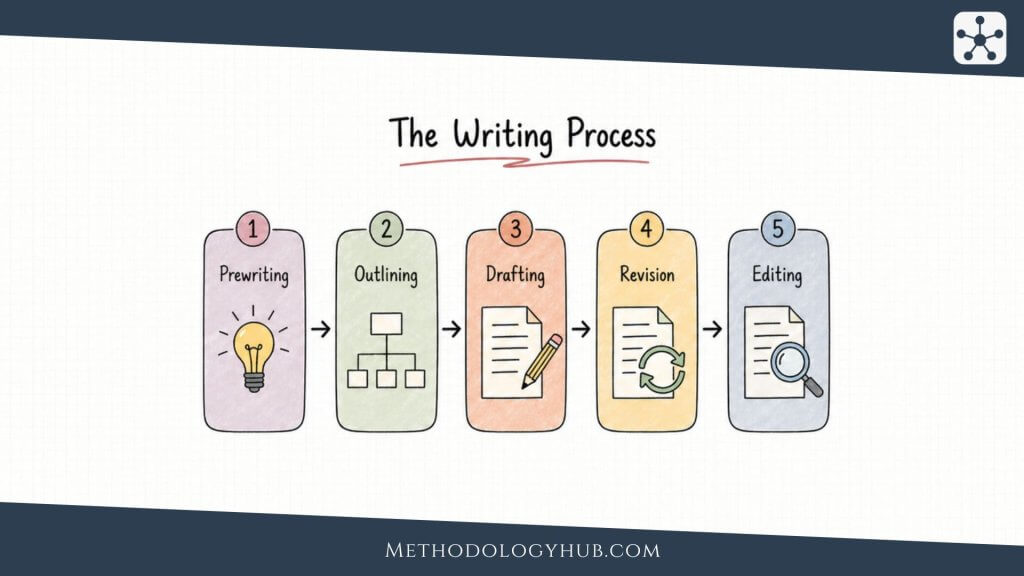
Analytical writing usually becomes clearer through stages. During planning, the writer can sort evidence into groups and decide which relationships are worth explaining. During drafting, the first version may still lean on summary because the writer is trying to get the material onto the page. During revision, the analytical work becomes sharper because the writer can see where evidence needs more explanation.
This is why the writing process is useful for analysis. It separates discovery from polishing. A writer can first ask what the evidence contains, then ask what the evidence shows, and only later refine the wording. Trying to solve all of those tasks in one pass often leads to paragraphs that sound rushed or overloaded.
A practical revision method is to write a short note beside each paragraph: “This paragraph explains…” If the note is difficult to finish, the paragraph may not yet have a clear analytical function. If several paragraphs have the same note, the structure may be repeating itself. These small checks help turn a draft from a collection of useful material into a connected analysis.
Examples of Analytical Writing
Examples of analytical writing are useful because the difference between description and analysis can feel abstract until it appears in sentences. The examples below show how analytical writing can appear in literature, history, social science, science, and source-based academic work.
These examples are not model paragraphs for every assignment. They are short demonstrations of the analytical move. In each case, the writer takes information and explains a relationship, pattern, or implication.
Example of analytical writing in literature
Descriptive version: The poem uses images of winter, darkness, and silence. The speaker describes an empty landscape and returns several times to the sound of wind.
Analytical version: The repeated images of winter and silence make the landscape feel less like a physical setting and more like an emotional condition. By returning to the sound of wind after each description of stillness, the poem creates a tension between outward calm and inward disturbance.
The analytical version identifies images and explains how those images work together. It also gives the reader a clearer interpretation of the poem’s emotional effect.
Example of analytical writing in history
Descriptive version: Several economic problems appeared before the reform period. Prices increased, wages changed slowly, and many workers moved from rural areas to cities.
Analytical version: The economic pressure before the reform period was not caused by one factor alone. Rising prices reduced household stability, while slow wage growth made that pressure more visible among workers. Migration to cities then intensified the strain because urban services had to respond to a larger population.
This example breaks the topic into parts and explains how they are connected. The analytical version gives the reader a chain of reasoning rather than a list of conditions.
Example of analytical writing in social science
Descriptive version: The interviews showed that students mentioned feedback, time pressure, and confidence when discussing revision.
Analytical version: The interviews suggest that students do not treat revision as a purely technical task. Feedback gives them direction, but time pressure shapes whether they can act on that direction, and confidence affects whether they are willing to make larger structural changes.
The analytical version groups the interview themes and explains how they work together. It also turns the findings into a more developed interpretation of student behaviour.
Example of analytical writing in science
Descriptive version: The plants in the shaded condition grew more slowly than the plants in the full-light condition. The shaded plants also had thinner stems.
Analytical version: The slower growth in the shaded condition suggests that limited light reduced the plants’ ability to produce enough energy for rapid development. The thinner stems point in the same direction, because the plants appear to have allocated fewer resources to structural growth under low-light conditions.
This example shows how analytical writing can interpret observed results without going beyond the available evidence. The writer explains a likely relationship, while keeping the claim tied to the observations.
Example of analytical writing in a literature review
Descriptive version: Smith studied teacher feedback in secondary schools. Chen studied peer review in first-year university courses. Alvarez studied written comments in online learning.
Analytical version: These studies approach feedback from different positions in the learning process. Smith focuses on teacher authority, Chen examines student-to-student interpretation, and Alvarez shifts the discussion toward digital delivery. Taken together, they show that feedback is not a single practice but a set of interactions shaped by who gives the response and where the response occurs.
The analytical version is stronger because it gives the group of sources a purpose. It tells the reader why these sources belong together and what pattern they create.
Example of analytical writing in an essay body paragraph
A fuller analytical paragraph might look like this:
Early feedback can improve revision because it gives students time to reconsider the structure of their work, work on larger choices, rather than only correcting surface errors. When comments arrive after a draft is nearly complete, students often treat them as editing advice. When comments arrive earlier, they can guide decisions about paragraph order, evidence, and the main claim. This timing changes the role of feedback: it becomes part of the thinking process rather than a final layer of correction.
The paragraph works analytically because it begins with a focused claim, explains a distinction, and shows how timing changes the function of feedback. It goes beyond saying that feedback is useful and explains the condition under which feedback changes the writing process.
Final Takeaway on Analytical Writing
Analytical writing helps academic texts move from information to interpretation. It gives the reader more than facts, summaries, or examples. It shows how those materials fit together and what can be understood from them.
The strongest analytical writing is not the most complicated writing. It is the writing that makes relationships clear. It chooses evidence carefully, explains what the evidence shows, and keeps the answer tied to a focused question. That is why analysis is useful in essays, literature reviews, reports, discussion sections, and many other academic tasks.
For students, the most practical step is to look again at each paragraph and ask what it does. Does it only report information, or does it explain a relationship? Does it leave evidence standing alone, or does it interpret the evidence? Does it connect back to the main claim? These questions make analytical writing easier to revise and easier for the reader to follow.
FAQs on Analytical Writing
What is analytical writing?
Analytical writing is a type of academic writing that breaks information into parts and explains relationships between those parts. It is used to interpret evidence, compare ideas, examine causes, identify patterns, and show how examples support a wider claim.
What is the difference between analytical and descriptive writing?
Descriptive writing reports facts, features, events, or source information. Analytical writing uses that information to explain patterns, relationships, causes, contrasts, or implications. Description tells the reader what is there, while analysis explains what the information shows.
What are the main features of analytical writing?
The main features of analytical writing are a focused claim, meaningful division of the topic into parts, careful use of evidence, explanation of relationships, and clear paragraph movement. Good analytical writing stays close to the evidence while showing the reader how the evidence should be understood.
When should I use analytical writing?
Use analytical writing when an assignment asks you to analyse, examine, compare, explain, interpret, discuss, or investigate. It is especially useful in essays, literature reviews, research papers, discussion sections, and any task that asks you to explain how evidence connects to a question.