Knowing how to write an essay is one of the most useful academic writing skills a student can develop, but it is also one of the most frequently misunderstood. Many students think of an essay as a place to put information they have found, add a few opinions, and hope that the result feels complete.
This article explains how to write a great essay and how essays work on the page: what belongs in an essay, how the writing process usually unfolds, and why some essays feel clear and convincing while others feel flat or unfocused.
What Is an Essay?
Knowing how to write an essay begins with understanding what an essay is actually meant to do. An essay is a piece of writing that explores, explains, argues, analyses, or reflects on a topic in a structured way.
In school, college, and university settings, essays are often used to test how well a student can think through a question, organise ideas, use evidence, and communicate clearly. That is why an essay is more than a collection of facts. It is a shaped response with a visible purpose.
At its core, an essay usually does one of two broad things. It either explains something clearly, or it makes a point and supports it. Many essays do both at once. Even when an essay is descriptive or reflective, it still needs direction. The reader should be able to see what the essay is trying to do and how each paragraph helps move that aim forward.
What an essay is meant to do
The exact purpose of an essay depends on the assignment. Some essays ask you to explain a concept. Others ask you to compare two ideas, discuss causes and effects, interpret evidence, or take a position on a question. Even so, most strong essays share the same general aim: they guide the reader through a line of thought. A weak essay often feels like notes placed one after another. A strong essay feels as if each sentence belongs to a larger argument or explanation.
Chapter takeaway
Essay Writing Process
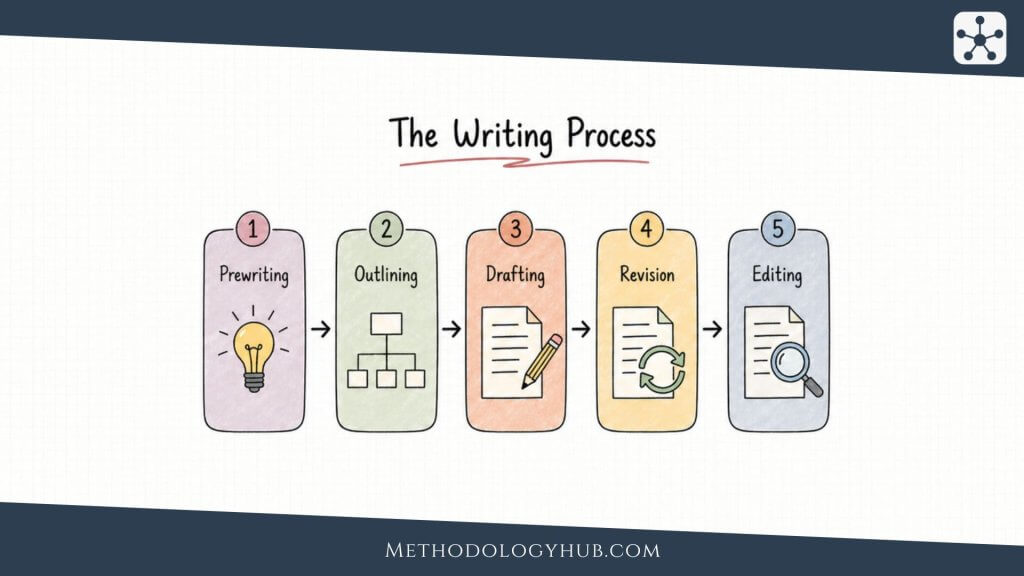
A large part of how to write an essay successfully happens before the draft even exists. Many weak essays go wrong before the first paragraph is written. The writer starts too quickly, chooses material without a plan, and only later discovers that the essay does not really answer the question. A good process reduces that risk. It does not make writing effortless, but it makes the work more controlled from the beginning.
The writing process does not need to be complicated. In most cases, it moves through a clear sequence: understand the task, choose or narrow the topic, gather material, decide on the main point, build an outline, draft, and revise. Strong essays are often the result of this process rather than of sudden inspiration.
Understand the essay prompt first
The first step is to understand what the assignment is actually asking you to do. This sounds obvious, but many students skip it. They see a familiar topic, start writing from memory, and miss the real demand of the question. A prompt might ask you to analyse, compare, evaluate, discuss, explain, or argue. Those verbs matter because they shape the whole essay.
Choose and narrow the topic
Sometimes the topic is fully given to you. In other cases, you are allowed to choose one. When that happens, it is usually better to choose a focused topic than a broad one.
Broad topics often lead to vague essays because the writer tries to say too much too quickly. A narrower topic makes it easier to organise evidence and say something specific.
Research before you draft
Once the direction is clear, gather material. That may include course notes, class texts, books, articles, examples, or your own earlier observations.
The goal at this stage is not to collect everything available. It is to collect what will actually help you answer the question. Research becomes useful when it is selective.
Write a working thesis
Before drafting the full essay, it helps to write a working thesis statement. This is a one-sentence version of your central point or main response to the question. It does not need to be perfect at first. In fact, many good theses change during drafting. What matters is that you begin with a visible direction.
A working thesis keeps the essay from drifting. It helps you decide what belongs in the essay and what does not. If a point does not support the thesis, it may not deserve a full paragraph.
Build an outline before writing
An outline does not need to be long or formal. In many cases, three or four lines are enough. The important thing is to know the job of each section before you begin. One line for the introduction, one for each body paragraph, and one for the conclusion can save a great deal of time later.
Outlining also helps you test the logic of the essay. If the planned paragraphs repeat one another or move in a strange order, you can fix that before the draft becomes harder to change. A few minutes of planning often improves the whole essay.
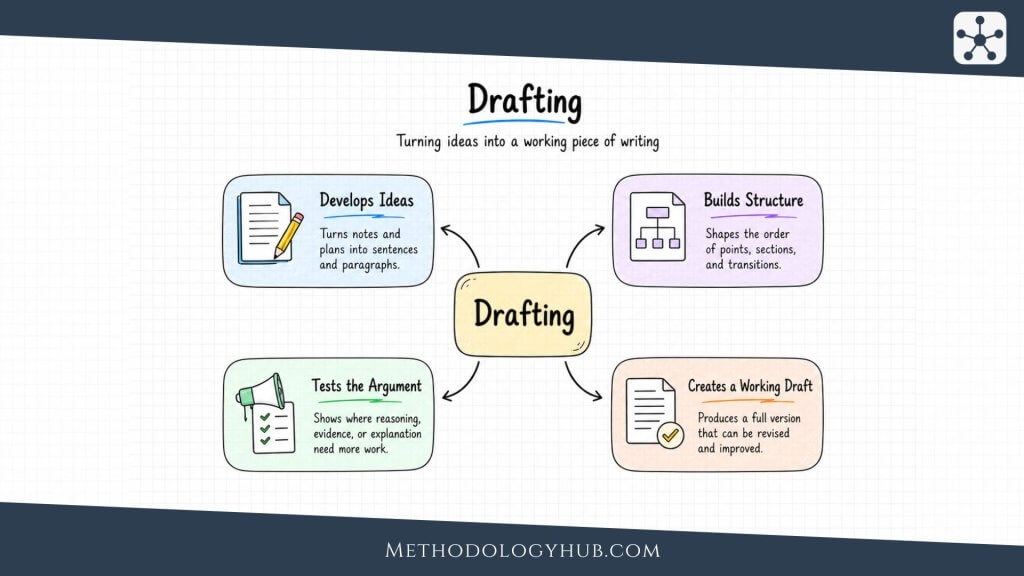
Draft, then revise
The first draft should aim for clarity, not perfection. Get the main ideas on the page and make sure the structure is visible. Revision is where the essay becomes stronger. During revision, you can improve topic sentences, cut repetition, strengthen the thesis, add better transitions, and correct unclear phrasing.
Many students think revision means fixing grammar at the end. Grammar matters, but revision starts earlier than that. The most useful revision questions are structural: does the essay answer the question, does each paragraph do a distinct job, and does the conclusion grow naturally from the argument? Once those are working, sentence-level editing becomes more worthwhile.
Chapter takeaway
Structure of an Essay
Anyone learning how to write an essay needs to see structure as more than a formal requirement. Most essays are easier to read when their structure is clear. The reader should not have to guess where the essay is going, what each paragraph is doing, or why a point appears when it does. Structure gives the essay a path. Without it, even good ideas can feel scattered.
The classic essay structure is simple: introduction, body, and conclusion. Within that framework, most essays also include a title and, when required, references. These parts may seem basic, but each one has a distinct job. Essays become stronger when the writer understands those jobs clearly.
How the parts work together
The strongest essays are not just divided into sections. Their sections actually support one another. The introduction creates expectations. The body paragraphs fulfil those expectations by developing the main points. The conclusion closes the route that the essay has already taken. When this relationship is working well, the essay feels coherent rather than stitched together.
This is also why structure is not only about headings or order. It is about proportion. An essay with a long introduction and rushed body paragraphs often feels unbalanced. An essay with strong body paragraphs but a vague conclusion can feel unfinished. Structure works best when each part receives the amount of space it genuinely needs.
Chapter takeaway
Essay Title
Even in a small element like the title, how to write an essay well involves making the topic clear from the start. The title is a small part of the essay, but it still matters. It gives the reader the first indication of the topic, focus, or approach.
In some academic contexts, the title is very simple and descriptive. In others, it may be slightly more specific or stylised. Either way, the best essay titles are usually clear before they are clever.
A weak title often sounds too broad, too vague, or too generic. A strong title tells the reader what kind of discussion to expect. It does not need to reveal the whole argument, but it should at least signal the essay’s territory.
What makes a title work
In most cases, a good title is relevant, precise, and readable. It should fit the assignment and reflect the actual content of the essay. If your essay discusses social media and elections, the title should not simply be “Technology Today.” That would be too broad. A title closer to the essay’s real subject helps the whole piece feel more focused.
This is also why many essay titles improve after the draft is finished. Once you know the true centre of the essay, it becomes easier to name it accurately. Writing the title last is often a practical choice. This is a small but useful part of how to write an essay because the title shapes the reader’s first expectations.
Descriptive vs more creative titles
Some essays work best with straightforward descriptive titles, especially in academic settings. Others allow slightly more creative phrasing, particularly in reflective or narrative work. Even then, clarity should remain visible.
A creative title can be effective if it still tells the reader what the essay is about. If it sounds interesting but leaves the topic hidden, it may create more confusion than value.
What to avoid
Titles often become weaker when they rely on vague words such as “things,” “issues,” “thoughts,” or “some ideas about.” They also weaken when they promise something the essay does not really deliver. The safest principle is simple: let the title reflect the actual content of the essay, not an exaggerated version of it.
Chapter takeaway
Essay Introduction
For many students, learning how to write an essay really begins with learning how to open one well. The introduction is where the essay begins to make a promise to the reader. It introduces the topic, creates direction, and often presents the thesis. A weak introduction delays too long, stays too general, or sounds as if it is circling the topic without entering it.
This does not mean every introduction has to be dramatic. In fact, many strong introductions are simple. They work because they are controlled. The reader quickly understands the topic, the question, and the line the essay will take.
What an introduction should do
Most essay introductions do three jobs. First, they introduce the topic or question. Second, they provide enough context to make the discussion understandable. Third, they move toward the central point of the essay, often through a thesis statement.
These tasks can be handled in a few sentences, but they still matter greatly because they shape the reader’s expectations for everything that follows.
A good introduction does not need to say everything at once. It needs to create a route. If the route is clear, the essay already has a stronger beginning.
How to open an essay
There are several ways to begin. You might start with a direct sentence about the topic, a brief contextual statement, a contrast, a problem, or a question that the essay will answer. The best option depends on the assignment. When you write an essay, direct openings often work better than dramatic ones. The reader usually values clarity more than performance.
For example, beginning with a broad sentence such as “Since the dawn of time, humans have communicated” rarely helps much. It sounds large, but it does not bring the reader quickly to the real topic. In most essays, it is better to begin closer to the issue you actually plan to discuss.
Background information: how much is enough
You will often need a little background when you write an essay introductions, but only enough to orient the reader. Too much background can delay the real beginning of the essay. If the introduction becomes a long information dump, the reader may still not know what the actual point is. Useful background supports the discussion rather than replacing it.
A good test is this: does each sentence in the introduction help the reader understand the question and move toward the thesis? If not, the introduction may be carrying material that belongs later or not at all.
The role of the thesis statement
The thesis statement is usually the most important sentence in the introduction. It tells the reader what the essay will argue, explain, or show. In some essays, the thesis is explicit and direct. In others, it is slightly more subtle. Even so, the central position or direction should still be visible. Without it, the essay may feel unfocused from the start.
A strong thesis is usually specific enough to guide the essay. It should not simply say that a topic is “important” or “interesting.” It should make a claim, suggest a relationship, or define a clear line of explanation.
The stronger the thesis, the easier it becomes to build the body paragraphs around it. That is why how to write an essay is so closely tied to writing an introduction that gives the reader direction early.
Chapter takeaway
Essay Paragraphs
Much of how to write an essay well is really about building body paragraphs that can carry the argument. Good body paragraphs are not just containers for information. Each one should have a job. It should develop one main point, support it clearly, and connect it back to the larger purpose of the essay. When paragraphs are built this way, the essay feels more convincing and easier to follow.
What a body paragraph should do
Most strong body paragraphs begin with a clear topic sentence. This sentence tells the reader what the paragraph is mainly about. After that, the paragraph usually develops the point through evidence, examples, explanation, or analysis. The exact balance depends on the essay type, but the basic logic remains useful in many cases.
A paragraph becomes weaker when it tries to do too many things at once. If one paragraph discusses several unrelated ideas, the reader may lose the line of thought. It is often better to split a large point into two paragraphs than to crowd too much into one.
Topic sentences create focus
A topic sentence gives the paragraph its centre. It tells the reader what to expect and helps the writer stay focused while developing the point. Good topic sentences are usually specific enough to guide the paragraph, but not so narrow that they leave no room for development.
This is one reason paragraph planning matters. If each paragraph has a visible topic sentence and a different purpose, the essay becomes easier to organise and revise. Many weak essays struggle because the paragraph plan is unclear.
Use evidence, but explain it too
One of the most common paragraph problems is dropping evidence into the paragraph without explaining it. A quotation, statistic, example, or source does not speak fully for itself. The reader needs help understanding why it matters and how it supports the point being made.
In academic writing, explanation is often what separates basic writing from stronger writing. The evidence is important, but the interpretation around it is usually where your own thinking becomes visible. A body paragraph should therefore do more than present material. It should show what that material means in relation to the thesis.
Analysis matters more than summary
Students often summarise when they should analyse. Summary tells the reader what happened or what a source says. Analysis goes further. It explains significance, pattern, implication, or relationship. Most essays need at least some analysis because they are not only asking you to repeat information. They are asking you to do something with it.
This does not mean analysis has to sound complicated. It often means answering one simple question after presenting evidence: what does this show? Once you start answering that question regularly, paragraphs usually become stronger. At this stage, how to write an essay becomes less about having information and more about explaining it clearly.
Transitions and paragraph flow
Good essays also pay attention to movement between paragraphs. The reader should feel that one point leads to the next. Sometimes this happens through a transition word such as “however,” “therefore,” or “in contrast.” Sometimes it happens through the logic of the argument itself. In either case, the connection should feel visible.
Transitions matter because they help the essay feel designed rather than assembled. A body section made of good paragraphs can still feel awkward if the jumps between them are unclear. A small sentence of connection often improves the flow considerably.
Chapter takeaway
Essay Conclusion
A final paragraph is also part of how to write an essay well, because endings shape the reader’s last impression. The conclusion is the final stage when you write an essay, but it is not just a formal ending. It is the point where the discussion becomes complete.
A weak conclusion may simply repeat earlier sentences or stop too suddenly. A strong conclusion leaves the reader with a clear sense of what the essay has shown and why it matters.
In many essays, the conclusion returns to the thesis in a more developed way. The essay has now gone through its evidence or discussion, so the conclusion can gather the main line of thought more confidently. It should sound like an ending, not like the start of a new discussion.
What a conclusion should do
A good conclusion usually does three things. It returns to the essay’s central point, brings together the main insights from the body, and ends in a way that feels proportionate to the topic. It does not need to repeat every paragraph mechanically. Instead, it should show the result of the essay’s movement.
This is why the conclusion often works best when it sounds slightly broader than the body paragraphs, but still grounded in what the essay has already argued. It should feel earned by the earlier discussion. In that sense, how to write an essay successfully includes knowing how to stop at the right moment and close the line of thought.
What to avoid in a conclusion
Conclusions usually become weaker when they introduce brand new evidence, open a different topic, or rely on empty phrases such as “In conclusion” without adding real substance. They also weaken when they merely repeat the introduction word for word. When you write an essay conclusion you should echo the thesis, but you should do so with the fuller understanding created by the body paragraphs.
In other words, when you write an essay conclusion it should feel like closure, not repetition. It should remind the reader of the essay’s value without sounding mechanical.
Chapter takeaway
Sources, Citations, and References
In many academic tasks, how to write an essay also means knowing how to handle other people’s ideas responsibly. Not every essay requires outside sources, but many academic essays do. When that happens, sources become part of the essay’s credibility.
They show that your discussion is informed, grounded, and able to engage with other ideas. The goal, however, is not simply to add quotations. The goal is to use sources in a way that strengthens your own argument or explanation.
This is why citations and references matter. They do more than satisfy formatting rules. They help the reader see where information comes from and distinguish your own analysis from borrowed material.
When essays need sources
Analytical, argumentative, and research-based essays often rely on sources because they ask you to discuss concepts, debates, evidence, or texts beyond your own experience. In these cases, sources support your claims and place your essay within a wider conversation. Even descriptive essays may sometimes use sources if they explain events, definitions, or context.
What matters most is relevance. A source should not appear simply to make the essay look academic. It should help you explain, support, or sharpen a point that matters to the essay.
How to use evidence properly
Strong essays usually introduce evidence clearly, present it selectively, and explain it afterward. That explanation is crucial. A quotation or paraphrase should not be left standing alone. The reader needs to understand why it has been included and how it connects to the paragraph’s purpose.
This is also where many essays become too source-heavy. If the paragraph is mostly quotation, your own voice disappears. Good academic writing lets sources support the discussion without replacing the writer’s role in interpreting them. This is another place where how to write an essay depends on judgment, not just on formatting rules.
Citations and reference lists
Citations are the brief signals inside the essay that show where borrowed material comes from. References, works cited pages, or bibliographies provide the full source details at the end. Different institutions use different citation styles, such as APA, MLA, or Chicago.
Because formatting rules differ, it is important to follow the style required by your teacher, department, or institution. Even so, the bigger issue is consistency. A consistently applied citation style is usually more effective than a half-correct mixture of several styles.
How to avoid plagiarism
Plagiarism happens when you present someone else’s words or ideas as if they were your own. This can happen through direct copying, incomplete citation, or careless paraphrasing that stays too close to the original wording.
Avoiding plagiarism is therefore not only about adding quotation marks. It is also about understanding when ideas need citation and how to separate source material from your own analysis. A useful habit is to keep careful notes during research and record where each idea came from. That makes it easier to cite properly when you begin drafting.
Chapter takeaway
Types of Essays
Part of how to write an essay well is recognising what kind of essay the task is asking for. Not all essays ask the same thing from the writer. This is one reason students sometimes struggle even when they know the general structure of an essay.
The task changes with the type. A persuasive essay does not work exactly like a narrative essay, and a compare and contrast essay needs a different kind of organisation than a descriptive one.
Recognising the essay type helps you adjust your approach. It affects the thesis, the paragraph structure, the tone, and the kind of evidence or examples you are likely to use. Once the type is clear, the writing process becomes much easier to control. This is one reason how to write an essay always depends on matching structure and tone to the real task.
Expository essay
An expository essay explains a topic clearly and logically. Its main goal is to inform or clarify rather than to tell a story or argue aggressively. These essays often define concepts, describe processes, or explain how something works. The writing should be organised, direct, and easy to follow.
Analytical essay
An analytical essay breaks something down and examines how it works. That “something” may be a text, argument, event, trend, or idea. Instead of simply describing the topic, the essay looks at patterns, meanings, relationships, or effects. Analytical essays usually depend heavily on interpretation.
Persuasive essay
A persuasive essay takes a position and tries to convince the reader. It often uses reasoning, examples, and evidence to support a claim. A strong persuasive essay does more than express opinion. It builds a case and shows why that case deserves agreement.
Narrative essay
A narrative essay tells a story, often from personal experience. Even though it is more story-based than other essay types, it still needs structure and purpose. The best narrative essays do more than recount events. They shape the story around a meaningful point or reflection.
Descriptive essay
A descriptive essay focuses on detailed description. It may describe a person, place, object, situation, or experience. Strong descriptive writing helps the reader imagine the subject clearly, but it still needs control. Without focus, descriptive essays can become repetitive or overly decorative.
Compare and contrast essay
A compare and contrast essay examines similarities and differences between two subjects. The challenge here is not only identifying points of comparison, but arranging them clearly. Some writers organise by subject, while others organise by point. Either approach can work if the structure remains easy to follow.
Cause and effect essay
A cause and effect essay explains why something happened, what it led to, or both. These essays often need strong logical organisation because causal claims can become weak if the links between events are unclear or oversimplified. Precision matters here.
Critical analysis essay
A critical analysis essay evaluates and interprets a text, theory, artwork, argument, or other subject. It usually combines description, analysis, and judgment. The writer is not simply saying whether something is good or bad. They are showing how it works and assessing its strengths, weaknesses, or implications.
Chapter takeaway
Essay Examples
Seeing realistic samples is one of the easiest ways to understand how to write an essay. The three examples below are not organised by the eight essay types discussed earlier. Instead, they are organised by common academic situations in which students are asked to write an essay: a high school assignment, a college admission essay, and a graduate school admission essay.
Studying examples in this way can make how you write an essay feel much less abstract. A high school essay usually depends on clear paragraph structure and a direct thesis. A college admission essay depends more on reflection and voice. A graduate admission essay depends on academic focus, evidence of preparation, and fit with the programme. Looking at those differences closely is often one of the fastest ways to improve how to write an essay for the specific task in front of you.
Chapter takeaway
Conclusion
Knowing how to write an essay matters because it helps you turn ideas into a clear response instead of a loose collection of facts. Once the task is understood, the thesis is focused, and the paragraphs are planned carefully, the whole essay becomes easier to control.
In the end, how to write an essay well comes back to a few habits: read the prompt closely, choose relevant points, explain your evidence, and revise for clarity. When those habits become part of your process, how to write an essay feels much less mysterious and much more manageable.
FAQs on How to Write an Essay
What is an essay?
An essay is a structured piece of writing that presents a clear argument supported by evidence and analysis. It aims to communicate ideas logically and persuasively within a scholarly context.
What is the structure of an essay?
An essay typically includes three main parts: an introduction, a body, and a conclusion. The introduction states the thesis, the body develops arguments through evidence and analysis, and the conclusion synthesizes findings.
How do I choose a topic for my essay?
Choose a topic that is specific, researchable, and aligned with the assignment prompt. A good topic allows for evidence-based argumentation rather than simple description.
What makes a strong thesis statement in an essay?
A strong thesis statement is clear, specific, and arguable. It guides the essay’s direction and tells readers what to expect.
How can I improve the structure of my essay?
Structure improves when each paragraph contributes one idea that supports the thesis and uses transition phrases for logical flow.
How do I write an essay conclusion?
An effective essay conclusion restates the thesis in light of evidence and emphasizes the broader significance of your argument. Avoid introducing new points when you write an essay conclusion.
How long should an essay be?
Essay length varies by level and assignment type, typically ranging from 1,000 to 3,000 words for undergraduate essays and longer for research papers.