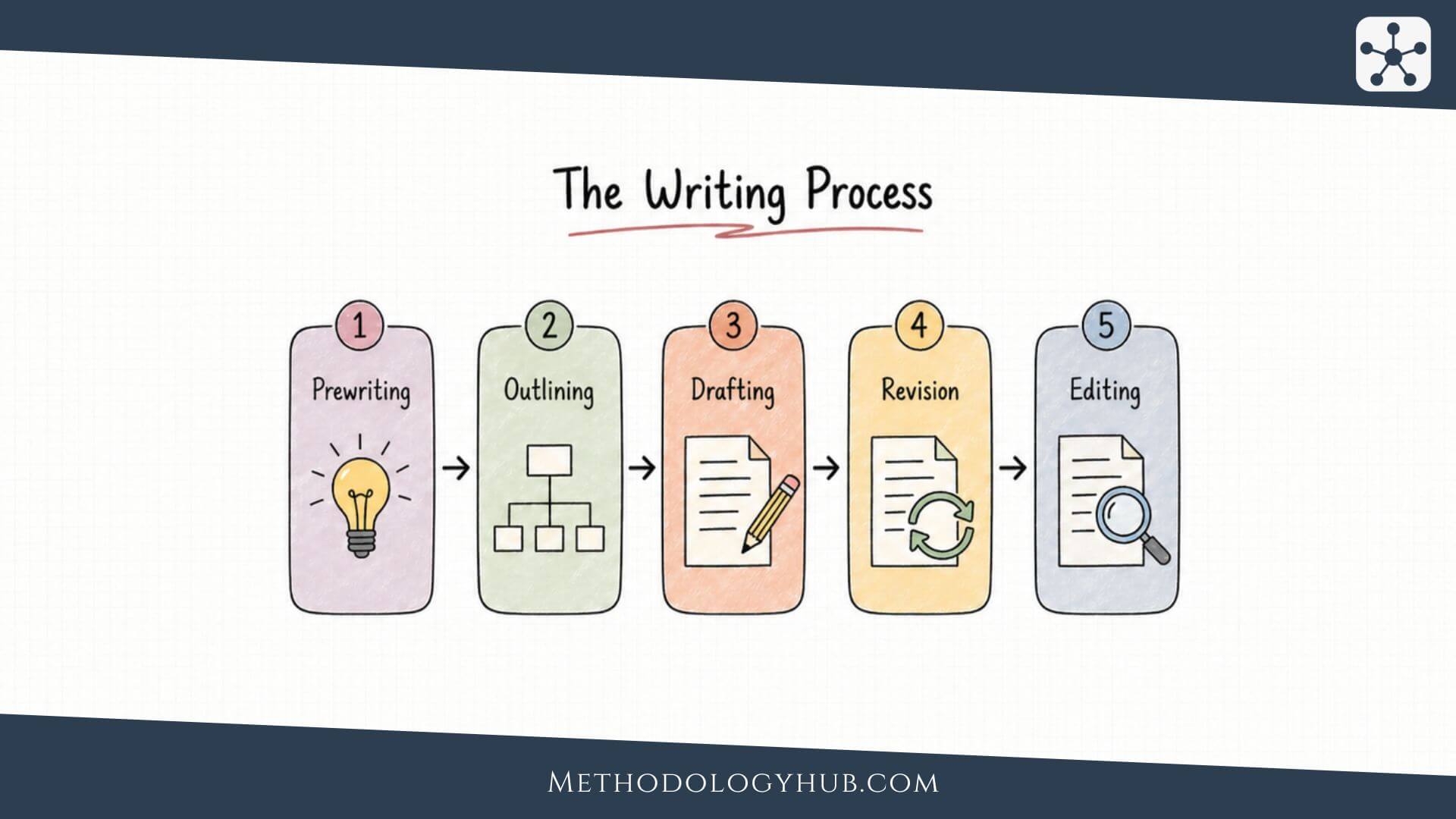
The writing process is the way writers turn an idea into a clear, finished piece of writing. It is not only about getting words onto the page. It is about moving through a series of decisions that help you discover your point, organise it, develop it, and polish it for a real reader.
This article explains what the writing process is, why it matters, how the five main steps work, and how to apply the process across different kinds of writing.
What Is the Writing Process?
The writing process is the structured sequence of stages writers use to move from a first idea to a final draft. It usually includes prewriting, outlining, drafting, revising, and editing. These stages give writers a practical way to handle a task that would otherwise feel too large or too vague.
That is why the writing process matters so much. Writing rarely becomes clear by accident. Most strong texts are the result of several different kinds of work: discovering what to say, deciding how to organise it, getting the first version down, rethinking weak parts, and polishing the final wording. When writers understand those stages, writing becomes easier to control.
Writing process definition
At its core, the writing process is a method for developing thought through stages. It is not a single burst of inspiration, and it is not just a final performance. It is a repeatable way of working that helps writers make better decisions at each point in the task.
In practice, the writing process usually helps writers do all of the following:
- generate and narrow ideas
- identify purpose and audience
- organise material into a usable structure
- develop a first draft without expecting perfection
- improve logic, coherence, and paragraph movement
- polish grammar, style, and presentation before submission
One of the most useful things about the writing process is that it separates different kinds of thinking. Generating ideas is not the same as editing sentences. Outlining a text structure is not the same as proofreading. When those tasks are separated, writers usually work with more clarity and less frustration.
The importance of the Writing Process
Writing without a process is like building without a blueprint. You might create something interesting, but it will lack structure, flow, and focus. A defined process gives writers a framework to manage complexity and to stay anchored in purpose. It reduces anxiety by breaking writing into manageable phases rather than facing the intimidating task of producing a finished work all at once.
For academic and professional writers, the writing process provides three key advantages:
- Clarity: Outlining and revising help you express complex ideas in logical order.
- Efficiency: Drafting and editing in distinct phases prevent overcorrection or confusion during composition.
- Depth: Revisiting earlier stages allows critical reflection, which enhances quality and insight.
The Writing Process Steps
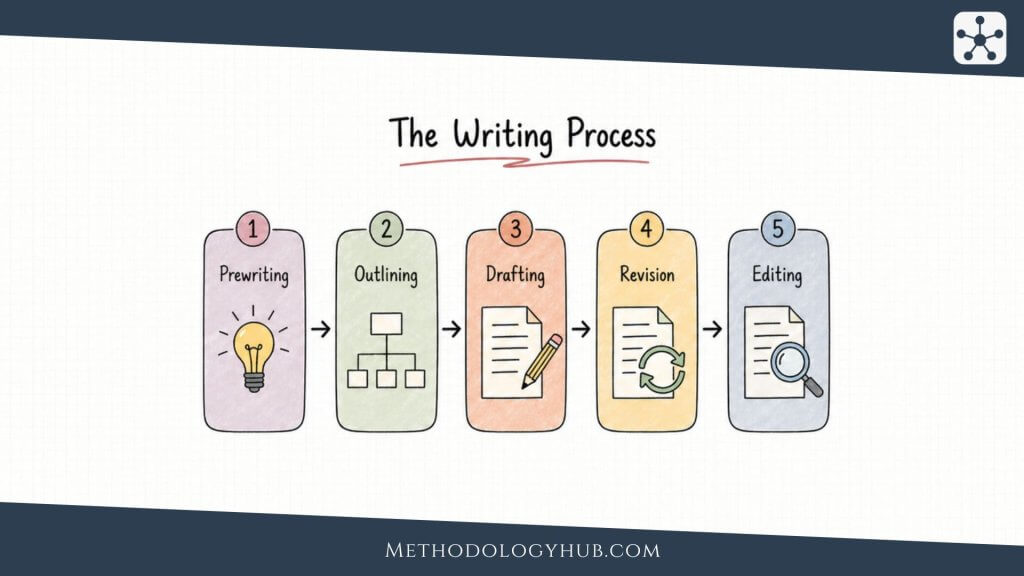
The writing process is often explained through five steps: prewriting, outlining, drafting, revising, and editing. These steps are useful because they give the whole task a visible shape. Instead of treating writing as one mysterious act, they show that strong writing is built through a sequence of different kinds of work.
At the same time, the five steps should not be understood as a perfectly rigid line. Writers often move back and forth between them. A draft may reveal a gap that sends you back to research. Revision may expose a structural problem that forces you to rebuild the outline. Editing may reveal that a sentence is awkward because the idea itself is still unclear. The stages are real, but they interact.
The five core steps
Most writing tasks can be understood through the following five steps:
- Prewriting: generating ideas, asking questions, gathering material, and identifying purpose
- Outlining: organising ideas into a structure that the reader can follow
- Drafting: writing the first version without expecting polish too early
- Revising: improving content, logic, development, and flow
- Editing: correcting language, formatting, and final presentation details
Each of these steps solves a different problem. Prewriting helps you discover what you want to say. Outlining helps you decide how to arrange it. Drafting turns ideas into visible text. Revising makes the argument clearer and more coherent. Editing ensures the final version is clean and ready for a reader.
Why the steps are recursive
One of the biggest misconceptions about the writing process is that you complete one step, lock it in, and never return. In reality, good writing is recursive. Writers loop back. They rethink ideas, move paragraphs, reframe introductions, and sometimes start whole sections again once the argument becomes clearer.
This does not mean the process is messy in a bad way. It means writing is a form of thinking. As your thinking changes, the draft changes too. The best writers usually do not fight that movement. They use it.
How the steps connect in practice
It helps to see the five steps as preparation for one another. Strong prewriting makes outlining easier. A clear plan makes drafting faster. A visible draft makes revision possible. Good revision makes editing more meaningful. The stages are distinct, but they build on one another.
This is also why the “steps” chapter matters before the individual step chapters. If you understand the whole process first, the later details make more sense. You stop seeing prewriting, outlining, or revising as isolated tips and begin to see how they function together inside one larger system.
Step 1: Prewriting
Prewriting is where writing begins before the first full draft exists. It is the stage in which writers test directions, gather material, and work out what the piece is really about. Without this stage, writing often begins too early and has to be rescued later through heavy revision.
That is why prewriting is not wasted time. It is the stage that gives the rest of the process direction. When you know your topic, purpose, and possible line of development before drafting, the actual writing usually becomes faster and more coherent.
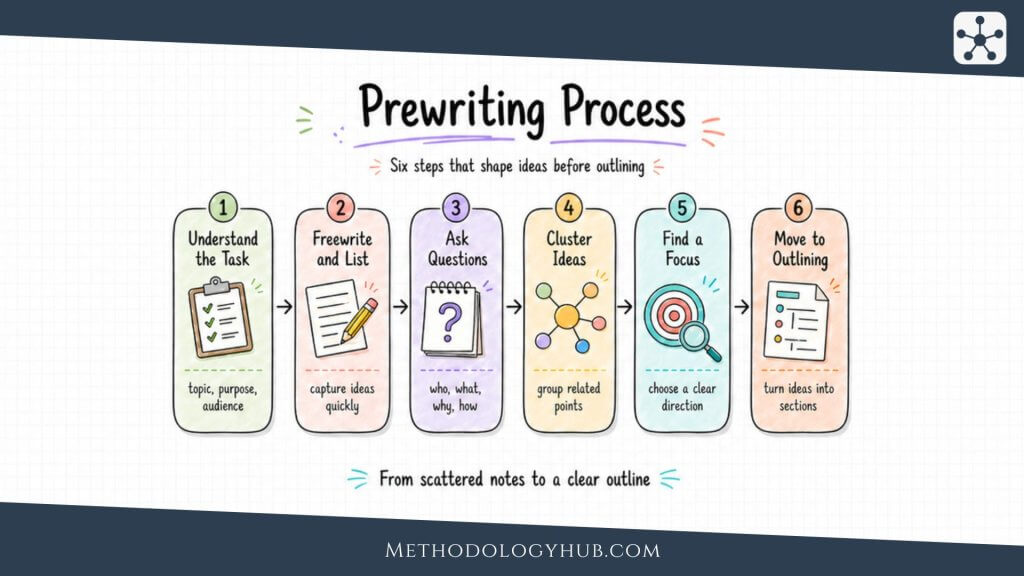
What happens in prewriting
Prewriting usually combines exploration and selection. First, you generate possibilities. Then you narrow them. At the start, the goal is not to be perfect. The goal is to produce enough material to discover where the strongest direction might be.
Writers often use prewriting to identify a central question, notice patterns in early research, test possible angles, and figure out what kind of response the task requires. This is especially useful when the topic still feels broad or vague.
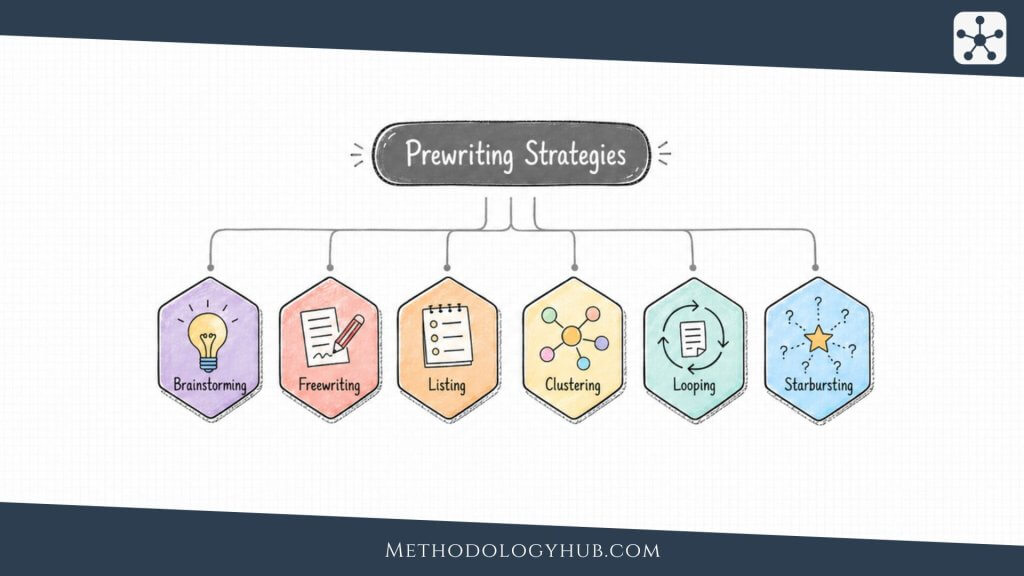
Common prewriting strategies include:
- brainstorming: listing ideas, terms, examples, and questions quickly
- freewriting: writing continuously for a short period without editing
- clustering or mind mapping: making visual links between related ideas
- questioning: asking what the topic means, why it matters, and what the reader needs
- quick note-taking: collecting early sources, quotes, or examples that may become useful later
Research and note-taking
For many writing tasks, prewriting also includes early research. This does not always mean deep reading at once. Often it means reading just enough to understand the topic, define the problem, and see what kinds of evidence or perspectives are available.
Good notes matter here. They help you keep track of useful points, avoid repeated reading, and prevent ideas from disappearing between sessions. They also make later outlining much easier, because your raw material is already visible and partly sorted.
Define direction before you draft
Prewriting becomes especially valuable once it leads to a clearer direction. Before moving into outlining, it helps to answer a few simple questions: what is this piece mainly about, who is it for, and what should the reader understand by the end?
You do not need a perfect final thesis yet, but you do need a usable direction. Even one or two sentences that name the main focus can save a great deal of confusion later. Prewriting is finished when the task feels less like a pile of possibilities and more like a path you can actually follow.
Step 2: Outlining
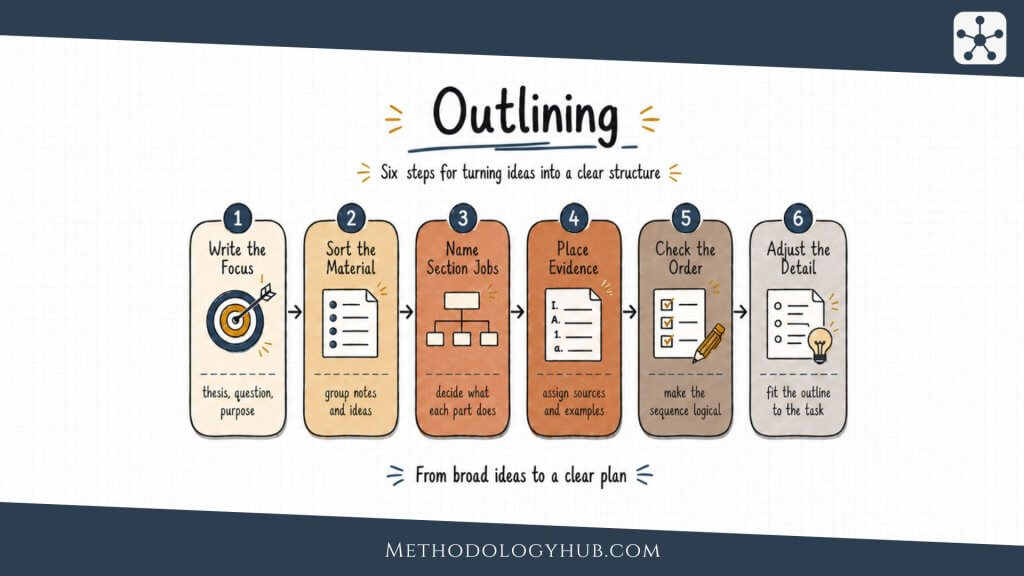
Outlining is the stage where ideas begin to take shape as structure. Once you have a topic and a direction, you need to decide how the reader will move through the material. That is what an outline really does. It turns loose content into a sequence.
Writers often skip outlining because they want to start drafting immediately. But structure problems are much easier to solve before the full draft exists. A short outline can prevent drift, repetition, and weak paragraph order later on.
Turn raw ideas into a structure
The first step in outlining is to review what came out of prewriting and sort it into groups. Which ideas belong together. Which points are central. Which examples support which claims. Once those relationships become clearer, the draft starts to gain shape.
Even a basic outline can help. Many writers only need a working introduction, three to five main points, and a rough ending before drafting begins. The purpose is not to predict every sentence. The purpose is to build a route the reader can follow.
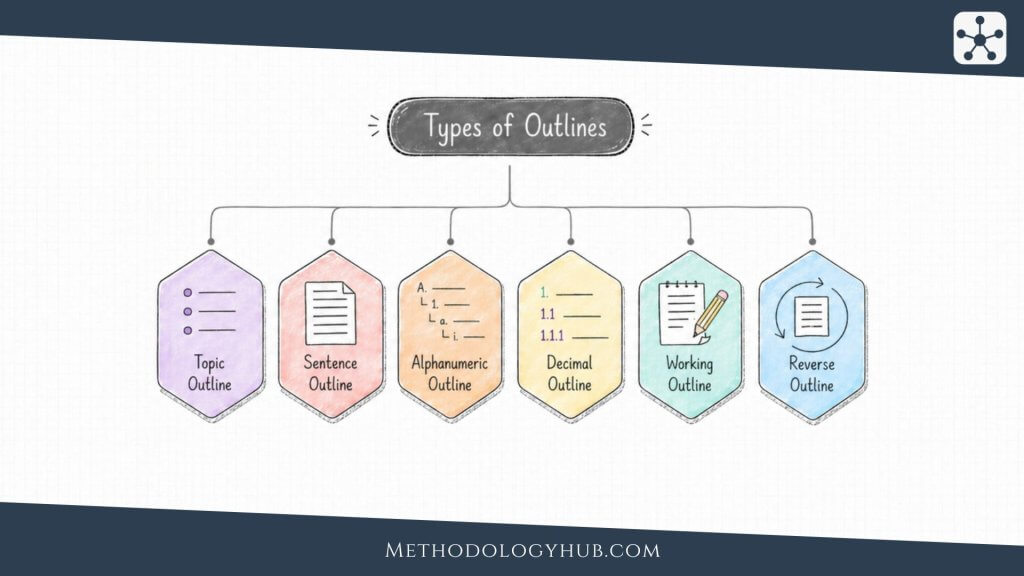
Choose a shape that fits the task
Different tasks need different structures. A reflective piece may unfold differently from an argumentative essay. A report may need headings shaped by method or findings. A blog article may need section breaks that make scanning easier. Good outlining depends on recognising what the genre expects.
Common structural patterns include:
- chronological: useful when explaining stages, history, or process
- problem-solution: useful when diagnosing an issue and proposing a response
- comparison: useful when weighing similarities, differences, or alternatives
- argument-driven: useful when building a thesis through several supporting claims
- question-led: useful when each section answers a distinct part of the overall topic
Outline paragraph movement, not just section titles
One common outlining mistake is planning only the main headings and stopping there. That can help, but stronger outlining usually goes one level deeper. It helps to know what each paragraph will try to do inside the section.
For example, one paragraph may define a concept, the next may present evidence, and the next may explain why that evidence matters. When you outline at that level, drafting becomes much smoother because you already know the job of the next paragraph before you begin writing it.
Step 3: Drafting
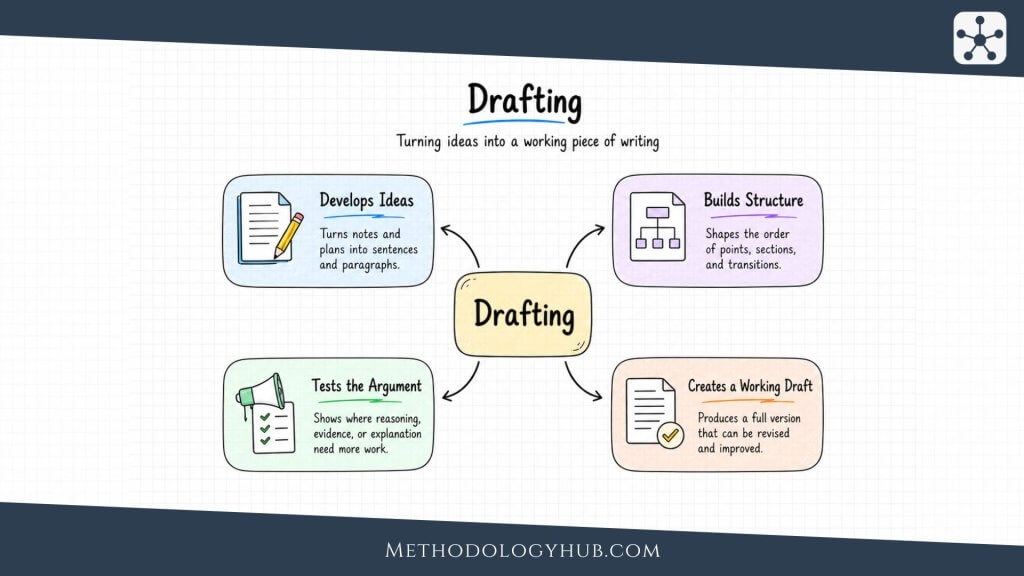
Drafting is the stage in which outlining becomes visible text. It is where the ideas, structure, and notes you have gathered finally begin to take form on the page. For many writers, this is the most emotionally difficult stage because it is the moment when thoughts become public enough to judge.
That is exactly why drafting should not be confused with finishing. The first draft is not supposed to be polished. Its job is to give you something real to work with. Once a draft exists, you can improve it. Before that, the writing still lives mostly in your head.
Draft for momentum, not perfection
One of the most helpful drafting habits is to focus on forward movement. Writers who stop every few sentences to fix wording often lose momentum and make the task harder than it needs to be. Drafting works better when you let yourself write imperfectly for a while.
That does not mean the draft should be careless. It means the standard should be usefulness, not polish. A useful first draft gets the argument onto the page, even if the phrasing is still rough and some transitions still need work.
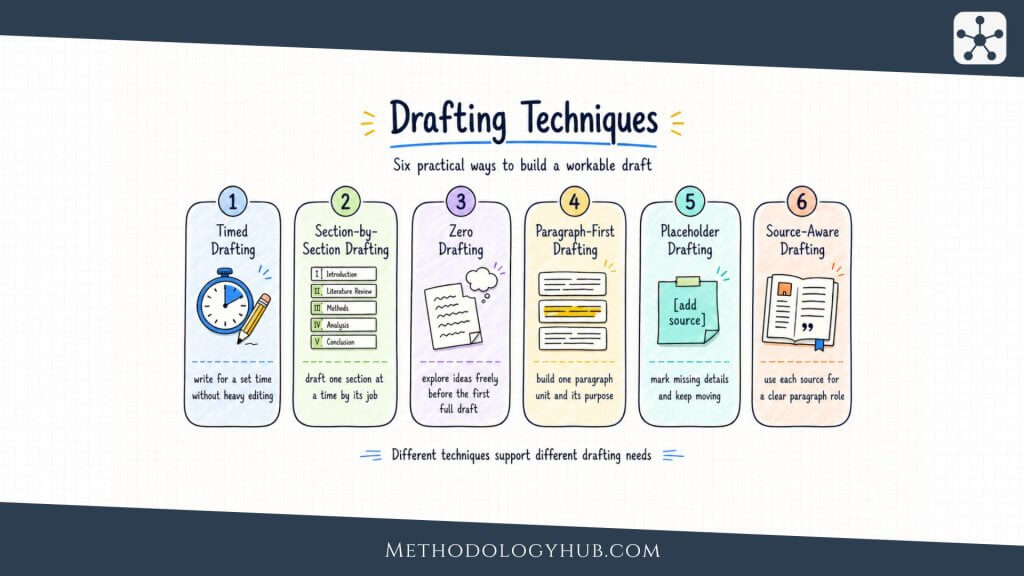
Helpful drafting strategies include:
- write in timed blocks: short focused sessions often reduce hesitation
- follow the outline closely: so you always know the next move
- use placeholders: instead of stopping to solve every detail immediately
- draft section by section: rather than trying to perfect the whole piece at once
Keep the reader in mind
Even in a first draft, audience awareness matters. You do not need final elegance yet, but the reader should still be able to follow what the paragraph is trying to do. A draft becomes stronger when each section already has a visible point and some sense of direction.
This is why clear topic sentences help even in rough versions. They give the paragraph an anchor. Later, revision can make the paragraph more precise, but the draft already has a core around which the rest of the thinking can grow.
Leave yourself useful markers
Drafting becomes easier when you permit yourself to leave notes inside the document. A phrase such as “need example here” or “check source” can keep you moving without losing track of what still needs attention. This is much more helpful than stopping the whole session to solve a small problem immediately.
A strong first draft is often uneven, but it is not empty. It contains the material revision needs. That is the real goal of drafting: not to produce a final performance, but to build something substantial enough to refine.
Step 4: Revision
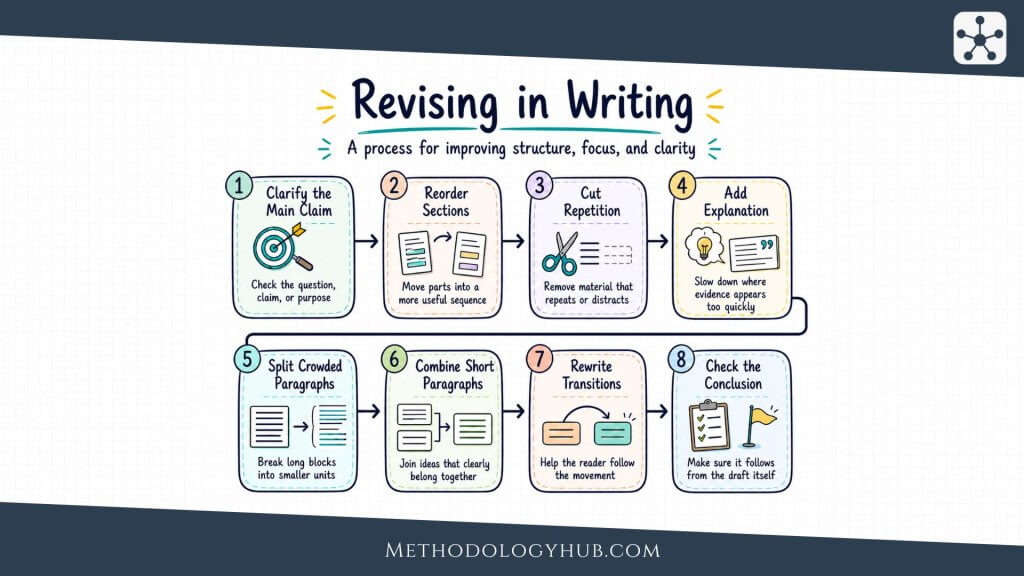
Revision is where writing usually becomes much stronger. This is the stage where you look again at the draft and ask whether the ideas are clear, the structure is working, and the reader can actually follow the line of thought. Revision deals with meaning and movement before it deals with surface polish.
Many writers underuse revision because they treat it as minor correction. In reality, revision is often the stage that makes the biggest difference. It is where weak sections are cut, arguments are sharpened, evidence is better integrated, and paragraphs are reorganised for clarity.
Revise the argument before the sentences
A helpful way to revise is to begin with the largest issues first. Is the main point clear. Does every section contribute to it. Are any paragraphs repeating the same idea. Is there enough explanation between pieces of evidence. These questions matter more at first than grammar.
If the structure is weak, sentence-level editing will not solve the real problem. That is why revision usually begins by checking focus, section order, paragraph purpose, and overall logic before anything else.
Useful revision questions include:
- Does the introduction prepare the reader for what follows?
- Does each paragraph make one clear contribution?
- Are examples and sources explained, not just inserted?
- Do transitions help the reader understand why the next point appears?
- Does the conclusion actually follow from the discussion?
Improve coherence and development
Once the larger structure is in place, revision often shifts to paragraph quality. A paragraph may have a good point but weak development. It may include evidence but not enough explanation. It may begin clearly but drift midway through. Revision is where you fix that.
One simple method is to read only the first sentence of each paragraph. If those first sentences do not form a logical sequence, the structure probably still needs work. Another useful method is to check whether each paragraph actually changes or advances the argument in some way. If it does not, it may not belong.
Use feedback productively
Outside feedback is especially useful during revision because writers are often too close to their own drafts to see certain problems clearly. A reader can quickly notice where an idea feels rushed, where a transition is missing, or where the piece assumes knowledge the audience may not have.
The most useful approach is to treat feedback as information rather than judgment. Instead of reacting defensively, look for patterns. If several comments point to the same weakness, that weakness is probably worth fixing in a deeper way, not only in the current draft but in your writing habits more broadly.
Step 5: Editing
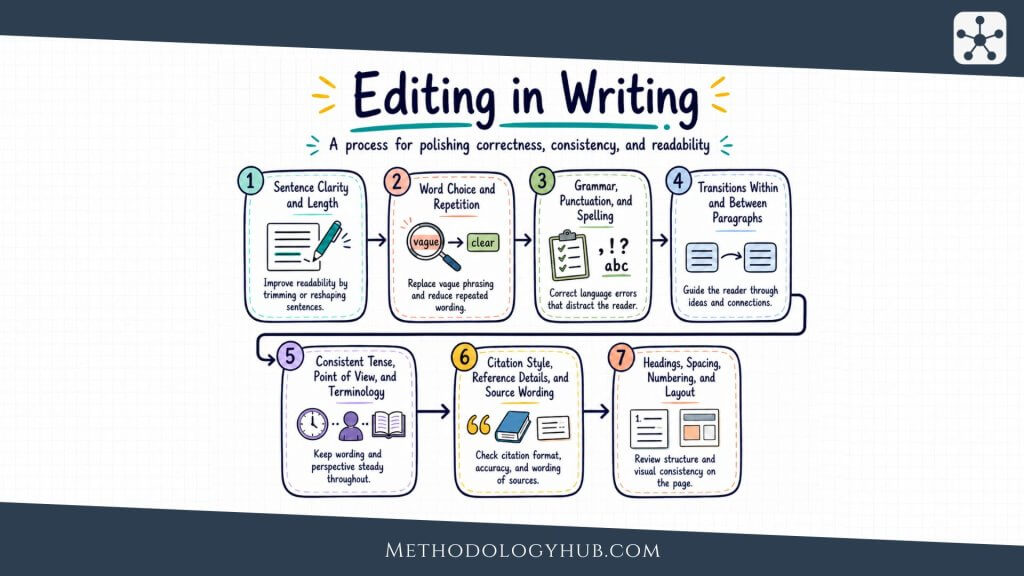
Editing and proofreading are the final stages of the writing process. By this point, the argument and structure should already be in place. The task now is to improve correctness, clarity, consistency, and presentation so that the final version feels clean and reliable.
This stage matters because even strong ideas can lose force when the final text is full of distractions. Awkward wording, inconsistent formatting, and missed errors can weaken the reader’s trust. Editing and proofreading help remove that noise.
Editing and proofreading are not the same
Editing usually focuses on style, clarity, and sentence quality. You may cut repetition, replace vague wording, tighten transitions, and improve rhythm. Proofreading is narrower. It checks grammar, spelling, punctuation, formatting, and other small errors that remain after editing.
Keeping those jobs separate is useful. If you try to proofread while the sentences still need rewriting, you end up doing small fixes on passages that may change again. The process works better when editing shapes the language first and proofreading comes after.
What to check line by line
At this stage, it helps to move slowly and deliberately. Small details become easier to spot when the larger revision work is already complete. Reading aloud, printing the text, or changing how it appears on the screen can make overlooked problems easier to see.
A final line-level check often includes:
- grammar, spelling, and punctuation
- sentence clarity and concision
- consistent tense, tone, and formatting
- accurate headings, references, links, or citations
- clean spacing, numbering, and presentation details
Final presentation matters too
Editing is not only about sentence correctness. It also includes how the text meets the expectations of its context. In some cases that means citation style. In others it means heading structure, layout, link formatting, or visual consistency. Presentation affects how professional and usable the writing feels.
The final review is also a good moment to step back and ask whether the piece now delivers what the introduction promised. If the answer is yes, the writing process has done its job. The text is not only finished. It is finished with intention.
The Writing Process for Different Text Types
The writing process remains useful across many kinds of writing, but it does not look exactly the same in every genre. A thesis, dissertation, research proposal, lab report, motivation letter, and essay all move through preparation, drafting, revision, and final editing, yet each one places pressure on different parts of that process. What changes is not the existence of the stages. What changes is the kind of work each stage has to do.
This matters because many writers become more effective once they stop treating all writing tasks as interchangeable. A strong draft does not only depend on general effort. It also depends on understanding what the genre is asking for. Some text types require deeper outlining and source management. Others depend more heavily on structure, methodological clarity, or persuasive self-presentation. When the process fits the genre, the writing usually becomes clearer and more controlled.
Seen this way, the writing process is both stable and flexible. The stages remain familiar, but the emphasis shifts with purpose, audience, and expectations. That is why learning to adjust your process across genres is such an important writing skill. It helps you move from merely completing a task to writing in a way that actually fits the task.
Writing a thesis
The writing process for a thesis usually places much greater weight on preparation and sustained outlining than shorter forms of writing do. A thesis is not just a longer essay. It is a long-form academic project that demands consistency over time, careful source use, and a clearer sense of how individual sections contribute to a larger argument. Because of that, the early stages of the writing process become more demanding.
In the prewriting stage, thesis writers often spend significant time narrowing the topic, defining a workable research question, and identifying a realistic scope. This stage can take longer than students expect, but it prevents major structural problems later. A thesis that begins too broadly often becomes difficult to organise, difficult to support with evidence, and difficult to complete coherently.
Outlining also matters more in thesis writing because the writer has to think at two levels at once:
- chapter level: what each chapter is meant to accomplish
- section level: how each subsection supports that chapter
- paragraph level: how each paragraph contributes to the line of reasoning
Drafting a thesis is rarely a smooth beginning-to-end process. Writers often move back and forth between chapters, notes, and revisions as the central argument develops. Revision is especially important because a thesis must feel coherent across a large number of pages. That means checking not only whether a sentence works, but also whether the full structure still makes sense after new material is added.
Writing a dissertation
The writing process for a dissertation shares many features with thesis writing, but the demands are usually greater in scale, depth, and originality. A dissertation often asks the writer to sustain a more advanced research question, engage more deeply with scholarship, and make a clearer independent contribution. Because of that, every stage of the process becomes more rigorous.
Prewriting for a dissertation usually involves prolonged reading, conceptual framing, and methodological clarification. The writer has to understand not only the topic itself, but also the scholarly conversation around it. This means the process of gathering and organising sources becomes central rather than secondary. Writers are not simply collecting material. They are positioning their work in relation to existing debates, theories, and findings.
Outlining a dissertation often includes:
- defining the research problem with precision
- mapping the relationship between chapters
- deciding how literature review, method, analysis, and conclusion will connect
- building a realistic timeline for drafting and revision
Revision in dissertation writing is also more layered. The writer may need to revise argument, method explanation, evidence selection, chapter sequence, and conceptual framing more than once. This is one reason dissertation writing is so demanding. It is not only long. It requires repeated rethinking at a high level. The process remains familiar, but it becomes much more recursive and strategic.
Writing a research proposal
The writing process for a research proposal is shaped by a different purpose. A proposal does not present a completed study. It explains what the writer plans to study, why that topic matters, and how the project will be carried out. That means the outlining stage becomes especially important, because the writer must show direction, feasibility, and relevance before the research is even complete.
In prewriting, proposal writers usually begin by identifying a research question that is both significant and manageable. This is often more difficult than it sounds. A good proposal question has to be focused enough to investigate realistically, but strong enough to justify why the project deserves attention.
Outlining a proposal usually means deciding how to balance several elements clearly:
- the topic: what the project is about
- the rationale: why the topic matters
- the literature context: how the project connects to existing research
- the method: how the study will be conducted
- the contribution: what the project is expected to add
Drafting in this genre tends to be more selective and persuasive than in longer academic writing. The writer must show that the project is worth doing, but must also avoid overstating what can realistically be achieved. Revision therefore focuses heavily on clarity, logic, and feasibility. The reader should come away thinking not only that the topic is interesting, but that the plan is focused, credible, and academically worthwhile.
Writing a lab report
The writing process for a lab report is more tightly structured than many other genres. Writers usually have less freedom in organisation, but much higher expectations of clarity, precision, and methodological transparency. This changes the process in important ways. The outlining stage is often shaped by an existing report structure, such as introduction, method, results, discussion, and conclusion.
Because the structure is already relatively fixed, prewriting often focuses less on inventing the overall form and more on understanding the experiment, the data, and the purpose of each section. The writer needs to know what belongs where. A common weakness in lab reports is that information appears in the wrong section or is described in a way that blurs the line between reporting and interpretation.
For that reason, writers often need to think carefully about section-specific tasks:
- introduction: establish context and purpose
- method: describe procedures clearly and accurately
- results: present findings without over-interpreting them
- discussion: explain meaning, limitations, and implications
Drafting a lab report usually depends on accuracy more than stylistic freedom. Revision is also highly specific. Writers need to check not only wording, but also numerical consistency, terminology, table labels, figure references, and the relationship between claims and data. In this genre, the writing process supports reliability as much as readability.
Writing a motivation letter
The writing process for a motivation letter is different again because the task is partly personal and partly strategic. A motivation letter asks the writer to present academic background, goals, and fit for a programme, scholarship, or opportunity. That means the process depends less on extended research and more on selection, focus, and self-presentation.
Prewriting is especially useful here because many weak letters fail before drafting even begins. Writers often try to include everything they have ever done instead of deciding which experiences actually support the application. The early stage should therefore focus on identifying the strongest material rather than the largest amount of material.
A useful outlining approach is to organise the letter around a few key questions:
- Why am I applying for this specific opportunity?
- What parts of my background are most relevant?
- What academic or professional direction am I trying to show?
- Why am I a good fit for this institution, programme, or project?
Drafting a motivation letter usually requires more control of tone than people expect. The writing should sound purposeful and credible, not exaggerated or generic. Revision therefore matters a great deal. Writers need to remove empty claims, strengthen specificity, and make sure the letter sounds grounded in actual experience rather than vague enthusiasm. In this genre, the writing process helps transform self-description into a focused academic argument about fit and readiness.
Writing an essay
The writing process for an essay is often the most familiar to students, but that familiarity can be misleading. Essays may be shorter than theses or dissertations, yet they still require clear outlining, controlled structure, and careful revision. In many ways, essays are where writers learn to apply the full writing process in a manageable form.
Prewriting in essay writing usually focuses on understanding the task, narrowing the topic, and identifying the type of response required. An essay prompt that asks you to analyse, discuss, evaluate, or compare is already shaping the process. Before drafting begins, the writer needs to know not just the topic, but the exact intellectual task the essay is meant to perform.
Outlining play a crucial role here because essays depend heavily on paragraph control and line of argument. A simple outline often works well:
- introduction: frame the issue and present the main claim
- body paragraphs: each develop one distinct part of the argument
- conclusion: draw the argument together without merely repeating it
Drafting an essay often feels easier than drafting a larger project, but it still benefits from the same discipline. Strong essays usually emerge when the writer keeps the argument visible from paragraph to paragraph rather than treating each paragraph as an isolated point. Revision is what makes that possible. It helps the writer test whether the essay actually develops reasoning, uses evidence well, and maintains focus from beginning to end.
What really changes from one text type to another
Although these text types differ, the deeper pattern stays surprisingly stable. All of them require some version of preparation, drafting, revision, and final editing. The difference lies in where the pressure falls. A lab report requires more precision in section control. A thesis or dissertation requires stronger large-scale outlining. A motivation letter depends more on selection and tone. A research proposal must persuade through feasibility. An essay depends heavily on argument and paragraph development.
This is why genre awareness improves writing so quickly. Once you understand what a given text type is trying to do, you can adjust your process to support that purpose more intelligently. The writing process does not disappear. It becomes more exact.
Techniques to Support the Writing Process
Good writing depends less on software than on repeatable techniques that help you think more clearly at each stage of the process. Strong writers do not move from idea to finished text by intuition alone. They use methods that help them generate ideas, test structure, stay focused, revise more intelligently, and notice weaknesses before the reader does.
That matters because writing problems often begin long before editing. A weak draft is usually not caused by one bad sentence. More often, it comes from unclear thinking, scattered outlining, rushed drafting, or revision that stays too close to grammar and never reaches structure. The right techniques help prevent those problems early.
This is also why one universal method rarely works for everyone. Some writers think best through questions and free notes. Others need visible structure, such as outlines, concept maps, or paragraph plans. What matters is not choosing the most impressive technique. It is choosing the ones that help you move through the writing process with more control.
Techniques for idea generation and direction
The early stages of writing often feel difficult because the writer is trying to do too many things at once. They are trying to discover a topic, narrow the focus, decide what matters, and imagine the final structure before they have enough material. This is where idea-generation techniques become useful. They reduce pressure by allowing exploration before commitment.
One useful approach is mind mapping. Instead of forcing ideas into a linear outline too early, mind mapping lets you place a central topic in the middle and build outward into themes, examples, questions, and connections. This works especially well when the subject still feels broad or when you suspect that several possible directions are competing for attention.
Another useful method is question-based brainstorming. Rather than asking only what you know about the topic, ask what the topic raises:
- What is the real problem or question here?
- Why does this matter to the intended reader?
- What tensions, disagreements, or patterns appear in the material?
- What would make this topic more specific and arguable?
This technique is especially helpful because it pushes the writer toward critical thinking early. Instead of collecting general observations, you begin looking for focus, stakes, and direction. That shift often marks the difference between a topic and a real writing angle.
Summarization techniques also help at this stage, especially when research is involved. If you can summarize a source, argument, or topic area in two or three clear sentences, you usually understand it well enough to start using it. If you cannot, more reading or note refinement may be needed. In that sense, summarization is not just a study skill. It is a diagnostic writing technique.
Techniques for outlining structure before drafting
Once ideas exist, the next challenge is turning them into a usable shape. Many writing problems come from weak structure, not weak content. A writer may have good material but still produce a confusing draft because the sequence is unclear or the main point is buried. Outlining techniques help solve that problem before full drafting begins.
The most practical method here is the outline method. A strong outline does not need to be long or formal. It only needs to show the reader’s path through the text. In most cases, that means identifying the central claim, listing the main supporting sections, and deciding what each paragraph or section needs to do.
- Main claim or purpose: What is the text trying to show, explain, or argue?
- Major sections: What are the two to five main moves that support that purpose?
- Paragraph tasks: What should each paragraph contribute that the others do not?
- Evidence placement: Where will examples, data, or citations do the most work?
Some writers benefit from concept mapping at this point rather than a strict outline. Concept mapping helps when the topic involves relationships between ideas rather than a simple sequence. It allows you to see cause and effect, comparison, overlap, and hierarchy before deciding how those relationships should appear in prose.
Techniques for drafting with focus and momentum
Drafting becomes easier when the writer stops expecting polish too early. The first version is not supposed to sound finished. Its job is to make the thinking visible. That is why focus techniques matter so much during drafting. They help you continue moving instead of stopping every few lines to judge what is not finished yet.
One of the most useful methods is the Pomodoro technique or any similar timed writing block. Working for a short, defined period reduces the psychological weight of the draft. Instead of thinking, “I need to write the whole section,” you only need to stay with the paragraph or subsection for one session. That usually makes starting easier, and starting is often the hardest part.
Another useful approach is section-by-section drafting. Rather than composing from beginning to end without pause, focus on completing one clear unit at a time. This keeps attention anchored in manageable decisions:
- What is the point of this section?
- What evidence belongs here?
- What should the reader understand by the end of it?
Writers also benefit from leaving temporary placeholders instead of breaking momentum. If you cannot remember a citation, an example, or the exact wording of a transition, mark it and keep going. Drafting usually improves when idea flow is protected from small interruptions.
Techniques for revision, reflection, and improvement
Revision becomes more effective when it is treated as a separate kind of thinking rather than an extension of drafting. Drafting creates material. Revision judges whether that material actually works. The strongest revision techniques help writers step back and evaluate structure, coherence, analysis, and reader impact instead of immediately fixing punctuation.
One useful method is the reverse outline. After drafting, reduce each paragraph to one sentence that states what it actually does. This reveals whether the draft has progression, repetition, or drift. It is a simple but powerful way to test structure honestly.
Metacognitive techniques matter here as well. Strong writers ask themselves questions not only about the text, but about their own decisions while writing. For example:
- Where does the argument become vague?
- Where am I describing instead of analysing?
- Which paragraph feels necessary, and which one only feels familiar?
- What would confuse a reader who does not already know what I mean?
That kind of self-questioning improves revision because it turns feedback inward. Instead of waiting for someone else to point out every weakness, the writer learns to detect patterns independently. This is one reason metacognition is so closely linked to stronger academic and analytical writing.
It also helps to revise in stages rather than all at once. Many weak revisions fail because the writer tries to fix everything simultaneously. A more effective pattern is to move in layers:
- first pass: argument, structure, and paragraph order
- second pass: evidence, examples, and explanation
- third pass: wording, clarity, and transitions
- final pass: grammar, punctuation, and formatting
The main lesson is that better writing usually comes from better habits of thinking. Techniques do not replace skill. They help build it. When you know which methods help you discover ideas, shape structure, protect focus, and revise more honestly, the writing process becomes less random and much more manageable.
Conclusion
The writing process is not just a school formula. It is a practical way of turning uncertain ideas into clear communication. Once you understand how prewriting, outlining, drafting, revising, and editing work together, writing becomes less mysterious and much easier to manage.
What usually makes the biggest difference is not trying to sound more impressive. It is learning how to move through the stages with more intention. Good writing improves when you prepare before drafting, draft without freezing, revise for meaning, and edit only after the larger work is done.
If there is one main takeaway from this guide, it is this: strong writing is usually the result of a strong process. The better your process becomes, the more reliable your writing becomes across different tasks and contexts.
- Generate ideas before you draft.
- Plan the structure before building the full piece.
- Use drafting to create momentum, not perfection.
- Revise for clarity and development before you edit the details.
Those habits make writing easier to shape, easier to improve, and easier for readers to trust.
FAQs on the Writing Process
What is the writing process?
The writing process is the series of stages writers use to move from an initial idea to a finished draft. It usually includes prewriting, outlining, drafting, revising, and editing. These stages help writers work more deliberately and improve the quality of the final text.
What are the five steps of the writing process?
The five main steps are prewriting, outlining, drafting, revising, and editing. Prewriting helps generate ideas, outlining organises them, drafting creates the first version, revising improves meaning and structure, and editing polishes the final language and presentation.
Is the writing process always linear?
No, the writing process is often recursive. Writers frequently move back to earlier stages when new ideas, missing evidence, or structural problems appear. That movement is a normal part of strong writing, not a sign that the process is failing.
What is the difference between revising and editing?
Revising focuses on larger issues such as argument, structure, paragraph development, and coherence. Editing focuses on sentence-level clarity, grammar, punctuation, spelling, and formatting. Revision changes the shape of the writing, while editing polishes the final version.
How can I improve my writing process?
You can improve your writing process by outlining before drafting, keeping drafting and editing separate, revising more deliberately, and using feedback to spot repeated weaknesses. Over time, the writing process improves most through practice, reflection, and repeatable habits.
Does the writing process work for different types of writing?
Yes, the writing process can be used for academic, professional, technical, and creative writing. The balance of the stages may change depending on the genre, but the core logic of preparation, drafting, revision, and editing remains useful across different contexts.