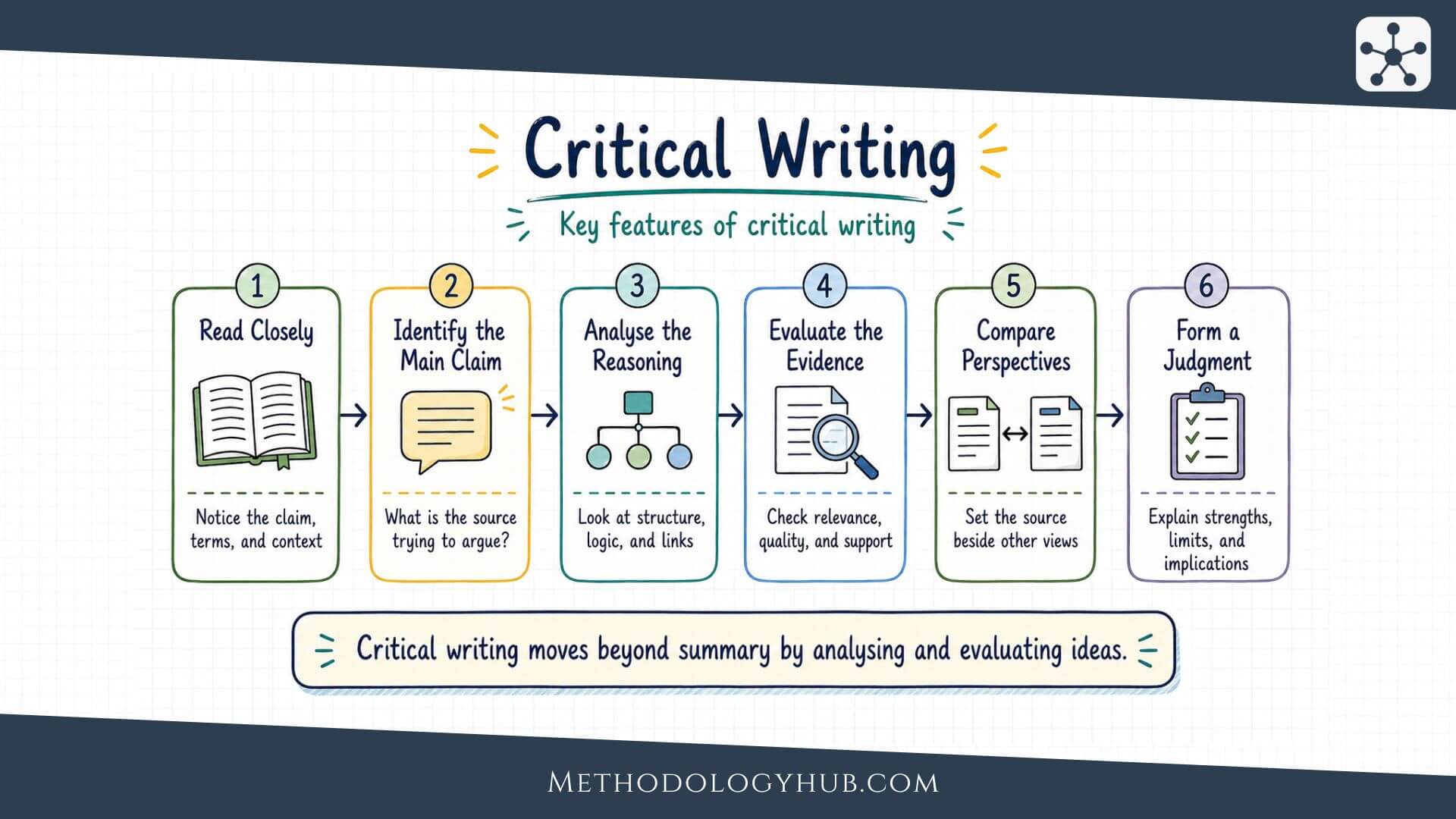
Critical writing is a form of academic writing that evaluates ideas, evidence, sources, arguments, and assumptions. It does more than report what a source says. It asks how convincing that source is, what its reasoning depends on, where its evidence is strong, and where the reader should be cautious.
This article explains what critical writing is, how it differs from descriptive, analytical, and persuasive writing, how to structure it, when to use it, and what it looks like in real academic paragraphs.
What Is Critical Writing?
Critical writing is writing that judges the quality of ideas rather than only presenting them. In academic work, that judgment should be reasoned, fair, and supported by evidence. A critical writer reads a source closely, identifies what it claims, examines how the claim is built, and then explains how far the reader can trust it for a particular purpose.
A simple example can make the idea easier to see. Suppose an essay discusses a study on homework and student achievement. Descriptive writing might state the study’s aim, sample, and findings. Analytical writing might compare the study with other research and identify patterns across the literature. Critical writing goes a step further. It asks whether the sample was suitable, whether the measure of achievement was narrow, whether the conclusion follows from the data, and whether another explanation could account for the findings.
Critical writing definition
Critical writing means evaluating information, evidence, reasoning, and interpretations in order to make a careful academic judgment. It does not mean being negative for the sake of sounding clever. A critical paragraph can praise a strong method, recognise a useful theory, or explain why a conclusion is convincing. The important point is that the paragraph shows judgment instead of simple acceptance.
That judgment usually grows from close reading. A writer first has to understand the material accurately. Only then can they examine it. This is one reason critical writing often appears after some description and analysis. You cannot evaluate a theory clearly if the reader has not yet been told what the theory says. You cannot judge a study’s evidence if the design and findings are still unclear. Good critical writing therefore uses description as a foundation, not as a substitute for evaluation.
Critical writing and critical thinking
Critical writing is the visible form of critical thinking on the page. The thinking happens when you compare claims, test assumptions, notice limits, and consider alternative interpretations. The writing happens when you explain those moves clearly enough for a reader to follow.
This connection is useful because many students are told to “be more critical” without being shown what that means in sentences. In practice, critical writing often uses verbs such as evaluates, questions, challenges, complicates, supports, limits, contrasts, qualifies, or suggests. These verbs help the writer move beyond reporting. They show what the writer is doing with the material.
Critical writing is not hostile writing
One misunderstanding is that critical writing has to attack every source. This usually leads to weak writing. A paragraph that dismisses a study without explaining why is no more critical than a paragraph that accepts it without question. Both skip the reasoning that the reader needs.
A better approach is controlled evaluation. The writer can recognise that a source is useful for one part of an argument while limited for another. For example, a small interview study may provide rich insight into student experiences, but it may not support broad claims about all students. A large survey may identify a pattern across many participants, but it may not explain the personal meanings behind that pattern. Critical writing keeps those distinctions visible.
Features of Critical Writing
The main features of critical writing are evaluation, evidence, comparison, balance, precision, and explanation. These features work together. A paragraph may sound critical because it uses strong language, but if it does not show evidence or reasoning, it is only making a claim about a claim. Good critical writing gives the reader enough detail to see why the judgment is reasonable.
It helps to think of critical writing as a set of reading and writing habits. The writer reads sources with questions in mind, then writes in a way that makes those questions useful to the reader. The result is not a louder paragraph. It is a clearer and more careful one.
Evaluation
Evaluation is the central feature. A critical writer asks how convincing an argument is, how well a source uses evidence, and how far a conclusion can be taken. The evaluation should be specific. Saying that a theory is “weak” tells the reader very little. Explaining that the theory accounts for classroom interaction but pays little attention to assessment pressure gives the reader something they can examine.
Evaluation also has to fit the task. In a literature review, the writer may evaluate a group of studies to show what is known and what remains uncertain. In an essay, the writer may evaluate two interpretations before defending one. In a report, the writer may evaluate the reliability of evidence before drawing a practical conclusion.
Evidence-based judgment
Critical writing should not rely on personal reaction alone. A writer may find a source convincing, but the academic task is to show why. That usually means pointing to evidence, design, reasoning, scope, definitions, or comparison with other sources.
For example, a writer might say that a study is useful because it compares several schools rather than one classroom. They might also say that the same study is limited because it measures achievement only through test scores. Both points are judgments, but they are not casual opinions. They are tied to features of the evidence.
Attention to assumptions
Many arguments depend on assumptions that are not stated directly. A policy argument about homework may assume that more time spent studying leads to better learning. A theory of motivation may assume that students respond similarly across age groups. A research article may assume that a particular questionnaire captures the concept it claims to measure.
Critical writing brings assumptions into view. It does not always reject them. Sometimes an assumption is reasonable. But naming it helps the reader understand the ground on which the argument stands.
Reading prompt: Before evaluating a source, ask what the author has to assume for the argument to work. Then ask whether that assumption is supported, limited, or left unexplained.
Comparison and contrast
Critical writing often becomes stronger when sources are read together. One article may look convincing on its own, but a second article may use a different method, define the concept differently, or reach a more cautious conclusion. Comparison helps the writer avoid treating one source as the whole conversation.
This is especially useful in literature reviews. Instead of summarising five studies one after another, a critical writer groups them by approach, evidence, findings, or limitation. The reader can then see where the field agrees, where it is divided, and where the evidence is thin.
Balanced and precise language
Critical writing usually avoids extreme wording unless the evidence justifies it. Words such as proves, always, never, completely, or obvious often make academic judgment look less careful. More precise language lets the writer make a strong point without overstating it.
For example, “This study proves that feedback improves writing” is probably too broad. A more careful sentence would be: “This study suggests that frequent formative feedback can improve revision quality in first-year writing courses, although the sample was limited to one institution.” The second version is still a clear judgment, but it names the scope of the evidence.
Explanation after evidence
Critical writing does not leave evidence to speak for itself. After presenting a source, example, or finding, the writer explains what it shows and how it affects the argument. This step is often where critical writing becomes visible.
A useful pattern is source, interpretation, judgment. First, identify the relevant source or evidence. Then explain what it means. Finally, state how it shapes the argument. The pattern does not need to be mechanical, but it reminds the writer that citation alone is not evaluation.
When to Use Critical Writing
Critical writing is used whenever an academic task asks the writer to evaluate rather than only explain. It is common in essays, literature reviews, research papers, discussion sections, book reviews, article reviews, dissertations, and reflective academic assignments. The exact form changes, but the central task stays similar: the writer must show judgment about ideas, sources, evidence, or interpretations.
Students often expect critical writing only in assignments that use verbs such as evaluate or critique. Those verbs are clear signals, but they are not the only ones. Questions that ask you to assess, discuss, compare, examine, or to what extent usually expect some critical judgment as well.
Use it in essays that ask for evaluation
Many essays need critical writing because they ask for a reasoned answer rather than a topic overview. If the question asks whether a theory explains a problem, whether one interpretation is more convincing than another, or whether a policy is supported by evidence, simple description will not be enough.
In that kind of essay, critical writing helps the writer move from source reporting to argument. A paragraph might first explain a research finding, then question the study’s scope, then use that evaluation to refine the essay’s position. The evaluation is not an extra comment at the end. It helps build the answer.
Use it in literature reviews
Literature reviews are one of the clearest places where critical writing appears. A literature review should not read like a catalogue of studies. It should organise the research conversation and judge what the existing literature does well, where it disagrees, and where further work is needed.
For example, a literature review on feedback in writing classes might group studies by type of feedback, educational level, or research method. Critical writing would then evaluate the strength of each group. It might note that experimental studies show short-term improvement, while interview studies explain how students experience feedback differently. This kind of writing helps the reader see the shape of the evidence instead of only the names of the sources.
Use it in discussion sections
In research reports and dissertations, the discussion section often requires critical writing. The writer does not simply repeat the findings. They interpret the findings in relation to the research question, previous studies, method, and limits of the project.
A discussion section might explain that a result supports earlier work, but only partly. It might point out that the sample was small, that the measure did not capture all parts of the concept, or that the finding is stronger for one subgroup than another. These statements help the reader understand what the study contributes and how cautiously the result should be read.
Use it when working with sources
Critical writing is also useful whenever sources disagree. Academic sources often differ because they use different methods, study different contexts, or begin with different assumptions. A writer who only reports each source separately leaves the reader to work out the relationship between them.
A critical writer makes that relationship explicit. They might explain that one author gives a stronger theoretical account, while another provides stronger empirical evidence. They might show that two studies seem to disagree because they define the same concept differently. This kind of evaluation turns a source list into a line of reasoning.
Structuring Critical Writing
Critical writing needs structure because evaluation can easily become scattered. A writer may notice many possible issues in a source: method, sample, definitions, assumptions, evidence, tone, theory, and conclusion. The task is not to mention every possible criticism. The task is to choose the points that help answer the assignment question.
A strong critical paragraph usually moves through a clear sequence. It introduces the point, presents the relevant source or evidence, explains what the source shows, evaluates its strength or limit, and connects that evaluation back to the wider argument. The sequence can vary, but the reader should always be able to see how the judgment is reached.
Begin with the question
Critical writing should begin with the assignment question or research question, not with a random list of things that could be criticised. A limitation is only useful if it affects the claim being made. A source detail is only worth discussing if it helps the reader understand the argument.
For example, if an essay asks whether peer feedback improves student writing, the writer does not need to evaluate every feature of every source. They need to evaluate the evidence that connects peer feedback to improvement. That might involve looking at how improvement was measured, how long the study lasted, and whether the feedback process was structured or informal.
Build paragraphs around judgments
A critical paragraph should usually have a clear judgment at its centre. The paragraph might argue that a source is useful but narrow, that a theory explains one part of a problem but not another, or that a finding is convincing because it is supported by several methods.
This is different from building a paragraph around a source title. A source-centred paragraph often begins, “Smith argues…” and then summarises the article. A judgment-centred paragraph begins with the point the writer needs to make, then uses Smith and other sources to support and refine that point. The second approach usually creates stronger academic movement.
Paragraph pattern: Point about the issue, evidence from the source, explanation of what the evidence shows, evaluation of strength or limit, link back to the argument.
Use evidence before evaluation
Evaluation is stronger when the reader can see the evidence first. A sentence such as “The study is limited” is not very helpful on its own. The reader needs to know what kind of limit is being discussed and why it affects the argument.
A fuller version might explain that the study is based on students from one course, that the writing task was short, and that improvement was measured immediately after the intervention. The writer can then argue that the study is useful for understanding short-term revision behaviour, but less useful for judging long-term writing development. This is critical writing because the evaluation is tied to specific evidence.
Connect evaluation to the wider argument
A critical comment should not sit alone at the end of a paragraph. It should change or refine the argument in some way. If a study is limited, what follows from that limit? Should the essay rely on the study only cautiously? Should it be paired with other evidence? Does it support a narrower claim than the author makes?
This final connection is often what separates a useful critical paragraph from a paragraph that only points out flaws. Academic writing is not a search for defects. It is a way of building a careful answer. Each evaluation should help that answer become more precise.
Plan the structure during the writing process
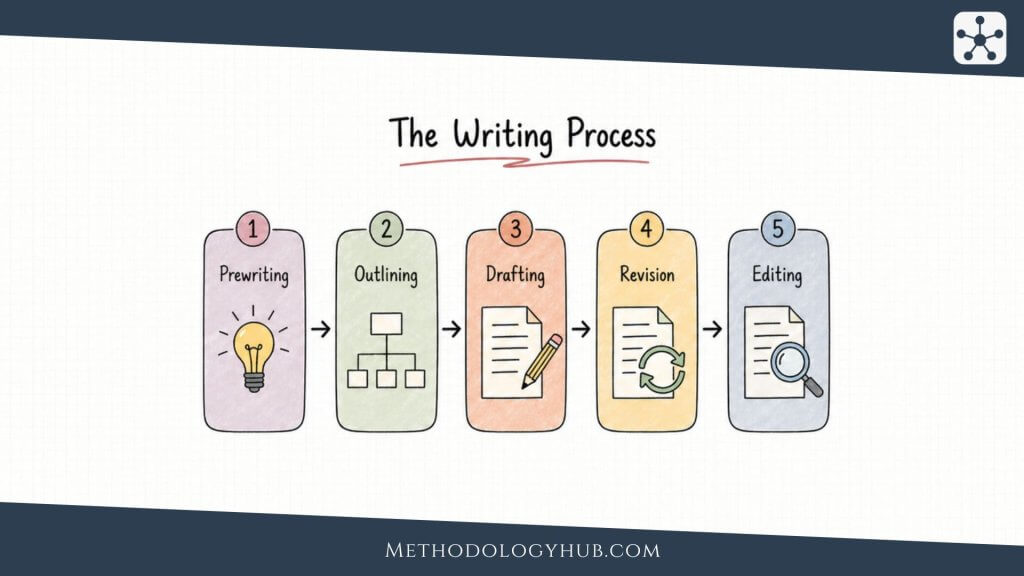
Critical writing becomes easier when it is planned before drafting. During the writing process, it helps to mark each source with notes such as useful evidence, limited sample, strong concept, unclear definition, or alternative interpretation. These notes can later become the basis for paragraph structure.
Planning also prevents a common problem: adding critical comments only after the main draft is already finished. When critique is added late, it often sounds like a separate layer. When it is planned early, it shapes the whole line of thought.
Differences With Other Types of Writing
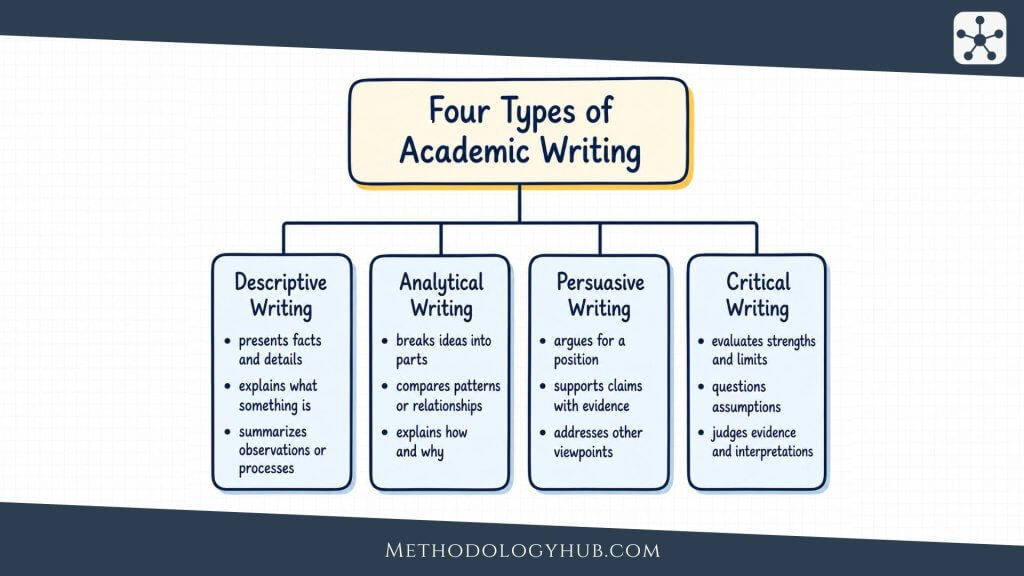
Critical writing is one of the main types of academic writing, alongside descriptive, analytical, and persuasive writing. These types are easier to understand when they are compared through what the writer is doing on the page.
In real assignments, the types often combine. A critical essay may begin with description, use analysis to organise evidence, include persuasion to defend a position, and use critique to evaluate sources. The difference is not always a clean boundary between separate texts. It is more often a shift in the writer’s task.
Critical writing vs descriptive writing
Descriptive writing tells the reader what something is, what happened, or what a source says. It is necessary because readers need information before they can follow an evaluation. A paragraph that defines a concept, summarises a study, or reports a sequence of events is often descriptive.
Critical writing uses description but does not stop there. After telling the reader what a source says, it asks how well the source supports its claim. For example, a descriptive sentence might state that a study found improvement after peer feedback. A critical sentence might add that the improvement was measured only once, which makes the evidence less useful for claims about long-term writing development.
Critical writing vs analytical writing
Analytical writing breaks information into parts and explains relationships. It might compare themes across interviews, identify patterns in studies, or explain how parts of an argument fit together. Analysis often prepares the ground for critique because it shows what is happening inside the material.
Critical writing adds judgment to that analysis. It does not only show that two studies use different methods. It explains how those methods affect the strength of the conclusions. It does not only identify a pattern in the literature. It asks whether that pattern is well supported, too narrow, or open to another interpretation.
Critical writing vs persuasive writing
Persuasive writing aims to convince the reader of a position. In academic work, persuasion should still be evidence-based and measured. The writer makes a claim, supports it, and addresses possible objections.
Critical writing often strengthens persuasion because it shows that the writer has tested the evidence before using it. A persuasive essay may argue that a teaching method is effective. A critical version of that argument would examine which studies support the claim, which contexts they studied, and where the evidence remains uncertain. The argument becomes more convincing because it is not pretending the evidence is simpler than it is.
| Type of writing | Main task | Typical question |
|---|---|---|
| Descriptive writing | Reports information clearly. | What does the source say? |
| Analytical writing | Explains parts, patterns, and relationships. | How does the material work? |
| Persuasive writing | Builds a reasoned position. | Which position should the reader accept? |
| Critical writing | Evaluates quality, strength, limits, and assumptions. | How convincing is the material, and for what purpose? |
How the types work together
The four types are best seen as writing moves rather than boxes. A single paragraph can contain more than one move. It may describe a study, analyse its method, use it to support a position, and then evaluate its limits. What makes the paragraph critical is the presence of reasoned judgment.
This is why many strong academic paragraphs feel layered. They do not rush straight to judgment. They prepare the reader, explain the material, and then make a careful evaluation. The result is smoother and more convincing than a paragraph that simply declares a source strong or weak.
Examples of Critical Writing
Examples make critical writing easier to recognise because the difference often appears in small sentence moves. A descriptive sentence may be accurate, but it leaves the reader with information only. A critical sentence uses that information to judge the quality, scope, or meaning of a claim.
The examples below use simple academic situations. They are not model paragraphs for every discipline, but they show how a writer can move from reporting to evaluation without becoming vague or hostile.
Example 1: evaluating a research study
A descriptive version might say:
The study surveyed 120 first-year students and found that students who used planning checklists received higher essay scores than students who did not use them.
This sentence gives useful information, but it does not evaluate the study. A critical version might read:
The study suggests that planning checklists may support first-year essay performance, but its evidence is limited by the use of one cohort and one assignment type. The findings are therefore useful for discussing early writing support, but they cannot show whether checklists improve academic writing across courses or over a longer period.
The second version still uses the original finding, but it judges the scope of the claim. It names what the study can support and what it cannot support. That is the critical move.
Example 2: comparing two sources
A descriptive comparison might say:
Garcia focuses on student motivation, while Ahmed focuses on teacher feedback. Both authors discuss academic writing development.
A critical comparison might say:
Garcia’s account is useful for explaining how students describe their own motivation, while Ahmed provides stronger evidence about classroom practice because the study includes teacher comments, student drafts, and revision records. Taken together, the sources suggest that writing development cannot be explained through motivation alone; it also depends on the kind of feedback students receive and how they use it during revision.
This version does more than place two sources side by side. It judges what each source contributes and uses the comparison to develop a fuller interpretation.
Example 3: evaluating a theory
A descriptive version might say:
The theory argues that students improve their writing when they receive regular feedback and opportunities to revise.
A critical version might say:
The theory gives a convincing account of writing as a process because it connects feedback with revision rather than treating writing as a one-time performance. However, it gives less attention to institutional conditions such as class size, marking time, and assignment deadlines, which may affect whether regular feedback is possible in practice.
This example shows that critical writing can recognise value and limitation in the same paragraph. The theory is not rejected. It is placed within a realistic boundary.
Example 4: critical writing in a literature review
A literature review becomes critical when it organises sources around judgment rather than listing them separately. A weak version might summarise one article per paragraph and leave the reader to make sense of the whole group. A stronger version groups sources by what they show.
Studies of peer feedback generally agree that students benefit from seeing how others approach the same task, but the evidence is stronger for short-term revision than for long-term writing development. Experimental studies tend to measure improvement within one assignment cycle, while interview-based studies show that students often need guidance before they can give useful comments. This suggests that peer feedback should be treated as a structured learning activity rather than as a simple exchange of opinions.
This paragraph does several things at once. It describes the literature, identifies a pattern, evaluates the strength of the evidence, and draws a cautious conclusion. That layered movement is typical of critical writing.
Critical Writing at Paragraph Level
Critical writing often becomes visible at paragraph level. A whole essay may have a critical purpose, but the reader experiences that purpose one paragraph at a time. If the paragraphs only summarise sources, the essay will still feel descriptive even if the introduction promises evaluation. If each paragraph makes a focused judgment and explains it, the essay begins to read critically.
This is why paragraph design is so useful for students. You do not have to make every sentence evaluative. A critical paragraph still needs context, evidence, and explanation. The question is whether those parts lead somewhere. The paragraph should guide the reader from information toward a reasoned judgment.
Start with a claim that can be evaluated
A topic sentence in critical writing should usually do more than announce the source. Instead of beginning with “Brown discusses feedback”, the paragraph might begin with “Research on feedback is strongest when it examines revision as well as student satisfaction.” The second version gives the paragraph a clearer job. It tells the reader that the paragraph will judge the quality of the evidence, not only introduce a scholar.
This does not mean every topic sentence has to be dramatic. In academic writing, a modest claim is often better than an exaggerated one. The topic sentence should name the issue, suggest the direction of the evaluation, and prepare the reader for the evidence that follows.
Give enough context for the evidence
Critical writing can become confusing when the writer moves too quickly from source to judgment. The reader needs enough context to understand what is being evaluated. If the paragraph criticises a study’s sample, the reader needs to know what the sample was. If the paragraph questions a theory’s scope, the reader needs to know what the theory tries to explain.
The goal is not to summarise everything. It is to select the details that make the evaluation fair. A sentence or two of description can prepare the ground for a stronger critical point. Description becomes a problem only when it takes over the paragraph and leaves no space for judgment.
Explain the critical move
The critical move is the moment when the writer evaluates the evidence. This may involve naming a strength, a limit, a tension, a gap, or a useful connection. The move should be explicit enough that the reader does not have to guess.
For example, a paragraph might say that a source is useful because it studies actual student drafts rather than relying only on self-reported attitudes. It might also say that the same source is limited because the drafts were collected from one course. Both points need explanation. The first point explains why the evidence is strong. The second explains how far the evidence can be taken.
Use transitions that show relationships
Critical writing depends heavily on relationships between ideas. A paragraph may need to show contrast, qualification, cause, limitation, or extension. Transitions help the reader see those relationships. Words and phrases such as however, although, in contrast, this suggests, this is limited by, and taken together can guide the reader through the writer’s reasoning.
The best transitions are not decorative. They name the logic of the paragraph. If one study appears to support another, the transition should show that connection. If a source complicates an earlier point, the transition should prepare the reader for that shift. Without these signals, even good evaluation can feel abrupt.
End by returning to the argument
A critical paragraph should usually end by linking the evaluation back to the argument. This does not always require a separate sentence, but the connection should be clear. The reader should know what follows from the evaluation.
For instance, if a study has a narrow sample, the final sentence might explain that the study is best used as evidence for one educational setting rather than as a general claim about all learners. If two sources disagree because they define a concept differently, the final sentence might explain which definition the essay will use and why. This return to the argument gives the paragraph direction.
| Paragraph part | Job in critical writing |
|---|---|
| Topic sentence | Introduces a point that can be evaluated, not only a source name. |
| Evidence | Provides the source detail, example, finding, or quotation that the judgment depends on. |
| Evaluation | Explains the strength, limit, assumption, implication, or scope of the evidence. |
| Link back | Shows how the evaluation affects the wider argument or answer. |
How to Write Critically
Critical writing becomes easier when it is treated as a set of decisions rather than a mysterious style. The writer has to decide what to evaluate, which evidence to use, how much description the reader needs, and how strongly the final judgment should be worded. These decisions can be built into the writing process from the beginning.
The aim is not to decorate a paragraph with critical-sounding phrases. The aim is to make your reasoning visible. A reader should be able to see how you moved from source evidence to your own academic judgment.
Read with evaluation questions
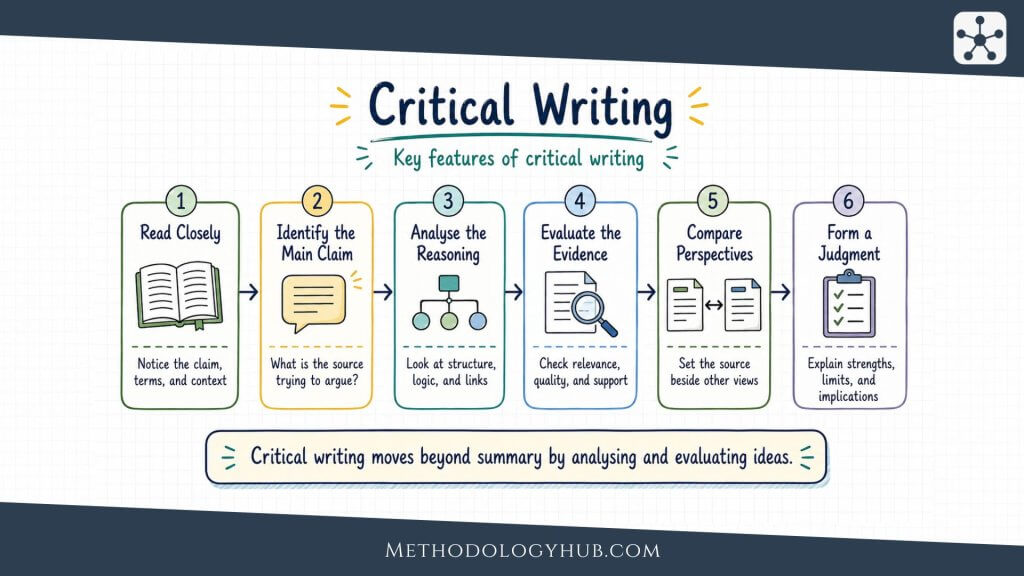
Critical writing starts before drafting. While reading, it helps to ask questions that focus on evidence and reasoning. What is the author’s main claim? What evidence supports it? What method produced that evidence? What is assumed? What is left outside the discussion? How does this source compare with others on the same topic?
These questions keep notes from becoming simple summaries. Instead of writing only what the source says, you begin to record how the source works. Later, those notes can become paragraph material.
Use reporting verbs carefully
Reporting verbs shape the reader’s understanding of a source. A sentence saying that an author proves something is much stronger than a sentence saying that an author suggests, argues, proposes, questions, or assumes it. Critical writing chooses these verbs with care.
For example, if a source is based on a small sample, “suggests” may be more accurate than “proves”. If a source presents an interpretation rather than a measured result, “argues” may be better than “shows”. These choices may look small, but they make the evaluation more precise.
Move beyond quotation
Quotations can be useful when the wording of a source is important, but they do not create critique by themselves. A paragraph full of quotations may still leave the writer’s judgment hidden. Critical writing needs explanation around the evidence.
After using a quotation or paraphrase, ask what the reader should notice. Does the evidence support a narrow point? Does it conflict with another source? Does it rely on a particular definition? Does it make a claim that the method cannot fully support? The answer should appear in the paragraph, not only in the writer’s mind.
Qualify your claims
Critical writing often becomes more convincing when claims are qualified. Qualifying does not mean weakening every point. It means matching the strength of the claim to the strength of the evidence.
Useful qualifying phrases include in this context, to some extent, this suggests, this may indicate, the evidence is stronger for, and the findings are limited to. These phrases help the writer avoid overstatement. They also show the reader that the writer understands the difference between a possible interpretation and a fully supported conclusion.
Revise for paragraph movement
During revision, read each paragraph and ask whether it actually moves beyond description. Does it make a judgment? Does it explain the reason for that judgment? Does it connect the evaluation back to the essay question? If the answer is no, the paragraph may need another sentence that explains what the evidence means.
It can also help to read the first sentence of each paragraph in sequence. If those sentences only name sources, the essay may be organised around reading notes rather than argument. If they state focused points, the essay is more likely to have a critical structure.
Conclusion
Critical writing is a careful way of evaluating ideas, sources, evidence, and arguments. It does not replace description, analysis, or persuasion. It uses them. A writer may need to describe a study before evaluating it, analyse a pattern before judging its strength, and build a persuasive argument from evidence that has already been tested.
The main difference is judgment. Critical writing asks whether a claim is convincing, what assumptions it depends on, how strong the evidence is, and how far the conclusion can reasonably go. That judgment should be visible in the writing, supported by evidence, and expressed with enough precision that the reader can follow it.
For students, the most practical step is to stop treating critique as a final sentence added after summary. Instead, build it into the whole process: read sources with questions, plan paragraphs around judgments, explain evidence carefully, and revise for clearer connections. When that happens, critical writing becomes less intimidating and much more useful.
FAQs on Critical Writing
What is critical writing?
Critical writing is academic writing that evaluates ideas, evidence, sources, arguments, and assumptions. It does not only report what a source says. It explains how convincing the source is, what supports its claim, where its limits are, and how it contributes to the writer’s own argument.
What are the main features of critical writing?
The main features of critical writing are evaluation, evidence-based judgment, attention to assumptions, comparison between sources, balanced wording, and clear explanation after evidence. A critical paragraph should show why a judgment is reasonable rather than simply stating that a source is strong or weak.
How is critical writing different from descriptive writing?
Descriptive writing presents information, such as what a source says, what happened, or how something works. Critical writing uses that information to evaluate quality, strength, scope, assumptions, and limitations. Description gives the reader a foundation, while critical writing explains what that foundation can support.
When should you use critical writing?
You should use critical writing when an assignment asks you to evaluate, assess, discuss, critique, compare, or judge how convincing a claim is. It is common in essays, literature reviews, research papers, dissertation discussion sections, article reviews, and academic reflections.
How do you write critically?
To write critically, begin by reading sources with evaluation questions in mind. Identify the main claim, examine the evidence, notice assumptions, compare the source with other research, and then explain your judgment in the paragraph. Use careful reporting verbs, avoid overstatement, and connect each evaluation back to the assignment question.