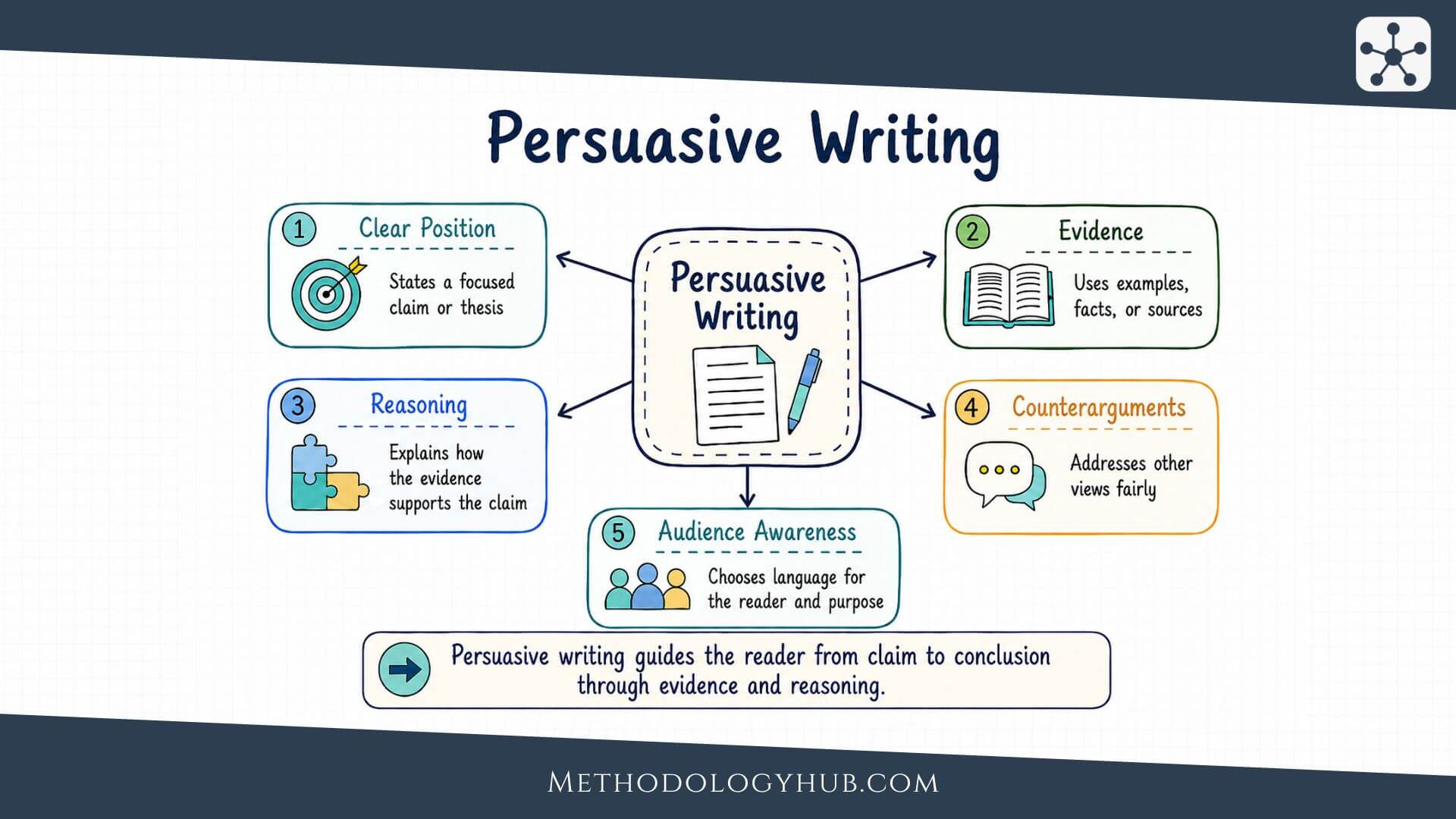
Persuasive writing is a type of academic writing used to build a clear position and support it with reasons, evidence, and careful explanation. It does not mean pressuring the reader or filling a text with emotional language. In an academic setting, persuasion works through a visible line of reasoning that the reader can follow, question, and evaluate.
This article explains what persuasive writing is, how it works in academic contexts, which features make it effective, how to structure a persuasive text, when to use it, how it differs from descriptive, analytical, and critical writing, and what persuasive writing can look like in practice.
What Is Persuasive Writing?
Persuasive writing is writing that tries to convince the reader to accept a position, interpretation, recommendation, or conclusion. In academic work, this persuasion must be built through reasoning. The writer makes a claim, supports it with evidence, explains how the evidence connects to the claim, and deals fairly with other possible views.
A persuasive text usually begins with a question that can be answered in more than one way. Should a school change its homework policy. Which interpretation of a poem is more convincing. Does a particular theory explain a case better than another theory. Once the question allows disagreement, the writer has to do more than report information. The writer has to guide the reader toward a defensible answer.
Persuasive writing definition
Persuasive writing means developing a position and supporting it through clear claims, relevant evidence, logical explanation, and careful attention to opposing views. It is common in essays, position papers, research papers, literature reviews, policy discussions in education, and discussion sections of academic reports.
The key word is position. A persuasive text does not simply describe a topic. It takes a stance on that topic. That stance may be strong, cautious, narrow, or conditional, but it must be visible enough for the reader to understand what the writer is arguing.
Persuasive writing in academic contexts
Academic persuasive writing is different from everyday persuasion. It should not rely on personal pressure, slogans, exaggeration, or dramatic certainty. A reader in school, college, or research expects more than confidence. They expect reasons.
For example, a student might write that small-group discussion improves reading comprehension. In persuasive writing, that claim would need evidence. The writer might use classroom studies, a comparison of teaching methods, and a short explanation of how peer discussion can help students test interpretations. The claim becomes persuasive because the reasoning is visible.
This is where persuasive writing connects closely to academic writing. Academic work often asks writers to explain what they think, but also to show how they reached that conclusion. The reader should not feel pushed. The reader should feel guided.
Persuasion, argument, and opinion
Many students first connect persuasion with opinion. That connection is understandable, but it can also create weak writing. An opinion tells the reader what the writer believes. An argument shows why that belief is reasonable in a specific context.
Suppose a student writes, “Students should read more novels in school.” That is an opinion. It becomes an academic argument only when the writer narrows the claim, explains the basis for it, and supports it with evidence. A stronger version might argue that guided novel reading can improve interpretive skills in lower secondary classrooms when it is paired with discussion and short written responses.
This narrower claim is easier to support because it gives the reader a clearer context. It names the type of reading, the group of students, and the conditions under which the claim applies. Persuasive writing becomes stronger when it moves away from broad approval or disapproval and toward a claim that can actually be defended.
Features of Persuasive Writing
The main features of persuasive writing are a clear position, a focused thesis, logical structure, relevant evidence, explained reasoning, attention to other viewpoints, and a tone that suits academic discussion. These features work together. A strong thesis without evidence feels unsupported. Evidence without explanation feels unfinished. A confident tone without balance can sound careless.
Good persuasive writing therefore has to do several things at once. It must lead the reader, but not rush them. It must make a claim, but not pretend that every question is simple. It must use evidence, but not leave the reader to guess what that evidence proves.
A clear position
The position is the answer the writer is asking the reader to accept. It may appear as a thesis in an essay, a main argument in a research paper, or a recommendation in a report. Without a clear position, persuasive writing loses direction.
A position should be more precise than a general topic. “School uniforms” is a topic. “School uniforms can reduce visible economic differences among students, but only when schools avoid costly branded requirements” is a position. The second version can guide a full paragraph or section because it makes a specific claim with a built-in condition.
A focused thesis
The thesis is the controlling claim of the text. In short essays, it often appears in the introduction. In longer academic work, it may develop across the opening section, but the reader still needs to understand the direction early.
A focused thesis usually does three things. It names the issue, states the writer’s position, and suggests the direction of the argument. It does not have to list every paragraph in advance, but it should prepare the reader for the line of reasoning that follows.
Example: A weak thesis says, “Homework is a difficult issue.” A stronger persuasive thesis says, “Short, purposeful homework tasks can support learning more effectively than long routine assignments because they give students practice without turning home study into repetition.”
Evidence that fits the claim
Persuasive writing depends on evidence. Depending on the subject, evidence may include research findings, historical examples, literary passages, survey results, classroom observations, theoretical arguments, or data from a study. The type of evidence should fit the question being asked.
Evidence should not appear as decoration. A quotation, statistic, or source summary is useful only when the writer explains how it supports the claim. Readers should not have to supply the connection themselves. A persuasive paragraph usually needs a claim, evidence, and interpretation working together.
Reasoning between evidence and conclusion
Reasoning is the bridge between evidence and conclusion. It explains why the evidence supports the claim and how the reader should understand it. Without reasoning, a paragraph can feel like a list of facts placed near an opinion.
For example, a writer may cite a study showing that students who discuss texts in pairs produce longer explanations. The persuasive work begins when the writer explains why that finding supports a claim about reading instruction. The evidence does not speak alone. The writer has to interpret it.
Engagement with opposing views
Persuasive writing becomes more credible when it recognises other reasonable positions. This does not mean giving every view equal space. It means showing that the writer understands the discussion and can explain why one position is still stronger in the context of the assignment.
For instance, a writer arguing for more formative feedback in school may acknowledge that teachers have limited marking time. That acknowledgement does not weaken the argument. It allows the writer to refine the claim by proposing shorter, targeted feedback cycles rather than constant written comments on every task.
Measured tone
The tone of persuasive writing should be confident enough to guide the reader and careful enough to remain believable. Words such as “always”, “never”, “proves”, and “everyone” can weaken academic persuasion when the evidence does not support that level of certainty.
Measured language helps a writer make strong claims without overstating them. Phrases such as “the evidence suggests”, “in this context”, “this comparison indicates”, or “a stronger interpretation is” can make an argument more precise. The goal is not to sound uncertain. The goal is to match the strength of the language to the strength of the evidence.
When to Use Persuasive Writing
Persuasive writing is useful when a task asks the writer to take a position, justify an interpretation, recommend a course of action, or argue that one explanation is more convincing than another. It appears across school, college, and university work, although the expected depth changes with the level of study.
Many assignment verbs signal persuasive writing. Words such as argue, justify, defend, discuss, make a case, recommend, and evaluate often require the writer to develop a position. Some tasks may not use the word persuasion at all, but they still expect a persuasive response because the writer must convince the reader that the answer is well supported.
Use it when the task asks for a position
If an assignment asks whether one approach is preferable, whether a claim is convincing, or whether a decision should be supported, persuasive writing is usually needed. The writer cannot simply present background information. They must make a case.
For example, a literature assignment might ask whether a character’s final decision is justified. A descriptive response would summarise the plot. An analytical response would examine motives, conflicts, and consequences. A persuasive response would use that analysis to argue for a particular interpretation of the decision.
Use it when evidence can support more than one answer
Persuasive writing is especially useful when a topic is open to interpretation. In many academic subjects, the same evidence can be read in different ways. A historian may interpret a policy as cautious reform, while another may see it as a limited response to pressure. A student writing persuasively has to show why one reading is more convincing.
This does not mean forcing certainty where it does not exist. A good persuasive text can make a conditional claim. It might argue that one explanation is stronger within a defined period, for a particular group, or under specific assumptions. Such boundaries often make the argument more convincing.
Use it in essays, reports, and research discussions
Persuasive writing is common in essays because essays often centre on an arguable thesis. It also appears in research papers when the writer interprets findings, chooses between explanations, or argues for a contribution. In reports, persuasive writing may appear when the writer recommends a response after presenting findings.
In a lab report or research report, persuasive writing usually appears most clearly in the discussion section. The writer explains what the results suggest, how they relate to previous work, and which interpretation should be accepted. The text may still be cautious, but it is making a case.
Use it after enough description and analysis
Persuasive writing often depends on other types of writing. A reader may need description before they can understand the issue. They may need analysis before they can see the parts of the problem. Persuasion often comes after that groundwork has been laid.
This is why academic texts often move from description to analysis to argument. A writer may first describe a theory, then analyse how it applies to a case, and then argue that it explains the case better than a competing theory. Persuasive writing is strongest when it grows out of accurate explanation and careful analysis.
Structuring Persuasive Writing
Structuring persuasive writing means arranging the claim, evidence, reasoning, and response to other views in an order the reader can follow. A persuasive structure should not feel like a pile of separate points. Each section should prepare for the next one and make the central position more convincing.
The exact structure depends on the assignment, but most persuasive texts include an introduction, a thesis, body paragraphs that develop reasons, evidence that supports those reasons, engagement with alternatives, and a conclusion that returns to the main claim.
Begin with the issue and the position
The introduction should help the reader understand the issue before asking them to accept a position. It usually gives a small amount of context, narrows the focus, and leads toward the thesis. The opening should not try to solve the whole question at once.
A useful introduction often moves from topic to problem to position. First, it names the general area. Then it shows the specific debate or question. Finally, it states the position the text will support. This gives the reader enough orientation to follow the argument.
Use body paragraphs to develop reasons
Each body paragraph should usually focus on one reason that supports the thesis. That reason may come from a source, a comparison, a case example, a pattern in data, or a close reading of a text. The paragraph should not simply add information. It should explain why that information helps the argument.
A useful persuasive paragraph often follows this movement:
- Claim: state the paragraph’s main reason or point.
- Evidence: give a source, example, finding, or passage that supports the claim.
- Explanation: show how the evidence connects to the claim.
- Link: connect the paragraph back to the thesis or forward to the next point.
This pattern does not have to be mechanical. Some paragraphs need more evidence. Others need more explanation. The point is that the reader should never wonder why a detail has been included.
Arrange reasons in a logical order
Paragraph order can change the force of a persuasive text. Some arguments work best by starting with the simplest reason and moving toward the strongest one. Others work best by first answering a possible objection, then developing the main case. A comparison essay may move point by point between two interpretations.
The writer should choose an order that helps the reader think. If a later point depends on an earlier concept, explain the concept first. If a counterargument is likely to distract the reader, address it before the main argument develops too far. Good structure reduces confusion and keeps attention on the thesis.
Answer other viewpoints without losing focus
Counterarguments are useful when they are part of the structure rather than an interruption. A writer may place them after the thesis, before the strongest reason, or near the end of the body section. The best position depends on how central the objection is to the topic.
A counterargument paragraph should do three things. It should present the other view accurately, explain why readers may find it reasonable, and then show why the writer’s position remains stronger. If the other view is treated unfairly, the response will feel weak. If it receives too much space, the main argument may lose momentum.
End by returning to the claim
The conclusion should not merely repeat the introduction. It should return to the central position after the argument has been developed. A good conclusion reminds the reader what has been shown and why the final position follows from the discussion.
In academic persuasive writing, a conclusion may also indicate the limits of the argument. It might state that the claim applies to a certain age group, text, method, or type of evidence. This kind of boundary does not reduce the argument. It shows that the writer understands its scope.
| Part of the text | Main job | Reader question it answers |
|---|---|---|
| Introduction | Introduce the issue and lead to the thesis. | What is being argued? |
| Thesis | State the central position. | What should I accept by the end? |
| Body paragraphs | Develop reasons with evidence and explanation. | Why should I accept it? |
| Counterargument | Consider another reasonable view and answer it. | What about the alternative? |
| Conclusion | Return to the claim and show what the argument has established. | What follows from the discussion? |
Building a Strong Argument
A persuasive structure gives the text shape, but the argument itself needs substance. Strong persuasive writing depends on how claims, reasons, and evidence interact. The reader should be able to see not just what the writer believes, but how each step in the argument has been built.
One useful way to think about argument is as a chain. The thesis is the main claim. Each body paragraph gives a reason for accepting that claim. Each reason is supported by evidence. Each piece of evidence is interpreted so the reader can see the connection. If one link is missing, the argument becomes harder to trust.
Claims need boundaries
A broad claim may sound strong, but it is often difficult to defend. Persuasive writing usually improves when the writer defines the scope of the claim. Scope can involve time, place, group, source type, method, or situation.
For example, “digital feedback improves writing” is very broad. A more useful claim might say, “brief digital feedback can support revision in first-year writing courses when students receive time to apply the comments before grading.” The second claim is narrower, but it is more persuasive because it gives the reader a clear situation to evaluate.
Reasons should be distinct
Body paragraphs should not repeat the same reason in different words. If a text argues that a reading programme is useful because it improves vocabulary, raises comprehension, and encourages discussion, those reasons are distinct. If three paragraphs all say that the programme is “helpful”, the argument will feel thin.
Distinct reasons help the reader see progress. Each paragraph adds something new to the case. The first might discuss vocabulary growth, the second might examine comprehension, and the third might consider classroom interaction. Together, they create a fuller argument than one repeated claim.
Evidence should be selected, not piled up
More evidence is not always better. A persuasive paragraph can become weaker when it includes too many sources without enough explanation. The reader needs to know which evidence is central and how it should be understood.
Selection is part of the writer’s responsibility. A strong paragraph may use one carefully chosen study or example and explain it well. A weaker paragraph may cite several sources quickly but never explain what they show. Academic persuasion depends on the quality of the connection, not only the quantity of references.
Counterarguments should refine the claim
Counterarguments do more than prove that the writer has noticed disagreement. They can help refine the thesis. When a writer recognises a real objection, the claim often becomes more precise.
For example, a paper may argue that group work improves learning. A counterargument might point out that group work can allow unequal participation. Instead of ignoring that point, the writer can refine the claim: group work is most useful when roles, accountability, and reflection are built into the task. The argument becomes more realistic and more convincing.
Planning note: If a counterargument forces you to make the thesis more specific, that is usually a gain. A precise claim is easier to defend than a broad one.
Transitions should show reasoning
Transitions in persuasive writing should do more than move from one paragraph to another. They should show how the reasoning develops. Words and phrases such as “because”, “therefore”, “however”, “in contrast”, “for this reason”, and “this suggests” help the reader see the relationship between ideas.
Good transitions do not have to be flashy. Often, the clearest transition is a sentence that names the connection directly. For example: “This evidence explains why feedback frequency is less useful than feedback timing.” The reader can then see why the next paragraph belongs in the argument.
Differences With Other Types of Writing
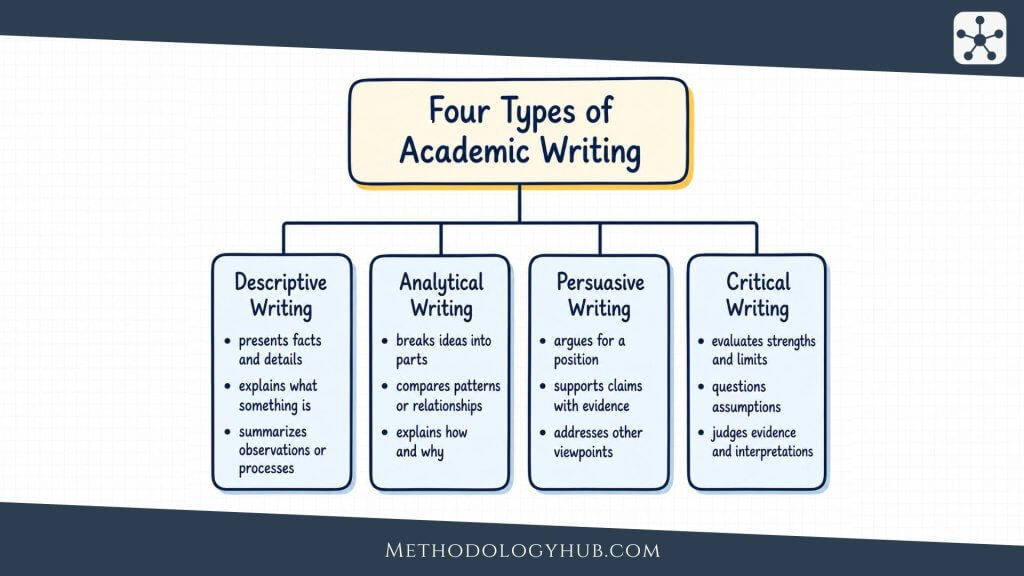
Persuasive writing is one of the four main types of academic writing, alongside descriptive, analytical, and critical writing. These types overlap in real assignments, but each has a different main job. Persuasive writing is the type most clearly focused on convincing the reader to accept a position.
The easiest way to see the difference is to ask what the paragraph is trying to do. Is it reporting information. Is it examining relationships. Is it arguing for a position. Is it evaluating strengths and limits. The answer shows which type of writing is most active at that moment.
Persuasive writing vs descriptive writing
Descriptive writing presents information clearly. It defines concepts, reports facts, summarises sources, and explains what happened. Persuasive writing uses some of that information to support a claim.
For example, descriptive writing might explain that a school introduced peer feedback in writing lessons. Persuasive writing would argue that peer feedback improved revision quality, then support that claim with examples or research evidence. Description provides the material. Persuasion uses the material to make a case.
Persuasive writing vs analytical writing
Analytical writing breaks information into parts and explains relationships. It may compare patterns, group findings, identify causes, or examine how something works. Persuasive writing often uses analysis, but it takes the next step by arguing for a conclusion.
For instance, analytical writing might compare two theories of motivation and explain how each treats student choice. Persuasive writing would use that comparison to argue that one theory is more useful for interpreting a particular classroom situation.
Persuasive writing vs critical writing
Critical writing evaluates ideas, evidence, assumptions, and limitations. It asks how convincing a claim is and where it may be weak. Persuasive writing may include critical writing because a strong argument often needs evaluation.
The difference is emphasis. Persuasive writing focuses on building and defending a position. Critical writing focuses on judging the strength of ideas and evidence. In advanced academic work, the two often work together. A writer may critically evaluate several studies in order to persuade the reader that one interpretation is stronger.
| Type of writing | Main task | Simple example |
|---|---|---|
| Descriptive writing | Reports what something is, says, or does. | The study surveyed 240 students. |
| Analytical writing | Examines parts, patterns, causes, or relationships. | The responses fall into three patterns. |
| Persuasive writing | Builds a position and supports it. | The evidence supports shorter feedback cycles. |
| Critical writing | Evaluates strengths, limits, assumptions, and quality. | The study is useful, but its sample limits the claim. |
How the types work together
In real academic writing, the four types rarely appear in isolation. A persuasive essay may describe the background, analyse the evidence, argue for a position, and critically evaluate the limits of that position. The types are best understood as writing moves rather than sealed categories.
For students, this distinction is useful because it helps diagnose what a paragraph is doing. If a paragraph gives accurate information but never supports the thesis, it may need a more persuasive final sentence. If a paragraph makes a claim but has no analysis, it may need more explanation before the reader can accept it.
Examples of Persuasive Writing
Examples of persuasive writing are easier to understand when the same topic is shown in different forms. The examples below are not full essays. They show the kind of movement that makes a sentence or paragraph persuasive: a position is stated, evidence or reasoning is introduced, and the writer explains why the reader should accept the claim.
The examples use school and academic contexts because persuasive writing is often taught through essays, source-based tasks, and research discussions. The same logic can be applied in many subjects, but the evidence must always fit the discipline.
Example of a persuasive thesis
A persuasive thesis should give the reader a clear position to follow. It should also be narrow enough to support within the assignment.
- Weak topic statement: “Feedback is useful for students.”
- Stronger persuasive thesis: “Written feedback is most useful when students receive time to revise, because comments that arrive only with a final grade rarely shape the next version of the work.”
The stronger version does more than approve of feedback. It defines a condition, gives a reason, and points toward the structure of the argument. A body paragraph could then discuss timing, another could discuss revision opportunities, and another could answer the concern that teachers have limited time.
Example of a persuasive paragraph
Here is a short example of persuasive writing in an academic style:
Short, focused homework tasks are more useful than long routine assignments because they make practice manageable and easier to connect to classroom learning. When homework repeats material without a clear purpose, students may complete the task without thinking carefully about what it is meant to reinforce. A shorter task that asks students to apply one concept, explain one answer, or prepare one question for the next lesson gives the teacher better evidence of understanding. For this reason, the quality of the task should receive more attention than the number of minutes it takes to finish.
This paragraph is persuasive because it makes a claim, gives a reason, explains the logic, and ends by returning to the position. It does not need dramatic language. The persuasion comes from the connection between the claim and the explanation.
Example using evidence
Persuasive writing becomes stronger when evidence is introduced and explained. The sentence below shows a basic movement from evidence to interpretation:
If classroom observations show that students revise more carefully after receiving one specific comment than after receiving a full page of corrections, this supports a more selective approach to feedback. The result suggests that students need comments they can act on, not simply a longer list of problems.
The first sentence introduces the evidence. The second sentence explains what the evidence suggests. Without the second sentence, the reader might understand the observation but not its role in the argument.
Example with a counterargument
A persuasive paragraph can also include another view. The goal is not to dismiss it quickly, but to answer it in a way that refines the claim.
Some teachers may prefer longer homework because it appears to provide more practice. That concern is reasonable, especially in subjects where skill develops through repetition. Still, length alone does not guarantee useful practice. If students repeat a process incorrectly or complete the work mechanically, the extra time may add little. A shorter task with a clear purpose can therefore be more effective when it gives students focused practice and gives teachers clearer evidence of what students understand.
This example gives space to the other view before returning to the thesis. The response is stronger because it does not pretend the other view is foolish. It explains why the writer’s position remains more convincing.
Example across a full essay plan
A persuasive essay on homework could be planned like this:
- Introduction: explain that homework is often judged by quantity, then introduce the argument for shorter, purposeful tasks.
- Body paragraph 1: argue that focused tasks make learning goals clearer.
- Body paragraph 2: show how shorter tasks can improve feedback and revision.
- Body paragraph 3: answer the view that longer homework gives more practice.
- Conclusion: return to the claim that homework quality should be judged by purpose and learning value rather than length.
This plan shows that persuasive writing is not simply a strong opinion placed at the beginning. The whole structure has to carry the position from start to finish.
Persuasive Writing and the Writing Process
Persuasive writing becomes easier when it follows a clear writing process. Many weak persuasive texts begin drafting before the writer has decided what they are actually arguing. The result is often a paper with useful information but no strong line of reasoning.
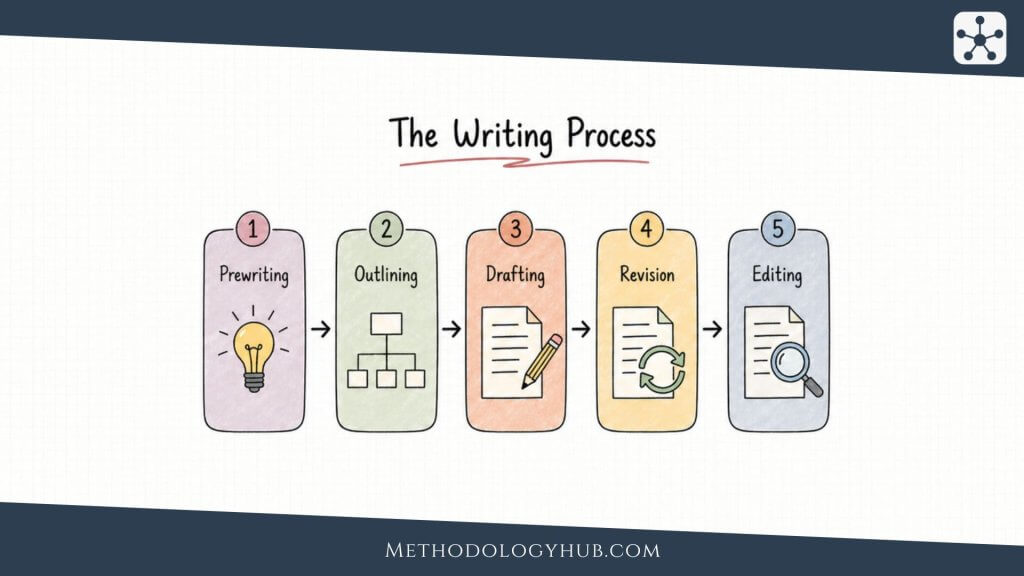
A process-based approach helps separate the tasks. First, the writer explores the topic. Then they form a working position. Next, they organise reasons and evidence. Drafting turns that plan into paragraphs. Revision checks whether the argument is actually convincing.
Prewriting for persuasive writing
During prewriting, the writer should identify the question, possible positions, available evidence, and likely objections. This stage is especially useful because the first position a writer thinks of is not always the strongest one.
Good prewriting questions include:
- What question is the assignment asking?
- What position could be defended with evidence?
- What reasons support that position?
- What would a thoughtful reader question or resist?
- What evidence is needed before the claim can be trusted?
Outlining the argument
Outlining helps the writer test whether the argument has enough structure before drafting begins. A persuasive outline should show the thesis, the main reasons, the evidence for each reason, and where other viewpoints will be addressed.
This is the stage where repetition often becomes visible. If three planned paragraphs make almost the same point, the writer can merge them or replace one with a stronger reason. If a claim has no evidence yet, the writer can look for support before the draft becomes too developed.
Drafting and revising persuasively
During drafting, the writer should focus on making the argument visible. Each paragraph should have a purpose. Each source should be introduced and explained. Each transition should help the reader understand why the next point follows.
Revision then asks larger questions. Is the thesis clear. Does each section support it. Is there enough explanation between evidence and conclusion. Has the writer answered the strongest alternative view. Are any claims broader than the evidence allows. These questions improve the argument before final editing begins.
Conclusion
Persuasive writing is the academic skill of building a position and guiding the reader toward it through reasons, evidence, and explanation. It is not the same as sounding forceful. A persuasive text earns its strength from the way it connects claims to support and handles other possible views.
The strongest persuasive writing usually begins with a precise thesis. It then develops distinct reasons, uses evidence selectively, explains the logic of each point, and keeps the tone measured. It may include description, analysis, and critique, but its central purpose is to make a case the reader can follow.
For students, the practical lesson is simple: do not begin with a broad opinion and then search for sentences that seem to support it. Begin with a real question, examine the evidence, shape a defensible position, and revise until each paragraph helps the reader understand why that position is reasonable.
FAQs on Persuasive Writing
What is persuasive writing?
Persuasive writing is writing that develops a position and supports it with reasons, evidence, and explanation. In academic contexts, persuasive writing is used to convince the reader that a claim, interpretation, recommendation, or conclusion is reasonable.
What are the main features of persuasive writing?
The main features of persuasive writing are a clear position, a focused thesis, logical structure, relevant evidence, careful reasoning, engagement with other viewpoints, and a measured academic tone. These features help the reader follow the argument from claim to support to conclusion.
How do you structure persuasive writing?
Persuasive writing is usually structured with an introduction that presents the issue, a thesis that states the position, body paragraphs that develop reasons with evidence, a response to opposing views, and a conclusion that returns to the central claim. Each paragraph should help the reader understand why the thesis is reasonable.
What is the difference between persuasive and analytical writing?
Analytical writing examines parts, patterns, relationships, and causes. Persuasive writing uses analysis to build and defend a position. In many academic essays, analysis explains the evidence, while persuasion uses that explanation to argue for a conclusion.
What is an example of persuasive writing?
An example of persuasive writing is an essay arguing that shorter, focused homework tasks support learning better than long routine assignments. The essay would need a clear thesis, reasons for the position, evidence or examples, and a response to the view that longer homework provides more practice.
When should you use persuasive writing?
Use persuasive writing when an assignment asks you to argue, justify, defend, discuss, recommend, or support a position. It is especially useful when a topic can be interpreted in more than one way and the reader needs to see why one answer is stronger than another.