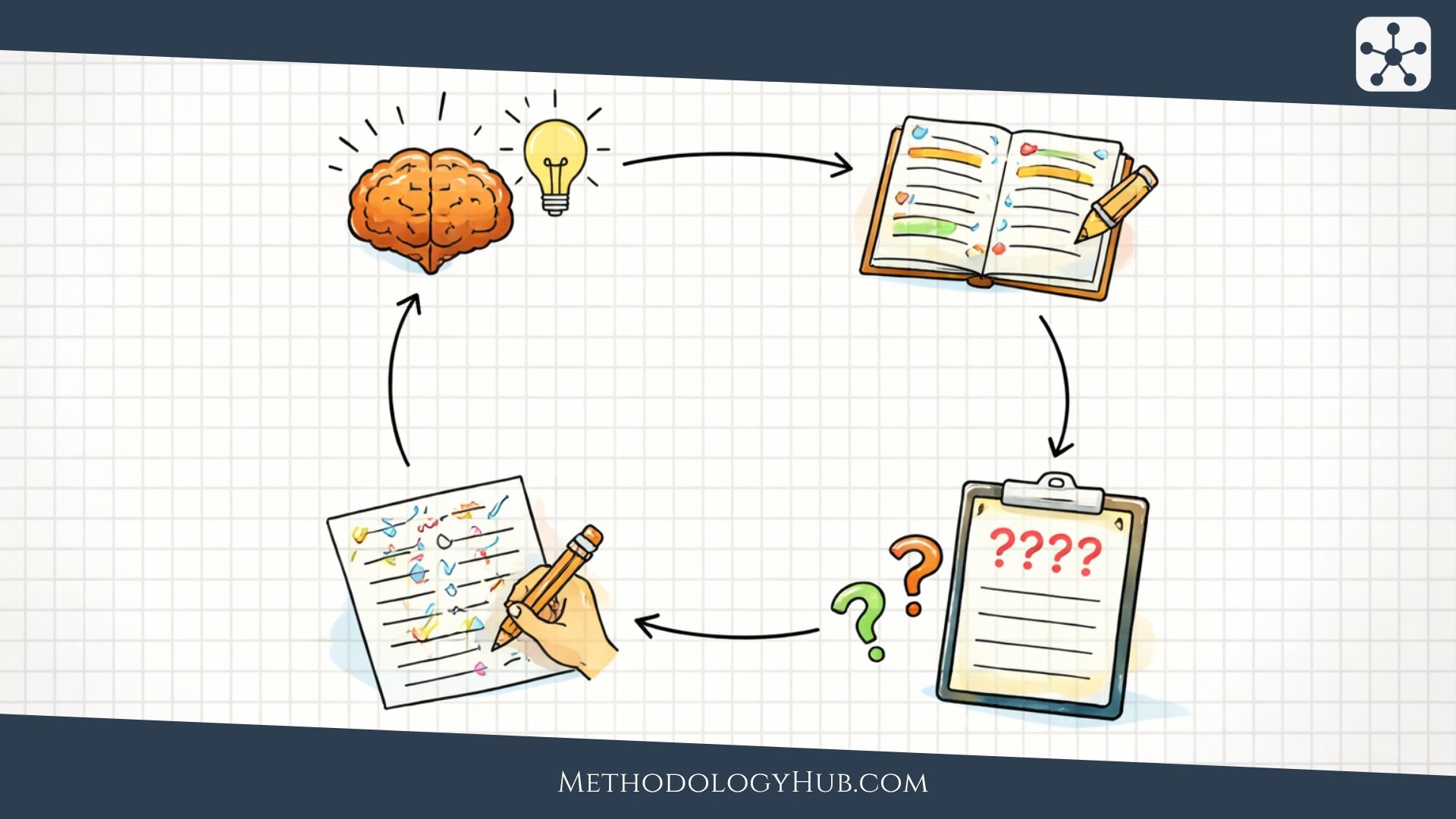
The Feynman technique is a way to study a concept by explaining it in your own words, checking where the explanation becomes uncertain, and returning to the source to resolve those gaps. Within the broader range of study methods, it is particularly useful when you recognise a definition but struggle to explain the reasoning behind it.
This article shows how to use the technique, develop an accurate explanation and adapt the process to different subjects. It also explains its connection with retrieval practices: when you put your notes aside before explaining, you test what you can retrieve from memory as well as what you understand.
What Is the Feynman Technique?
Choose something you have recently studied and try teaching it to someone unfamiliar with the topic. You might describe how diffusion works, explain a fraction calculation or unpack the argument in a research paper. As you explain, pay attention to the point where you can name a concept but cannot describe what happens or why. That point gives the next reading session a specific purpose.
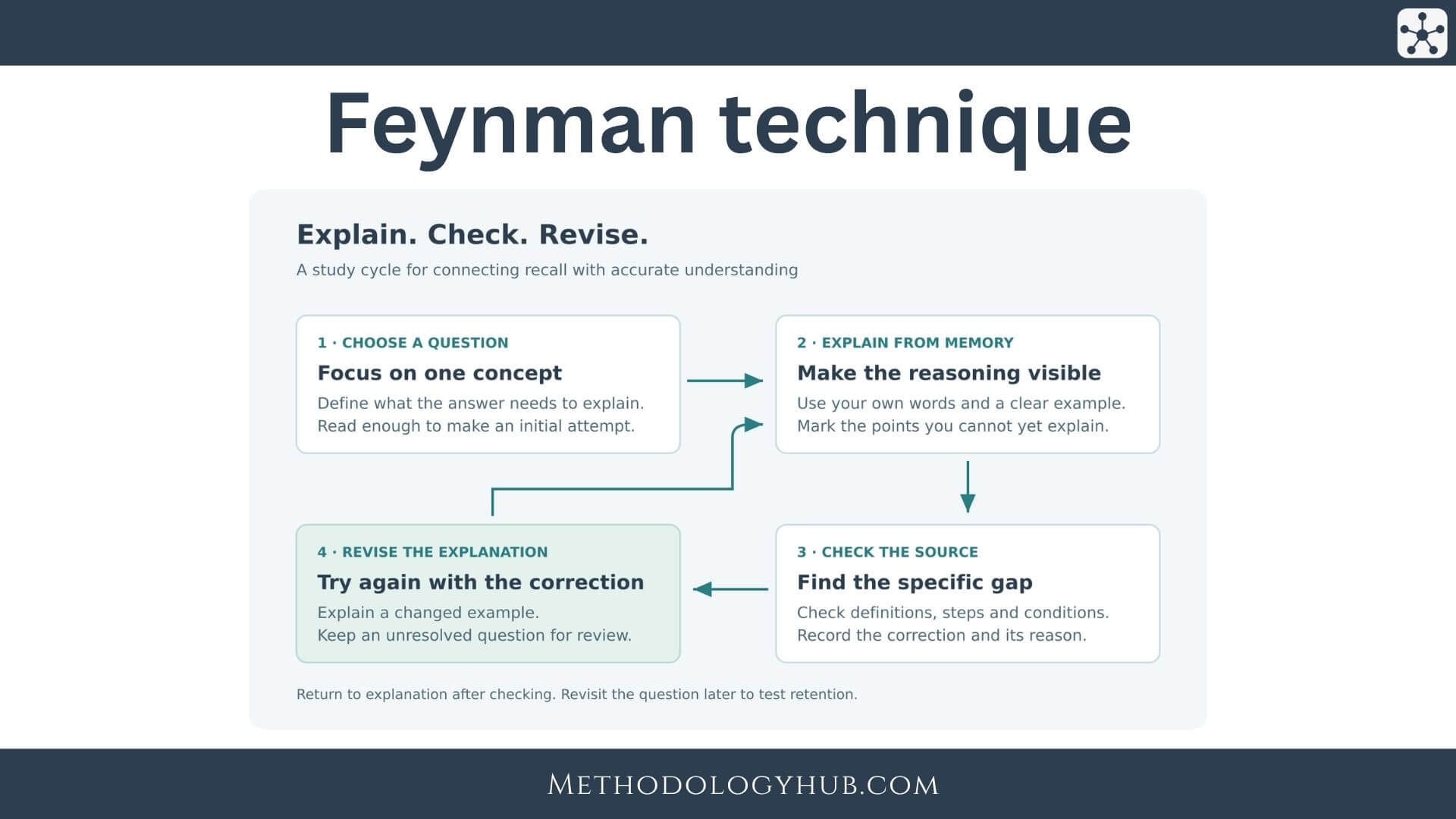
The technique takes its name from physicist Richard Feynman and the emphasis on clear explanation associated with his teaching. In study advice, it usually appears as a short cycle: choose a topic, explain it, investigate gaps and improve the explanation. The exact number of steps varies between versions. You can follow the same learning process in a notebook, in conversation or at a whiteboard.
Explaining a concept in your own words
An explanation should make the relationship between ideas visible. Suppose your textbook states a rule for dividing fractions. Repeating the rule demonstrates recall of the procedure. Explaining what the division asks, why the calculation produces that answer and how a diagram represents it gives you several additional checks on understanding. You can still use the correct mathematical vocabulary throughout.
Plain language helps when it makes reasoning easier to follow. Keep a technical term if the subject needs it, then explain its meaning through the example. Someone learning biology needs words such as concentration and diffusion. Replacing every technical word with a loose everyday substitute can remove precisely the distinction the lesson is meant to teach.
Learning with or without an audience
You can explain to an imagined listener if you are studying alone. Write a paragraph as though a classmate has missed the lesson, or speak while sketching the process. An actual listener adds questions you may not think to ask yourself. A pause or a request for clarification can show which assumption you left unstated.
The listener does not need to assess every factual detail. Their role can be to identify an unclear sentence or ask what a term means. Check accuracy against your course material afterward. An explanation can sound convincing while containing an error, and a listener unfamiliar with the subject may have no reason to challenge it.
How the Feynman Technique Works
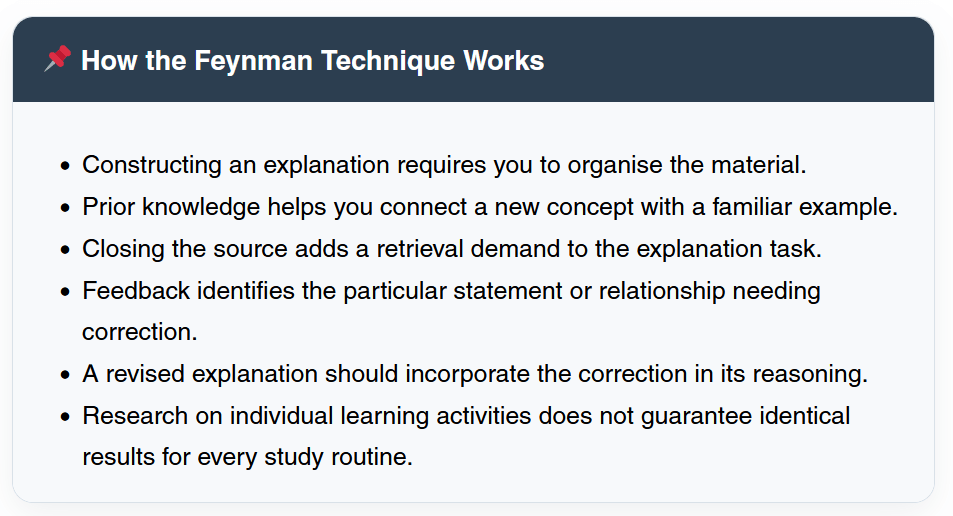
Explaining requires decisions that ordinary reading can leave unresolved. You must choose a starting point, introduce the knowledge the listener needs and connect each statement to the next. A paragraph that seemed clear in the textbook may be difficult to reconstruct because the textbook supplied a relationship you had not noticed. Writing the explanation makes that missing relationship easier to locate.
Connecting new material with prior knowledge
To explain a new concept, you draw on something already understood. A fraction diagram can connect a calculation with familiar quantities. A comparison between two passages can connect an interpretation with textual evidence. These links give you a way to examine the new material, particularly when an isolated definition offers little guidance about its use.
This is close to what educational research calls self-explanation: generating an account of how information fits together or why a step follows. Research on self-explanation provides support for this learning activity in particular settings. It does not establish that every version of the named Feynman technique is equally effective, or that a short explanation can replace the practice required by a subject.
Retrieving an explanation from memory
When the source is closed, explanation also involves retrieval. You must reconstruct the concept without borrowing the textbook’s next sentence. That can reveal a difference between recognising a familiar passage and being able to produce its reasoning. You may remember the main definition while losing the conditions under which it applies.
You can start with the source open when the topic is new. Reading a worked example and explaining each step may help you establish an initial understanding. Later, repeat the explanation with the source hidden. Keep those attempts separate in your notes so that guided explanation and unaided recall do not become indistinguishable.
Using feedback to revise understanding
Checking gives an uncertain explanation somewhere to go. Perhaps a definition is incomplete, an example contradicts the stated rule or a diagram reverses the direction of a process. Record the specific discrepancy and find the relevant source passage. Then explain the corrected relationship again, including the point that was previously missing.
A brief correction is often enough. You do not need to rewrite every sentence whenever you find an error. Preserve the first attempt, mark the change and add a question that tests it. This record makes the next revision session more focused because you can see what required attention last time.
How to Use the Feynman Technique
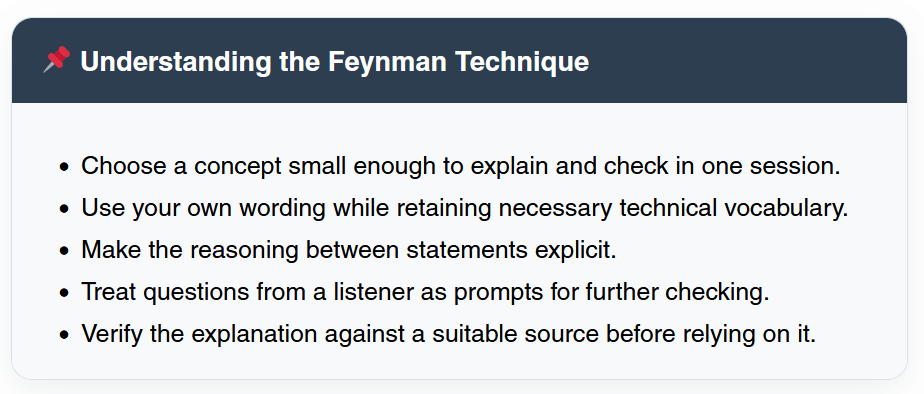
Prepare a source you can check, a place to record your explanation and one question to answer. A notebook is enough. Work through the steps with a topic you have already encountered, allowing yourself to stop and investigate when the explanation exposes an unfamiliar prerequisite. The purpose of the session is to leave with a more accurate account than the one you started with.
Step 1 – Choose a focused question
Turn a broad topic into a question with a manageable answer. “Fractions” covers too much for one explanation. “What does dividing three quarters by one eighth mean?” gives you a calculation, a diagram and a result to examine. In literature, “How does this passage support the interpretation?” is more workable than explaining an entire novel.
Before beginning, decide what the answer needs to include. Use the question wording, learning objective or assessment criteria as a guide. A process explanation may require the correct sequence and a reason for each transition. An argument explanation may require a claim, supporting evidence and a stated limitation.
Step 2 – Read enough to begin
Read the relevant section, inspect its diagrams and work through any essential example. If the explanation depends on an earlier definition, check that definition now. Avoid collecting extra material simply because it is nearby. Stay with the question you chose until you can make an initial attempt at answering it.
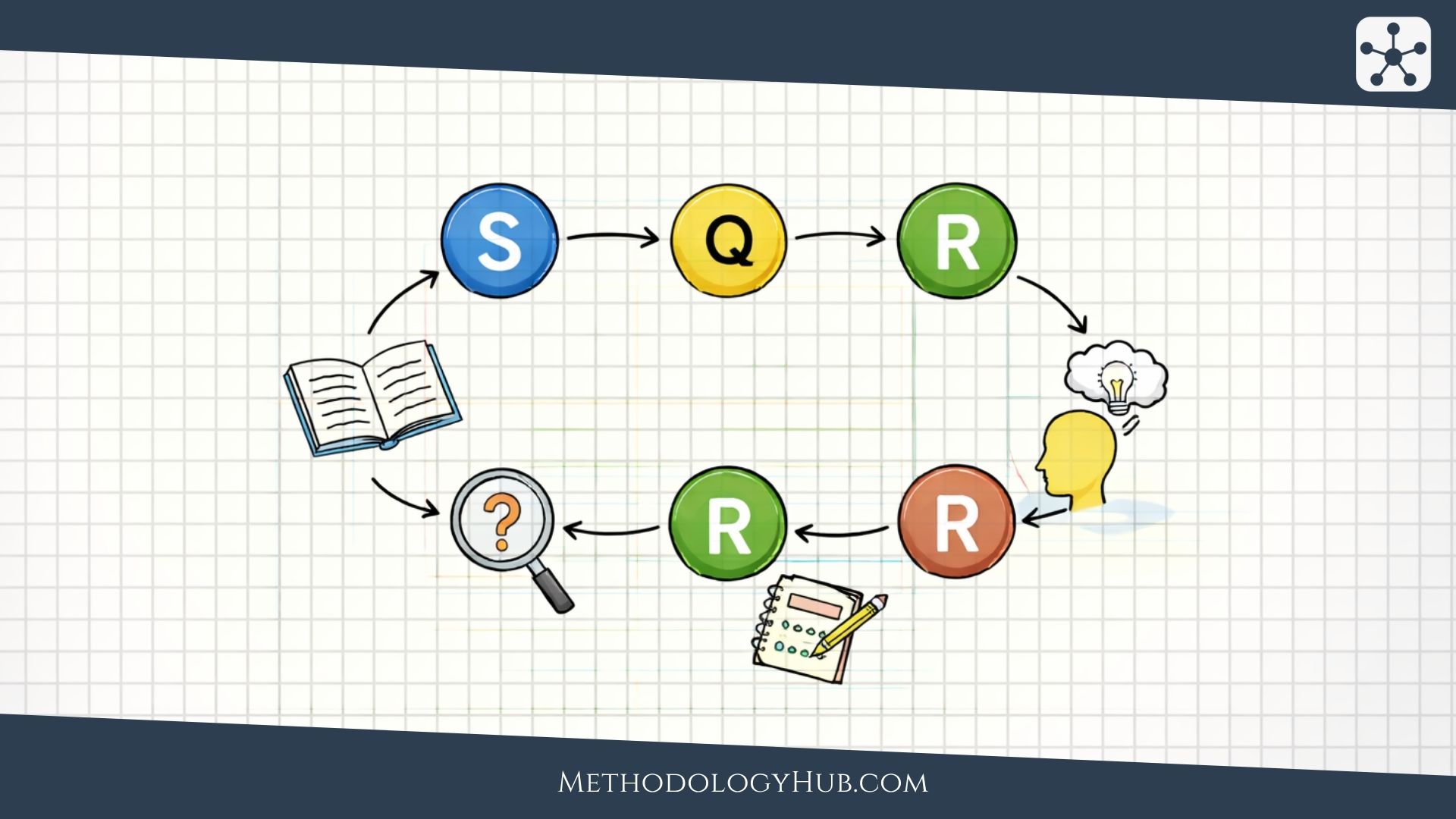
For a dense chapter, the SQ3R method can provide the reading sequence before you attempt an explanation. Survey the section, set a question and read for its answer. You can then use the explanation as a more developed recitation, checking whether you can connect the main ideas after closing the chapter.
Step 3 – Explain without borrowing the wording
Set the source aside and explain the answer in a short passage or spoken account. Begin where a listener with the necessary background could follow. Introduce a term when you need it, show how it operates in the example and continue the reasoning. There is no need to squeeze the entire explanation into a single sentence.
If you use a diagram, label its parts and explain the arrows. If you use an equation, state what the quantities represent. A copied diagram or formula can hide the same gaps as a copied paragraph, so reconstruct enough of it to check whether you understand its structure.
Use these prompts when the explanation stalls:
- What does this term refer to in the example?
- What connects this statement with the previous one?
- Which condition allows this step to follow?
- How could I check the result independently?
Continue past a minor gap if the rest of the explanation is still possible, leaving a clear mark beside the uncertain point. If the gap affects every later step, stop there. Guessing a missing principle can produce several paragraphs that depend on the same mistaken assumption.
Step 4 – Investigate the gaps
Compare the explanation with the relevant source. Look beyond matching keywords. Check whether the causal direction, sequence, definition and conditions agree. In a worked problem, compare the reasoning as well as the numerical answer. Two calculations can reach the same result through different routes, and an accidental correct answer may conceal an invalid step.
| What you notice | What to check | Useful correction |
|---|---|---|
| A term appears without an explanation | The definition and its use in context | Add a short explanation beside the example |
| One step seems to appear from nowhere | The rule or prerequisite linking the steps | State the missing relationship |
| An example fits only part of the definition | Conditions and exceptions | Replace the example or explain its limit |
| A calculation gives an unexpected result | Units, quantities and the chosen procedure | Rework the relevant step and check the interpretation |
Write the correction where you will see it during revision. A margin note, a revised sentence or a new diagram label is often sufficient. If two sources appear to disagree, check whether they use different definitions or assumptions before deciding that one account must be wrong.
Step 5 – Explain the corrected version
Close the source again and answer the original question. Give the corrected point enough space to be understood, especially if your first explanation skipped a condition or confused two concepts. Then try a small variation in the example. Changing a quantity or asking about an exception can show whether the explanation extends beyond the wording you have just practised.
Finish with a short record of what remains uncertain. That might be a prerequisite to read, a question for a tutor or a problem to attempt later. The session can end with useful progress even when the topic is not completely resolved.
Feynman Technique Examples
The examples below show how an initial answer can become a fuller explanation. Each starts with a question, develops the reasoning and introduces a check. The point is to make the relationship between ideas visible in a form suited to the subject. A calculation, a biological process and a literary interpretation need different kinds of supporting detail.
Example 1 – Explaining division with fractions
Suppose the question is: how many one-eighth portions fit into three quarters of a whole? You may recall that dividing by a fraction means multiplying by its reciprocal. That rule produces 3/4 × 8 = 6. To explain the result, draw one whole divided into eight equal parts and shade three quarters of it.
The shaded area contains six eighths. Since each portion is one eighth of the same whole, six portions fit into the shaded amount. The diagram connects the division question with the answer. It also shows why the reference whole must stay consistent: an eighth of one quantity cannot automatically be compared with three quarters of a different-sized quantity.
Now alter the question. How many one-quarter portions fit into three quarters? The answer is three, which you can check on the same diagram. Ask the learner to explain why the number of portions changes when the portion size changes. This variation tests the meaning of division, alongside recall of the calculation rule.
Example 2 – Explaining diffusion
Start with the question: why can a dissolved substance spread from a region of higher concentration to a region of lower concentration? An initial explanation might say that particles “move where there is more space”. That wording leaves the movement itself unclear and can suggest that individual particles choose a destination.
A more precise explanation begins with random particle movement. Particles move in different directions. When more particles of that substance are present on one side of a boundary, more can cross from that side over a given interval, producing net movement down the concentration gradient. Movement in both directions continues; the net change describes the overall result.
Draw particles on both sides and arrows in each direction. Then ask what happens when the concentration becomes uniform. At equilibrium, random movement continues even though there is no overall concentration-driven net movement. The follow-up question checks an important distinction that a memorised phrase about “high to low” can leave unexplained.
Example 3 – Explaining a literary interpretation
Imagine a poem repeatedly describes a room as closed, narrow and difficult to leave. You want to explain the interpretation that the setting suggests confinement. Begin with the words in the passage, then describe their shared pattern and connect that pattern with the interpretation. Keep the quoted wording separate from your account of its effect.
A first explanation may simply label the imagery “negative”. Ask which details justify that description. Does the narrator explicitly feel trapped, or is confinement an inference from the setting? Could the room also suggest protection? These questions help you state the scope of the claim and consider evidence that would support another reading.
The revised explanation should make its reasoning traceable. A listener should be able to locate the textual detail, follow the interpretation and understand any qualification. Several interpretations may remain plausible. The check is whether the explanation accounts for the evidence and responds to relevant alternatives, rather than whether it reproduces one memorised sentence about the poem.
These examples also suggest a practical choice: use the form that exposes the relationship you need to examine. A diagram can clarify quantities or movement; a carefully constructed paragraph can clarify an argument. There is no requirement to turn every subject into a spoken lesson if a written explanation makes the reasoning easier to inspect.
Feynman Technique vs Active Recall
The Feynman technique and active recall overlap when you explain a concept with the source closed. Active recall describes the attempt to retrieve information; the explanation task determines what you do with that information. A flashcard may ask for a term, while an explanation may ask how that term connects with a process or example.
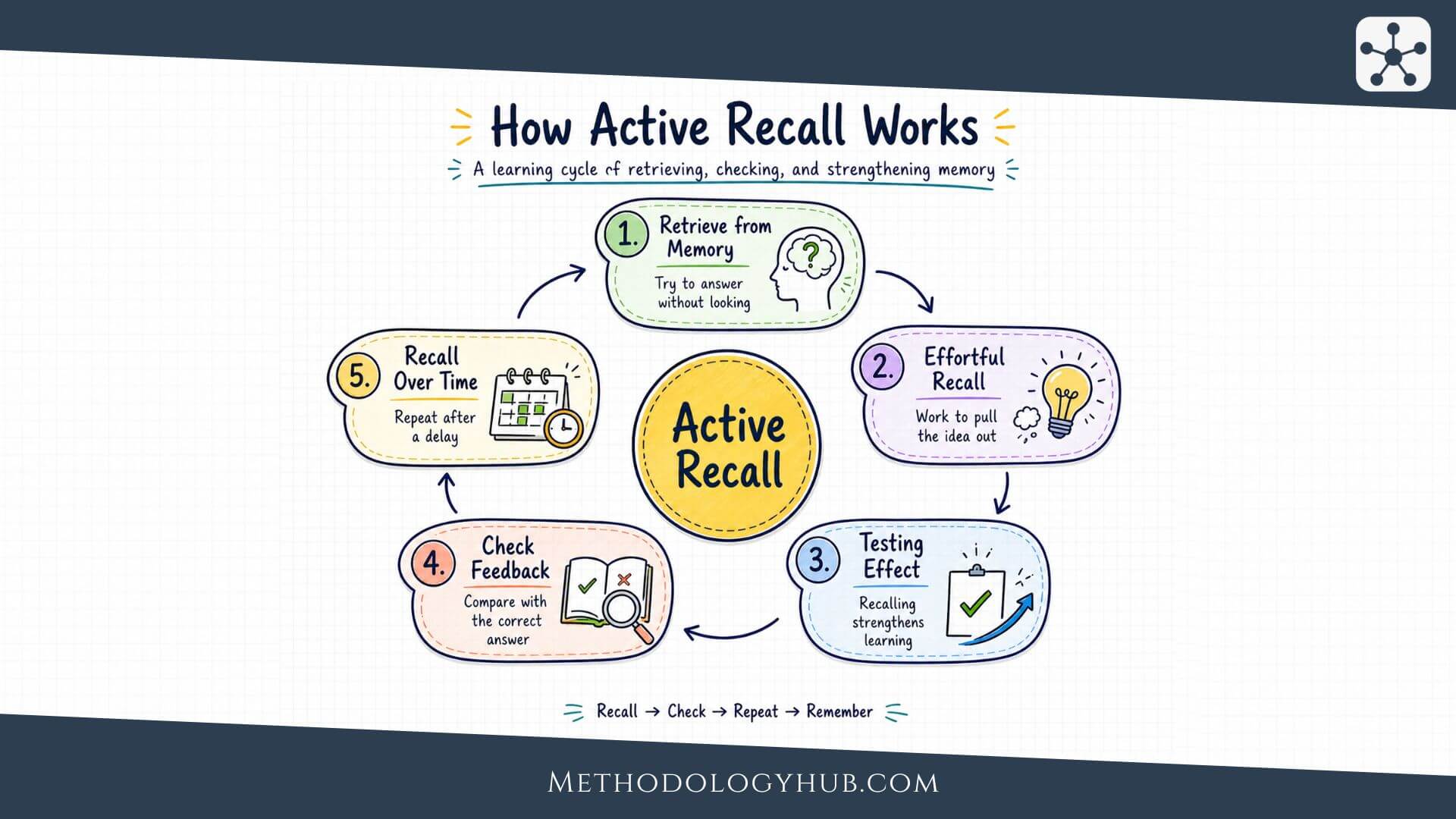
You can therefore use active recall within a Feynman-style session without treating the two as competing options. First retrieve the definition, then explain its application. If the definition is missing, investigate that gap before developing the example. If the definition is correct but the application is unclear, focus the next attempt on the reasoning.
| Study activity | Typical output | What to examine afterward |
|---|---|---|
| Active recall | An answer produced without seeing the source | Whether the retrieved answer is correct and complete |
| Feynman-style explanation | A connected account of a concept | Whether the reasoning, example and conditions are accurate |
| Blurting | A broad record of remembered material | Which topics, details or connections are absent |
| Summary writing | A shortened account of source material | Whether the selection preserves the source’s meaning |
The blurting method can help you survey what you remember across a topic before choosing one difficult relationship to explain. For example, a blank-page recall of a biology chapter may show that the main terms are available but the mechanism is unclear. Use the explanation session to investigate that mechanism, then return to a broader recall check later.
Summary writing can also prepare the material, especially when a chapter contains more detail than one session can address. Keep track of whether the source was open while you wrote. An accurate summary constructed from a visible passage shows that you selected and represented its content; a later closed-book explanation adds a separate check on retrieval.
Choosing according to the question
For a definition-heavy assessment, brief recall questions may cover more material in the available time. For a question asking how a process works, an extended explanation can expose missing steps. Where an assessment requires calculations or essay writing, follow explanation with the corresponding task. Being able to describe a procedure does not establish that you can complete it accurately under assessment conditions.
Choose the next activity from the result of the current one. If your explanation is accurate but slow, practise answering within the relevant time limit. If the answer is fluent but unsupported, return to the evidence. This keeps the study sequence tied to the difficulty you can actually observe.
How to Check a Feynman Explanation
A smooth explanation is pleasant to hear, but its accuracy needs an independent check. Compare it with an appropriate textbook, course source or worked solution. For an interpretation, return to the evidence and ask whether the claim is supported. The final explanation should preserve the distinctions the subject requires, even when the wording is simpler than the original passage.
Keep the necessary conditions
A rule often depends on a condition that disappears during simplification. Ask where the explanation applies and whether the example meets that condition. In a calculation, check units and assumptions. In a research interpretation, check which observations support the conclusion and whether the claim extends beyond those observations.
The habits used in critical reading are useful here. Identify the claim, inspect the evidence and distinguish the author’s statement from your interpretation. If you simplify a cautious finding into an absolute claim, the explanation has changed the content as well as the wording.
Give an analogy a clear boundary
An analogy can provide a familiar starting point when a concept is abstract. State the particular relationship being compared, then show where the comparison stops. For diffusion, a picture of people moving randomly between spaces might illustrate movement in both directions. It would be misleading if the account depended on people making purposeful decisions that particles do not make.
An example from the subject itself is often enough. Before adding an analogy, ask whether a diagram, a small calculation or a concrete case explains the relationship more accurately. An entertaining comparison earns its place only if the learner can return from it to the concept being studied.
Use a short accuracy check after the explanation:
- Can each technical term be explained in the present example?
- Does every step follow from a stated reason or an established rule?
- Are the conditions and relevant exceptions still visible?
- Can the explanation handle a changed example or a reasonable objection?
Allow time to act on the answers. If a question reveals an uncertain condition, revise the relevant sentence and test it again. A checklist completed without correction provides a record of uncertainty, but the source comparison and revised explanation are what resolve it.
Using the Feynman Technique for Revision
Keep the explanation in a form you can revisit without reading the answer immediately. A question at the top of a page can prompt a new attempt, while the corrected explanation sits below a fold or on another page. When you return, answer first and compare afterward. This allows the revision session to check what remains available after a delay.
Keep a record that supports the next attempt
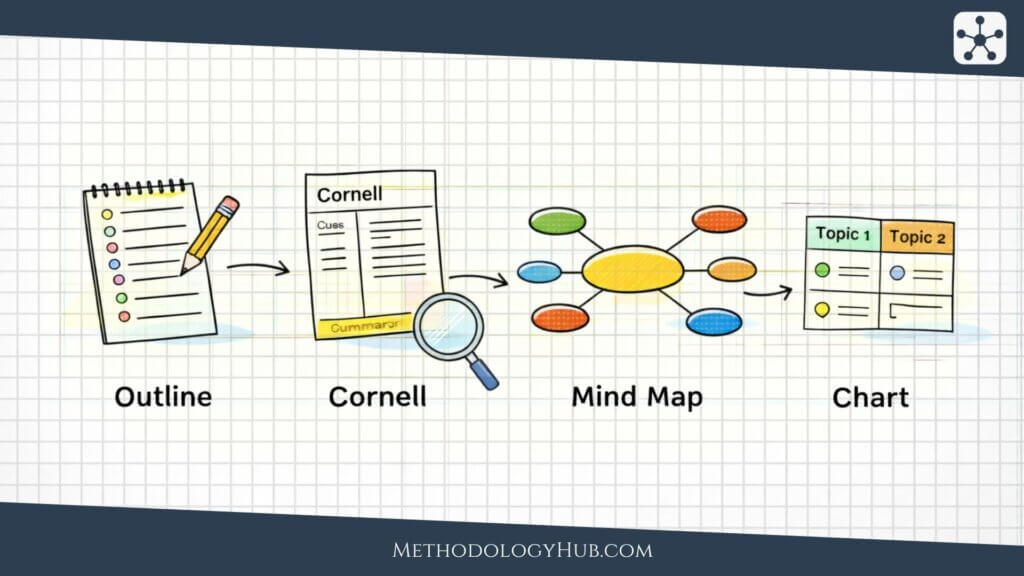
Several note-taking methods can hold the material without requiring a separate set of polished notes. Use a cue column for explanation questions, a small diagram for a process or a short outline for the sequence of an argument. Keep the original source reference alongside any correction that you may need to check again.
A useful revision record contains the question, the point that caused difficulty and the correction. Avoid transcribing an entire explanation after every attempt. If only one condition was missing, record that condition and create a prompt that asks when it applies. The next attempt should make the unresolved point easier to test.
| Revision task | Evidence from the explanation | Next practice activity |
|---|---|---|
| Recall a definition | Technical vocabulary is missing | Retrieve the definition, then explain an example |
| Explain a process | The sequence is incomplete | Reconstruct the diagram and justify each transition |
| Apply a rule | The example uses an unstated condition | Check the condition and attempt a different problem |
| Interpret an argument | The claim lacks supporting evidence | Revisit the passage and revise the interpretation |
Use the record to choose a task you can complete in the available session. A missing definition may need a short retrieval check, whereas an uncertain argument may require another reading of the source. Keep the explanation question visible while deciding which activity to practise next.
Revisit the reasoning after a delay
Spaced revision gives you another opportunity to reconstruct the explanation when the wording is less fresh. You might revisit a topic in a later session, then again after a longer interval if recall remains accurate. Adjust the interval to the difficulty of the material and the time available before assessment; a fixed calendar pattern is not necessary for every concept.
When the explanation becomes familiar, vary the prompt. Ask for a different example, a comparison with a related concept or an explanation of an exception. You can also reverse the task by presenting a result and asking which conditions could produce it. Check that the new question remains within the material you are expected to learn.
Fit explanation into assessment practice
Use the assessment format to decide what follows the explanation. A written exam may require a concise paragraph; an oral assessment may involve follow-up questions; a problem set requires completed calculations. Practise that output after working through the concept. This shows whether the understanding developed during explanation is available in the form the task demands.
Before finishing a revision session, choose the next action:
- Repeat the explanation later if retrieval is incomplete.
- Check a prerequisite if the reasoning depends on an unfamiliar concept.
- Attempt a practice problem if the explanation is accurate but application is untested.
- Ask for feedback if the source does not resolve the uncertainty.
Keep the decision specific. “Review the chapter” is less useful than a question identifying the missing relationship. Over several sessions, these small records can show whether the same difficulty persists or whether you are ready to spend more time on application and assessment practice.
Conclusion
The Feynman technique gives you a practical way to examine what you understand: explain a focused concept, check the reasoning and revise the points that remain uncertain. Use plain language where it helps, retain technical terms where precision requires them, and let examples show how the explanation works.
For the next study session, choose one question you can answer and verify. Keep the first attempt, record the correction and return to the question later. Follow the explanation with a calculation, an interpretation or another task that asks you to use the knowledge.
Cite this article
Whether you are preparing course materials, writing an academic paper, or sharing resources with students, we kindly ask that you acknowledge Methodology Hub as the source.
To make referencing easier, you can use the “Cite this page” tool below to automatically generate a citation in your preferred referencing style, including APA, MLA, Chicago, Harvard, and others. Simply select a citation style and click the generated reference to copy it.
When reproducing images, figures, or other materials from this page, please include an appropriate source credit and a link to the original page. Proper attribution helps others locate the original material and supports the continued development of freely accessible educational resources.