Study methods are the practical systems people use to understand, retain, and apply what they learn. Good study methods make study time more deliberate, and the best study methods make it easier to see what is actually working. They help you decide how to read, how to take notes, how to review, and how to check whether the material is actually staying with you.
Some methods are best for retrieval, some for organisation, some for reading, and some for planning. What matters is matching the method to the task. Used well, they make studying clearer and less wasteful.
What are the best study methods?
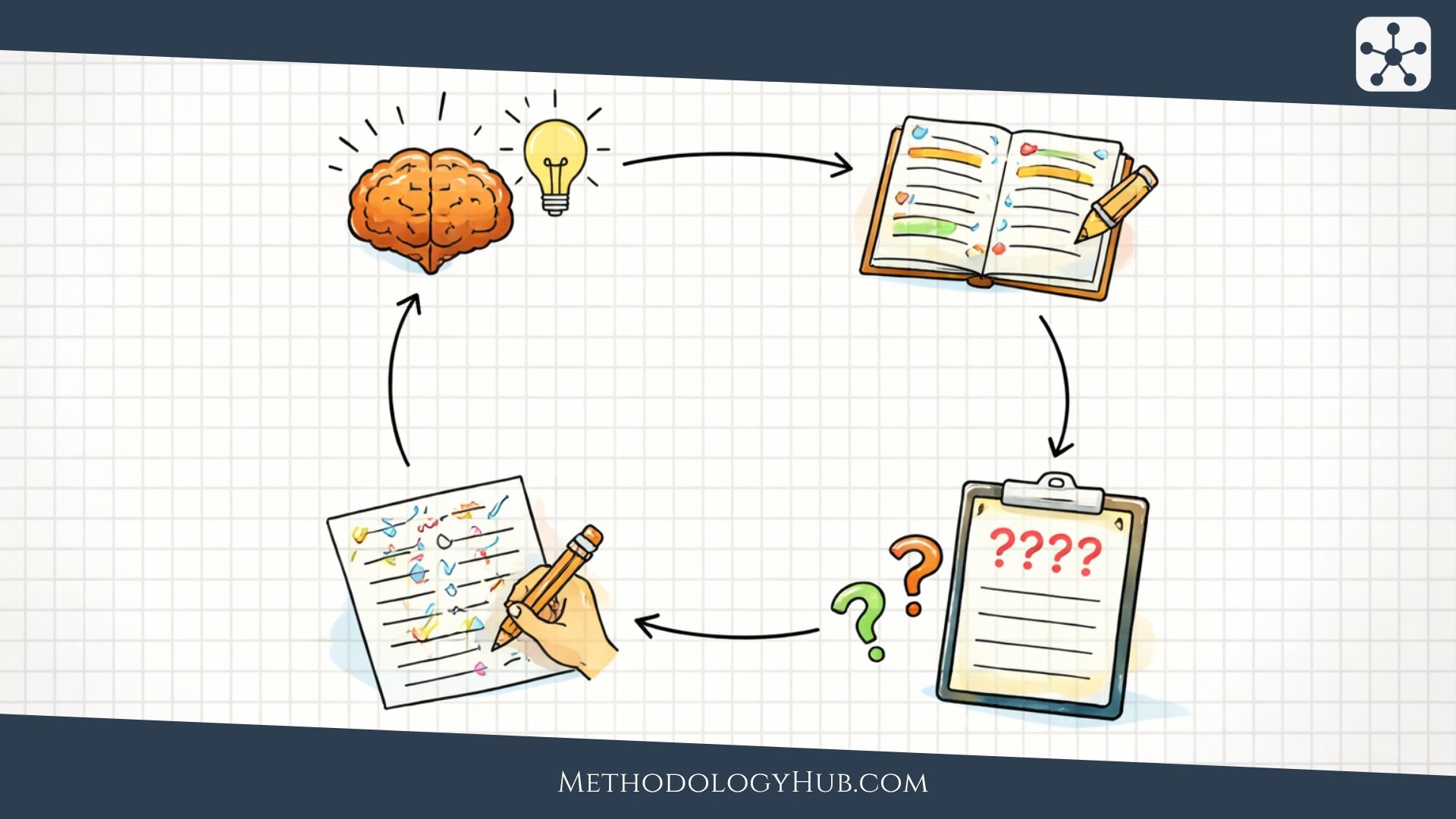
The best study methods are the ones that make learning active, visible, and repeatable. In practice, that usually means study methods that force recall, explanation, organisation, comparison, or application. A strong method does more than fill time. It gives the session a clear job and makes it easier to tell whether the material is actually staying with you.
That is why some study methods tend to work better than others across subjects. Active recall, spaced repetition, blurting, and practice questions are strong because they test memory directly instead of relying on recognition. Cornell notes, outlining, mind mapping, and concept mapping are useful because they give information a clearer structure. Reading methods such as SQ3R, PQRST, and REAP help when the problem is not memorising isolated facts but working through dense material without drifting.
A useful way to think about study methods is by function. Some study methods are mainly for recall. Some are mainly for understanding. Some are mainly for organising what you have learned. Some are mainly for making sure the work actually gets done on time. Studying improves when those functions are separated, because it stops you expecting one method to do everything at once.
The rest of this article is organised in that way. Instead of treating all study methods as one blurred category, the next chapters group them by what they are mainly trying to improve.
- Retrieval practices make you retrieve, explain, or apply what you know.
- Note-taking methods help you organise information while learning it.
- Reading strategies are useful for working through difficult or information-heavy texts.
- Memorisation techniques help key material stay available over time.
- Time-management strategies protect attention and turn intention into a schedule.
Seen that way, the best study methods are usually the ones that combine well. You might read with SQ3R, take notes with Cornell, review with active recall, and keep the week on track with time blocking. Good study rarely depends on one brilliant trick. More often, it depends on a small set of study methods that support different parts of the learning process.
Retrieval Practices
Retrieval Practices are study methods that ask you to do something with the material instead of only looking at it. They shift studying from review to performance. That usually means retrieving information, explaining it in your own words, or applying it to a question.
These study methods are especially useful when the goal is understanding plus recall. They expose gaps quickly, and they make it harder to mistake familiarity for learning.
Active recall
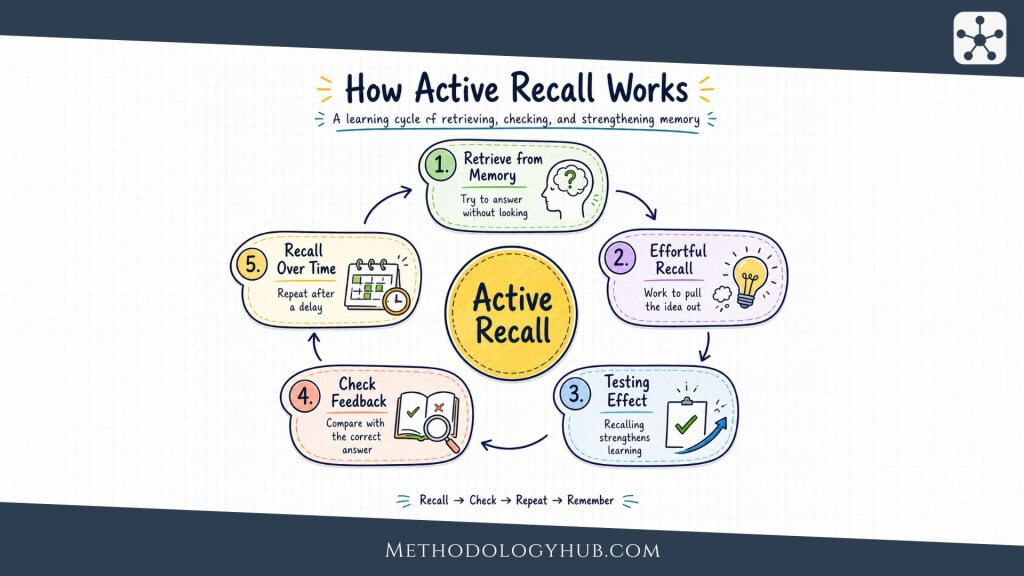
Among study methods for retrieval, active recall is one of the most direct and used. Instead of keeping the material in front of you and reading it again, you close the notes and try to bring the ideas back from memory. That effort matters because remembering is part of learning, not only a way to check whether learning has already happened.
This method works best when the goal is clear recall of concepts, definitions, formulas, or processes. It is useful in almost every subject because it shows what you actually know and what still feels familiar only because you have just seen it on the page.
In practical use, active recall is strongest when it stays specific. Trying to recall an entire subject at once often becomes vague and discouraging, but recalling one topic, one process, or one question set at a time makes the weaknesses clearer. It also combines well with spaced repetition, because the timing decides when you return and retrieval decides what happens when you do.
Feynman technique
Among study methods for understanding, the Feynman technique turns understanding into explanation. You take an idea and explain it in plain language as if you were teaching it to someone who has never seen it before. That pressure to simplify is useful because it exposes where your grasp of the topic is still thin or vague.
It is especially useful for subjects that look clear until you try to explain them. If you can only repeat the textbook wording, you probably do not understand the idea well enough yet. The method pushes you toward clarity, examples, and clean reasoning.
The method is especially helpful for hidden confusion. Many topics feel clear when you are reading them and less clear when you try to say them plainly. That is why the act of teaching, even to an imaginary beginner, can be so revealing. It pushes you to replace borrowed wording with understanding you can actually use.
Blurting method
Among study methods built around retrieval, the blurting method is one of the quickest to use. After studying a topic, you take a blank sheet and write down everything that comes to mind. The point is not to produce polished notes. The point is to reveal what is available in memory without support.
Because it is rough and immediate, blurting is good for revision sessions and exam preparation. It shows missing points fast, and it helps you see whether you know the material well enough to produce it without prompts. In practice, it works best when you follow it with correction and review.
What makes blurting different from ordinary note-taking is speed and exposure. You are not trying to create a polished page. You are trying to see the shape of your memory before the notes correct it. That makes the method useful shortly before exams, but it can also work during ordinary revision whenever you need an honest picture of what is sticking.
Practice questions
Among study methods that prepare you for performance, practice questions make studying more concrete because they turn knowledge into a task. Instead of asking whether a topic looks familiar, they ask whether you can answer, solve, compare, or explain under some degree of pressure.
This method works well across subjects. In mathematics, it tests procedures. In science, it checks explanation and application. In essay-based subjects, it helps you organise a response around a question rather than around a pile of notes. It is one of the simplest ways to make revision look more like the real assessment.
Its deeper value is that it makes feedback more specific. A wrong answer tells you more than a vague feeling of uncertainty. It can show whether the problem is factual recall, misunderstanding of the question, weak method, or weak timing. For that reason, practice questions are often one of the best bridges between study and assessment.
Note-taking methods
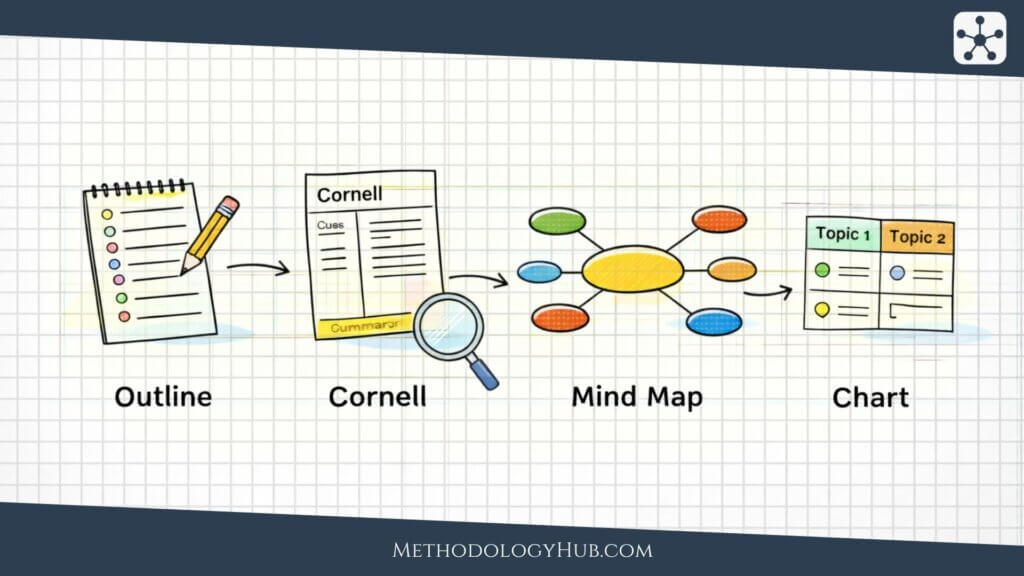
Note-taking methods are study methods that shape what happens while you are reading, listening, or reviewing. The strongest systems do more than record information. They help you sort, compress, and organise it in a form you can return to later.
Different note-taking study methods suit different kinds of material. Some are better for linear lectures, some for broad topics, and some for showing relationships between ideas. The right choice depends on the structure of the subject and the purpose of the notes.
Cornell method
Among study methods for structured notes, the Cornell method is one of the clearest systems. It separates notes, cues, and summary. That layout slows down the urge to copy everything because the page already tells you that not every detail belongs in the same place.
What makes the Cornell method useful is that it does not stop at note-taking. It also supports revision. The cue column becomes a built-in self-testing tool, and the summary section forces you to decide what the page was actually about instead of leaving the notes as a raw transcript.
It also encourages a useful delay between recording and understanding. You do not need to interpret every point perfectly in the moment. Later, when you add cues and write the summary, you process the material again from a more reflective position. That second pass is one of the reasons the method supports learning better than a single block of unstructured notes.
Mind mapping
Among visual study methods, mind mapping starts with a central topic and builds outward through branches. It suits material that has many connected parts because it lets you see categories, subtopics, and links on one page instead of across disconnected notes.
It is most useful when the aim is to organise, connect, and compress information. A mind map is not the best choice for every task, but it helps when you are planning an essay, revising a broad chapter, or trying to see how subtopics relate to one another.
Its main advantage is that it shows relationships without forcing them into a straight line. That can make complex topics easier to survey, especially when the material branches into causes, examples, themes, or categories. The method works less well when extreme detail matters, but it is very strong for planning and for seeing the shape of a subject quickly.
Concept mapping
Among study methods that show relationships, concept mapping is close to mind mapping but usually more explicit. Instead of only grouping information around a centre, it labels links and shows how one idea connects to another. That makes it especially useful when the structure of the topic matters as much as the content itself.
This method works well when you need to understand structure rather than memorise isolated points. In biology, it can show how parts of a system interact. In social science, it can show how concepts overlap. In humanities, it can help you trace claims, themes, and tensions across a text or theory.
For that reason, concept mapping often supports deeper understanding better than ordinary summary notes. It makes you decide exactly how ideas relate instead of letting them sit beside one another without explanation. When a map feels hard to build, that difficulty is often useful because it shows where the structure of the topic is still unclear.
Outlining method
Among study methods for ordered notes, the outlining method organises material in levels. Main ideas appear first, then subpoints, then supporting details. It is simple, but that simplicity is part of its value. A good outline makes hierarchy visible immediately.
This method is a strong choice for lectures, textbook chapters, and essays because it follows logical structure well. It is less visual than mapping, but often easier to scan later. It also makes revision more efficient because you can reduce a long topic to a clean hierarchy instead of a wall of notes.
It is also one of the easiest methods to turn into later revision material. A clean outline can become flashcards, essay plans, summaries, or quick verbal review. Because the structure is already built into the notes, it reduces the work needed later when you want to revisit the topic without rereading everything from the beginning.
Reading strategies
Reading strategies are study methods for working through material that is dense, technical, or easy to drift through without retaining much. A structured reading method gives the reading a sequence. It sets up questions, checks comprehension, and creates a way back into the material later.
These study methods are most useful for textbooks, course chapters, and academic articles. They are designed to reduce passive reading and replace it with a more deliberate routine.
SQ3R Method
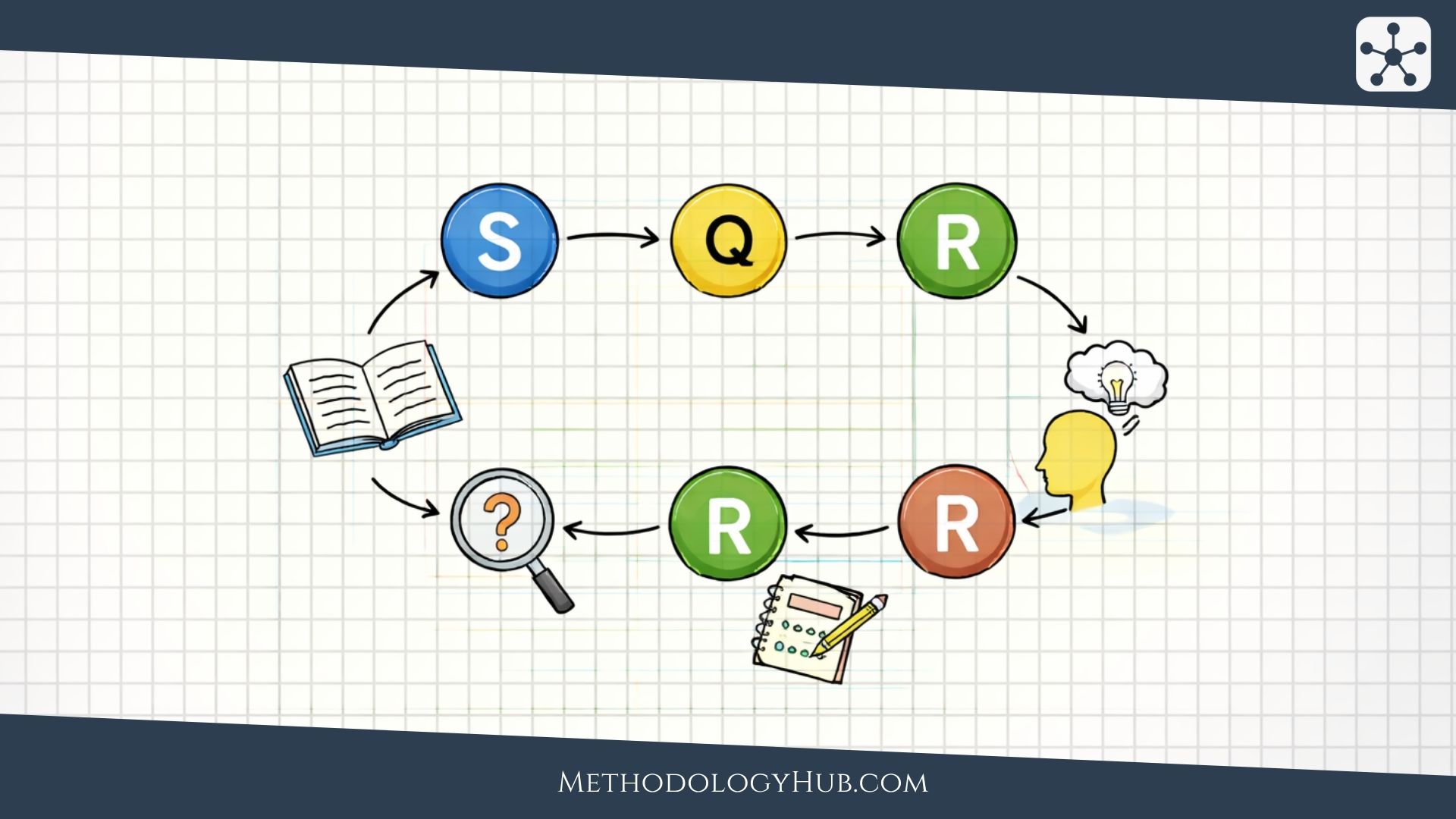
Among study methods for reading, SQ3R is built around five actions: survey, question, read, recite, and review. It is designed to stop passive reading. Instead of moving through a chapter in one flow and hoping something stays behind, you work through it in stages that force attention and recall.
This method is useful for textbooks and dense course reading because it gives the reading a job at each stage. It works especially well when you need both comprehension and recall. It also reduces the common problem of finishing a chapter and realising that very little actually stayed with you.
Another strength of SQ3R is that it creates a reason to pause between sections. That matters because understanding often feels stronger while the page is still open in front of you. By stopping to recite and review, you separate recognition from memory. The method therefore works not only as a reading routine, but also as a built-in comprehension check.
Critical Reading
Critical reading means reading with judgment instead of only reading for information. The goal is not just to understand what a text says, but to examine how it says it, what it assumes, what evidence it uses, and whether its conclusions actually follow. A critical reader does not treat the page as automatically correct. They keep asking what the writer is trying to prove and how convincing that proof really is.
This strategy is especially useful when reading opinion articles, research papers, essays, textbooks, news reports, and argumentative texts. In these cases, understanding the topic is only part of the job. You also need to notice the author’s position, the quality of the evidence, the limits of the argument, and the difference between fact, interpretation, and persuasion. Critical reading therefore helps you avoid accepting weak claims simply because they are written confidently.
Critical reading also slows down the habit of reading as if every sentence has the same value. Some sentences define terms, some present evidence, some make claims, and others try to persuade. By separating these parts, the reader can see the structure of the argument more clearly. This is useful for study because it turns reading into analysis. Instead of only collecting notes, you begin to judge which ideas are strong, which are unsupported, and which need to be questioned further.
PQRST
Among study methods for active reading, PQRST stands for preview, question, read, summarise, and test. Like SQ3R, it turns reading into an active process, but it places stronger emphasis on summarising after reading and then checking yourself.
The strength of PQRST is that it combines understanding with checking. Previewing gives direction, questioning creates focus, summarising forces compression, and testing exposes what did not stick. Used consistently, it can make long reading assignments more manageable and less passive.
What makes PQRST useful over time is its rhythm. Previewing prevents you from reading blindly, summarising forces selection, and testing creates accountability. If a reading assignment keeps sliding out of memory soon after you finish it, the problem is often not effort but the lack of a method that returns the material to you in an active form.
REAP method
Among study methods that slow reading down productively, REAP stands for read, encode, annotate, and ponder. It is a reading method that asks you to work with the material rather than move through it quickly. Encoding means restating the idea in your own words, which already pushes you beyond passive reading.
This method is useful when the reading calls for interpretation, not just recall. It suits academic articles, theory-heavy chapters, and argumentative texts because it slows the process down and gives you a clear place to record your thinking while you read.
Because REAP asks you to annotate and ponder, it also helps turn reading into material you can later write or discuss from. It is not only about remembering what the text said. It is about recording your own response to its claims, patterns, and implications. That makes it especially valuable in subjects where interpretation matters as much as recall.
Memorisation techniques
Memorisation techniques help information stay available across time. Some of them work by timing review well, some by using place or pattern, and some by turning flat material into something easier to hold in mind.
These study methods are helpful when a subject depends on accurate recall, but they also work best when paired with understanding. Memory is stronger when the material has both meaning and structure.
Spaced repetition
Among study methods for long-term retention, spaced repetition is built on timing. Instead of reviewing the same material again and again in one sitting, you return to it across increasing intervals. That spacing matters because forgetting begins quickly, and well-timed review interrupts that decline.
It is one of the most practical methods for content that must stay available over time, such as vocabulary, formulas, definitions, and key concepts. The method is simple, but it depends on consistency. Its strength comes from repeated return, not from one long session.
The deeper logic of the method is that memory becomes stronger when retrieval is slightly effortful. Reviewing too soon can feel smooth, but that smoothness can be misleading. A well-timed return makes you work just enough to rebuild the answer, and that rebuilding is part of what makes the memory last longer.
Method of Loci
Among study methods for vivid recall, the Method of Loci uses place to support memory. You connect pieces of information to locations in a space you know well, such as a room, a route, or a building. During recall, you mentally move through that space and pick the information back up.
This method works best for ordered information, lists, speeches, and grouped facts. It can feel strange at first, but it becomes easier once the locations are stable and the images are vivid. The method depends on clear placement and strong mental pictures, not on repeating the same words again and again.
The method works because location gives memory a route. Instead of recalling disconnected items from nowhere, you recall them from a sequence of familiar places. That gives the material order and context. For some learners it feels highly natural, while for others it improves only after practice, but in either case it rewards careful setup more than repetition.
Chunking
Among study methods that reduce overload, chunking is the habit of breaking large amounts of information into smaller, meaningful units. Instead of treating every detail as separate, you group items that belong together. That makes complex material easier to hold and easier to retrieve.
This method is useful when the material has patterns, categories, or sequences. It can help with numbers, terminology, dates, concepts, and even essay planning. Chunking does not remove the need to learn the details, but it makes the details easier to handle because they sit inside a larger pattern.
Chunking is also valuable because it supports understanding while helping memory. When you group material well, you usually notice how the parts belong together. That makes the topic easier to explain and easier to revise later. In many subjects, the difference between overload and clarity is simply whether the material has been grouped into usable units.
Mnemonics
Among study methods for memorisation, mnemonics are memory aids that turn material into something easier to recall. They can take the form of acronyms, phrases, rhymes, images, or associations. Their value comes from making the material less flat and more distinctive.
They are most helpful for fixed sets of information that are hard to keep in order on their own. Mnemonics are not a substitute for understanding, but they can be a strong support when you need reliable recall. Used well, they shorten the distance between seeing the cue and retrieving the answer.
The reason mnemonics help is not that they make information simpler in itself, but that they give the mind a quicker route back to it. A strong cue can hold a list together long enough for full recall to follow. They are especially useful at the early stage of memorisation, before the material becomes familiar enough to stand on its own.
Time-management strategies
Time-management strategies do not replace learning methods, but they shape whether good study happens at all. They help you decide what to do first, how long to stay with it, and how to protect attention long enough for deeper work.
In practice, these study methods are useful when the problem is not knowledge but drift, overload, or delay. They turn vague intentions into a plan you can actually follow.
Pomodoro technique
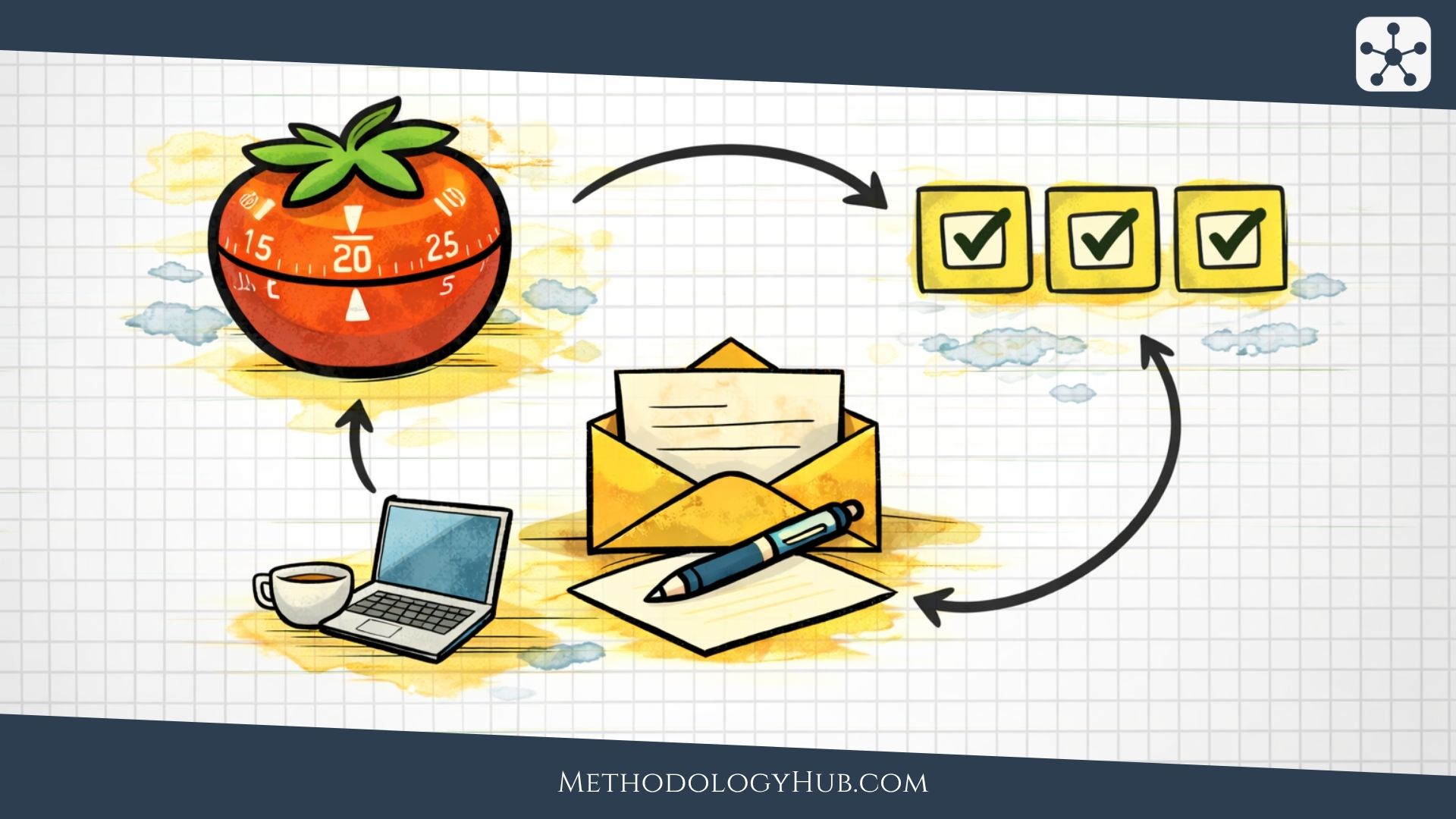
Among study methods for protecting attention, the Pomodoro technique is built around short, focused work sessions and regular breaks. The usual version uses 25 minutes of work followed by 5 minutes of rest, though the exact timing can be adjusted.
This method is useful when starting feels difficult, when concentration slips, or when a task seems too large to face in one block. It is less about magic numbers than about rhythm. A timed session reduces drift, and a planned break makes it easier to return without bargaining with yourself.
The method is also useful because it lowers the entry cost of difficult work. Committing to twenty-five minutes feels easier than committing to an entire afternoon, and that smaller promise often gets study moving. Once the session starts, attention tends to stabilise because the decision about when to stop has already been made.
Time blocking
Among study methods for planning, time blocking means assigning work to specific parts of the day before the day begins. Instead of relying on a loose to-do list, you decide when a task will happen and how much time it gets.
It is especially useful when the workload is spread across different subjects or responsibilities. A block can be used for reading, problem sets, revision, writing, or admin. The value of the method is not that every block will run perfectly, but that your day has an intentional structure instead of reacting to whatever feels urgent.
Its deeper benefit is that it turns intention into placement. Many tasks stay abstract until they have a place in the calendar. Once the block exists, the work becomes more real and easier to protect from distraction or postponement. Even when the day changes, the method still helps because it shows what had been given priority and what has to move.
Eisenhower matrix
Among study methods for deciding what to do first, the Eisenhower matrix sorts tasks by urgency and importance. It helps when everything feels equally pressing and you need a clearer way to decide what deserves attention now, what can wait, and what may not need doing at all.
For studying, it is useful at the planning stage. It helps you separate genuine deadlines from background pressure, and it reduces the tendency to spend time on easy low-value tasks just because they feel manageable. In that sense, it supports study before the studying itself begins.
That makes the matrix useful beyond productivity in a narrow sense. It helps restore proportion. Academic work often feels stressful because every task seems to arrive with the same emotional weight. Sorting the tasks forces a clearer judgment, and that clearer judgment can protect time for the work that actually matters most.
How to choose effective methods for learning
Choosing effective study methods starts with the task, not with preference alone. Before picking among study methods, it helps to ask what the work is actually asking you to do. Do you need to remember facts, understand a process, compare arguments, solve problems, or prepare for timed questions? Different tasks make different demands, and study methods become effective when they match that demand closely.
That is why the same student may need several study methods in the same week. A reading-heavy subject may call for SQ3R or REAP to slow down and process the text properly. A fact-heavy subject may need spaced repetition or chunking. A problem-solving subject may benefit more from practice questions and active recall than from elaborate notes. The study methods should follow the form of the learning, not the other way around.
It also helps to think about where studying usually breaks down. Some students understand the material but cannot retrieve it under pressure. Others remember isolated facts but do not see the structure of the topic. Others know what to do, but they delay the work or let it spread too loosely across the week. When the weak point is clear, the choice becomes more practical. Retrieval problems call for retrieval methods. Organisation problems call for note-taking systems. Planning problems call for time-management methods.
Another useful principle is to choose study methods that combine well. One method rarely does everything. Cornell notes can help you capture material clearly, but they do not replace testing yourself. Active recall can show what you know, but it does not automatically create a study schedule. Time blocking can protect the time, but it does not decide what kind of mental work should happen inside that block. Effective learning usually comes from a sequence rather than a single move.
It is also worth testing study methods honestly instead of adopting them just because they sound productive. A method is only useful if it changes the quality of your learning. After a week or two, ask simple questions. Did the method make recall easier? Did it help you understand the material better? Did it make review more focused? If the answer is no, the method may not fit the task, or you may need to combine it with something else.
One of the most common mistakes is choosing study methods by appearance instead of function. A method may look organised or feel satisfying without doing much for learning. Colourful notes, long summaries, and repeated rereading can create a sense of progress, but that feeling is not the same as strong recall or strong understanding. The best way to judge study methods is to ask what they force you to do.
In practice, a small working combination of study methods is usually enough. You do not need to use every method in this article. Most students benefit more from choosing three or four study methods that serve different purposes and repeating them consistently. For example, you might use one reading method, one note-taking method, one retrieval method, and one planning method. That gives you a system without making studying feel crowded.
Conclusion
Study methods matter because they change what studying looks like on the page and in the mind. Good study methods turn vague effort into a procedure. That makes it easier to focus, easier to notice problems, and easier to build a routine that holds up across different subjects.
The most useful approach is usually a mixed one. Choose a few study methods that match the demands of the work, use them consistently, and keep the ones that make your understanding clearer and your review more honest. Good study is rarely about doing more. More often, it is about choosing study methods that do the right mental work in the right order.
FAQs – Study Methods and Effective Study Techniques
What are study methods?
Study methods are structured ways to learn, review, and remember information. They include approaches such as active recall, spaced repetition, note summarizing, practice testing, and time-blocked revision.
What are the most effective study techniques for students?
The most effective study techniques usually include active recall, spaced repetition, practice questions, interleaving, and teaching the material out loud. These methods help students strengthen memory and improve understanding better than passive rereading.
How do I choose the best study method for my subject?
Choose your study method based on the type of subject. For memorization-heavy topics, use flashcards and spaced repetition. For math or science, prioritize problem solving and worked examples. For essay-based subjects, use outlines, recall practice, and timed writing.
What is the difference between study techniques and study strategies?
Study techniques are specific actions such as making flashcards or answering practice questions. Study strategies are broader plans that organize those techniques, such as deciding when to revise, how to rotate subjects, and how to track weak areas over time.
What is a study focus method?
A study focus method is a way to maintain concentration during revision sessions. Common options include the Pomodoro technique, distraction-free study blocks, task batching, and setting one clear goal for each session to reduce mental overload.
What are some different study methods I can try?
Different study methods include active recall, spaced repetition, blurting, mind mapping, summarizing, Cornell notes, self-quizzing, group discussion, and past paper practice. Trying a few methods can help you find the mix that fits your goals and subject type.
Are effective study tips enough, or do I need a full study system?
Study tips can help in the short term, but a full study system is usually more effective. A good system includes a revision schedule, clear session goals, regular review, practice testing, and time to revisit mistakes.
What study techniques work best when I have limited time?
When time is limited, use high-impact techniques such as active recall, past questions, quick blurting sessions, and focused review of weak topics. These methods are more efficient than rereading full chapters or rewriting notes from scratch.
What are the best study techniques for long-term retention?
The best study techniques for long-term retention are active recall, spaced repetition, interleaving, and practice testing. These methods help move information into long-term memory by forcing you to retrieve it repeatedly over time instead of passively rereading notes.