How to cite sources is a practical research skill. It tells the reader where information came from, gives credit to the original author, and makes your own work easier to check. In academic writing, citation is not a decorative detail added at the end. It is part of how a paper shows its evidence.
This guide explains how to cite sources in the text, how different citation styles work, when a citation is needed, and how to cite journal articles, PDFs, websites, images, videos, Wikipedia, and AI-generated material.
What Is Citation?
Citation is a formal way of showing that a piece of information, wording, data, image, argument, or idea came from another source. A citation usually appears in two places. First, it appears close to the borrowed material in the body of the text. Second, it appears as a fuller entry in a reference list, works cited list, bibliography, or notes section.
In simple terms, citation answers two questions for the reader: who produced the source, and where can the source be found. A short in-text citation may only give the author’s name and year. A full reference gives more detail, such as the title, publisher, journal, volume, issue, page range, DOI, or URL.
Citation also separates your contribution from the work of others. In a research paper, that separation is essential. Readers need to know when you are presenting your own interpretation and when you are drawing from existing scholarship.
It may help to think of citation as a trail through the research. A reader may agree with your interpretation, question it, or want to read further. Good citation gives that reader a route back to the material that shaped the paragraph. Without that route, even a clear sentence can feel unsupported.
The Importance of Citation in Research
Research writing is built from many voices. Your paper may define a concept from one author, use data from another, compare findings from several studies, and then add your own analysis. Citation keeps that conversation clear. It gives credit, helps readers verify claims, and shows how your work connects to existing research.
A citation is not a substitute for thinking. Adding a source at the end of a sentence does not automatically make the sentence strong. The source still needs to be relevant, accurate, and explained. Strong citation works best when it is paired with careful reading and clear analysis.
Citation vs Reference vs Bibliography
These terms are related, but they are not identical. A citation usually means the brief marker placed in the text or note. A reference is the fuller entry that gives publication details. A bibliography is often a broader list of sources, sometimes including works consulted even if they were not cited directly.
The exact wording depends on the citation style. APA usually uses “References.” MLA uses “Works Cited.” Chicago may use “Bibliography” for notes and bibliography style, or “References” for author-date style. The names vary, but the purpose stays the same: readers should be able to trace the source.
A bibliography can also be used in a wider sense. Some assignments ask for an annotated bibliography, where each entry includes a short explanation of the source. Some research projects keep a working bibliography during reading, then turn only the cited items into the final reference list. The label should follow the assignment or style guide, not personal habit.
When to Cite Sources
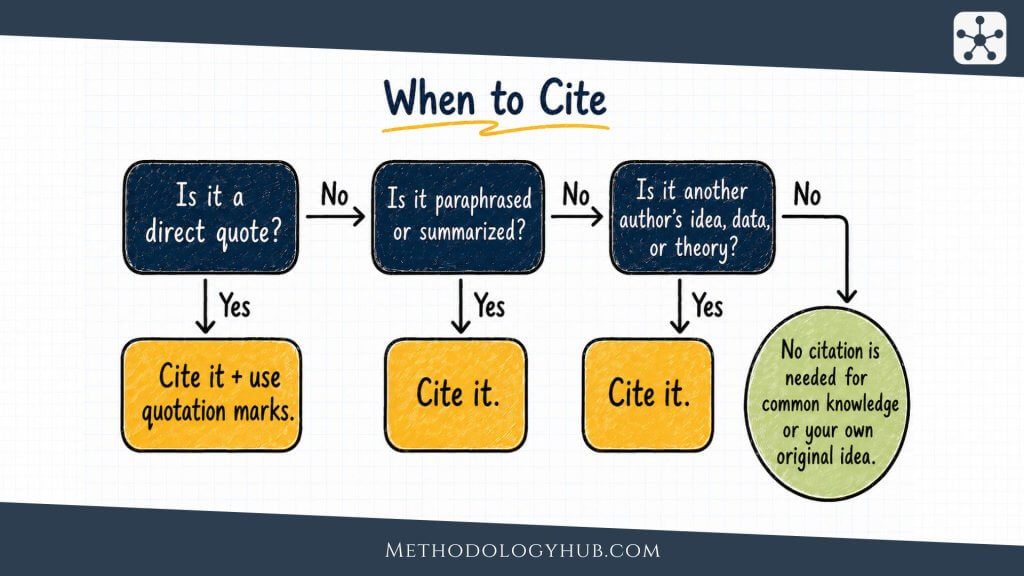
You need to cite whenever your writing depends on someone else’s words, findings, data, structure, argument, or original idea. This includes obvious cases, such as a direct quotation, and less obvious cases, such as a paraphrased theory or a statistic that has become part of your discussion.
Many citation problems begin because writers think citation is only needed for copied wording. That is not enough. A sentence can be fully rewritten and still require a citation if the idea comes from a source.
Another problem appears when a paragraph moves between several sources too quickly. If one sentence comes from a journal article, the next from a report, and the next from your own interpretation, the citation pattern must make that movement clear. The reader should not have to guess which source supports which sentence.
Using Direct Quotes
A direct quote uses the exact words of a source. Because the wording belongs to the original author, quotation marks are needed, along with a citation. In many styles, the citation should include a page number or another precise location when the source has stable pages.
Use quotations sparingly. They work well when the original wording is especially precise, disputed, memorable, or central to your analysis. If the wording is ordinary and only the idea is needed, paraphrasing usually fits more smoothly.
Long quotations need extra care. They may require block formatting, different punctuation, or a lead-in sentence, depending on the style. They also need explanation after the quote. A quote should not be left to speak for itself, because the reader still needs to know how it fits your argument.
Paraphrasing and Summarizing
Paraphrasing means restating a source idea in your own wording and sentence structure. Summarizing means reducing a larger section, article, chapter, or argument to its main point. Both require citation. The words may be yours, but the underlying idea still belongs to the source.
A useful habit is to cite as soon as the source enters the paragraph, not only at the end. This helps the reader see where the borrowed idea begins and where your own interpretation resumes.
Using Data, Statistics, or Ideas
Data and statistics nearly always need citation. That includes survey results, population figures, percentages, clinical findings, experimental results, and measurements from datasets. Even if a number appears simple, the reader needs to know the source and context.
The same rule applies to ideas. If a scholar developed a theory, coined a term, proposed a model, or made an interpretation that you use, cite it. Citation is not only for facts. It is also for intellectual work.
Common Knowledge and When Not to Cite
Common knowledge usually does not need a citation. These are facts that educated readers in your field would already know or could confirm easily in many general sources. For example, a statement that the Earth orbits the Sun does not need a citation in most academic contexts.
The line is not always obvious. If the information is specific, statistical, contested, surprising, recent, or tied to a particular study, cite it. If you are unsure, citing is usually safer than leaving the source unmarked.
How to Cite In-Text
In-text citation is the brief citation placed inside the body of your writing. It connects a sentence, phrase, quotation, or paragraph to the full source entry. The form changes by citation style, but the purpose is always the same: the reader should know which source supports the material.
Most in-text citation systems use one of three patterns: parenthetical citations, narrative citations, or numbered notes. Some styles allow more than one pattern, so the best choice depends on the style guide and the assignment instructions.
In-text citation also has a rhythm. If every sentence begins with a source name, the paragraph can feel like a list. If the source appears only once at the end, the reader may not know how much of the paragraph belongs to that source. Strong writing usually names the source clearly, develops the borrowed idea, and then adds the writer’s own explanation.
Parenthetical Citations
A parenthetical citation places source information in parentheses and are useful when the source supports the sentence but the author’s name does not need to be part of the grammar. They keep the focus on the claim while still giving the reader the source.
Narrative Citations
A narrative citation includes the author’s name in the sentence itself and are useful when the author is part of the discussion. They work well in literature reviews, comparisons between scholars, and paragraphs where the source’s position needs to be visible.
Footnotes
Footnotes appear at the bottom of the page. In Chicago notes and bibliography style, a superscript number in the sentence points to a numbered note. The note gives source details, and the paper may also include a bibliography at the end.
Footnotes are common in history, theology, philosophy, and some humanities fields. They let writers cite sources without interrupting the paragraph as much as parenthetical citation can.
Common Citation Styles
Citation styles are systems for formatting citations consistently. They decide what information appears, what order it appears in, how names are written, whether titles use italics or quotation marks, and whether the text uses parenthetical citations, notes, or author-date references.
There is no single best citation style for every paper. The right style is usually the one required by the instructor, department, journal, or publisher. If no style is assigned, choose the one most common in the discipline.
Consistency is more important than memory. You do not need to remember every punctuation rule before you begin writing. You do need to use one reliable guide, apply it consistently, and check details before submission. Citation style is precise work, and small differences can change the appearance of the final list.
APA Citation Style
APA style is widely used in psychology, education, health sciences, and many social sciences. It uses an author-date system, so the year appears near the author’s name in the text. This helps readers see how recent a source is.
MLA Citation Style
MLA style is common in literature, languages, cultural studies, and other humanities fields. It often uses author-page citation in the text, such as (Smith 42). The full entries appear in a Works Cited list.
MLA is especially useful for textual analysis because page numbers help readers locate passages in novels, poems, essays, plays, and scholarly works. It also uses a flexible container system for sources that appear inside larger works, such as articles inside journals or videos on platforms.
Chicago Citation Style
Chicago style has two main systems. Notes and bibliography style uses footnotes or endnotes and is common in history and some humanities fields. Author-date style uses parenthetical citations and a reference list, and is used in some sciences and social sciences.
Because Chicago allows both systems, it is important to know which one has been assigned. A paper using notes and bibliography will look very different from a paper using Chicago author-date style.
Harvard Citation Style
Harvard style is an author-date system used by many universities. It usually places the author’s surname and year in parentheses, with page numbers added for quotes or specific ideas. A reference list at the end gives full details.
One thing to remember is that Harvard is not one single global manual in the same way APA or MLA is. Universities often publish their own Harvard guide. That means small details can change from one institution to another.
This is why two Harvard references can both be acceptable while looking slightly different. One university may ask for initials after surnames. Another may handle online access dates differently. If your course uses Harvard, follow the local version supplied by your institution.
How to Cite Sources
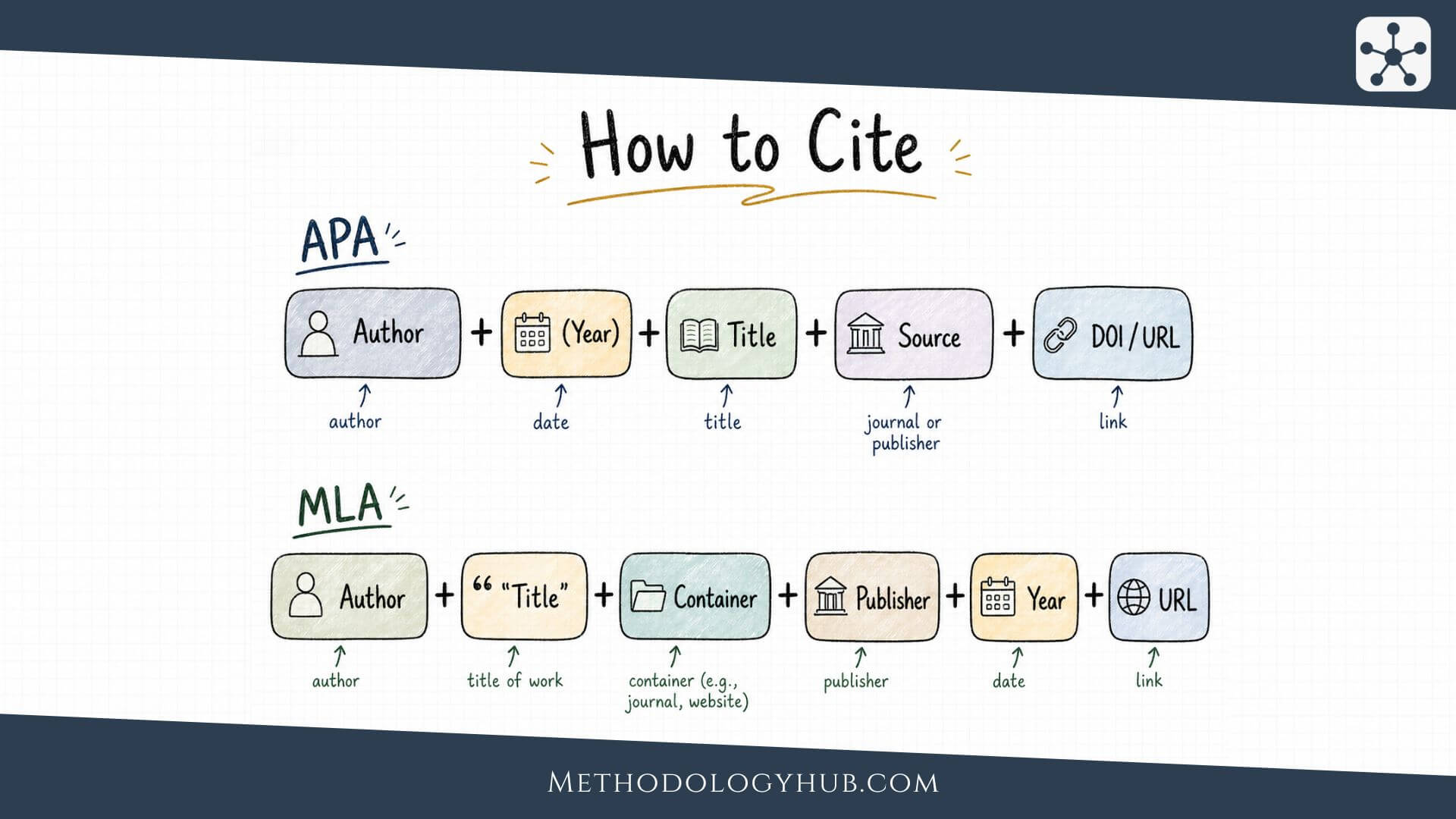
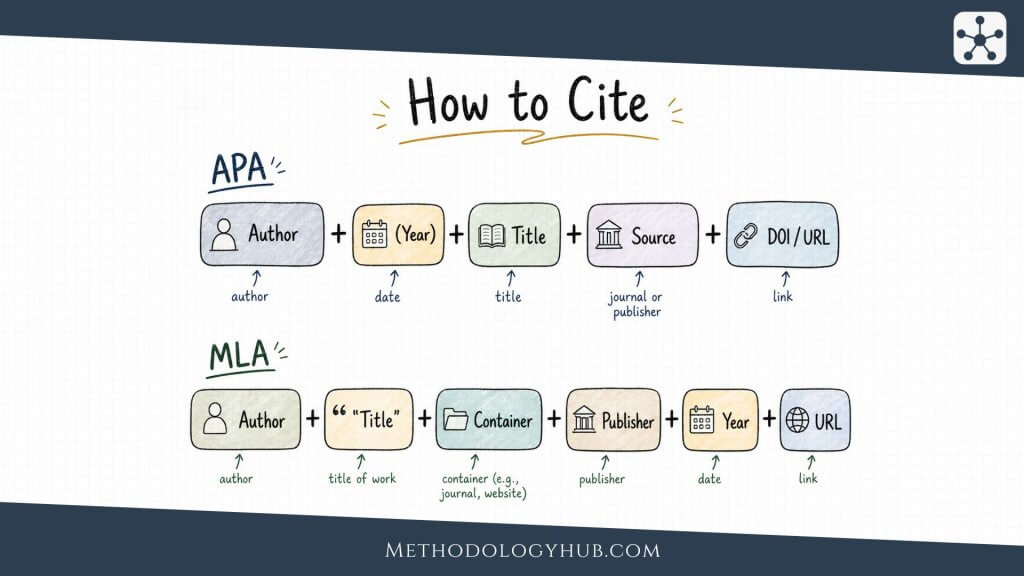
Learning how to cite sources becomes easier once you know which details each source type needs. Most citations are built from the same basic pieces: author, date, title, container, publisher, location, and access information when relevant.
The order and punctuation change across styles, but the underlying task stays similar. Identify what the source is, find the required details, and format them according to the assigned guide.
Good source details are usually found on the title page, article landing page, DOI record, database record, copyright page, or publisher page. The browser tab title is not always enough. It may shorten the title, omit authors, or show the platform name instead of the source title. When in doubt, use the most complete publication record available.
Methodology Hub also provides a privacy-friendly citation generator. It is free and has no AI, no login requirement, no saved citation history on our servers, and no cloud processing of your source list. You can use the citation generator to create citations of any kind of source in major citation styles, including APA, MLA, Chicago, Harvard, and BibTeX.
How to Cite a Book
To cite a book, record the author, year or publication date, title, edition if relevant, publisher, and DOI or URL if it is an online book. For a chapter in an edited book, include the chapter author and title, the editor, the book title, page range, publisher, and DOI or URL if available.
Pay attention to editions. A second edition is not always the same as the first, and a translated edition may have different publication details from the original. If your discussion relies on a specific page, chapter, or translation, the citation should point to the version you actually used.
In APA, a book reference usually begins with the author’s surname and initials, followed by the year, italicized title, and publisher. In MLA, the author’s full name is followed by the title, publisher, and year. In Chicago, the format changes depending on whether you use notes or author-date style.
How to Cite a Journal Article
To cite a journal article, collect the author, year, article title, journal title, volume, issue, page range or article number, and DOI. The DOI is especially useful because it gives a stable path to the article even when a journal website changes.
For online journal articles, prefer the DOI when one exists. A database name is usually not needed in many modern styles unless the source is hard to locate without it or the style guide specifically asks for it.
Be careful with preprints and articles published ahead of print. They may not have final page numbers yet, and their status can change after peer review. Cite the version you used, and check whether your style asks for labels such as preprint, advance online publication, or article number.
How to Cite a PDF
A PDF is a file format, not a source type. Before citing a PDF, ask what the PDF actually is. It may be a journal article, report, book chapter, thesis, government document, conference paper, or dataset documentation. Cite the source type, then add the URL or DOI if needed.
For example, a journal article downloaded as a PDF should be cited as a journal article. A government report in PDF form should be cited as a report. The fact that it is a PDF usually does not control the citation.
How to Cite a Website
To cite a website or web page, look for the author or organization, page title, website name, publication or update date, URL, and access date if the style requires it. If there is no named personal author, the organization may be the author.
Web pages change more often than books and journal articles, so use the most specific page URL rather than the homepage. If the page has no date, many styles allow “n.d.” for no date. If the page is likely to change, an access date can help the reader understand when you consulted it.
How to Cite a Photo
To cite a photo, record the creator, title or description, date, repository or website, and URL or museum record when available. If the image is from a database, archive, museum collection, or article, cite the place where you found it.
For images used in presentations or published work, also check permission and licensing. Citation gives credit, but it does not automatically give permission to reuse an image in every context.
How to Cite a Video
To cite a video, include the creator or channel, date, title, platform or publisher, and URL. If you refer to a specific moment in the video, add a timestamp in the text or note where the style allows it.
For academic work, cite the version you actually watched. If a lecture appears on a university site and is also reposted elsewhere, the university source is usually better than an unofficial copy.
How to Cite Wikipedia
Wikipedia can be useful for orientation, but citing Wikipedia in academic work is often not welcomed. Many instructors and journals expect students to cite original, peer-reviewed, or otherwise authoritative sources instead of a general encyclopedia.
If you must cite Wikipedia, use the permanent version of the article rather than the live page. Wikipedia pages change frequently, so a permanent link helps the reader see the exact version you consulted. In most research papers, though, it is better to follow the references listed in the Wikipedia article and cite the original sources directly.
This is especially true when the topic is technical, medical, historical, legal, or scientific. A Wikipedia article may point you toward useful vocabulary and source names, but the cited studies, books, reports, and archival records are usually the materials your paper should depend on.
How to Cite AI
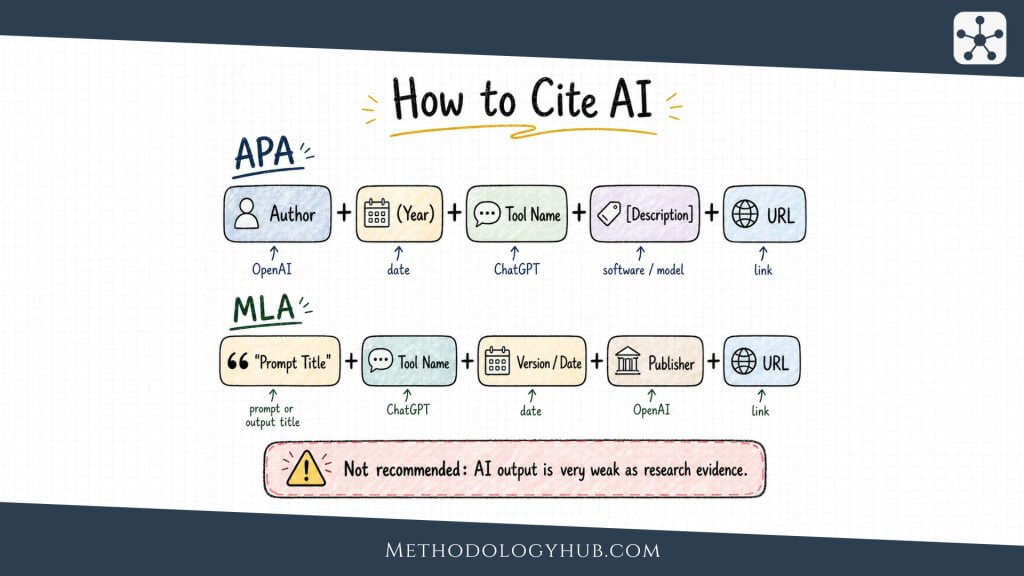
AI tools have made citation more complicated. They can produce text that sounds like a source, but an AI answer is not the same as a journal article, book, dataset, or archival document. It may summarize real material, mix sources, omit context, or invent details. For research writing, the safer approach is to cite the original non-AI source whenever possible.
In many academic settings, citing an AI-generated answer is not viewed positively. If AI helped you find terms, refine a question, or improve wording, follow your institution’s disclosure rules. If you need evidence for a claim, use peer-reviewed or otherwise verifiable sources instead of the AI output.
There is also a difference between acknowledging tool use and citing evidence. A disclosure may tell the reader that a tool helped with language or planning. A citation, by contrast, supports a claim. AI tools are often not the best support for claims because they do not provide stable, inspectable evidence in the way published sources do.
Dangers in using AI for research
AI can be useful for brainstorming, but it is risky as a research source. It may provide references that look real but do not exist. It may give a correct-sounding summary of a study while changing the findings. It may also flatten disagreement between scholars into a smooth answer that hides uncertainty.
The main problem is verification. A reader cannot easily recover the same AI response, especially if the tool changes, the model changes, or the prompt is private. That makes AI-generated text weaker as evidence than a published source with stable bibliographic details.
AI can also blur source responsibility. If a tool summarizes three articles, the answer may not show which claim came from which article. In a research paragraph, that is a serious problem. The reader needs a direct connection between the claim and the source that supports it.
How to Cite AI in APA
When APA style requires an AI citation, the reference usually treats the company as the author and the AI tool as software. The exact format can change as guidance develops, so check the current APA Style guidance and your institutional rules.
A general APA-style AI reference may include the company, year, tool name or model name, version or descriptor in brackets, and URL. In the text, the citation would normally use the company name and year.
If the response is not publicly recoverable, your instructor may ask you to include the prompt or the full transcript in an appendix instead of treating the answer like a normal source. This is another reason to check local rules before relying on AI material in assessed work.
Example: How to Cite ChatGPT
A simple APA-style reference for ChatGPT may look like this:
An in-text citation may look like this: (OpenAI, 2025). If your work quotes or discusses a specific response, include the prompt, date, or transcript details if your instructor asks for them. In most academic papers, however, it is better to cite the original article, book, report, or dataset that supports the claim.
Paraphrasing Sources Correctly
Paraphrasing is one of the most useful citation skills because it lets you bring source ideas into your own argument without overloading the paper with quotations. Done well, it shows that you understand the source and can explain it in your own writing voice.
It also helps the paragraph read as one piece of writing. A paragraph built only from quotations can feel broken because each quotation arrives with a different rhythm and voice. Paraphrasing lets you keep the paragraph moving while still giving proper credit.
Done poorly, paraphrasing can become too close to the original. Changing a few words while keeping the source’s sentence pattern is not enough. A good paraphrase changes both wording and structure while preserving the meaning.
What Is Paraphrasing
Paraphrasing means restating a specific idea from a source in your own words and sentence structure. It is different from copying, and it is also different from summarizing. A paraphrase usually stays close to one idea or passage, while a summary condenses a larger section into a shorter overview.
A paraphrase still needs a citation. The sentence belongs to you, but the idea came from the source. Without citation, the reader may assume the idea is yours.
The best paraphrases are not shorter copies. They are rewritten explanations. They often change the order of information, connect the idea to the paragraph, and use terms that fit the writer’s own analysis. Technical terms may remain the same, but the surrounding sentence should be yours.
How to Paraphrase Without Plagiarism
Start by reading the source until you understand the point without looking at the exact wording. Then close the source or move it aside. Write the idea in a new sentence pattern, using language that fits the rest of your paragraph. After that, compare your version with the original to make sure the meaning is accurate and the wording is not too close.
It helps to add your own analytical sentence after the paraphrase. That sentence should explain how the source supports your point, complicates it, or connects to the paragraph. Without that explanation, the paraphrase may feel inserted rather than integrated.
Paraphrasing vs Quoting
Use paraphrasing when the idea is more important than the exact wording. Use quoting when the wording itself needs to be preserved, analyzed, or challenged. In most research papers, paraphrasing appears more often than quoting because it keeps your own sentence flow in control.
A paper with too many quotations can begin to sound like a collection of borrowed voices. A paper with careful paraphrasing and selective quotation usually reads more smoothly because the writer remains in charge of the discussion.
That does not mean quotation is weak. A short quotation can be powerful when you analyze the wording closely. The problem comes when quotation replaces explanation. After a quotation, the reader should still hear your interpretation.
Avoiding Plagiarism
Plagiarism occurs when someone presents another person’s words, ideas, data, or work as their own. It can happen through copying, careless paraphrasing, missing citations, reused work, or incorrect handling of sources. Sometimes it is deliberate. Sometimes it comes from rushed notes, poor organization, or uncertainty about citation rules.
In academic writing, the reader needs to see the boundary between your work and the source’s work. Citation is one part of that boundary. Careful paraphrasing, accurate quotation, and honest note-taking are just as important.
A useful way to prevent confusion is to treat research notes as a map. Mark quotes, paraphrases, summaries, and your own reactions differently. When the draft begins, you will know which sentences need quotation marks, which need citations, and which are your own analysis.
What Is Plagiarism
Plagiarism is the use of someone else’s intellectual work without proper acknowledgment. It can involve a full paper, a paragraph, a sentence, a phrase, a chart, a method, a dataset, or a distinctive idea. The size of the borrowed material does not remove the problem.
Plagiarism is not only about copied words. If you use a source’s argument, structure, or interpretation without credit, the issue remains even if the wording has changed.
Types of Plagiarism
Plagiarism can take several forms. Direct plagiarism copies wording without quotation marks and citation. Patchwriting stays too close to the original sentence structure while replacing some words. Source-based plagiarism gives incomplete, misleading, or false source information. Self-plagiarism reuses your own previous work when new work is expected.
Accidental plagiarism can still have serious consequences. That is why source tracking should begin during reading, not during the final hour before submission.
Students often run into trouble when they paste source text into notes without marking it as copied. Days later, the wording can look like their own rough draft. A simple habit – quotation marks around copied text from the beginning – prevents that confusion.
How to Avoid Plagiarism in Research
The best prevention is a careful process. Keep full source details from the start. Put direct quotations in quotation marks in your notes. Record page numbers for specific claims. Write paraphrases after you understand the source, not while copying its sentence shape. Add citations during drafting rather than trying to reconstruct them later.
Before submitting, check every paragraph that uses research. Ask whether the reader can see which ideas are yours and which come from sources. If the answer is unclear, add a citation, revise the wording, or explain the source’s role more directly.
It also helps to check the final reference list against the in-text citations. Every in-text citation should have a matching full entry, and every full entry should usually be cited in the text, unless the assigned style allows a broader bibliography. This final check catches missing sources before the reader does.
Citation Tools and Generators
Citation tools can save time, especially when a project uses many sources. They help store references, format bibliographies, and keep citation details organized. Still, they do not remove the writer’s responsibility. Generated citations can contain errors, missing details, wrong capitalization, or incorrect source types.
Use tools as support, then check the result against the style guide. This is especially important for unusual sources, translated works, edited volumes, datasets, legal materials, images, and online sources with missing information.
A tool can format what it is given, but it cannot always know whether the details are correct. If the source record has the wrong author, the final citation will repeat that error. If a website title is confused with a page title, the generator may produce a citation that looks polished but points poorly.
Reference Management Software
Reference managers such as Zotero, Mendeley, EndNote, and similar tools help collect source records, attach PDFs, add notes, and insert citations into documents. They are especially useful for literature reviews, theses, dissertations, and research papers with many sources.
The main benefit is organization. A reference manager keeps your source library in one place, which makes it easier to avoid lost URLs, missing DOIs, and inconsistent formatting. Even so, imported records should be checked. Databases sometimes export titles in all capitals, omit page ranges, or confuse authors with editors.
Reference managers are most helpful when you use them early. Adding sources after the paper is already drafted is possible, but it removes much of the advantage. When sources are saved during reading, notes, tags, folders, and attachments can support the whole research process.
Online Citation Generator
Online citation generators can be useful for quick references, but many tools now depend on AI, accounts, tracking, or cloud processing. That is not ideal when students only need a clean citation without handing over unnecessary information.
Methodology Hub also provides a privacy-friendly citation generator for quick formatting. It has no AI, no login requirement, no saved citation history on our servers, and no cloud processing of your source list. You can use the citation generator to create citations in major citation styles, including APA, MLA, Chicago, Harvard, and BibTeX.
The generator can help with formatting, but you should still review every result. Check author names, dates, titles, italics, capitalization, DOI links, and source type. A citation is only useful if it points accurately to the source you actually used.
For longer projects, a generator and a reference manager can work together. The generator helps with one citation at a time, while the reference manager keeps the whole library organized. Both are useful, but neither replaces checking the assigned style guide.
Conclusion
Knowing how to cite is less about memorizing punctuation and more about showing the reader how your work was built. Once you know when to cite, how in-text citations connect to full references, and how styles differ, the process becomes much easier to handle.
The strongest habit is simple: keep source details from the beginning. Record authors, dates, titles, page numbers, DOIs, URLs, and notes while you read. Then, when you draft, you can focus on explanation and analysis instead of searching for missing citation details at the end.
Citation also improves the quality of your writing. It encourages you to choose sources carefully, distinguish your own ideas from borrowed ones, and build paragraphs that are supported without being crowded by references.
If you remember one thing, let it be this: citation is not just formatting. It is how research writing keeps its evidence visible, traceable, and fair to the people whose work made the discussion possible.
FAQs on How to Cite
What does it mean to cite a source?
To cite a source means to show where information, wording, data, images, or ideas came from. In academic writing, citation helps the reader see which parts of the text are based on your own analysis and which parts come from another author, study, book, article, website, or other source.
When do you need to cite a source?
You need to cite a source when you use a direct quote, paraphrase an idea, summarise research, include data or statistics, refer to a theory, or use a specific argument that came from someone else. You usually do not need a citation for basic common knowledge, but you should cite when the information is specific, debatable, or connected to a particular source.
Do you need to cite when paraphrasing?
Yes, paraphrased material still needs a citation. Paraphrasing changes the wording, but the idea still comes from the original source. A strong paraphrase uses your own sentence structure and fits naturally into your paragraph, but it should still give credit to the author or source that supplied the idea.
How do you cite in text?
In-text citation depends on the citation style you are using. APA usually uses author and year, MLA usually uses author and page number, and Chicago may use footnotes, endnotes, or author-date citations. The purpose is the same in each style: the reader should be able to connect the sentence in the text to the full source information at the end of the work.
What is the difference between a citation and a reference?
A citation is the short source marker that appears in the text, footnote, or endnote. A reference gives the fuller source details, usually at the end of the paper. For example, an in-text citation may include only the author’s name and year, while the reference includes the title, publisher or journal, date, page range, DOI, or URL.
Which citation style should you use?
You should use the citation style required by your teacher, department, university, journal, or publisher. If no style is assigned, choose the style normally used in your field. APA is common in psychology, education, and social sciences, MLA is common in language and literature, Chicago is often used in history and humanities, and Harvard is used across many academic subjects.
How do you cite a website with no author?
If a website has no named author, most citation styles begin with the page title or move the title into the author position. You should still include the date, website name, and URL when the style requires them. If there is no date, styles such as APA often use “n.d.” to show that no publication date is available.
How do you cite a PDF?
A PDF should be cited according to what kind of source it is. A PDF may be a journal article, report, book chapter, dissertation, working paper, or government document. Identify the source type first, then cite it using the format for that source type, including the DOI or URL if the PDF is available online and the citation style requires it.
Can you cite Wikipedia in academic writing?
Citing Wikipedia directly is usually discouraged in academic writing. Wikipedia can be useful for getting an overview or finding sources listed in the reference section, but it is better to read and cite the original academic books, journal articles, reports, or primary sources behind the page. If you must cite Wikipedia, use a permanent link to the exact version you consulted.
How do you cite ChatGPT or another AI tool?
To cite ChatGPT or another AI tool, follow the rules of your institution and citation style. AI-generated answers should not normally replace academic sources, because they may be inaccurate or difficult to verify. If AI use must be cited or disclosed, include details such as the tool name, creator, date, model or version if required, and enough information about the prompt or output for the reader to understand what was used.