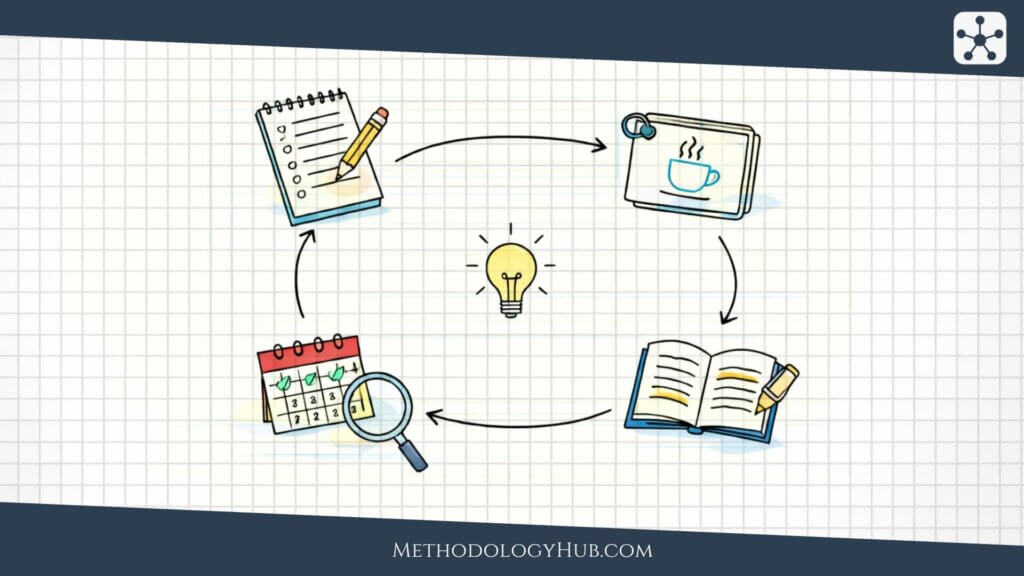
Active recall is a study method and retrieval practice based on remembering information from memory instead of only looking at it again. The student reads, listens, or studies something once, then closes the source and tries to bring the idea back without help. That small shift changes the study session. The material is no longer something to recognise on the page. It becomes something the learner has to produce.
This article explains what active recall is, how it works, how it differs from passive review, how to use it in a study session, which techniques are most useful, and how it can be adapted to different study materials
What Is Active Recall?
Active recall is the deliberate attempt to remember information without looking at the answer first. A student might close a textbook and explain a concept, cover a lecture slide and write the main points, answer a practice question, or use a flashcard without turning it over too soon. The form can change, but the centre of the method stays the same: memory has to do the work before the source gives support.
This is different from ordinary review. When students reread notes, scan a chapter, or look through highlighted passages, they are often recognising material that is already visible. Recognition feels smooth. A sentence seems familiar. A term looks known. A diagram appears easier the second time. Active recall interrupts that comfort by asking a sharper question: can the learner produce the idea when the page is closed?
Active recall definition
Active recall is a retrieval-based study method in which the learner tries to bring information back from memory before checking the source. It is used to strengthen retention, expose gaps in understanding, and make later review more focused.
The method is sometimes discussed under other names. In cognitive psychology, the research term is often retrieval practice. In education, it may appear as self-testing, practice testing, test-enhanced learning, or recall practice. These terms are not always identical in every study, but they share a central idea. Learning is helped when the learner retrieves information, not only when the learner receives it again.
Active recall and recognition
The difference between recall and recognition explains much of the method. Recognition is useful, but it is not the same as readiness. A student may recognise a definition in a textbook and still be unable to write it in an exam. They may follow a worked solution while it is on the page and still be unable to solve a related problem later. Recognition can tell the learner that material has been seen before. It cannot always tell the learner that the material is available for use.
Active recall brings that difference into the open. When the learner tries to answer before checking, weak knowledge becomes visible. Sometimes the first attempt is nearly complete. Sometimes only a few fragments appear. Sometimes the learner remembers the example but not the principle, or the term but not the relation between terms. Those partial answers are useful because they show where the next review should go.
What active recall looks like in practice
A simple active recall session can be very short. Read a paragraph, close the book, and ask, “What was the main point?” Watch a short lecture segment, pause it, and write the steps of the process. Review a diagram, cover the labels, and redraw the structure from memory. After reading an article section, look away and explain the argument in two or three sentences.
None of this requires a special tool. Flashcards can help. Question banks can help. Digital systems can help. But active recall begins with an honest attempt to remember before the answer is shown. The tool is secondary. The retrieval attempt is the method.
- answer a question before checking notes
- write a closed-book summary after a section
- redraw a diagram without labels
- explain a concept aloud in plain language
- complete a practice problem before looking at the solution
How Active Recall Works
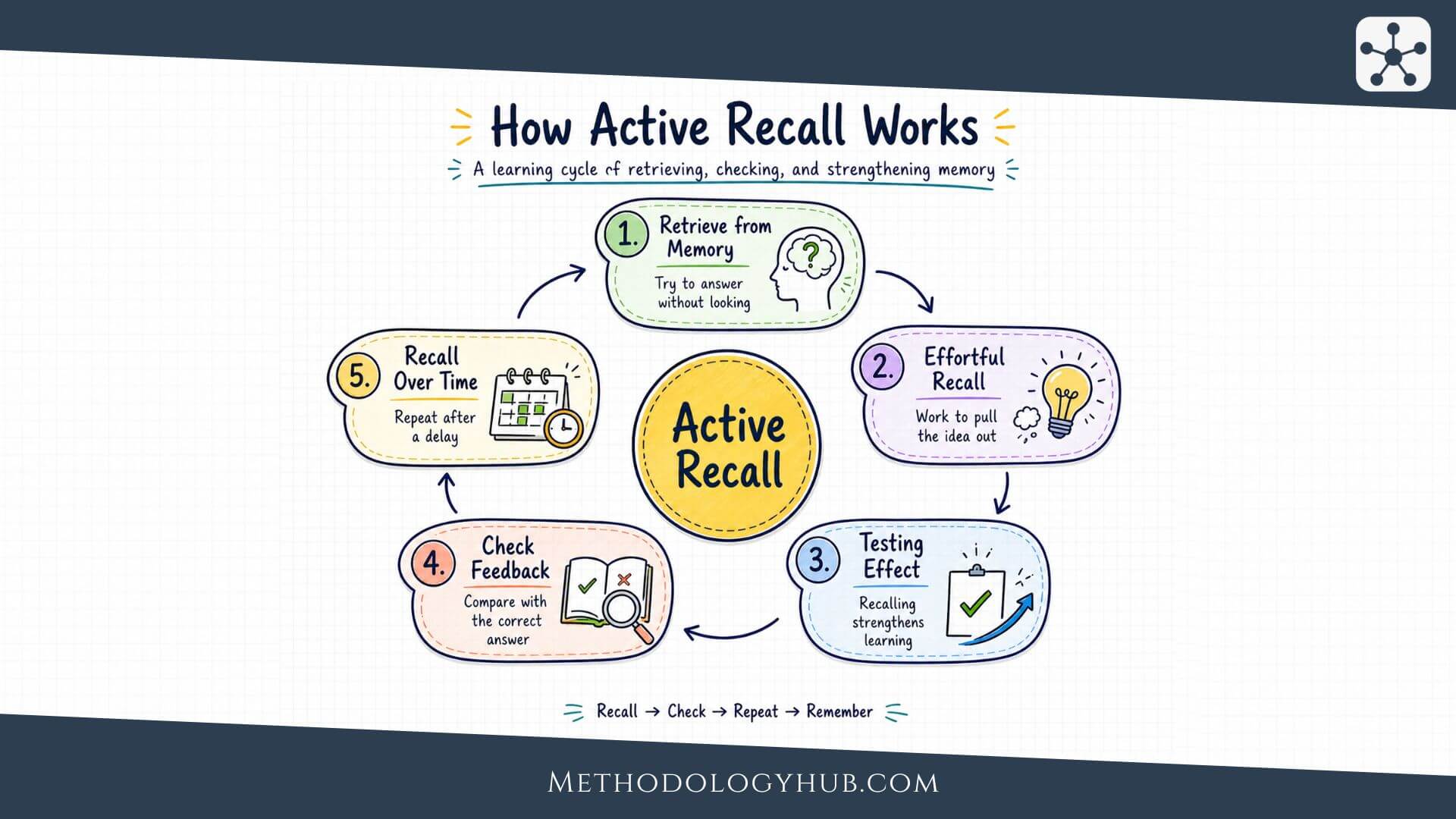
Active recall works because it changes the role of memory during study. In passive review, the source carries most of the load. The notes are open, the chapter is visible, and the answer is already present. In active recall, the learner has to reconstruct the answer. That reconstruction is effortful, and the effort is part of the learning process.
The method is closely related to retrieval practice. Research on the testing effect has shown that taking tests or doing retrieval practice can improve later retention, even when those tests are used for learning rather than grading. This does not mean that every quiz is useful or that all questions are equally good. It means that the act of bringing information back from memory can change what happens after the study session.
Retrieval strengthens access
One way to understand active recall is to think of memory as more than storage. A student may have encountered information, but still have trouble reaching it later. Retrieval practice trains access. Each serious attempt to recall a term, idea, explanation, or process gives the learner practice at finding that information again.
This is one reason active recall can feel less pleasant than rereading. Rereading is smooth because the answer is already there. Recall is slower because the learner has to search. The first few seconds of uncertainty are not a sign that the method is failing. They are often the point at which the method begins to do useful work.
Useful test: if a study method feels fluent the whole time, it may be showing you the answer more often than asking you to retrieve it.
Effort changes the study signal
Not all effort helps learning, but well-placed retrieval effort can be productive. A learner who pauses after reading and tries to explain the point receives a clearer signal than a learner who simply reads the paragraph twice. The recall attempt says, “This part is ready,” “This part is vague,” or “This part is missing.” That signal is sharper than the feeling of familiarity that often follows rereading.
The difficulty should still be reasonable. If the material is completely new and no first understanding has formed, recall may produce little more than frustration. Initial exposure, explanation, examples, and guided reading still have a place. Active recall is strongest after the learner has enough contact with the material to attempt a meaningful answer.
Feedback turns recall into correction
Recall alone is not enough. After trying to answer, the learner has to check. The answer may be incomplete, partly wrong, or accurate in outline but weak in detail. Feedback repairs the attempt. That feedback can come from a textbook, lecture slide, marking scheme, worked solution, teacher, peer, or answer key.
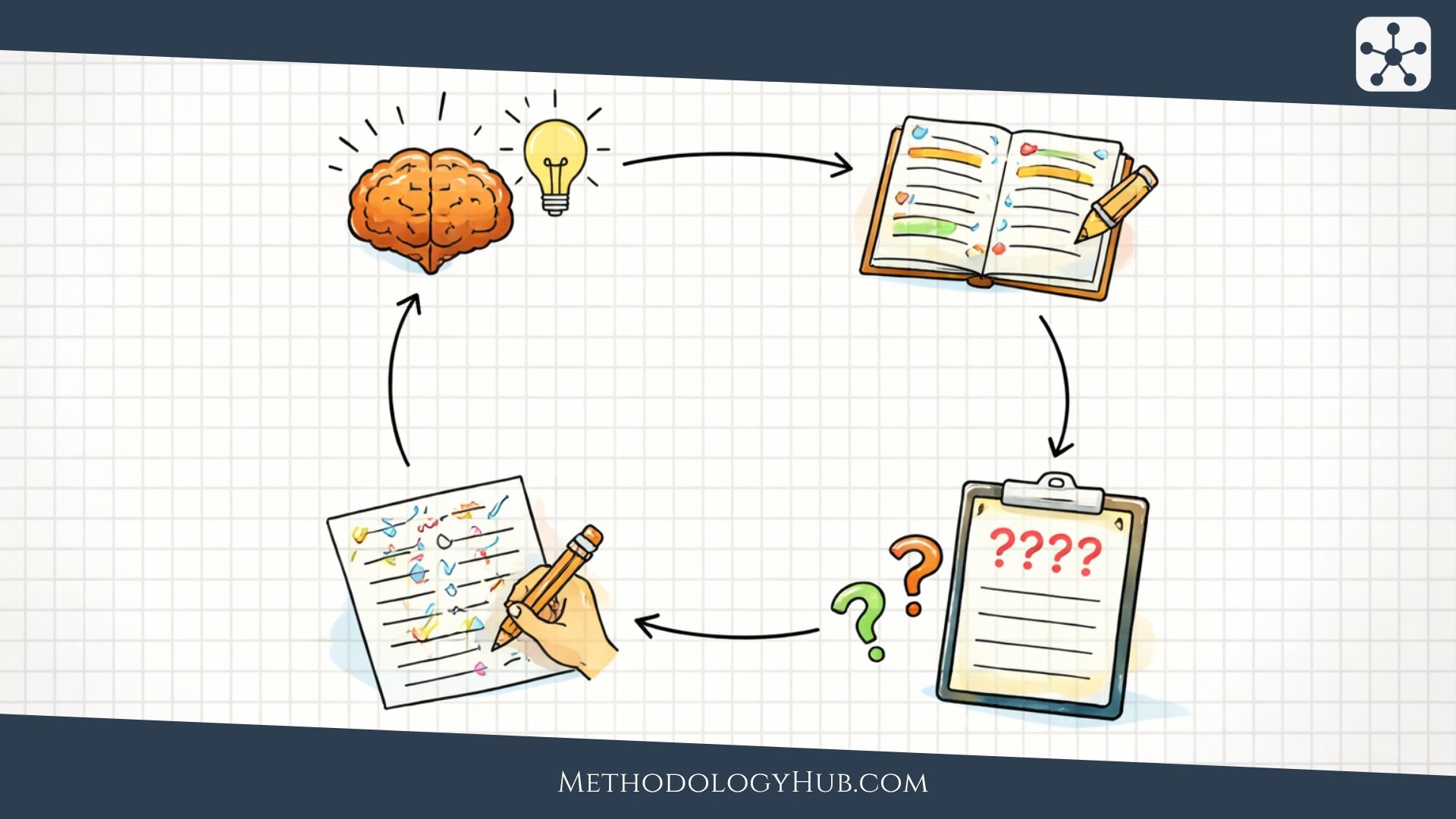
The order is important. Try first, then check. If the learner checks first, the session becomes recognition again. If the learner tries but never checks, errors can settle in. Active recall works best as a cycle: retrieve, compare, correct, and retrieve again later.
Recall can deepen understanding
Active recall is sometimes described as memorisation, but it does not have to be narrow. A good recall prompt can ask for more than a definition. It can ask the learner to compare two theories, reconstruct a sequence, explain a cause, apply a concept to a case, or state the evidence behind a claim. In that form, retrieval practice can support understanding rather than replace it.
The quality of the prompt decides much of the quality of the recall. “What is classical conditioning?” may be useful at first. Later, a stronger prompt might ask, “How does classical conditioning differ from operant conditioning?” or “Which part of this example is the conditioned stimulus?” The learner is still retrieving, but now the answer requires structure and relation.
Active Recall vs Passive Review
Active recall and passive review can look similar from the outside. Both may involve the same textbook, notes, lecture slides, or digital files. The difference is in what the learner is asked to do. Passive review asks the learner to look again. Active recall asks the learner to bring something back before looking again.
This difference can be easy to miss because passive review often feels productive. A student may spend an hour rereading a chapter, underlining terms, and reorganising notes. The work looks serious. The problem appears later, when the material must be used without the page. If the study session never required retrieval, the learner may discover too late that recognition was mistaken for readiness.
Rereading
Rereading can help when the first reading was confused, rushed, or incomplete. It can also help when a student returns to a difficult passage with a specific question. The weaker version is rereading as the whole study plan. The learner moves through the same notes again and again, hoping that exposure will turn into recall.
Active recall changes rereading by placing it after a test of memory. Instead of rereading the whole chapter first, the learner asks, “What can I explain already?” The answer decides where rereading is needed. This makes rereading more selective. The page is reopened to repair a specific weakness, not to repeat the entire session from the beginning.
Highlighting and marking
Marking a text can be useful when it helps the learner return to terms, claims, examples, and questions. It becomes less useful when it replaces thinking. A marked page may look organised while the learner has not yet tried to explain anything from memory. In that case, the marks record exposure, not retrieval.
A better approach is to mark less and recall more. After a short section, the learner can cover the page and ask what the marked lines were doing. Were they definitions, evidence, examples, objections, or steps in an argument? If the answer cannot be recalled, the mark needs to be turned into a prompt.
Reviewing notes
Notes are useful when they are built for later use. A page of copied sentences is harder to recall from than a page of questions, diagrams, short summaries, and problem prompts. Active recall can therefore change the form of note-taking. Instead of writing only statements, the learner writes questions that will be answered later without looking.
For example, a note that says “working memory has limited capacity” can become “What limits working memory during reading?” A note that lists the stages of a process can become “Can I write the stages in order and explain what changes at each stage?” The second version already prepares a recall session.
Recognition-based study
Recognition-based study is not useless. Students need to read, listen, observe, and recognise patterns before they can recall them well. The difficulty appears when recognition becomes the only evidence of learning. A student may recognise a formula but not know when to use it. They may recognise a theorist’s name but not explain the argument. They may recognise a diagram but not recreate it.
Active recall does not remove recognition. It puts recognition in a more useful place. First, try to produce the answer. Then, use recognition to check and correct. The learner still returns to the source, but the return has a purpose.
Recall-based study
Recall-based study is more honest because it brings uncertainty forward. It does not wait until the exam, seminar, or writing task to reveal weak areas. It makes those areas visible during the study session, when there is still time to fix them. That is why active recall can feel slower in the moment but more efficient across several sessions.
The difference is not that passive review is always wrong and active recall is always right. Students often need both. They need exposure before retrieval, and they need correction after retrieval. The point is sequence. Learn enough to attempt an answer, retrieve it without help, check it, and then return to the parts that did not hold.
How to Use Active Recall
Active recall is simple, but it becomes more useful when it is treated as a process rather than a vague instruction to test yourself. A good recall session has a beginning, a hidden-answer moment, a check, and a later return. The steps below can be used with a textbook chapter, lecture, article, diagram, problem set, or revision sheet.
Step 1 – Study the material once
Begin with enough exposure to understand the material at a first level. Read the section, watch the lecture segment, examine the diagram, or work through the example. This first pass should not be passive, but it also does not need to contain the whole recall process yet. The learner is building the first version of the idea.
During this stage, look for the structure. What is being defined? Which examples support the explanation? Which terms control the meaning? Which steps belong in the process? A recall attempt works better when the learner knows what type of answer should come back.
Step 2 – Close or cover the source
The source has to disappear for the recall attempt to count. Close the book, cover the notes, turn the flashcard over, pause the video, hide the labels, or move the worked solution out of view. This is the part many learners weaken without noticing. They keep the notes half visible, glance too soon, or answer while reading the sentence.
The hidden-answer moment should be brief but genuine. Even thirty seconds of honest retrieval can show more than another minute of looking. The aim is not to suffer through silence. The aim is to give memory a chance to respond before the page does.
Practical rule: look first to understand, look away to retrieve, then look back to correct.
Step 3 – Retrieve the answer
Now answer from memory. The answer can be spoken, written, drawn, typed, or solved. For a definition, write the idea in your own words. For a process, list the stages and explain what happens in each one. For a diagram, redraw the structure. For an argument, state the claim, the evidence, and the conclusion. For a calculation, set up the method before checking the solution.
Try to make the answer specific enough to judge. “This section was about memory” is too loose. “This section explained that retrieval practice strengthens later access by forcing the learner to reconstruct information before feedback” is much easier to check. A recall answer does not need to be elegant. It needs to be clear enough to compare with the source.
Step 4 – Check the answer
After the attempt, reopen the source and compare. What was correct? What was missing? What was vague? What was wrong? The comparison should be calm and precise. A weak answer is not a failed session. It is information about what the next session should repair.
It can help to mark answers in three categories: recalled, partly recalled, and not recalled. Recalled material can be reviewed later. Partly recalled material needs another attempt soon. Material that did not come back at all may need a short restudy before another recall attempt.
Step 5 – Repeat after a delay
A single recall attempt is useful, but the method becomes stronger when retrieval returns after time has passed. The delay can be short at first: later the same day, the next day, then a few days later. The exact schedule can change by subject and difficulty. The principle is steady: recall should happen again before the material has faded completely.
Later attempts should not always use the same question. Repeating the same wording can train a narrow answer. Once the basic answer is stable, change the prompt. Ask for an example, a comparison, an application, a diagram, or a problem. That keeps active recall from becoming mechanical.
- start with a short section or small concept
- hide the answer completely
- write or say a specific response
- check against the source
- try again after a delay
- change the prompt once the basic answer is stable
Choosing the right size for a recall attempt
The size of the recall unit changes the whole session. If the unit is too small, active recall becomes a list of disconnected fragments. If the unit is too large, the attempt becomes vague because there is too much to hold at once. A useful unit is large enough to contain a complete idea and small enough to check without confusion.
For a textbook, one subsection may be the right size. For a dense article, one paragraph or one figure may be enough. For a lecture, one slide group or one worked example may be better than the whole hour. For a problem-solving subject, one problem type is often a good unit because the learner has to recall both the method and the conditions under which it applies.
The question should match the unit. After a short definition, ask for the definition and an example. After a longer section, ask for the main claim, supporting points, and the relation between them. After a diagram, ask for labels and connections. This keeps active recall from becoming a shallow yes-or-no check.
Keeping a light record of recall
A record can help, but it should not become a separate project. The learner only needs enough information to decide what returns soon and what can wait. A simple mark beside each prompt is enough: strong, partial, or absent. Some students prefer numbers, such as 0, 1, and 2. Others prefer dates for the next review. The format is less important than the habit of using the result.
Light records are useful because memory can feel different from one day to the next. A concept that seemed secure on Monday may be weaker on Thursday. A prompt that failed twice may become stable after one clear explanation. Tracking that movement keeps review from being driven by mood or guesswork. The learner does not have to review everything equally. The record shows where active recall should return first.
Active Recall Techniques
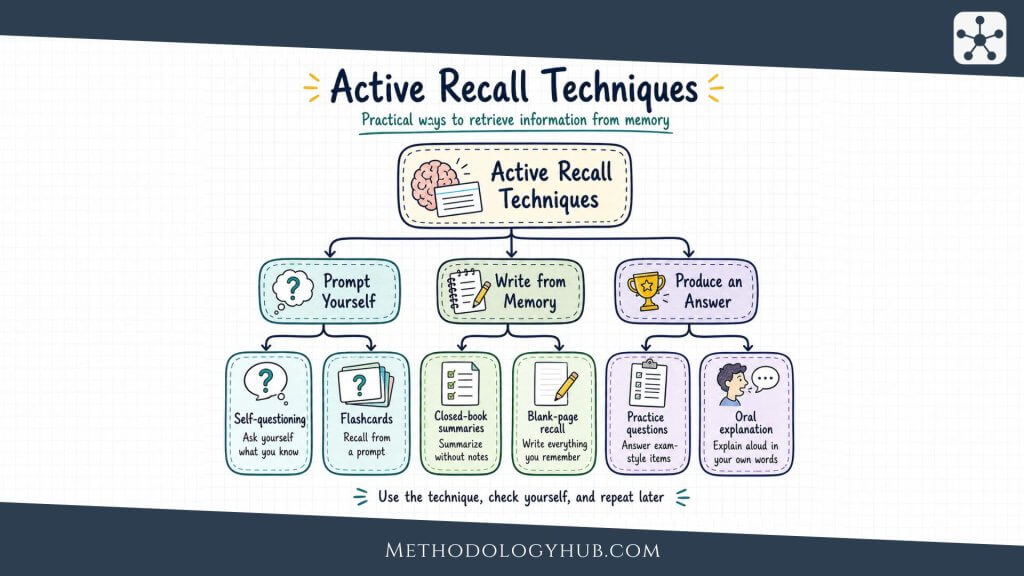
There is no single technique that defines active recall. The method can be quiet, written, spoken, visual, or problem-based. The best technique depends on the material and on what the learner will eventually need to do with it. A vocabulary list, a legal case, a biology diagram, a philosophical argument, and a statistics problem all invite different forms of retrieval.
Self-questioning
Self-questioning is the most flexible form of active recall. It turns notes, headings, diagrams, and lecture points into prompts. A heading becomes a question. A definition becomes a prompt. A worked example becomes a problem to solve without looking. A paragraph becomes a request for a summary.
Good questions are specific but not overly narrow. They should require the learner to produce something. “What is the difference between recognition and recall?” is better than “Do I know recognition and recall?” A useful prompt should create an answer that can be checked.
Flashcards
Flashcards are useful when the front of the card asks for retrieval and the back gives feedback. They work especially well for terms, definitions, formulas, dates, vocabulary, labelled structures, and short conceptual distinctions. They become weaker when the learner turns the card too quickly or writes cards that only test isolated fragments.
A strong flashcard often has one clear task. It may ask for a definition, an example, a contrast, a step, or a labelled part of a diagram. Cards that ask five questions at once are harder to judge. Cards that are too easy may create the same recognition problem as rereading.
Practice questions
Practice questions are one of the strongest forms of active recall because they resemble later use. In some subjects, that later use may be an exam. In others, it may be a seminar, lab report, essay, problem set, or oral explanation. Questions help because they require the learner to select, organise, and produce an answer rather than only review content.
Practice questions should vary in type. Some can test facts. Others can test explanation, comparison, application, or evaluation. A student preparing for a statistics exam, for example, should not only recall formulas. They should also decide which formula fits a problem and explain the result.
Closed-book summaries
A closed-book summary is useful for readings and lectures. After a section, the learner closes the source and writes the main idea in a few sentences. The summary should be short enough to force selection. If it becomes a copy of the original wording, it is probably doing less work than it should.
This technique is especially helpful for academic texts because it reveals the structure of understanding. Can the learner state the claim? Can they name the evidence? Can they explain the example? Can they say how the section connects to the previous one? A good summary does not need every detail. It needs the shape of the idea.
Blank-page recall
Blank-page recall begins with an empty page and a topic. The learner writes everything they can remember, then checks the source. This can work well before an exam, after a lecture, or at the start of a review session. It is especially good for seeing the boundaries of memory. The page shows what came back easily, what came back vaguely, and what did not appear.
The technique should not become a long copying session after checking. Once the learner sees the gaps, they can add corrections in a different section or colour, then repeat the blank-page attempt later. The value lies in the contrast between the first attempt and the source.
Oral explanation
Oral explanation is useful when the learner needs to speak, discuss, teach, or defend an idea. It is also useful when writing feels too slow. The learner closes the source and explains the concept aloud as if speaking to a classmate. The explanation should include the main point, an example, and any necessary distinction.
This method often reveals shaky wording. A learner may understand the idea partly, but struggle to say it cleanly. That struggle is useful. It shows that the idea needs either more explanation, a better example, or another recall attempt.
Diagram and concept-map recall
Some material is easier to recall visually. Processes, systems, hierarchies, anatomical structures, models, and theoretical relations often fit diagrams. The learner studies the original, hides it, then redraws the structure from memory. After checking, missing links and labels can be corrected.
Concept-map recall can also work for argumentative material. The learner writes the central idea, then draws related concepts, supporting evidence, objections, and examples. This makes active recall less linear. It helps when the subject depends on relationships between ideas rather than a list of facts.
Active Recall for Different Study Materials
Active recall becomes more useful when it is adapted to the material. A textbook chapter does not need the same recall routine as a journal article. Lecture notes do not behave like vocabulary lists. A diagram asks for a different response from an essay plan. The method stays the same, but the prompt changes.
Textbook chapters
Textbooks usually have a visible structure: headings, subheadings, definitions, diagrams, summary sections, examples, and end-of-chapter questions. That structure makes active recall easier to set up. Turn headings into questions, read one section, close the book, and answer the question before moving on.
After a larger section, try to recall the whole sequence. What did the chapter introduce first? Which terms were defined? Which examples were used? Which process or argument held the section together? This turns the textbook from a stream of information into a set of retrieval prompts.
Academic articles
Academic articles often need a different route. Begin with the title, abstract, introduction, headings, and conclusion. Then ask a small set of questions: What is the research question? What method is used? What did the authors find? What do they claim? What limits do they state? How does this article connect to other reading?
Active recall helps prevent article reading from becoming a blur of abstract, methods, results, and discussion. After each section, look away and state what the section contributed. The method section may require a procedure summary. The results section may require the main pattern. The discussion may require the authors’ interpretation and any caution they add.
Journal article check: try to recall the research question, method, finding, interpretation, and limit as separate pieces before judging the whole article.
Lecture notes
Lecture notes often look useful while they are fresh. A week later, they may be harder to use because the spoken explanation is gone. Active recall can repair that problem by turning notes into questions soon after class. Instead of only rewriting notes, the learner asks what each section of the lecture was trying to explain.
A good post-lecture routine is short. Close the notes and write the main ideas from memory. Then reopen the notes and add what was missing. If slides were used, cover the slide titles and try to reconstruct the sequence. If examples were discussed, recall the example and the point it was meant to show.
Definitions and concepts
Definitions are easy to recognise and harder to produce. For active recall, the learner should first try to state the definition in plain language, then check the exact wording if precision is required. After that, the learner should add an example and a non-example. This prevents the definition from floating alone.
Concepts also need relations. A term is more useful when the learner can say what it resembles, what it differs from, and where it appears in a larger structure. For example, a concept in sociology, biology, or psychology should not only be named. It should be placed in a theory, process, or case.
Diagrams and processes
Diagrams invite visual recall. Study the labelled version, hide it, then redraw the parts and connections. For a process, write the steps in order and explain what changes from one step to the next. Checking should focus not only on labels, but also on sequence and relation.
This is especially useful in anatomy, biology, geography, engineering, and any subject that uses models. A learner who can redraw a diagram from memory usually has a different level of control than one who only recognises the finished diagram.
Exam preparation
For exam preparation, active recall should become more like the final task. If the exam asks for essays, recall plans, arguments, theorists, evidence, and examples. If it asks for problem solving, practise full problems without solutions visible. If it asks for short answers, write concise responses under timed conditions.
It is tempting to review everything again before attempting questions. A better sequence is often to attempt first, then review. The attempt shows which areas deserve attention. Without that attempt, the learner may spend too long on familiar areas and too little on weak ones.
Active Recall and Spaced Repetition
Active recall and spaced repetition are often mentioned together, but they are not the same thing. Active recall describes what the learner does: retrieving information from memory. Spaced repetition describes when the learner returns to the material: after intervals rather than in one compressed session. The two methods fit together because retrieval gives the review session a task, and spacing gives retrieval a schedule.
Retrieval and spacing
A student can use active recall without a spaced schedule. They might test themselves once after reading a chapter. That is still active recall. A student can also space their study without much retrieval. They might reread the same notes on Monday, Wednesday, and Friday. That is spaced, but it may still be passive. The stronger combination is spaced retrieval: return after a delay and try to recall before looking.
This combination is useful because memory changes over time. Something that felt clear immediately after reading may be harder the next day. That later difficulty is informative. It shows what can still be retrieved and what needs repair. Review becomes a series of checks rather than a series of rereads.
A simple review schedule
The schedule does not need to be complicated. After studying, do a short recall attempt. Later the same day, try again. The next day, return to the same prompts. After a few days, test the material again, but vary the question. Before an exam or assessment, use mixed prompts so that the material is not only recalled in the original order.
The exact interval should respond to performance. If an answer comes back easily several times, the next interval can be longer. If it fails, the learner may need a shorter interval and a better explanation before the next attempt. Spacing should be flexible enough to follow memory rather than a fixed calendar alone.
Combining feedback and spacing
Feedback is still needed when retrieval is spaced. A spaced schedule that repeats wrong answers is not useful. Each attempt should be followed by checking and correction. The learner can then decide which prompts should return soon and which can wait.
Digital flashcard systems often automate this by showing cards more or less often according to performance. A paper system can do the same thing with piles, dates, or marks. The system does not need to be elaborate. It only needs to make weak material appear sooner and stable material appear later.
Avoiding mechanical repetition
Spaced active recall can become mechanical if the learner repeats identical cards without thinking. To avoid that, prompts should change as knowledge grows. Start with basic definitions. Then ask for examples, contrasts, applications, diagrams, or problem variations. The recall process should follow the way the material will be used.
For reading-heavy subjects, this may mean moving from “What does this term mean?” to “How does this author use the term differently from another author?” For technical subjects, it may mean moving from “What is the formula?” to “Which problem calls for this formula, and what assumption is being made?”
Conclusion
Active recall is useful because it gives study sessions a more honest test. Instead of asking whether the material looks familiar, it asks whether the learner can bring it back. That difference is small in appearance and large in practice. A student who recalls, checks, and returns later has a clearer view of what is stable, what is partial, and what needs another explanation.
The method should not be treated as a rigid ritual. Some material needs reading first. Some material needs examples. Some material needs discussion, problem solving, or written analysis. Active recall works best when it is added to those activities with judgment. It can support reading, lectures, notes, diagrams, definitions, essays, and exam preparation, but it should be shaped by the task.
A practical way to begin is simple: after the next section you study, close the source and write what you remember. Then check. That one cycle contains the method in miniature. Retrieve before looking, correct after checking, and return after a delay.
FAQ about active recall
What is active recall?
Active recall is a study method in which the learner tries to retrieve information from memory before checking the source. It can be done through questions, flashcards, closed-book summaries, practice problems, diagrams, or oral explanation.
Is active recall the same as retrieval practice?
Active recall is closely related to retrieval practice. Retrieval practice is the research term often used for learning activities that require information to be brought back from memory. Active recall is the study-method phrase students often use for the same basic process.
How do I practise active recall?
Study a small section, close the source, answer a question or explain the idea from memory, check the answer, correct gaps, and repeat the attempt after a delay.
Are flashcards active recall?
Flashcards can be active recall if the learner answers before turning the card over. If the learner looks at the answer first or turns the card too quickly, the activity becomes recognition rather than recall.
Can active recall be used for academic reading?
Yes. After reading a paragraph, section, chapter, or article, the reader can close the text and recall the main claim, definition, evidence, method, example, or conclusion before checking the source.
How does active recall work with spaced repetition?
Active recall is the retrieval attempt. Spaced repetition is the timing of later review. Together, they create spaced retrieval: the learner returns after a delay and tries to recall before looking again.