Drafting is the stage of the writing process where a writer turns a plan into working prose. It comes after ideas have been gathered and arranged, but before the text is ready for serious revision or final editing. A draft does not need to be elegant on the first pass. It needs to exist, hold the main line of thought, and give the writer something concrete to improve.
This article explains what drafting is, how it fits into the writing process, which drafting techniques can help academic writers, and how a text moves from a rough draft to a final draft.
What Is Drafting?
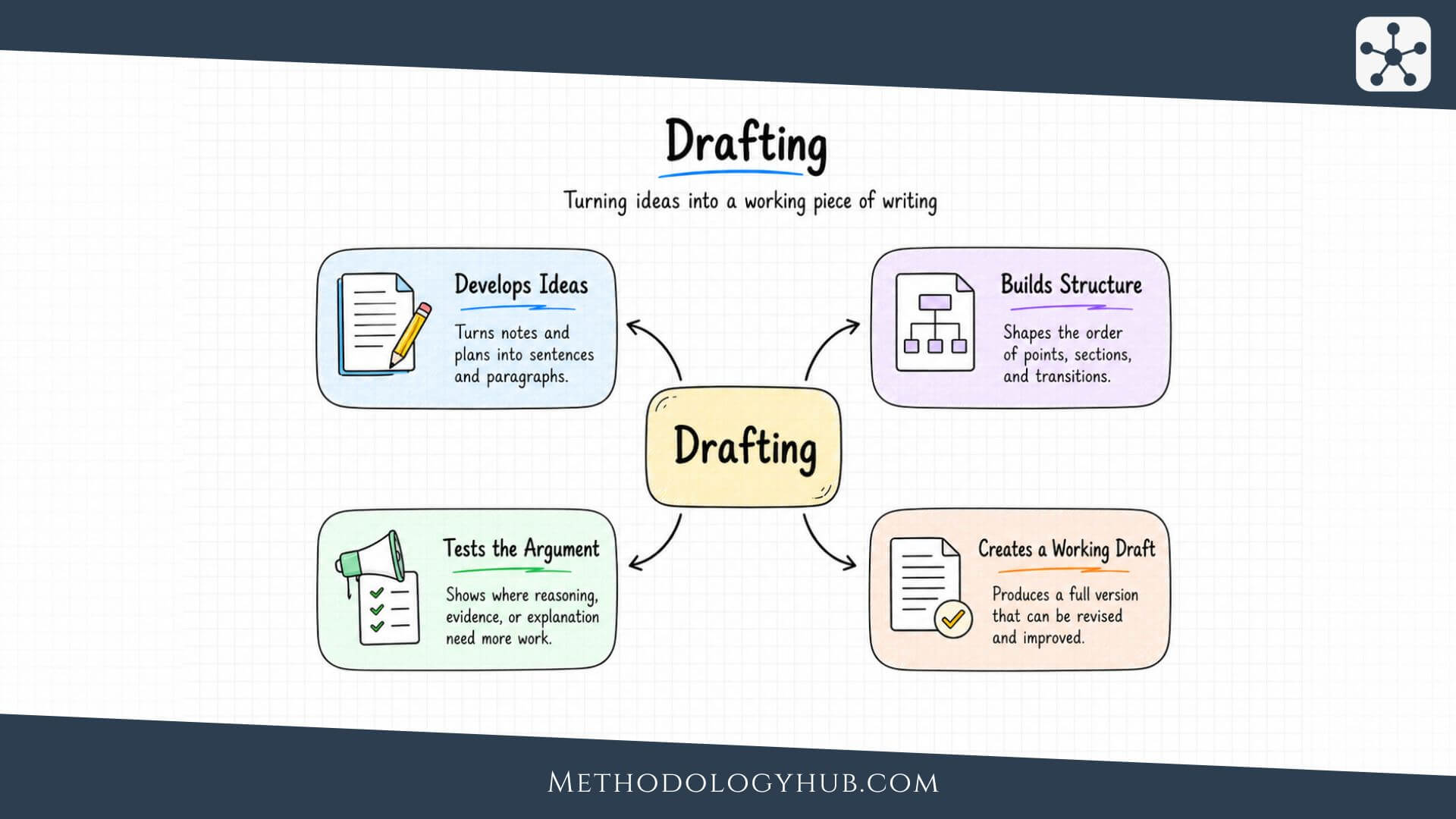
Drafting is the act of composing a first workable version of a text. It is the point where notes, outlines, examples, evidence, and early decisions become sentences and paragraphs. The draft may still be incomplete, uneven, or awkward in places, but it has crossed an important threshold: the writing has moved from preparation into visible form.
In academic writing, drafting often begins with a plan, but the plan does not have to be perfect. A writer may have a working thesis, a research question, a set of section headings, or a paragraph outline. Drafting uses those materials as support while allowing the text to develop. Sometimes a paragraph confirms the plan. Sometimes it reveals that the plan needs adjustment. Both outcomes are useful.
Drafting definition
Drafting is the stage in the writing process where a writer produces a preliminary version of a text. It comes after enough thinking and planning have taken place to give the text direction, and before the full work of revision, and editing begins.
The word preliminary is important. A draft is not a failed final version. It is an early version built for development. It gives the writer something to question, cut, expand, rearrange, and refine. Without a draft, revision has no material to work on. Without revision, the draft usually remains closer to thinking than to finished communication.
What happens during drafting
During drafting, the writer begins making decisions at sentence and paragraph level. The outline may say that a section should define a concept, but the draft must decide how that definition will begin, how much background the reader needs, which example will make the point clear, and where the paragraph should end.
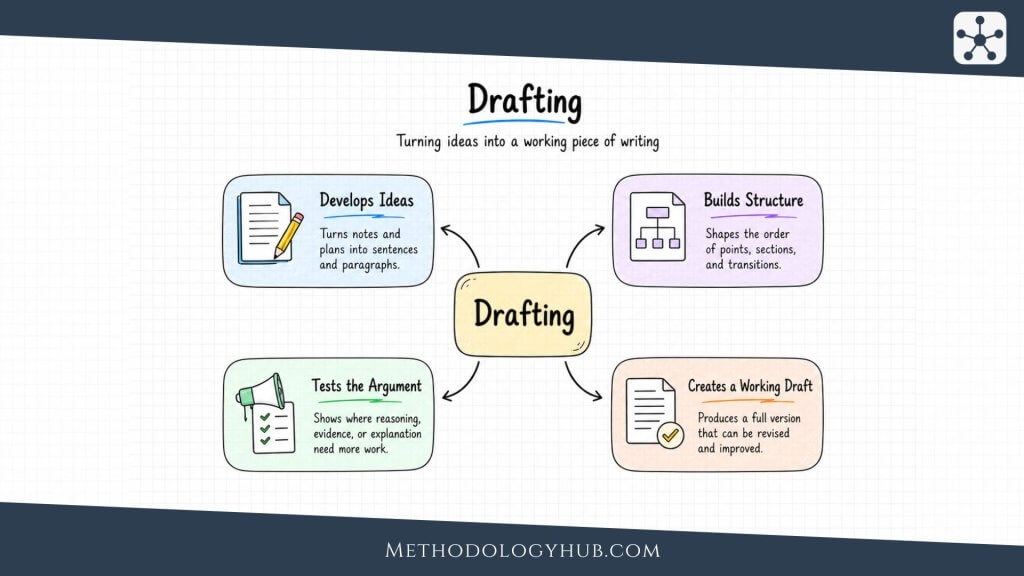
Writers often do several things while drafting:
- turn section notes into paragraphs
- write topic sentences that anchor each paragraph
- explain evidence rather than only placing it in the text
- connect one paragraph to the next
- leave placeholders for sources, examples, or wording that will be checked later
- notice where the outline is too thin, too crowded, or out of order
- produce enough text for later revision to be meaningful
These actions do not always happen neatly. A writer may draft three strong paragraphs and then stop because a source is missing. Another writer may begin in the middle because the introduction depends on what the body sections eventually show. Drafting is often practical in that way. It uses the part of the project that is ready first.
Drafting is different from outlining and revising
Outlining gives the text a planned route. Drafting travels that route in prose. The outline can identify the section order, but it cannot fully predict the work of explanation. Once the writer begins drafting, the text asks for details: definitions, transitions, examples, qualifications, citations, and paragraph movement.
Drafting is also different from revising. Drafting creates the first full or partial version. Revising asks whether that version works. The distinction helps because many writers try to revise too early. They stop after every sentence, polish a phrase, change a word, move punctuation, and then lose the thread of the paragraph. Drafting works better when the writer protects movement long enough to let the text take shape.
Drafting as a thinking stage
Drafting is not only transcription. It is not simply copying an outline into longer sentences. Writers often discover what they actually mean while writing the first version. A sentence may lead to a sharper claim. A paragraph may show that an example belongs earlier. A section may grow because the writer finally sees the explanation the reader will need.
This is why a draft can feel uncertain and still be productive. It may contain trial wording, uneven rhythm, and bracketed notes. Those signs do not mean the work is weak. They show that the writer is still thinking through the material. In academic writing, that thinking should later be revised into a clear and controlled text, but it does not need to appear fully formed at the first attempt.
Drafting in the Writing Process
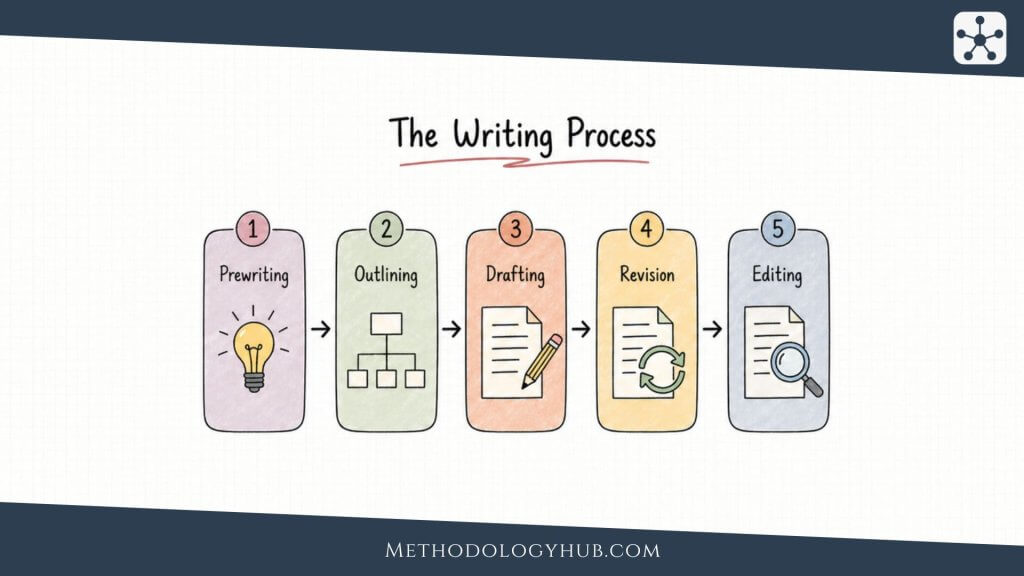
Drafting usually follows prewriting and outlining. Prewriting opens the topic and gathers material. Outlining arranges that material into a sequence. Drafting then asks how the sequence works when it becomes language for a reader.
Placed in this position, drafting has a clear job. It does not have to settle every detail. It has to move the project from planned structure into readable development. A section that looked simple in outline form may need more explanation once it becomes prose. A quotation that looked useful in notes may need a different role once the paragraph takes shape. Drafting is where these discoveries begin to happen.
How drafting follows prewriting
Prewriting gives drafting something to use. A writer who has gathered notes, questions, source summaries, and possible claims is less likely to begin with an empty page. There may still be hesitation, but the draft can begin from material that already exists.
For example, a student preparing an essay on peer feedback may have prewriting notes about comment quality, revision decisions, classroom guidance, and student confidence. Drafting begins when the student stops only collecting those ideas and starts turning them into a paragraph sequence: first a definition, then a problem, then an example, then a claim about how feedback supports revision.
How drafting follows outlining
An outline helps reduce the number of decisions the writer must make during drafting. If the section order has already been chosen, the writer can focus on explanation and paragraph development. The outline does not remove all difficulty, but it keeps the writer from having to invent the whole structure while also composing sentences.
Still, an outline should not be treated as a cage. Drafting may show that a planned section is too large, that two sections repeat one another, or that a definition belongs before the example rather than after it. When that happens, the writer can adjust the structure. The draft is allowed to teach the outline what it did not know yet.
How drafting prepares revision
Revision is easier when the draft contains enough substance. A thin draft can still be revised, but the writer may have to return to prewriting or research first. A fuller draft gives revision more to examine. It shows the actual argument, not only the intended one.
This is why the first draft should not be judged only by polish. A useful draft may include rough sentences, repeated words, and temporary notes, but it should begin to show the real work of the text. The reader should be able to see the main idea, the major sections, and the evidence that will later be refined.
Drafting is recursive
A writing process diagram may show drafting as one step, but actual writing rarely moves in one clean line. A writer may draft part of the introduction, move to a body section, return to the outline, draft a different section, and then revise the introduction after the argument becomes clearer.
This movement is normal. Drafting can begin before every detail is known. It can also pause when more thinking is needed. The useful question is not whether the draft followed the plan perfectly. The useful question is whether the draft helped the writer move the project forward.
Drafting Techniques
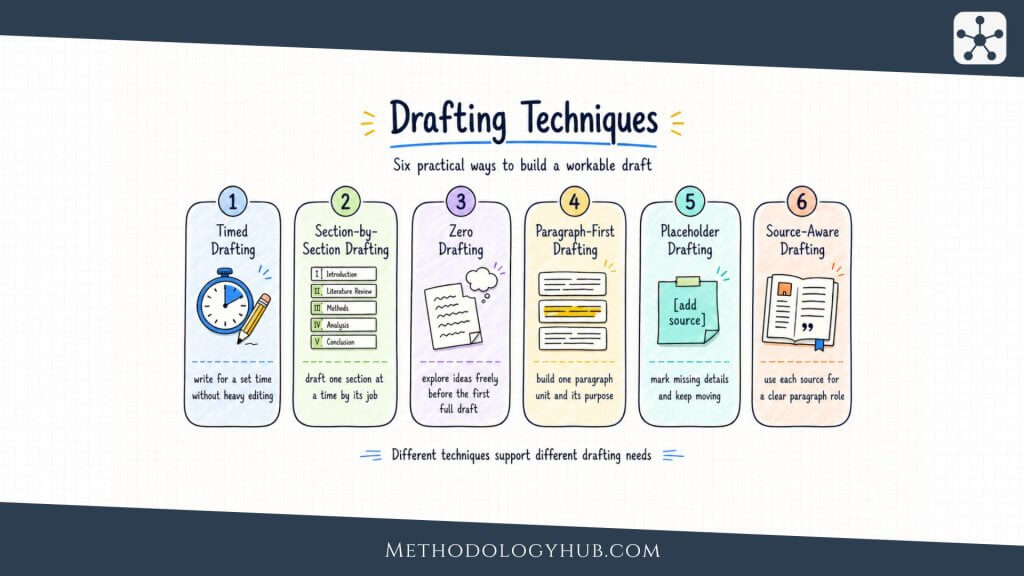
Drafting techniques are practical methods for getting a text onto the page without asking the first version to do too much too soon. Some techniques protect momentum. Some help with paragraph structure. Others help writers handle sources, uncertainty, or difficult sections. A useful technique is not the one that looks most formal. It is the one that helps the writer produce a workable draft.
Different writers need different kinds of support. A writer who hesitates over every sentence may need timed drafting. A writer with many notes but no prose may need section-by-section drafting. A writer with a complex argument may need paragraph plans. The techniques below can be combined rather than used as separate rules.
Timed drafting
Timed drafting means writing for a set period without stopping to edit heavily. The time block may be short, such as twenty minutes, or longer, such as one hour. The point is to create a limited writing session with a clear beginning and end.
This technique is helpful because it changes the task from “write the whole paper” to “work steadily on this section for a defined period.” The smaller frame lowers pressure. It also helps the writer notice that drafting is built from repeated sessions, not from one perfect sitting.
Timed drafting works best when the writer begins with a specific target:
- draft the paragraph that defines the main term
- write the first page of the literature review section
- turn three source notes into one explanatory paragraph
- draft the method section without stopping for final wording
After the session, the writer can mark what needs attention. That may include missing citations, unclear transitions, or evidence that still needs checking. The goal of the timed session is not to hide those needs. It is to keep them from stopping the draft too early.
Section-by-section drafting
Section-by-section drafting treats the text as a set of manageable units. Instead of beginning at the title and pushing straight through to the conclusion, the writer drafts one section at a time. This approach is useful for research papers, proposals, reports, theses, and any text with headings.
A section draft should begin from the section’s job. A background section may need to prepare the reader. A literature section may need to group sources. A method section may need to describe material and procedure. An analysis section may need to explain evidence in relation to a claim.
Before drafting a section, the writer can answer three questions:
- What should the reader understand by the end of this section?
- Which evidence, examples, or sources belong here?
- How does this section prepare the next one?
Those questions keep the section from becoming a loose collection of paragraphs. They also help the writer stop at a reasonable point. A section is not complete because it has reached a certain length. It is complete when it has done its assigned work well enough for revision to begin.
Zero drafting
A zero draft is a rough exploratory version written before the first full draft. It is less organised than a first draft and often closer to extended thinking. The writer uses it to find the argument, test language, and discover which ideas are ready for development.
Zero drafting can be especially useful when the writer has read and planned but still does not know how to begin. Instead of forcing a polished introduction, the writer writes through the topic in a loose way: what the section is trying to say, what evidence seems useful, what the reader may need, and what questions still remain.
Afterward, the zero draft should be reread with selection in mind. Some sentences may become part of the actual draft. Others may only reveal the direction. The zero draft does not need to be preserved as a whole. Its value is that it helps the writer move from silence into material.
Paragraph-first drafting
Paragraph-first drafting begins with small paragraph units rather than whole chapters or sections. The writer chooses one paragraph job and drafts only that unit. This is useful when a long assignment feels too abstract.
A paragraph job might be to define a term, introduce a source, explain a result, compare two findings, or connect evidence to the thesis. Once the job is clear, the paragraph can be drafted with a simple movement: point, explanation, evidence, interpretation, and connection.
This technique helps academic writing because paragraphs are not only containers for information. They are units of movement. Each paragraph should change the reader’s understanding in some small way. Paragraph-first drafting makes that work visible.
Placeholder drafting
Placeholder drafting allows the writer to mark unresolved details without interrupting the session. A placeholder can be simple: [add source], [define term], [check page number], [example from interview], or [transition needed]. These notes keep the draft moving while preserving tasks for later.
Placeholders are useful when a writer stops too often for small problems. Searching for a page number may be necessary, but doing it in the middle of a fragile paragraph can break concentration. A placeholder lets the writer return to the detail during revision or editing.
The important habit is to make placeholders visible and searchable. Square brackets, capital letters, or comments can help. Before the final draft, the writer should search the document for all placeholders and resolve them one by one.
Source-aware drafting
Academic drafting often involves sources. Source-aware drafting means writing with a clear sense of what each source is doing in the paragraph. A source may define a concept, give evidence, present a method, show disagreement, or provide context. It should not appear only because it was found during research.
A practical approach is to draft around source roles rather than source order. Instead of writing one paragraph per article, the writer can ask what job the paragraph needs and then choose the source that helps with that job. This keeps the draft from becoming a list of summaries.
From Rough Draft to Final Draft
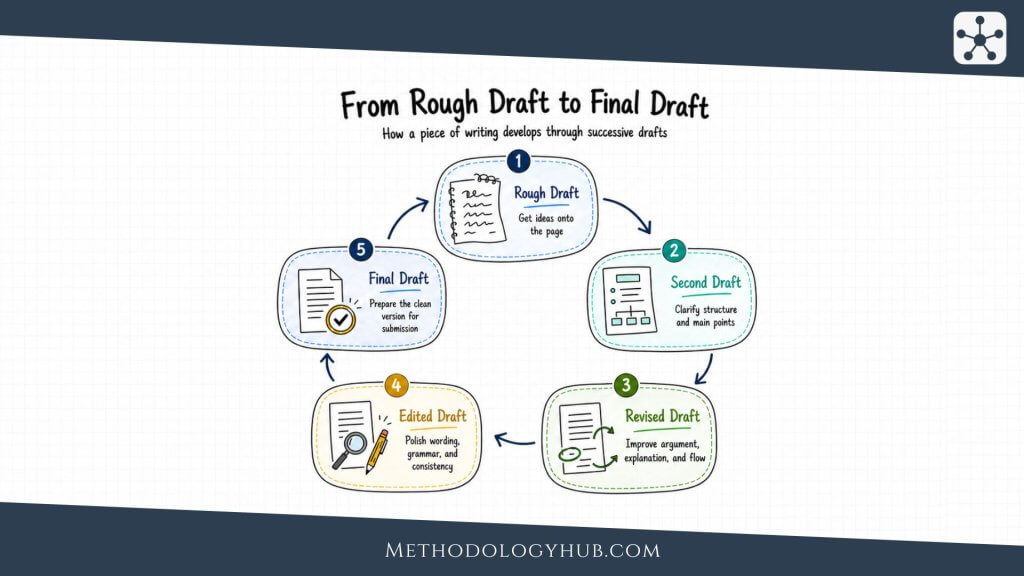
A text often passes through several versions before it is ready. These versions do not always have fixed names, but the movement is familiar: an exploratory version, a rough draft, a fuller first draft, a revised draft, and then a final draft. Each version has a different purpose.
Understanding those purposes helps writers stop demanding the wrong thing from the wrong version. A rough draft should not be treated like a submission copy. A final draft should not still contain unresolved structure questions. The stages can overlap, but they should not be confused.
Step 1: Start with a zero draft or rough notes
Some writers begin with a zero draft before the rough draft. Others begin with notes, an outline, or a section plan. The aim is to create a low-pressure bridge between planning and full drafting.
At this stage, the writer may write in fragments. A paragraph may begin with a question. A source may be named without full citation detail. A claim may appear in several forms before one feels accurate. This early material is allowed to be messy because it is serving discovery.
Step 2: Build the rough draft
The rough draft is the first substantial version of the text. It should show the basic structure and include most of the main content, but it may still contain gaps, uneven development, and rough transitions. The writer is not finished. The writer now has enough text to see what the project is becoming.
A rough draft should usually include:
- a working introduction or at least a note about what the introduction must do
- main sections in a plausible order
- paragraphs that begin developing the central claim or question
- source notes, examples, or data where they are needed
- visible placeholders for missing information
- a provisional conclusion or ending note
The rough draft does not need to sound finished. It should, however, be substantial enough that another reader, or the writer after a break, can see the intended shape of the work.
Step 3: Create the first full draft
The first full draft contains all major sections from beginning to end. It may still need strong revision, but it no longer consists of disconnected pieces. The writer can now read the whole text and ask whether it moves in a way the reader can follow.
This stage often reveals structural problems that were hidden during section drafting. The introduction may promise a different paper from the one that follows. A source-heavy section may slow the argument. A paragraph may belong in another section. These discoveries are not signs that drafting failed. They are the reason drafting exists before revision.
Step 4: Move into the revised draft
The revised draft is not merely the rough draft with corrected spelling. It is a version shaped by rereading. The writer checks whether the thesis or research question is clear, whether the sections are in a useful order, whether paragraphs develop their points, and whether evidence is explained rather than inserted.
At this stage, the writer may add material, cut repetition, move paragraphs, combine short sections, or split a crowded one. The revised draft should feel more controlled than the rough draft. It should also feel more reader-facing. The text is no longer only a record of the writer’s thinking. It is being shaped for someone else to follow.
Step 5: Prepare the final draft
The final draft is the version prepared for submission or publication. By this stage, the structure should be settled. The writer can now focus on sentence clarity, citation accuracy, formatting, headings, punctuation, spelling, and consistency.
Final drafting is sometimes called editing or proofreading, but it still belongs to the larger drafting path because it completes the movement from first version to finished version. A final draft should not contain bracketed source reminders, unresolved claims, missing references, or sections that still need major rearrangement.
Draft names are useful, but the work is more important
Not every assignment requires every version. A short response may move from rough paragraph to final submission in one sitting. A thesis chapter may require several full drafts, feedback rounds, and structural revisions. The names are less important than the function of each version.
The writer should ask what the current version is supposed to do. If it is meant to find the idea, it can be loose. If it is meant to test structure, it should be complete enough to read in order. If it is meant to be final, it should be clean, accurate, and ready for its reader.
Drafting Academic Texts
Drafting changes shape depending on the kind of academic text being written. The general stage remains the same, but an essay, literature review, research proposal, lab report, thesis, or dissertation places pressure on different parts of the draft. Some texts need argument movement. Some need source synthesis. Others need careful method description or section control.
This means that a writer should not draft every academic task in the same way. The best drafting route is shaped by genre, purpose, evidence, and reader expectation. A useful first question is simple: what kind of work does this text need to do?
Drafting essays
Essay drafting usually begins from a working thesis and a small set of main points. The draft should develop those points in a sequence that helps the reader understand the argument. A short essay may not need many headings, but it still needs paragraph movement.
For an essay, drafting often works best when the writer builds the body paragraphs before polishing the introduction. The introduction may change once the body reveals what the essay actually argues. A temporary opening can be enough at first: introduce the topic, identify the focus, and state the working thesis. The writer can return later to make the opening more precise.
Drafting research papers
Research paper drafting is usually source-aware from the beginning. The writer needs to introduce sources, use them for clear purposes, and connect them to the paper’s central question. The draft should not become a chain of article summaries.
A practical method is to draft each section around a claim or problem, then bring in sources according to their roles. One source may provide background. Another may offer evidence. Another may complicate the claim. The writer’s own explanation should hold the paragraph together.
Drafting literature reviews
A literature review draft should show relationships between sources. It should not move source by source unless the task specifically requires that structure. Most literature reviews work better when drafted by themes, methods, findings, debates, or concepts.
At the drafting stage, the writer can use section labels such as “definitions of feedback”, “studies on student use of comments”, or “research on revision outcomes”. These labels help keep the review focused on patterns. Later, revision can refine the headings and improve transitions between themes.
Drafting research proposals
A proposal draft presents a study that has not yet been completed. It needs to make the project understandable before the research is finished. That means the draft should explain the problem, the question, the relevant literature, the method, the scope, and the expected contribution in a controlled order.
Proposal drafting should be specific without promising too much. A vague method section weakens the plan. So does an overextended claim about what the project will prove. The draft should show what the writer can reasonably investigate with the available time, data, texts, participants, or materials.
Drafting lab reports and empirical reports
Lab reports and empirical reports often follow expected sections, such as introduction, method, results, and discussion. Drafting these texts requires attention to what belongs in each section. The method section describes what was done. The results section reports findings. The discussion interprets those findings in relation to the research question and relevant literature.
Because the structure is more fixed, drafting can begin with the sections that have the clearest material. Some writers draft the method first because the procedure is already known. Others draft results before writing the introduction. The order of drafting does not need to match the final order of reading.
Drafting theses and dissertations
Long academic projects require drafting at several levels. A thesis chapter needs paragraph movement, but it also needs chapter purpose. A dissertation needs chapter purpose, but it also needs overall project coherence. The writer has to think locally and globally at the same time.
For long projects, drafting often works best in planned cycles. The writer drafts a section, reviews its purpose, returns to the chapter outline, and then drafts the next section. Over time, the project may require reverse outlining, chapter summaries, and recurring checks against the research question. This is slower than writing a short essay, but it prevents the project from becoming a pile of unrelated sections.
Drafting Paragraphs and Sections
Drafting becomes easier when the writer thinks at paragraph and section level. A draft is not only a long stream of sentences. It is made from units that do different kinds of work. Sections guide the reader through larger parts of the text. Paragraphs carry the smaller steps inside those sections.
When paragraphs and sections have clear jobs, the whole draft becomes easier to revise. The writer can see whether a paragraph defines, explains, compares, supports, questions, or connects. If that job is unclear, the paragraph may need to be split, moved, expanded, or removed.
Name the job before drafting the paragraph
Before drafting a difficult paragraph, it helps to name its job in plain language. The job does not need to be polished. It can be a note such as “explain why source notes need roles” or “connect the interview example to the research question.” That small note gives the paragraph a direction.
Once the job is named, the writer can decide how the paragraph should move. A definition paragraph may need a term, an explanation, and a short example. An evidence paragraph may need a point, a source, an interpretation, and a link back to the section claim. A comparison paragraph may need two items, a basis for comparison, and a conclusion about the relationship.
Use topic sentences as drafting anchors
A topic sentence does not have to be perfect in the first draft, but it should give the paragraph an anchor. It tells the writer what the paragraph is trying to do and helps the reader understand why the paragraph appears here.
Some topic sentences state a claim. Others announce a shift, define a concept, or introduce a problem. In a rough draft, the topic sentence may be too broad. That is acceptable at first. During revision, the writer can sharpen it so that it matches the paragraph’s actual content.
Develop evidence instead of dropping it in
Academic drafts often weaken when evidence appears without enough explanation. A quotation, statistic, interview extract, or study finding does not speak for itself. The writer needs to explain what it shows, how it connects to the paragraph point, and how much weight it can carry.
A useful drafting pattern is:
- Point: state what the paragraph is claiming or explaining.
- Context: prepare the source, example, or data.
- Evidence: present the relevant material.
- Interpretation: explain what the evidence shows.
- Connection: link the paragraph back to the section or argument.
This pattern should not become mechanical. It is a guide for development, not a formula that every paragraph must follow. Its main value is that it reminds the writer not to stop after inserting evidence.
Draft transitions for meaning, not decoration
Transitions are not only words such as however, therefore, or next. A useful transition explains the relationship between ideas. It shows whether the next paragraph adds evidence, changes direction, gives an example, narrows the focus, or answers a question raised by the previous paragraph.
During drafting, transitions can be rough. The writer might write, “This connects to the next issue, which is how students decide whether to use feedback.” That sentence may be too plain for the final version, but it protects the movement of the draft. Later, revision can make it smoother.
Draft sections around movement
A section should do more than collect paragraphs under a heading. It should move the reader through a part of the argument or explanation. A section may begin by defining a concept, then show the problem, then present evidence, then explain what follows from that evidence.
Before drafting a section, the writer can make a small section map:
- Opening paragraph: introduce the section’s point.
- Development paragraph: explain the concept or background.
- Evidence paragraph: present and interpret the main support.
- Connection paragraph: prepare the next section.
This map may change as drafting continues. It simply gives the section a starting shape. When the draft is complete, the writer can check whether the section still follows that movement or has found a stronger one.
Drafting with Sources and Notes
Many academic drafts begin from notes rather than from memory. The writer may have reading notes, lecture notes, quotations, data, interview extracts, observations, or a source matrix. Drafting with these materials requires selection. Not every note belongs in the draft, and not every source should receive the same amount of attention.
The central task is to turn notes into prose without losing control of the writer’s own line of thought. Sources should support the draft, not take it over. The writer’s job is to decide what each piece of material does and how it helps the reader understand the argument.
Turn notes into paragraph roles
A note becomes easier to draft when it has a role. A source note may define a concept, give background, support a claim, show disagreement, introduce a method, or raise a question. If the writer cannot name the role, the note may not be ready for the draft.
Before drafting a source-based paragraph, the writer can label notes with simple tags:
- definition: material that explains a term
- background: material that prepares the reader
- evidence: material that supports a claim
- contrast: material that shows a difference between sources
- method: material that explains how research was conducted
- question: material that points to uncertainty or further inquiry
These tags make drafting more deliberate. The writer is no longer copying notes into the paper in the order they were found. The writer is placing material where it can do useful work.
Paraphrase before polishing
Paraphrasing during drafting can be difficult because the writer is thinking about source meaning and sentence wording at the same time. One useful approach is to create a rough paraphrase first, then refine it during revision while checking accuracy against the source.
The rough paraphrase should not copy the source’s sentence structure. It should express the idea in the writer’s own developing language. If exact wording is needed, the writer should mark it as a quotation immediately and record page or location details. This prevents confusion later, especially in long projects with many notes.
Draft around synthesis, not source order
Synthesis means showing relationships between sources. A draft that summarises one article, then another, then another may be useful at the note stage, but it often becomes flat as academic prose. The reader usually needs to know how the sources connect.
During drafting, the writer can begin with the relationship rather than the source:
- Several studies define the concept in similar ways.
- Two findings point in different directions.
- One method gives useful detail but has a narrow context.
- A later study extends an earlier claim.
These sentences place the writer in control of the paragraph. The sources still matter to the argument, but they are not allowed to determine the entire structure of the draft.
Keep citation details visible
Drafting with sources should include enough citation information to make final checking possible. The writer does not need perfect formatting during the rough draft, but the source must be traceable. Page numbers, article names, author names, dates, and links should be kept close to the material they support.
This habit prevents a common late-stage problem: a strong paragraph contains a useful idea, but the writer cannot find where it came from. A draft can be rough, but source tracking should be careful. It is much easier to clean a rough citation than to recover a missing source after several days of writing.
Balance source material and explanation
A source-heavy draft may look academic but still feel underdeveloped. If every paragraph moves from one citation to another, the writer’s own explanation can disappear. Drafting should include space for interpretation: what the evidence means, how it connects to the question, and what the reader should understand from it.
A helpful check is to highlight source material in one colour and the writer’s own explanation in another. If the paragraph is mostly source material, more interpretation may be needed. If the paragraph contains claims but little evidence, the writer may need to return to notes or research.
Conclusion
Drafting is the stage where a planned text becomes a workable first version. It turns notes, outlines, sources, and early ideas into connected paragraphs that can be read, tested, and improved. The draft does not need to be perfect. It needs to be complete enough for revision to begin.
A strong drafting process gives the writer room to think on the page. The first draft can be rough, the second draft can strengthen structure and development, and later drafts can refine language, evidence, and transitions. In academic writing, this gradual movement is often what allows a paper, essay, report, or proposal to become clearer and more precise.
Drafting works best when it is treated as part of the full writing process. Prewriting gives the writer material, outlining gives that material structure, drafting turns the structure into prose, revision improves the text, and editing prepares the final version for the reader.
FAQs on Drafting
What is drafting in writing?
Drafting is the stage of the writing process where a writer creates a preliminary version of a text. It turns notes, outlines, and ideas into paragraphs that can later be revised, edited, and prepared for a reader.
What is the difference between a rough draft and a final draft?
A rough draft is an early version that develops the main content and structure. A final draft is the reader-ready version after revision, editing, citation checking, formatting, and proofreading.
When should drafting begin?
Drafting should begin when the writer has enough direction to start writing. That direction may come from prewriting notes, a working thesis, a research question, an outline, or a small paragraph plan.
Which drafting techniques are useful for academic writing?
Useful drafting techniques include timed drafting, section-by-section drafting, zero drafting, paragraph-first drafting, placeholder drafting, and source-aware drafting. The best choice depends on the problem the writer is trying to solve.
Does a draft have to begin with the introduction?
A draft does not have to begin with the introduction. Many writers draft body sections first because the introduction becomes easier to write after the argument, evidence, or analysis has taken clearer shape.