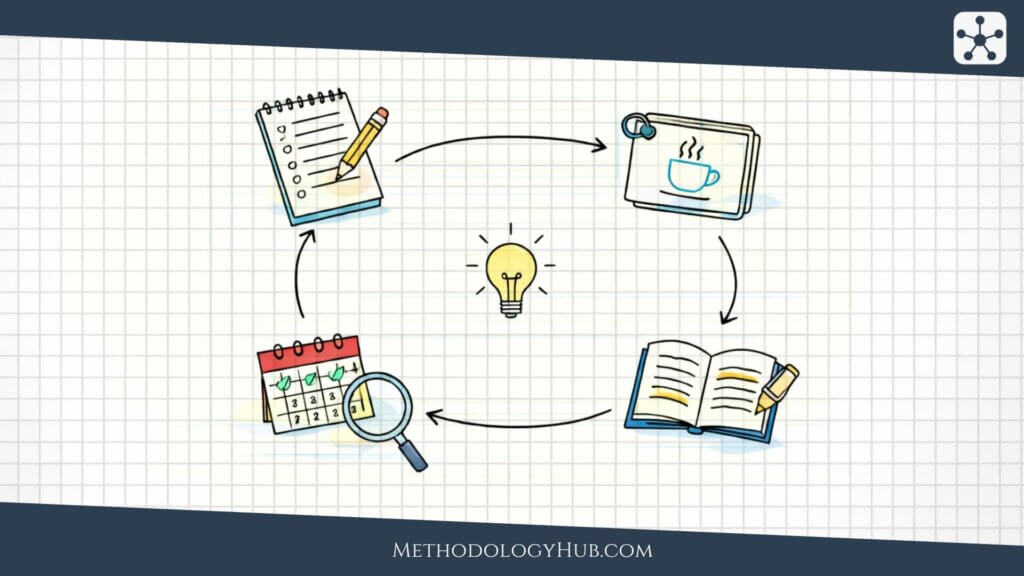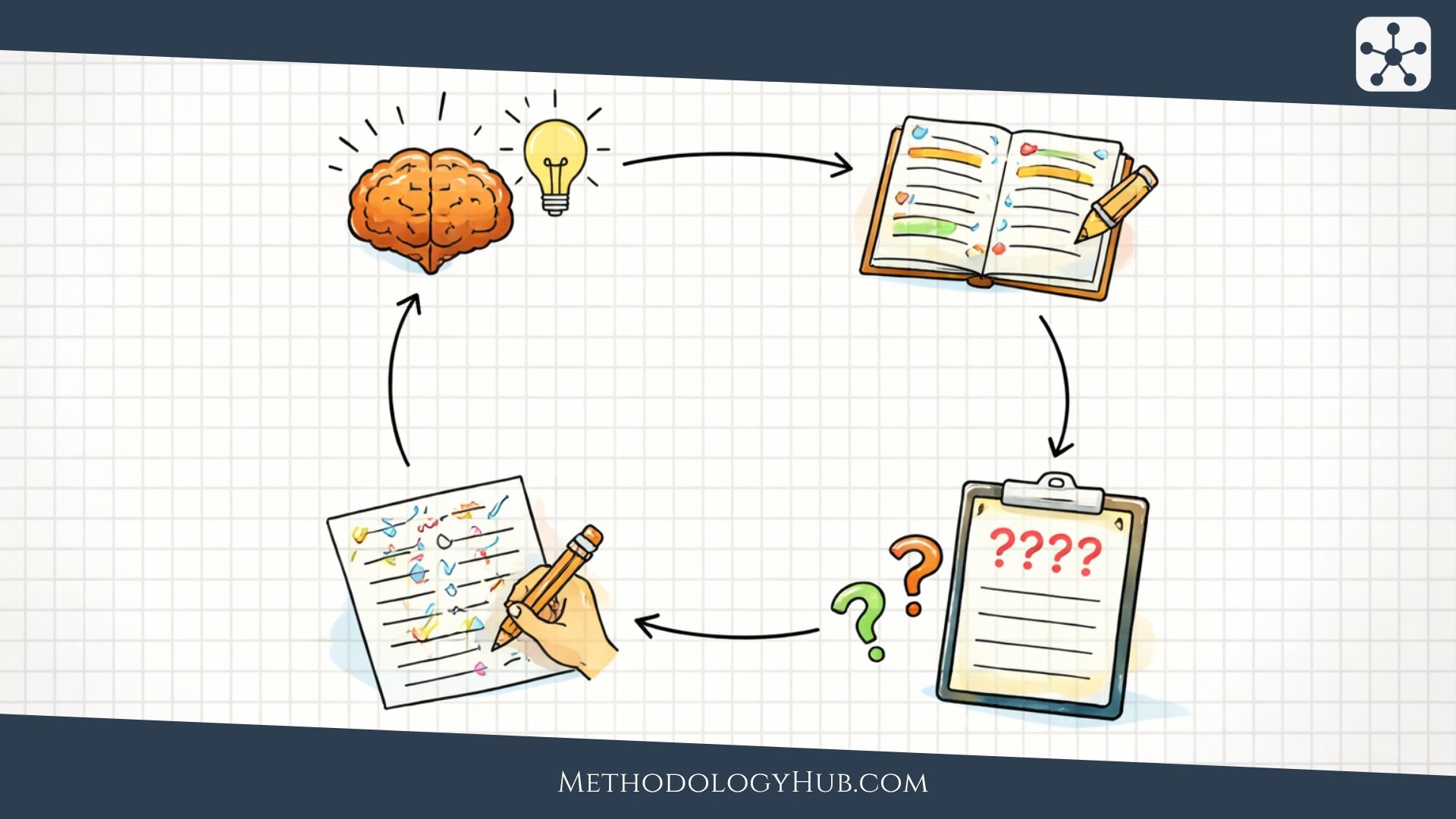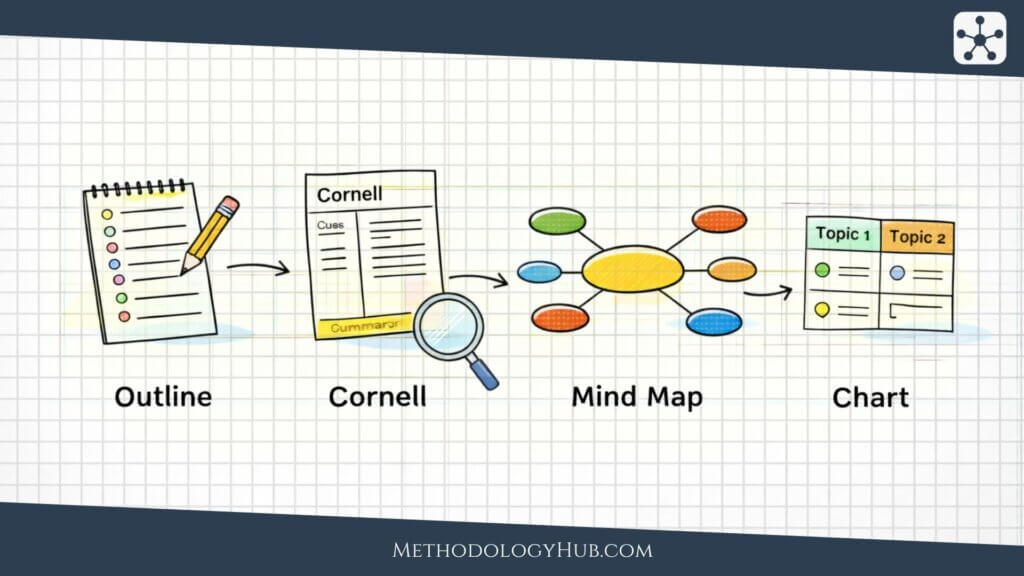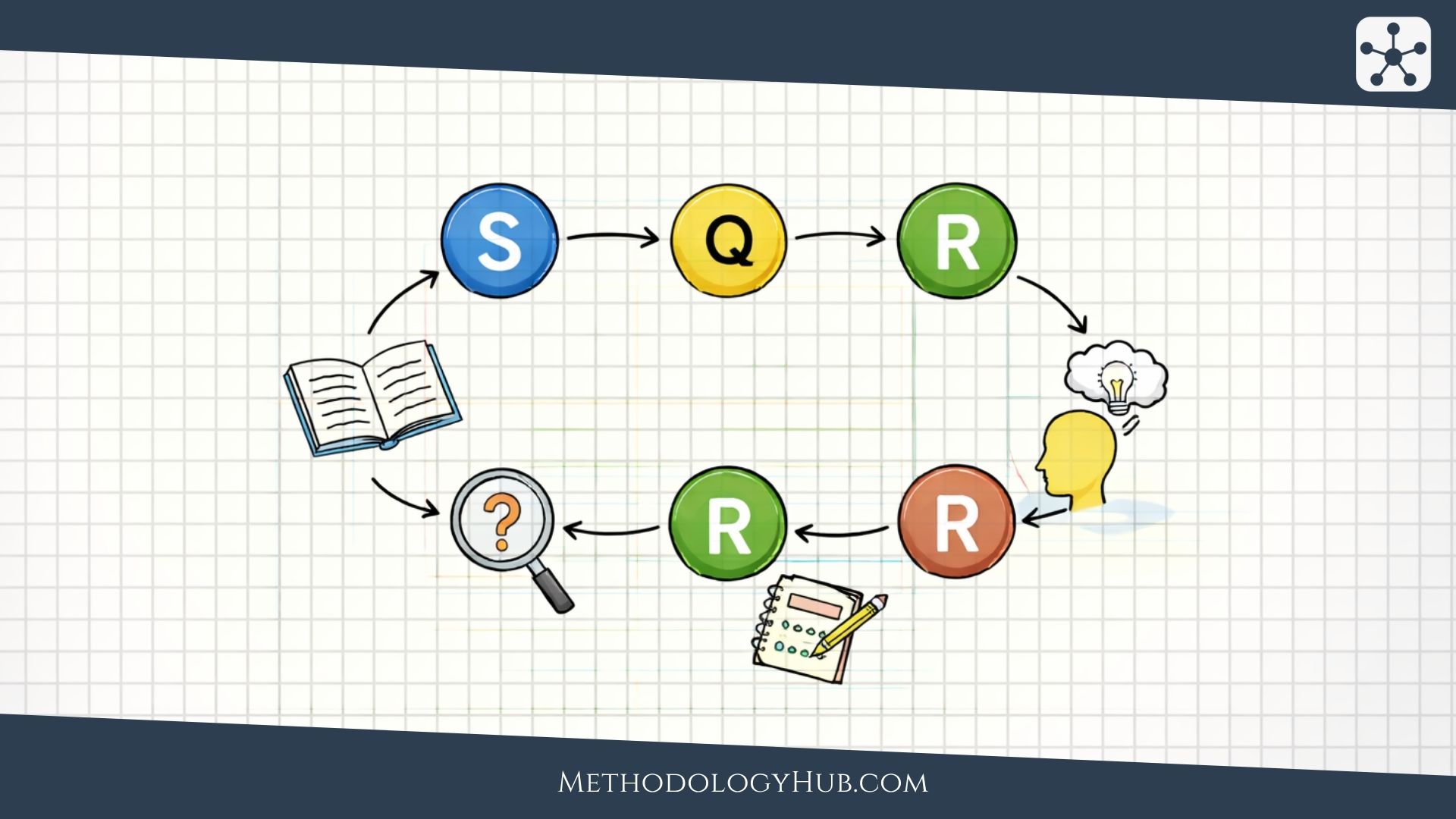
The SQ3R Method is a reading and study strategy built to help you understand material the first time, remember more of it later, and stop slipping into that familiar pattern of reading a page and realising none of it stayed with you.
This article explains what the SQ3R Method is, how to use it properly, why it can help with comprehension and recall, where it works especially well, where it can feel clumsy, and which mistakes turn it into a slow ritual instead of a useful study method.
What Is the SQ3R Method?
The SQ3R Method is a structured reading process designed to make study reading more active. Instead of opening a chapter and moving line by line until your eyes glaze over, you preview the material, turn headings into questions, read with a purpose, say the important ideas back from memory, and then return later for review. The method is usually associated with Francis P. Robinson, who introduced it in the mid-20th century as part of his work on effective study habits.
What makes the SQ3R Method different from ordinary reading is that it treats understanding as something you build step by step. The first step gives you a map. The second gives you a reason to pay attention. The third is the actual reading. The fourth checks whether anything stuck. The fifth keeps the material from evaporating after one session. In other words, it tries to turn reading into study, not just exposure.
SQ3R Method definition
The SQ3R Method is a five-step study technique for reading informational material: Survey, Question, Read, Recite, and Review. It is most often used with textbooks, articles, chapters, lecture readings, and other material where understanding depends on structure, key ideas, and later recall.
At its best, the method helps with three everyday study problems. First, it stops you from entering a text cold. Second, it gives you a clear reason to read each section. Third, it forces a memory check before you move on. Those are simple shifts, but they matter. A surprising amount of ineffective studying comes from reading without orientation, without questions, and without testing what you actually remember.
In practice, the SQ3R Method usually involves these moves:
- survey the chapter, article, or section before reading in full
- turn headings and key ideas into questions
- read with the aim of answering those questions
- recite the main points from memory in your own words
- review the material again after the first session
How the SQ3R Method Works
The SQ3R Method does not work because the acronym is clever or because five steps are somehow magical. It works, when it works, because the method combines several study habits that are stronger together than they are alone. It asks you to preview before reading, question while reading, retrieve after reading, and return later instead of treating a chapter as a one-time event.
It gives the brain structure before detail
One reason the method helps is that it does not begin with detail. Surveying gives you a rough frame first. That makes later information easier to sort because it is arriving into a shape you already recognise. Without that frame, details can feel disconnected, especially in textbooks where every paragraph seems to introduce new terms and distinctions.
It turns reading into self-testing early
Another reason it helps is that the recite step forces an early check on understanding. Many weak study sessions fail because there is no memory check until much later. SQ3R builds one into the session itself. That is a big improvement over reading passively and trusting that recognition will turn into recall on its own.
It works with several well-known learning principles
The direct research base on SQ3R itself is not huge, and not every comparison study places it at the top. Still, the method packages several useful habits into one routine: previewing, self-questioning, retrieval, and later review.
How to Use the SQ3R Method
The SQ3R Method is simple enough to learn in one sitting, but it works far better when you understand the point of each step. Many people try it once, find it slower than ordinary reading, and give up. That reaction is understandable. SQ3R usually does take a bit more effort up front. The trade-off is that it aims to save time later by reducing rereading, confusion, and the false comfort of material that looks familiar but cannot be explained from memory.
Step 1 – Survey: Building a Mental Framework
The first step of the SQ3R Method is survey, and it is often the one people rush through or skip entirely. That is a mistake. Surveying gives you a first look at the shape of the material before you begin close reading. You are not trying to master the chapter yet. You are trying to understand what kind of thing it is, how it is organised, and where the main ideas probably sit.
Think of it as walking through a building before being asked to remember what is in each room. You notice the layout, the entrances, the sequence of sections, and where the important areas seem to be. That first orientation lowers confusion later. It also gives your memory something to attach details to once the actual reading begins.
Why surveying matters
Dense reading is often hard not because every sentence is complicated, but because the reader has no mental frame for where the argument is going. Surveying helps with that. A quick look at headings, summaries, diagrams, opening paragraphs, and section breaks tells you what the author is trying to do. Even when the text is difficult, it is easier to follow when you already know its rough layout.
That is also why surveying is more than skimming. Skimming can be aimless. Surveying is selective. You are looking for structure, emphasis, and direction. You want the text to stop being a wall and start becoming a map.
How to survey a text properly
Begin with the title, subheadings, introduction, conclusion, and any summary material. Look at diagrams, charts, tables, definitions, and bolded terms if they are there. In a textbook chapter, section headings often tell you the logic of the whole chapter. In an academic article, the abstract, headings, and discussion section can give you a fast sense of the study’s purpose and overall argument.
You do not need to spend a long time here. Often five minutes is enough. The point is not to pre-read the whole chapter. The point is to give yourself a usable overview.
- read the title and section headings
- look at introductions, conclusions, and summaries
- notice diagrams, key terms, and tables
- ask what the author seems to be trying to explain or prove
Common mistakes during the survey step
The biggest mistake is treating survey as an empty ritual. If you flick through the pages without really noticing anything, nothing useful has happened. Another common mistake is spending so long previewing that you are half reading the chapter before you ever reach the question step. Survey should orient you, not exhaust you.
A better approach is to finish the survey with a few plain observations in mind. What are the main sections? Which parts look concept-heavy? Which parts seem likely to contain definitions, processes, or arguments you will need later? That is enough to do the job.
Survey is successful when: you could explain the general shape of the text before you have read it closely.
Step 2 – Question: Giving the Reading a Job
Once you have surveyed the material, the next step in the SQ3R Method is question. This is where the reading stops being passive. Instead of moving through the chapter with no clear target, you turn headings, subheadings, and major claims into questions that the text will need to answer.
This matters because attention works better when it has something concrete to look for. A heading like “Causes of Inflation” is easy to read past. A question like “What causes inflation according to this section?” creates a task. It gives the section a purpose before you enter it.
Why questions change the way you read
Reading without questions often turns into recognition without understanding. You see the words, you nod at the explanations, and the material feels familiar while it is in front of you. Questions interrupt that passive feeling. They make you read with a small amount of tension in the best sense. You want to know what the section says. You are looking for an answer, an example, a distinction, or a definition.
How to form effective questions
You do not need to write a huge list. Three to five real questions for a section is often enough. The easiest method is to convert headings into questions. You can also ask what the author wants you to understand, how one idea differs from another, what evidence supports a claim, or why a concept matters within the chapter.
- turn headings into who, what, why, and how questions
- ask what problem the section is trying to solve
- ask what examples or evidence the author uses
- ask what you would need to explain from memory later
Questioning keeps curiosity from being accidental
Some material is naturally interesting. A lot of study reading is not. One quiet advantage of the question step is that it creates a reason to care even when the text itself feels dry. Once a question is on the page, the section has a purpose. You are not reading because the assignment exists. You are reading because something now needs answering.
That may sound small, but it changes the feel of a study session. The method works better when you are trying to resolve something, not merely trying to survive a chapter.
Step 3 – Read: Looking for Answers, Not Just Words
After surveying and questioning, you are ready for the actual reading step. This is the centre of the SQ3R Method, but it is not ordinary reading. You are reading to answer the questions you created, to identify the main ideas, and to notice how the author builds the explanation. That makes the reading more directed and less sleepy.
In practice, this is where many people fall back into old habits. They start well, then drift into highlighting nearly everything, rereading the same paragraph without deciding what it means, or losing the connection between the question and the section in front of them. The reading step only works when it stays tied to purpose.
What active reading looks like here
Active reading during SQ3R means searching for the answer, noticing key distinctions, and checking whether you understand the structure of the explanation. You may underline lightly, write short notes, or mark a definition, but those are secondary habits. The real activity is mental. You are asking, “What is this section saying?” and “How does it answer the question I started with?”
It also helps to pause at natural stopping points. At the end of a subsection, ask yourself whether you could state the main idea in one or two sentences. If you cannot, that is a sign to slow down before moving further.
How to read without turning the page into decoration
Selective marking can help, but indiscriminate marking usually does not. When too much is highlighted, nothing stands out. It is better to mark definitions, contrasts, short processes, or lines that genuinely answer one of your questions. The same goes for notes. Short, functional notes are useful. Rewriting the chapter in the margins is not.
If the text is especially dense, try reading one subsection at a time rather than several pages in a single run. That makes recitation easier and prevents the common problem of reaching the bottom of page six with only a vague sense that the chapter seemed important.
What to do when the section still feels muddy
If you finish a section and still cannot tell what it was trying to say, do not barrel on. Go back to the question, identify the sentence or example that seems central, and try to restate it more plainly. Sometimes the problem is not the whole section. Sometimes it is one term, one distinction, or one missing background idea.
The SQ3R Method helps here because it gives you a place to catch confusion early. Passive reading often lets confusion pile up silently until the end of the chapter. Directed reading makes it easier to notice where things first went fuzzy.
Step 4 – Recite: Checking What Actually Stayed
The recite step is where the SQ3R Method becomes more than a reading strategy. After finishing a section, you look away from the text and try to say the main ideas in your own words. You can speak them aloud, write them down briefly, or answer your original questions from memory. What matters is that the material has to come from you, not from the page.
This step is often the least comfortable and one of the most useful. It exposes the difference between “I recognise this when I see it” and “I can explain this without help.” That difference matters in exams, essays, discussions, and any real use of the material later.
How to recite effectively
Close the book or cover the page. Then answer the questions you set earlier or explain the section as though you were telling it to someone else. Keep it simple. You are not trying to perform. You are trying to check whether the main idea, the logic, and the essential details are available without support.
- look away from the text before you begin
- answer your own questions in plain language
- state the main idea first, then the supporting points
- return to the page only after you have tried honestly
Even a short recitation matters. One or two minutes after each subsection can do far more than reading the same paragraph twice while hoping it somehow turns into memory by itself.
Common mistakes during recitation
The most common mistake is peeking too early. The second is being too vague. If your recap is only, “It was about supply and demand stuff,” you have not really checked anything. A stronger recitation sounds more like, “This section explained that prices rise when demand increases faster than supply, and it used housing as the example.”
Another mistake is waiting until the end of a long chapter to recite everything at once. Reciting works better in smaller intervals. The shorter the distance between reading and retrieval, the easier it is to spot weak areas while they are still easy to repair.
Practical rule: if you cannot say it back simply, you probably need one more look before moving on.
Step 5 – Review: Keeping the Material Available
The final step of the SQ3R Method is review. This is where you return to the material after a delay and see what still holds. Review is not meant to be a complete restart. It is a follow-up. You revisit the questions, check your notes, recall the main ideas, and reopen only the parts that have already started to slip.
This step matters because one good study session is rarely enough on its own. Even when a chapter feels clear right after reading, memory thins out quickly if nothing pulls the material back into use. Review slows that loss and turns the first reading session into something more durable.
What effective review looks like
A useful review session is usually brief and active. Start by trying to recall the chapter or section without looking. Then check your questions, summaries, and marked passages. Notice what came back easily and what did not. The aim is not to spend another hour with the text. The aim is to strengthen the right parts before they disappear entirely.
For many people, a simple schedule works well: a quick review later the same day, another the next day, then one more after a few days if the material is important. The exact timing matters less than the habit of returning before everything has gone stale.
Review is where the whole method pays off
Without review, the method still improves the first reading session. With review, it becomes a more complete learning system. Survey helps you orient yourself. Question helps you focus. Read helps you gather the information. Recite helps you test it. Review keeps it in reach.
That last part is why people often remember SQ3R as more than a reading trick. It is really a study routine for getting more from written material over time.
Make the SQ3R Method More Efficient
The basic method is enough to start, but a few adjustments can make it far more usable. Most people do not abandon SQ3R because the steps are impossible. They abandon it because the method feels slow, too formal, or awkward for the kind of reading they are actually doing. That usually means the setup needs adjusting, not that the method is useless.
Match the full method to the right kind of reading
SQ3R is strongest with material that has structure and density: textbook chapters, theory-heavy readings, long articles, exam preparation, and technical explanations. It is less necessary for every short handout, simple email, or reading that you only need once. Using the full method for every sentence you meet is a good way to make it feel cumbersome.
Write your questions where you can see them
Keeping questions in your head is possible, but writing them down usually works better. It keeps the reading pointed. It also gives the recite and review steps something to return to. A page of short questions beside the text can do more for focus than a page full of underlining.
Recite in small chunks, not only at the end
This is one of the easiest improvements to make. Instead of waiting until the whole chapter is done, recite after each subsection or after every few pages. That shortens the distance between reading and retrieval, which makes it easier to notice exactly where understanding started to slip.
Use your own words early
The method becomes more useful the moment you stop borrowing the author’s wording and start translating the ideas into your own. That does not mean oversimplifying everything. It means checking whether you can restate the key point without leaning on the original sentence structure. If you cannot, you may still be following the wording more than the idea.
Let the review step stay brief but regular
Many people drop the review step because they imagine it has to be another full study session. It usually does not. A short return visit is often enough. Five or ten minutes spent recalling and checking weak spots can keep the original session alive much better than another long reread a week later.
Where the SQ3R Method Works Well
No study technique is equally good for every task. The SQ3R Method has a clear profile. It tends to help most when the material is written, structured, and important enough that you will need to explain or recall it later. It is less helpful when reading is purely quick, transactional, or so simple that formal study steps would add more friction than value.
Textbooks and assigned academic reading
This is the most obvious fit. Textbooks are full of headings, subheadings, definitions, diagrams, summary sections, and end-of-chapter questions. In other words, they are built in a way that makes surveying and questioning natural. The method helps you resist the common habit of reading a chapter from top to bottom and then realising that only scattered phrases remain.
Dense theory and concept-heavy reading
Subjects like psychology, history, economics, law, biology, and philosophy often involve explanations that build over several pages. Here the survey step helps with orientation, and the recite step helps you see whether you understood the logic of the section or merely followed it while it was visible.
Exam preparation
The method is also useful when you know the reading will eventually have to come back out of memory. That can make it a good fit for exam revision, especially when paired with later self-testing. Questions become prompts. Recitation becomes practice. Review becomes a way to keep the material active across several days instead of one long session.
Long articles and reports
SQ3R is not only for textbooks. It can also work well with journal articles, policy reports, long essays, and professional reading. With articles, the survey step may focus more on title, abstract, section headings, methods, results, and conclusion. The same logic still applies: orient yourself, generate questions, read with purpose, recall from memory, then return later.
Where the SQ3R Method Needs Adjustment
The method has limits. It can feel too slow for short or simple reading, it cannot replace missing background knowledge, and it is not always the best fit for reading that depends on flow and immersion. It helps most when the material is structured, dense, and important enough to revisit later.
Fair expectation: the SQ3R Method improves how you handle reading material. It does not remove the need for attention, prior knowledge, or later practice.
Common Mistakes
The SQ3R Method is straightforward, but it is easy to use in ways that drain most of its value. Usually the problem is not dramatic. It is a small habit that turns the process back into passive reading.
Rushing the survey step
When people skip surveying, they lose the map that the rest of the method depends on. The reading begins cold, and questions become weaker because there is no clear view of the chapter’s structure. Survey does not need to be long, but it needs to be real.
Writing flat or useless questions
If the question step produces vague prompts like “What is this about?” for every section, the reading step will not gain much direction. Better questions are specific enough to guide attention and broad enough to capture the main idea of the section.
Highlighting instead of reciting
This is a common substitution. Recitation feels effortful, so people reach for a pen instead. The page ends up marked, which feels productive, but the actual memory check never happens. Highlighting can support the method. It cannot replace retrieval.
Reciting with the text still in view
This weakens the whole point of the step. The method is trying to find out what is available from memory. If the answer is always sitting in front of you, the test becomes too easy to mean much.
Dropping the review step completely
Without review, the method becomes a good first reading routine and nothing more. That still has value, but much of the longer-term benefit disappears. A short later review is often the difference between material that feels familiar for an hour and material that stays usable.
Using the full method for every tiny reading task
When the method is applied too rigidly, it starts to feel bloated. That is when people decide it is inefficient. Often the real issue is mismatch. The full version is meant for material that deserves real study, not every page you encounter in a normal day.
Conclusion
The SQ3R Method lasts because it addresses a very ordinary problem. People often read as though exposure is enough. It usually is not. Understanding takes structure, questions, memory checks, and later return visits. SQ3R bundles those habits into one routine that is easy to remember and, with practice, fairly easy to use.
That does not mean the method is perfect or universal. It can feel slow when used on the wrong kind of reading, and it is not the only sensible study system available. But for textbooks, long readings, exam preparation, and concept-heavy material, it still offers something useful: a way to make reading more deliberate and less easy to fake.
That is probably the best way to think about it. The SQ3R Method does not promise genius, speed, or perfect memory. What it offers is a better way to work with written material so that more of it is understood now and more of it is still there later.
FAQ about the SQ3R Method
What is the SQ3R Method?
The SQ3R Method is a five-step study strategy for reading: survey, question, read, recite, and review. It is used to make reading more active and easier to remember later.
What does SQ3R stand for?
SQ3R stands for Survey, Question, Read, Recite, and Review. Each step is meant to move reading from passive exposure toward understanding and recall.
Is the SQ3R Method good for studying?
Yes, especially for textbooks, long readings, and exam preparation. It is most useful when you need to understand and remember material rather than just read it once.
How long does the SQ3R Method take?
It usually takes a bit longer than ordinary reading because you preview, question, recite, and review. The trade-off is that many learners need less rereading later.
Can I use the SQ3R Method for articles, not just textbooks?
Yes. The SQ3R Method can work with textbook chapters, academic articles, reports, and other structured reading. You may just need a lighter version for shorter texts.
What is the most important step in the SQ3R Method?
The method works best when all five steps are used together, but many people get the biggest difference from recite and review because those steps reveal what they can actually remember.