Outlining is the stage of the writing process where a writer turns notes, ideas, sources, and early decisions into a workable structure. It comes after the topic has begun to take shape and before the draft needs to carry the full weight of the argument. A good outline does not write the paper for the writer, but it gives the paper a visible route.
This article explains what outlining is, how it works, which outline types are useful in academic writing, and how to use sample outlines for essays, research papers, literature reviews, and proposals.
What Is Outlining?
Outlining is the act of arranging the main parts of a planned text before drafting it in full. It can be as simple as a short list of paragraph jobs or as detailed as a multi-level structure with headings, subheadings, sources, examples, and notes for transitions. In academic writing, outlining helps the writer see how the parts of a text will fit together before those parts become finished paragraphs.
An outline is not the same as a finished draft. It is also not the same as a topic list. A topic list may name areas to cover, but an outline begins to show order, proportion, and connection. It asks what the reader should meet first, what needs explanation, where evidence should appear, and how each section prepares the next one.
Outlining definition
Outlining is a planning method in which a writer organises ideas, claims, evidence, and sections into a clear sequence before drafting. The outline can use headings, bullet points, numbers, complete sentences, short phrases, or paragraph notes, depending on the task and the level of detail needed.
What an outline does
An outline gives the writer a way to test structure before investing too much time in polished sentences. It shows whether the planned text has a beginning, a middle, and an end. It also shows whether the argument has enough support, whether two sections repeat the same job, and whether an idea has been placed too early for the reader to understand it.
During outlining, writers often make decisions such as:
- which central claim, question, or purpose will guide the text
- which sections are needed to develop that purpose
- which ideas belong together and which should be separated
- where definitions, background, evidence, and analysis should appear
- which sources support each part of the discussion
- how the text should move from one section to the next
- which ideas should be left out because they do not serve the focus
These choices are easier to make in outline form than in a full draft. A misplaced section can be moved in seconds. A weak point can be marked for more reading. A crowded paragraph can be split before it becomes a long and difficult page of prose.
Outlining and prewriting
Outlining usually grows out of prewriting. Prewriting opens the topic by gathering ideas, questions, notes, and possible directions. Outlining then arranges that material into a more deliberate order. If prewriting is the stage where the writer asks what the text could become, outlining is the stage where the writer asks how the text should be built.
This distinction helps writers avoid outlining too early. A formal outline made before there is enough material often becomes a row of empty headings. The writer may have an introduction, three body sections, and a conclusion, but no real sense of what each part will do. Prewriting gives the outline content. Outlining gives the content shape.
Outlining and drafting
Drafting turns an outline into connected paragraphs. The outline may name the work of a section, but the draft has to explain it, develop it, and make it readable. A strong outline therefore supports drafting without replacing it. It gives the writer a route, but the route still has to be travelled sentence by sentence.
The outline also reduces the number of decisions the writer must make at once. Without an outline, a writer has to choose the next idea, remember the evidence, manage paragraph order, and create sentences at the same time. With an outline, some of those choices have already been made. The writer can give more attention to explanation, style, and connection.
Outlining in the Writing Process
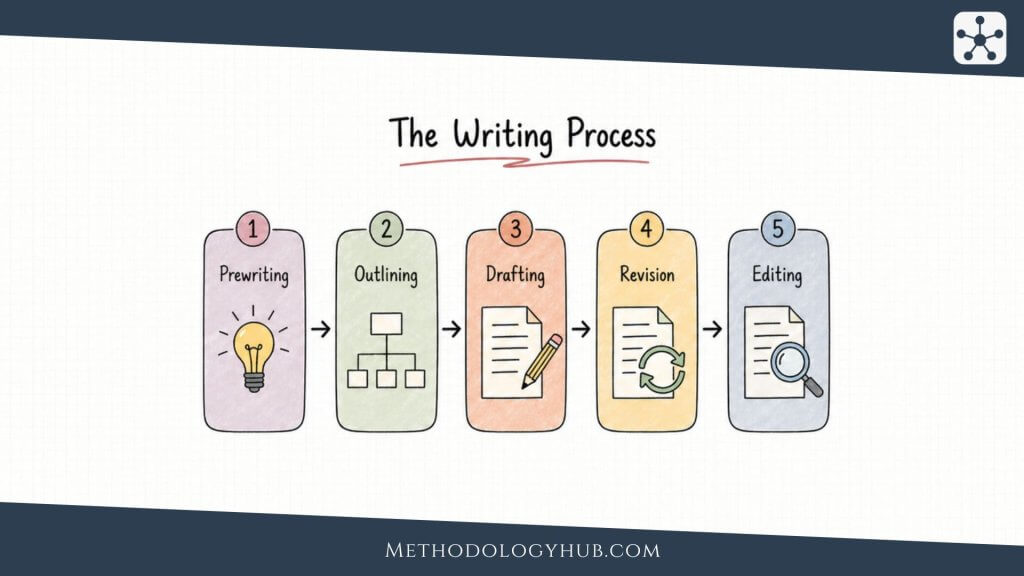
Outlining is usually the stage after prewriting and before drafting. It belongs in the middle of the writing process because it translates discovery into structure. The writer has already gathered enough material to make choices, but has not yet committed those choices to a full draft.
Placed in this position, outlining gives the writing process a useful pause. The writer can stop collecting material and begin asking how the material should work. A source may become background, a quotation may support a claim, a question may become a section, and a rough thesis may become the centre of the outline.
How outlining follows prewriting
Prewriting often leaves the writer with more material than the final text can use. There may be notes from readings, early questions, examples from class, possible claims, and half-formed paragraph ideas. Outlining begins by reading that material again and looking for order.
A writer might notice that several notes define the same concept, while others compare two sources, and others point toward a possible argument. Those groups can become outline sections. The outline does not need to preserve every note. It selects the notes that serve the focus and places them where they can help the reader follow the discussion.
How outlining prepares drafting
Drafting becomes easier when each section already has a purpose. A paragraph does not have to begin from nothing. It begins from a job: define a term, explain a problem, present evidence, compare two positions, interpret a result, or connect a claim to the larger argument.
How outlining supports revision
Outlining can return after drafting. When a draft feels unfocused, a reverse outline can show what each paragraph actually does. Sometimes the planned structure and the written structure no longer match. A section may have grown in a direction that is more useful than the original plan. Another section may be repeating material that already appears elsewhere.
Revision often begins by making the structure visible again. The writer can write a one-line summary beside each paragraph, then compare those summaries with the thesis or research question. If the paragraph summaries do not build a clear sequence, the draft needs structural revision before sentence-level editing begins.
Outlining is flexible
A writing process diagram may make outlining look like a single step. In practice, writers outline, draft, return to the outline, move sections, draft again, and then outline the revised draft. This movement is not a failure of planning. It is part of how writing develops.
The outline should therefore be treated as a working document. It can be changed when the writer finds stronger evidence, narrows the question, or realises that a section belongs elsewhere. A rigid outline can trap a weak structure. A flexible outline helps the writer keep control while still allowing the text to improve.
How to Create an Outline
Creating an outline begins with looking at the material already available. The writer may have a prompt, a working thesis, a research question, reading notes, lecture notes, data, examples, and ideas from prewriting. The first task is not to make the outline look tidy. The first task is to decide what the text is trying to do.
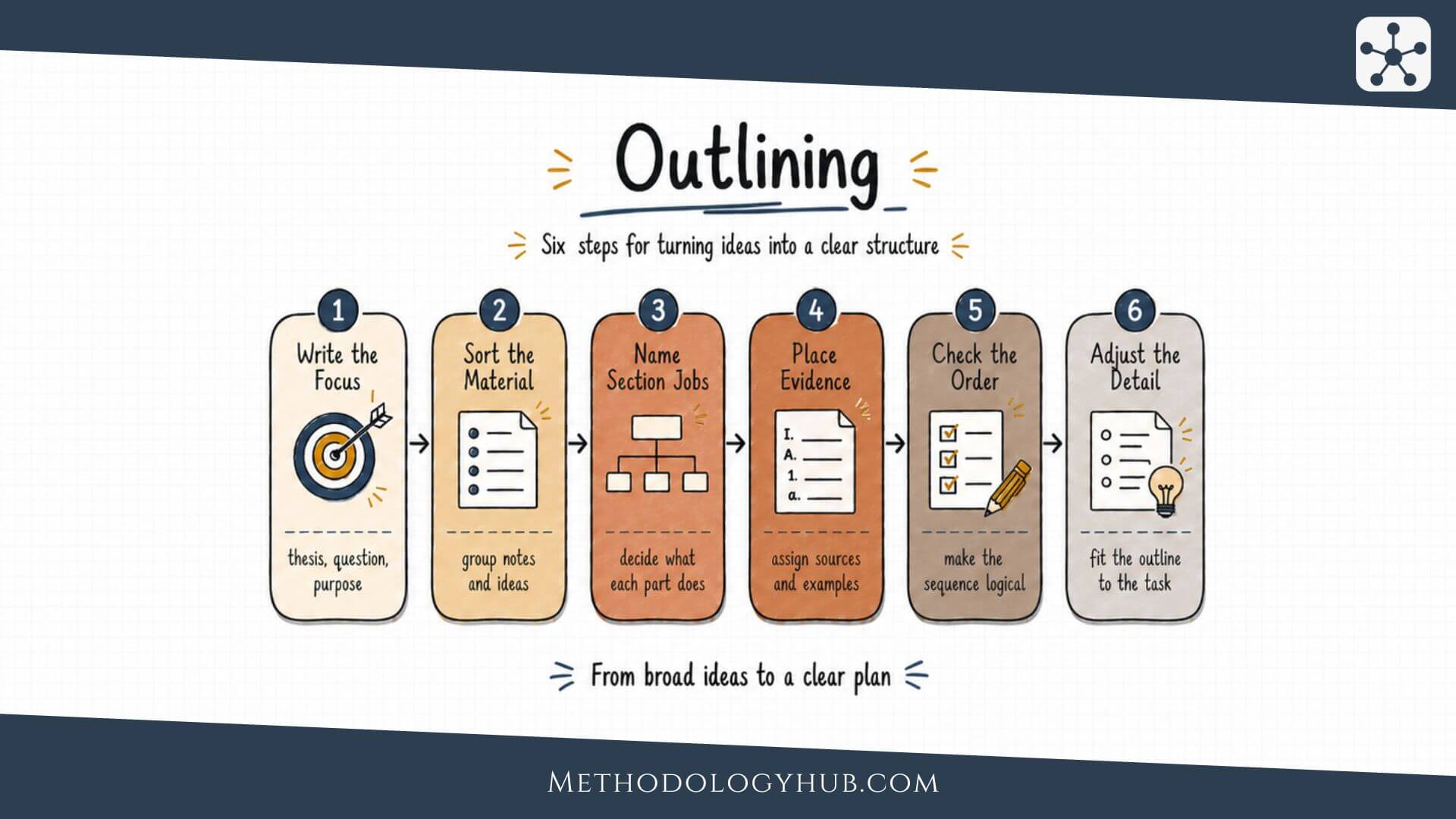
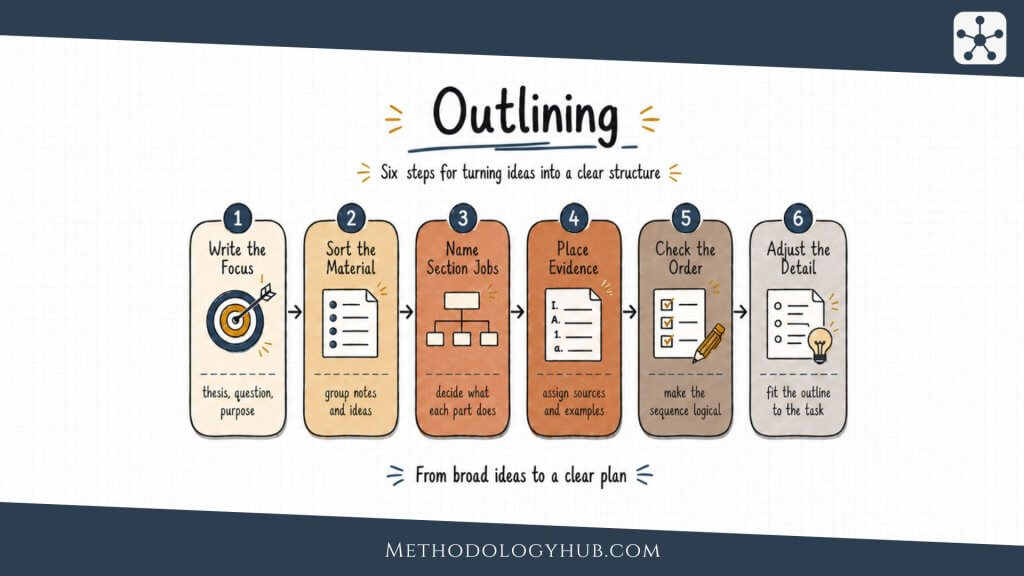
A useful outline usually grows through several passes. The writer starts with a central focus, groups related material, names section jobs, places evidence, checks the order, and then adjusts the plan. This can be done on paper, in a document, in a spreadsheet, or with outlining software. The tool is less important than the thinking.
Start with the central focus
An outline needs a centre. For an essay, the centre may be a working thesis. For a proposal, it may be a research question. For a literature review, it may be the organising problem or debate. For a report, it may be the purpose of the investigation.
Before writing headings, the writer should try to state that centre in one or two sentences. The sentence may be rough, but it should give the outline direction. Without it, the outline can become a list of related topics rather than a structure that moves toward a point.
Group related material
Once the focus is visible, the writer can group notes and ideas. Some material may define terms. Some may show background. Some may support the central claim. Some may present a different view. Some may help explain a method or interpret a finding.
Grouping is often the moment when the future structure begins to appear. A pile of notes about student feedback, for example, might form groups such as definitions of feedback, student use of comments, teacher guidance, revision outcomes, and limits of peer response. Those groups are not yet polished headings, but they show the shape of a possible essay.
Name the job of each section
Every section should do something. A heading such as “background” may be useful, but it is still broad. The writer should ask what the background section must actually accomplish. Does it define a concept? Explain a debate? Introduce a case? Give the reader enough context to understand the later analysis?
A section job can be written in simple language:
- define the term that the argument depends on
- explain the problem the paper responds to
- summarise the main positions in the literature
- present evidence for the first claim
- compare two explanations
- connect the findings to the research question
These job statements help prevent empty headings. They also make drafting easier because the writer knows what each section is expected to achieve.
Place evidence before drafting
In academic writing, an outline should usually include evidence notes. A section without evidence may still be possible, especially if it defines terms or explains the structure of the paper, but most analytical sections need support. Placing evidence in the outline helps the writer see whether the argument is ready to draft.
Evidence notes do not need to be long. A writer can place a source name, a page number, a short paraphrase, or a reminder such as “use interview extract about feedback confusion here”. The point is to give the future paragraph something to work with. If a section has no support, the writer can mark it for more reading before the draft reaches that point.
Check the order
After sections and evidence have been placed, the writer should read the outline from top to bottom. The order should feel reasonable to someone who does not already know the topic. If the outline uses a term before defining it, the definition may need to move earlier. If evidence appears before the claim it supports, the paragraph order may need to change. If the conclusion introduces a new major idea, that idea may need a section of its own or may need to be removed.
Good order depends on genre. An argumentative essay may move from context to claim, then through several supporting reasons. A literature review may move by themes, methods, or debates. A proposal may move from problem to question, from question to method, and from method to feasibility. The outline should match the task rather than follow one universal pattern.
Make the outline detailed enough, but not heavier than the task
A short essay may only need a one-page outline. A thesis chapter may need several levels of headings, notes on sources, paragraph roles, and planned transitions. A research proposal may need a structure that includes problem, literature, question, method, scope, and timeline. The outline should fit the size and complexity of the writing task.
Too little detail can leave the writer guessing during drafting. Too much detail can become a separate project that delays the draft. A useful balance is to include enough information that the next writing session can begin with confidence. The outline should make the first few paragraphs possible.
Types of Outlines
There is no single outline format that works for every writer or every assignment. The best type depends on the length of the text, the amount of source material, the writer’s stage in the process, and the kind of thinking the task requires. Some outlines are brief and open. Others are detailed and formal.
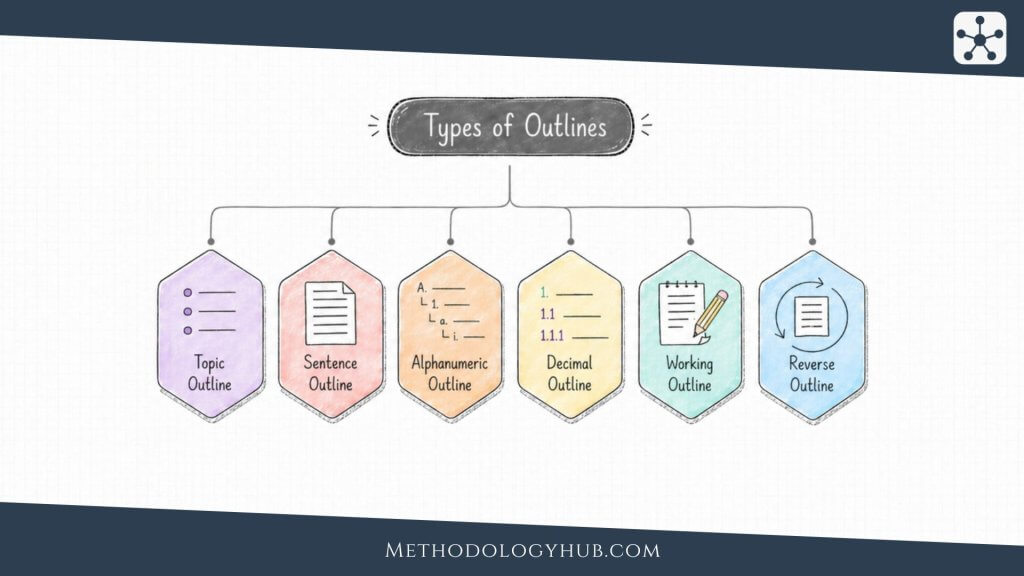
The six types below are useful for academic writing because they solve different structural problems. A writer can also combine them. For example, a research paper may begin as a working outline, become an alphanumeric outline, and then be checked later with a reverse outline.
Topic outline
A topic outline uses short phrases rather than full sentences. It is useful when the writer needs a quick structure but does not yet want to write every claim in final form. The phrases may name sections, concepts, sources, or paragraph roles.
A topic outline for a short essay might include an introduction, a definition section, two analytical sections, and a conclusion. Each part may only contain a phrase such as “definition of formative feedback” or “student response to teacher comments”. The outline is light, but it gives the draft a path.
Sentence outline
A sentence outline uses complete sentences for each main point. It is more detailed than a topic outline because the writer must state what each section or paragraph will say. This type is useful for longer essays, research papers, and projects where the argument needs careful control.
The sentence outline can reveal weak thinking early. A heading may look strong as a phrase, but when the writer tries to turn it into a sentence, the claim may become vague. This is useful. It shows which parts of the paper need more thinking before drafting.
Alphanumeric outline
An alphanumeric outline uses a traditional hierarchy of Roman numerals, capital letters, numbers, and lowercase letters. It is useful when a paper has several levels of structure, such as main sections, subsections, supporting points, and evidence notes.
This format helps the writer see subordination. A main section may be labelled I. A subsection may be labelled A. A smaller supporting point may be labelled 1. The visual hierarchy shows which ideas are main points and which ideas are supporting details. That can be especially helpful in research papers and formal proposals.
Decimal outline
A decimal outline uses numbers such as 1, 1.1, 1.2, 1.2.1, and 2. This format is common in reports, theses, dissertations, and longer academic documents because it makes hierarchy precise. It is also useful when sections may later become numbered headings in the final document.
The decimal format can make a large project easier to navigate. A writer can see that 2.3 belongs inside chapter or section 2, while 2.3.1 belongs inside 2.3. If the numbering becomes too deep, that may be a sign that the structure is too complex for the reader and should be simplified.
Working outline
A working outline is a flexible outline used while the writer is still thinking. It may include questions, source reminders, rough section titles, possible claims, and notes such as “move this earlier” or “needs stronger evidence”. It is not meant to be clean. It is meant to be useful.
This type of outline works well after prewriting and before formal drafting. It lets the writer keep uncertainty visible. A working outline can include several possible orders before one is chosen. It can also hold material that may or may not survive into the final text.
Reverse outline
A reverse outline is made after a draft exists. Instead of planning what each paragraph should do, the writer reads the draft and writes down what each paragraph actually does. This type is especially useful during revision because it shows the real structure of the text.
A reverse outline may reveal that two paragraphs perform the same function, that a main claim appears too late, or that a section has drifted away from the assignment. It can also show strengths. A draft that felt messy may have a clear sequence once the paragraph jobs are written down.
Sample Outlines
Sample outlines are useful because they show how structure looks before it becomes a draft. They should not be copied mechanically. A sample outline is a model of movement, not a universal template. The writer still has to adjust the structure to the assignment, question, sources, and word limit.
The examples below use academic topics rather than commercial or promotional examples. They show how an outline can handle an essay, a research paper, a literature review, and a paragraph-level plan.
Sample outline for an argumentative essay
This sample shows a short essay outline on peer feedback in academic writing. It uses a topic outline format, with brief notes for evidence and paragraph work.
- Introduction: introduce peer feedback as part of the writing process; present the working thesis that peer feedback improves revision when students are taught how to use comments.
- Definition section: explain peer feedback as response from other students during drafting or revision; distinguish it from teacher assessment.
- First argument: peer feedback helps writers notice reader confusion; use an example from a draft workshop.
- Second argument: feedback is more useful when students receive guidance on comment quality; use one source on response training.
- Limit section: peer comments can be vague or inaccurate when the task is unclear; connect this limit to the need for teacher support.
- Conclusion: return to revision, not simply feedback exchange; explain that the value of peer feedback depends on how it is built into the writing process.
Notice that the outline does more than list topics. Each section has a role. The definition section prepares the reader. The argument sections develop the thesis. The limit section makes the discussion more careful. The conclusion returns to the central idea without adding a new major claim.
Sample outline for a research paper
This sample uses a sentence outline for a research paper on how first-year students use reading notes when writing essays. The complete sentences help the writer check whether the planned sections form a coherent argument.
- Introduction: First-year students often take reading notes, but those notes do not automatically become useful writing material.
- Background: Academic reading and academic writing are connected because notes can preserve source ideas, questions, and possible evidence.
- Research focus: The paper examines how students transform reading notes into essay plans and body paragraphs.
- Literature section 1: Studies of reading notes show that students often record information without assigning it a later writing purpose.
- Literature section 2: Research on writing planning suggests that organised notes can help writers build sections and select evidence.
- Analysis section: Notes become more useful when students label them by function, such as definition, evidence, contrast, or question.
- Discussion: The paper argues that note-taking instruction should include outlining because students need to move from source storage to structure.
- Conclusion: Reading notes support academic writing most effectively when they are reviewed, sorted, and placed in an outline before drafting.
This kind of outline is useful before a longer draft because it tests the chain of reasoning. If two sentence points do not connect, the writer can revise the plan before writing several pages.
Sample outline for a literature review
A literature review outline should not simply move article by article. It should show relationships between sources. This sample uses thematic sections for a review on outlining as a writing strategy.
- Introduction: define the review focus as outlining in academic writing and learning contexts.
- Theme 1 – Outlining and text structure: group studies that examine how outlines affect organisation and argument presentation.
- Theme 2 – Outlining and writing process: discuss research on planning, drafting time, revision, and mental effort.
- Theme 3 – Electronic outlining: compare studies on digital outline tools, built-in word processor functions, and observational learning.
- Theme 4 – Outlining in second-language writing: examine studies where outlining is compared with freewriting or other prewriting strategies.
- Theme 5 – Limits and conditions: identify where outlining helps, where effects are mixed, and what instruction may be needed.
- Conclusion: synthesise what the literature suggests about outlining as a strategy that depends on task, writer experience, and teaching support.
The outline keeps the literature review focused on patterns. Each theme gathers sources around a shared question. This helps the final review avoid a simple sequence of summaries.
Sample paragraph outline
Sometimes the whole paper is not the problem. A writer may only need to plan a difficult paragraph. A paragraph outline can be very small, but it can still prevent confusion.
- Paragraph job: explain why an outline should include evidence notes.
- Topic sentence: evidence notes help the writer see whether each section has enough support before drafting begins.
- Explanation: an outline that only lists claims can hide weak support.
- Example: a section on peer feedback should identify which source, observation, or classroom example will support the claim.
- Connection: placing evidence early makes the draft easier to write and easier to revise.
This small outline gives the paragraph a route. The writer knows where the paragraph begins, what it explains, what example it uses, and how it connects back to the larger section.
Proposal Outlining
Proposal outlining is the planning stage for a research proposal. It helps the writer move from a broad interest to a study that can be explained, justified, and carried out. A proposal outline needs more than section order. It needs a clear research problem, a focused question, a sense of the literature, a feasible method, and realistic limits.
Because a proposal describes work that has not yet been completed, the outline has to make the planned project understandable. The reader should be able to see what the study will investigate, why the question is worth asking in an academic context, how the data or material will be handled, and what the project can reasonably claim to do.
Start with the research problem
A proposal outline should begin with the problem or gap the project responds to. This does not need to be exaggerated. In academic writing, a problem can be a tension in existing research, an underexplored case, a method that has not been applied to a specific context, or a practical question that needs careful study.
At the outline stage, the writer can describe the problem in a few lines. For example: “Research on peer feedback often discusses comment quality, but less attention is given to how students decide which comments to use during revision.” This kind of note gives the proposal a purpose without turning it into a full introduction yet.
Connect the question to the literature
The literature section of a proposal outline should show what the project is building from. It does not need to include every source the writer has read. It should identify the main concepts, debates, or findings that lead to the research question.
A proposal outline might organise the literature like this:
- Concept group: definitions of peer feedback and revision.
- Research group: studies on student response to feedback.
- Gap group: limited attention to how students select comments for revision.
- Connection: the present project examines that selection process in first-year academic writing.
This structure gives the future literature review a route. It also helps the writer avoid a proposal that lists sources without showing how those sources lead to the study.
Outline the method before writing the method section
The method section of a proposal needs careful outlining because it must be specific enough to be credible. The writer should identify the material or participants, the data collection method, the analysis plan, and the limits of the project.
A method outline may include:
- research design or approach
- participants, texts, cases, or data sources
- criteria for selecting material
- steps for collecting or preparing data
- steps for analysis
- scope limits and practical constraints
This outline helps the writer see whether the project can actually be carried out. If the method requires data the writer cannot access, the research question may need to change. If the analysis plan is too broad, the project may need narrower material.
Sample proposal outline
The following sample shows a research proposal outline for a small study on reading notes and essay planning. It is written as a working outline rather than a polished proposal.
- Title: From reading notes to essay plans: how first-year students organise source material before drafting.
- Problem: students often collect source notes, but those notes may not become structured writing material.
- Research question: how do first-year students use reading notes when creating outlines for argumentative essays?
- Background: connect academic reading, note-taking, prewriting, and outlining.
- Literature group 1: research on note-taking and source use in student writing.
- Literature group 2: research on planning and outlining as writing strategies.
- Method: collect student reading notes, essay outlines, and short reflective comments from one writing course.
- Analysis: compare note categories with outline sections; identify how notes are selected, moved, or left unused.
- Scope: small qualitative study focused on one course context; not a broad measurement of writing achievement.
- Expected contribution: show how students transform source material into structure before drafting.
- Timeline: collect materials after the outlining activity, code notes and outlines, draft findings, revise proposal or report.
This outline gives the proposal a structure before the writer begins composing paragraphs. It also keeps the project realistic. The study has a clear context, a specific question, and a method that fits the available material.
Outlining for Different Academic Texts
Outlining changes depending on the kind of academic text being written. The same basic act remains: arrange material before drafting. Yet each genre asks for a different kind of structure. An essay outline usually follows an argument. A literature review outline follows relationships between sources. A report outline follows sections that readers expect.
Using the same outline for every task can create problems. A five-paragraph essay structure will not support a research proposal. A literature review organised by source will often become repetitive. A thesis outline that only names chapters may not be detailed enough to guide writing. The outline should fit the genre.
Outlining essays
An essay outline should begin with the prompt and the working thesis. The writer needs to know what the essay is being asked to do: analyse, compare, explain, evaluate, or argue. The outline should then arrange the body sections so that each one develops the thesis in a distinct way.
For essays, paragraph roles are especially useful. A writer can label one paragraph as definition, another as first reason, another as evidence, another as limitation, and another as response. These labels make the essay easier to draft and easier to revise.
Outlining research papers
A research paper outline needs to manage both argument and sources. The writer should decide which sources provide background, which support the main claim, which offer contrast, and which help define terms or methods. Placing sources in the outline prevents the draft from becoming a sequence of summaries.
A useful research paper outline often includes brief source notes under each section. These notes can include author names, page numbers, data points, or paraphrase reminders. The writer can then draft with a clear sense of where evidence belongs.
Outlining literature reviews
A literature review outline should organise sources by relationship. The structure may be thematic, methodological, chronological, or conceptual. The best choice depends on what the review is trying to show.
If the review is about how outlining affects writing quality, sections might focus on planning, text structure, digital outline tools, second-language writing, and instruction. If the review is about one concept over time, a chronological structure may work better. The outline should help the reader understand the field, not simply remember which article came first.
Outlining reports
Reports often have expected sections, such as introduction, method, results, discussion, and conclusion. The outline should help place information in the correct section. Background and aims belong near the beginning. Procedures belong in the method. Findings belong in the results. Interpretation belongs in the discussion.
Reports need section control because readers expect information to appear in predictable places. An outline helps the writer separate what was done, what was found, and what the findings mean.
Outlining theses and dissertations
A thesis or dissertation needs outlining at several levels. At the project level, the writer needs a chapter plan. At the chapter level, each chapter needs internal sections. At the paragraph level, difficult arguments may need small local outlines.
Long projects also change over time. A chapter outline written early may no longer fit after data analysis or after a literature review becomes more focused. Saving old outlines can help the writer see how the project has developed, but the current outline should always reflect the current argument.
Using an Outline During Drafting
An outline is most useful when it remains active during drafting. It should not be created and then ignored. The writer can keep it open beside the draft, use it to choose the next paragraph, mark completed sections, and adjust it when the writing changes direction.
Many writers discover new connections while drafting. A planned section may become stronger than expected. A minor point may need more evidence. A transition may show that two sections belong together. The outline should be flexible enough to record those discoveries.
Draft from paragraph jobs
Instead of drafting from headings alone, it helps to draft from paragraph jobs. A heading names a topic. A paragraph job names the work that paragraph must do. For example, “source use” is a topic. “Explain how source notes become evidence in the outline” is a paragraph job.
This small change can improve drafting. The writer is no longer trying to write everything about a heading. The writer is performing one defined task. Once that task is done, the next paragraph can take over a different task.
Use placeholders carefully
Placeholders can help drafting continue when a detail is missing. A writer might write “add source on something” or “explain connection to something” and move forward. This keeps the draft from stopping every time a small gap appears.
Placeholders should be visible and specific. A vague marker such as “fix later” is easy to miss. A useful marker says what is needed. Before final editing, every placeholder should be resolved, removed, or turned into a revision task.
Revise the outline while drafting
If the draft changes, the outline should change with it. The writer can move section notes, cross out unused ideas, add evidence reminders, or rename headings. This keeps the plan and the draft in conversation.
A revised outline can also help after feedback. If a teacher or peer says that the argument is hard to follow, the writer can return to the outline and trace the sequence. The problem may not be the wording of one sentence. It may be the order of several sections.
Move from outline to revision
After a full draft exists, the outline can become a revision tool. The writer can compare the planned structure with the written structure. If the draft no longer follows the outline, that is not automatically a problem. The draft may have improved. The writer needs to decide which structure is stronger.
A reverse outline is useful here. Write one sentence beside each paragraph stating what it does. Then read those sentences in order. If they form a clear path, the draft likely has a workable structure. If they jump around, repeat, or leave gaps, revision should begin with organisation before editing begins.
Conclusion
Outlining helps writers move from gathered material to a planned text. It makes structure visible before the full draft begins, so the writer can test order, section roles, evidence placement, and paragraph movement. For academic writing, this is especially useful because the reader needs more than information. The reader needs a clear route through the argument, review, report, or proposal.
A good outline does not need to be complicated. It only needs to serve the writing task. A short essay may need a topic outline with paragraph roles. A research paper may need a sentence outline with source notes. A literature review may need thematic groups. A proposal may need a careful plan that connects problem, question, literature, method, and scope.
Outlining also remains useful after drafting starts. The writer can revise the outline, draft from paragraph jobs, mark missing evidence, and create a reverse outline during revision. In that sense, outlining is not just preparation. It is a way of keeping the structure of a text visible while the writing develops.
- Use outlining to arrange ideas before drafting.
- Choose an outline type that fits the task.
- Give each section and paragraph a job.
- Place evidence in the outline before writing the full draft.
- Return to the outline when revision shows structural problems.
FAQs on Outlining
What is outlining?
Outlining is the stage of the writing process where writers organise ideas, evidence, sources, and section order before drafting. It helps turn notes and early thinking into a planned structure.
What are the main types of outlines?
Common types of outlines include topic outlines, sentence outlines, alphanumeric outlines, decimal outlines, working outlines, and reverse outlines. Each type offers a different level of detail and is useful at a different point in the writing process.
What is the difference between prewriting and outlining?
Prewriting generates and gathers material, such as ideas, questions, and notes. Outlining organises that material into a sequence of sections and paragraph roles before drafting begins.
How detailed should an outline be?
An outline should be detailed enough to make drafting possible. A short essay may only need section labels and paragraph roles, while a thesis chapter or proposal may need headings, subheadings, source notes, evidence, and planned transitions.
What is proposal outlining?
Proposal outlining is the process of planning a research proposal before writing it in full. It usually includes the research problem, research question, literature groups, method, scope, feasibility, and expected contribution.