Prewriting is the early work that happens before a full draft begins. It is the stage where a writer gathers ideas, tests possible directions, narrows a topic, studies the assignment, and builds enough confidence to begin writing with a purpose. Instead of opening a blank document and hoping the first sentence will solve everything, prewriting gives the writer material to work with.
This article explains what prewriting is, how it works, which strategies help most, and how to use it as the first stage of the writing process.
What Is Prewriting?
Prewriting is the preparation stage of writing. It includes the thinking, reading, questioning, note-making, and organising that help a writer move from a loose idea to a workable direction. It can be brief, such as a ten-minute list before an essay draft, or extended, such as several days of reading and note sorting before a research proposal.
The aim is not to produce polished sentences. In fact, polished sentences can get in the way too early. Prewriting works best when the writer allows incomplete notes, rough questions, fragments, diagrams, and trial claims to exist without judging them too quickly. Those early pieces are not the final text. They are the material from which the final text may later grow.
Prewriting definition
Prewriting is the stage in the writing process where writers generate ideas, clarify purpose, gather material, and prepare a direction before outlining and drafting. It is often the first formal stage of the writing process, but it can return later whenever a draft reveals a new problem or a better angle.
That last point is worth keeping in mind. Prewriting is not limited to the first hour of a project. A writer may return to prewriting after discovering that the original topic is too broad, that the evidence points in a different direction, or that the outline has become too rigid. In that sense, prewriting is less like a doorway and more like a workspace. Writers come back to it when they need to think again.
What happens during prewriting
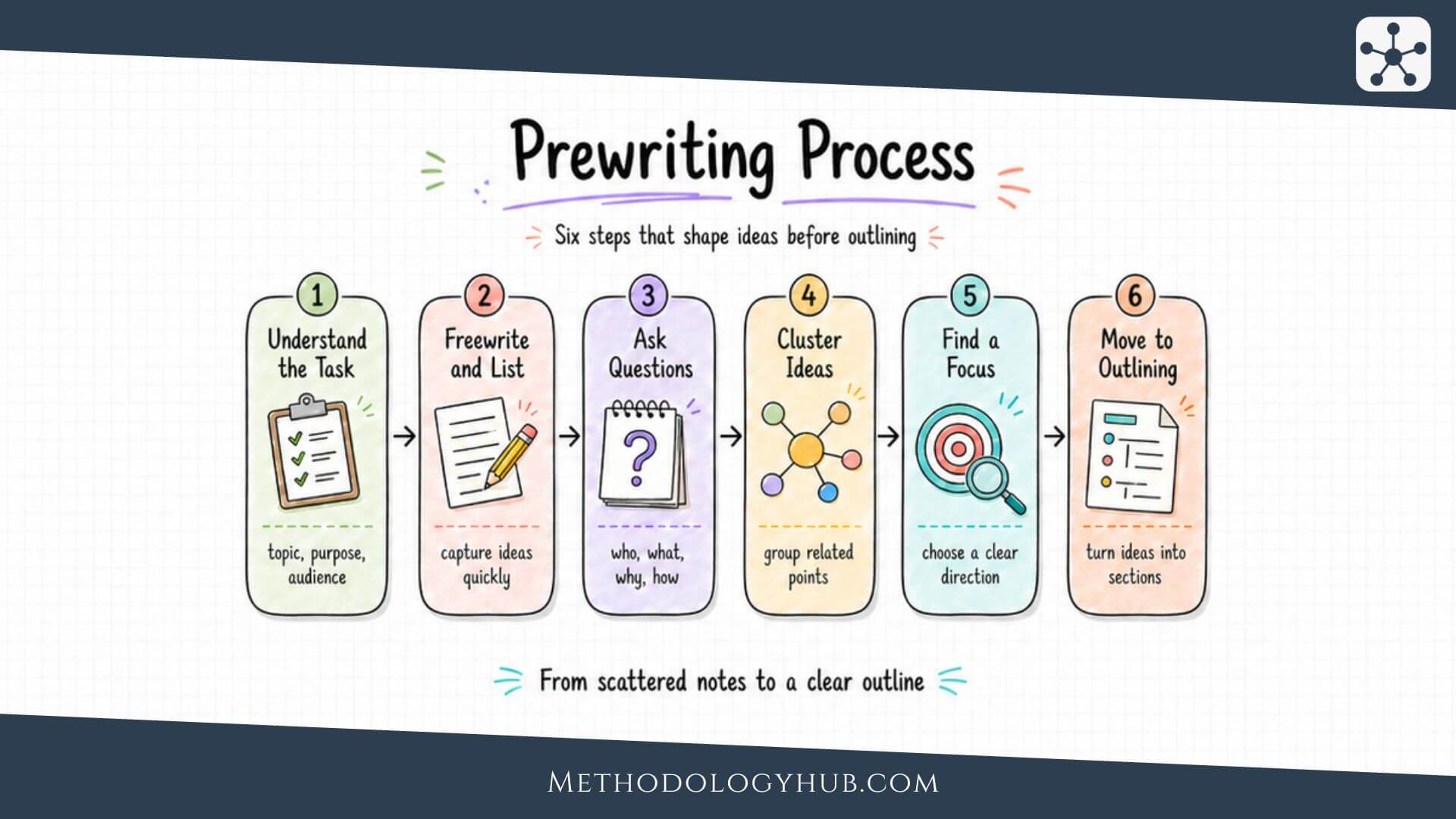
Prewriting usually has two movements. First, the writer opens the topic by producing possibilities. Then the writer narrows those possibilities into a usable direction. Both movements are needed. A topic that is narrowed too soon can feel thin. A topic that stays open for too long can become impossible to draft.
During prewriting, writers often do several of the following:
- read the assignment prompt carefully
- list ideas, questions, examples, and possible sources
- separate broad topics from workable angles
- identify the intended reader and purpose
- collect notes from readings, lectures, observations, or data
- test a possible thesis, research question, or central focus
- sort material into early groups before outlining
These tasks do not always happen in the same order. A student writing a short essay may begin with listing and then move quickly into a thesis. A student writing a literature review may begin with reading, then create a map of recurring concepts, then return to listing once the field becomes clearer. The order depends on the task, but the purpose stays similar: create enough direction that drafting no longer feels like guessing.
Prewriting and outlining are related, but not identical
Prewriting is often confused with outlining, but the two stages do different kinds of work. Outlining arranges material into a sequence. Prewriting comes earlier and is wider: it includes messy discovery, quick notes, questions, reading, and trial directions before the structure is ready to organise.
This distinction helps because many writers feel pressure to outline too early. They try to create Roman numerals, headings, and paragraph order before they have enough material to arrange. Prewriting gives them permission to spend time with the topic first. Once patterns appear, an outline has something real to organise.
Prewriting in the Writing Process
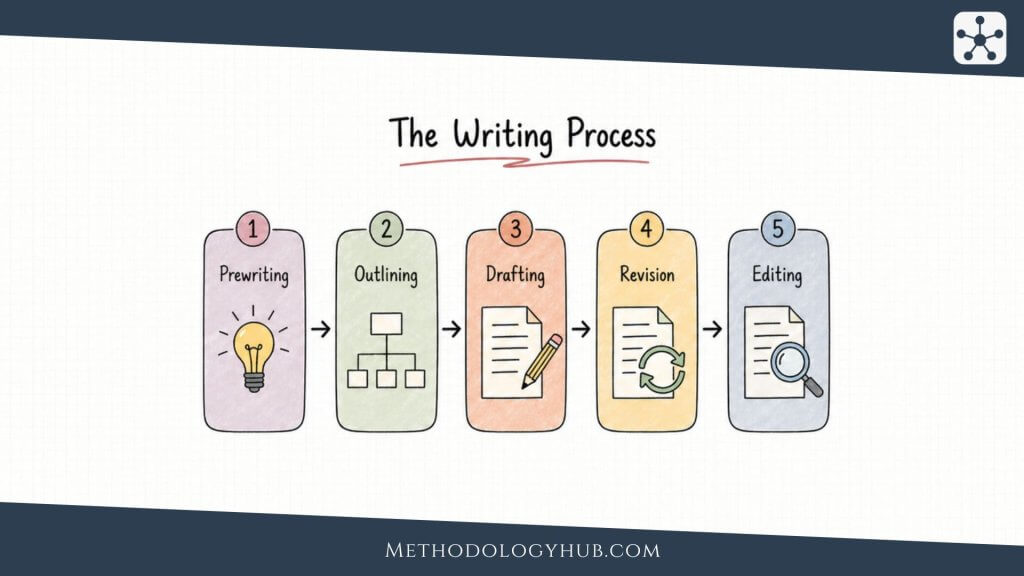
Prewriting is the first stage of the writing process, followed by outlining, drafting, revising, and editing. It gives the rest of the process a starting point. Without it, writers often begin drafting before they know what they are trying to do. The result may still be useful, but it often takes more revision to repair focus, structure, and evidence.
Placed inside the writing process, prewriting has a clear job. It does not need to solve every problem. It should help the writer understand the task, gather enough material, and form a direction that can be developed further. The outline will organise that direction. The draft will test it in full sentences. Revision will improve it. Editing will polish it.
How prewriting connects to outlining
Outlining depends on prewriting because an outline needs content to arrange. If a writer has only a topic, the outline may become a list of empty headings. Prewriting fills those headings with possible claims, examples, questions, and sources. Once that material is visible, the writer can begin asking where each part belongs.
For example, a student writing about feedback in academic writing might begin with scattered notes from readings, classroom experience, and questions about peer review. Prewriting helps collect those ideas. Outlining then asks how they should move: perhaps from feedback as response, to feedback as revision support, to the limits of feedback when the writer has no clear direction.
How prewriting connects to drafting
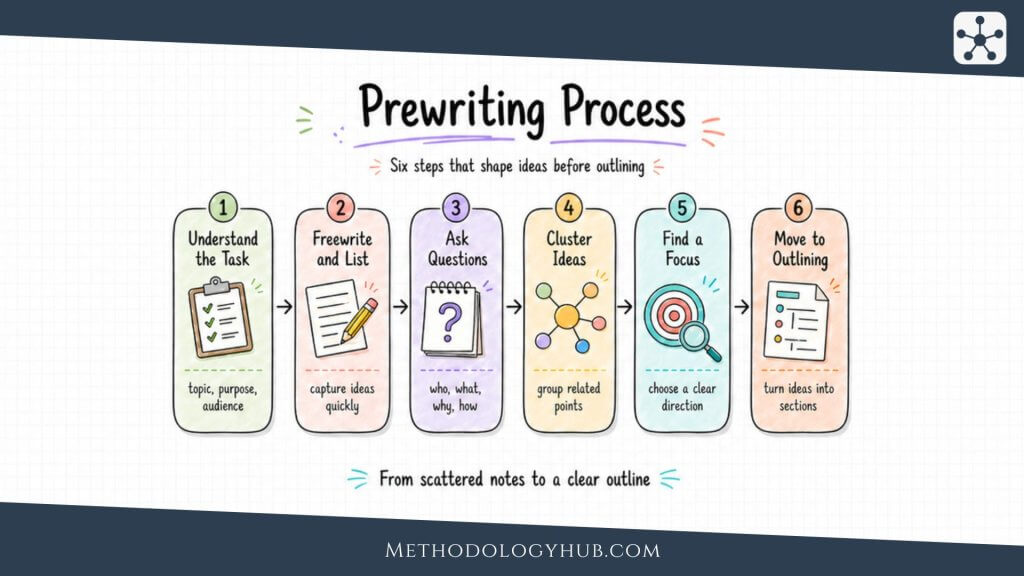
Drafting is easier when the writer has something to say and some sense of order. Prewriting provides both. It gives the writer a working focus, a store of material, and a few decisions about audience and purpose. The first draft may still be rough, but it is less likely to be empty.
This does not mean that prewriting removes uncertainty. Writing often changes as it develops. A paragraph may reveal that the thesis needs adjustment. A source may turn out to be less useful than expected. A section may grow longer than expected. Prewriting simply reduces the number of problems the writer has to face at once.
How prewriting connects to revision
Prewriting can also support revision. When a draft feels unfocused, the writer can return to early notes and ask what the central question should have been. When a paragraph feels thin, the writer can use listing or freewriting to produce more explanation. When a section has become too crowded, clustering can show which ideas are mixed together.
This is one reason experienced writers often keep their prewriting notes. Notes that seemed minor at first may become useful later. A question that did not fit the first outline may become the opening of a stronger section. A discarded example may help explain a difficult point in revision.
Prewriting is recursive
A simple diagram of the writing process can make the stages look fixed. In practice, writers move back and forth. They may draft a section, notice that the evidence is weak, return to research notes, map a new order, and then draft again. This movement is normal. It shows that writing is developing.
Prewriting therefore works best when it is treated as a flexible tool rather than a one-time duty. The writer uses it whenever the text needs more thought: before the first outline, before a difficult section, after feedback, or during revision when a paragraph no longer fits.
Prewriting Strategies
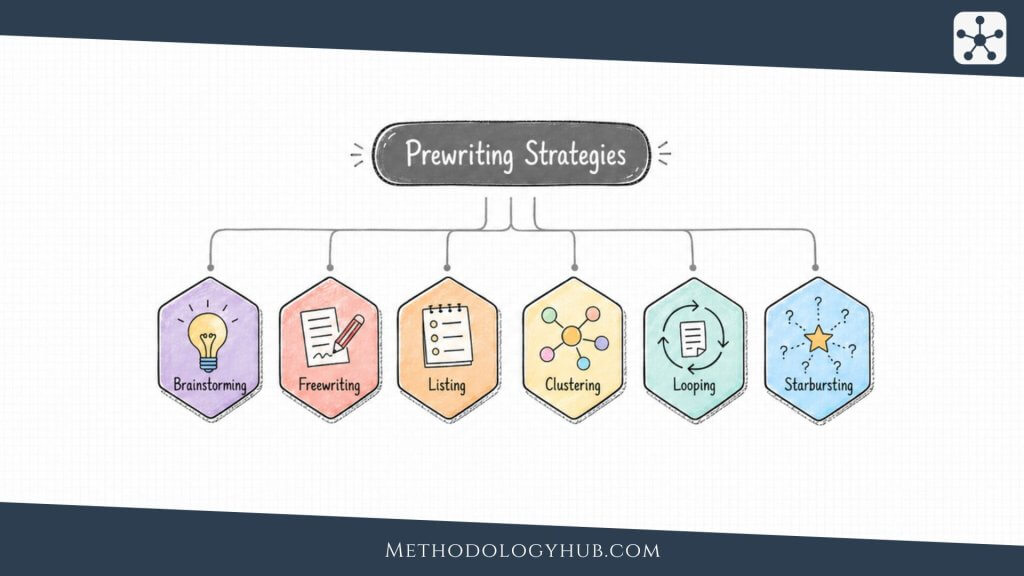
Prewriting strategies are practical methods for generating and shaping ideas before outlining and drafting. Some are fast and informal. Others are more visual or more analytical. The best strategy depends on the task, the writer, and the kind of difficulty the writer is facing at that moment.
If the problem is a lack of ideas, freewriting or listing may help. If the problem is too many disconnected ideas, clustering may show relationships. If the writer has one promising idea but needs to deepen it, looping can help. If the topic needs questions from several angles, starbursting is often useful. These strategies are not separate rules. They are tools, and writers often combine them.
Freewriting
Freewriting means writing continuously for a set amount of time without stopping to edit. The writer may choose five, ten, or fifteen minutes and then write whatever comes to mind about the topic. The sentences do not need to be clean. The order does not need to be logical. The point is to keep thinking on the page long enough for unexpected ideas to appear.
This strategy is useful when a topic feels blocked. A writer who cannot begin an essay on classroom assessment might start with a rough sentence such as, “I am not sure what I think about assessment yet, but the part that keeps coming back is feedback.” That sentence may not belong in the final draft, but it opens a path. A few minutes later, the writer may discover a more precise concern: feedback only helps when students know how to use it.
After freewriting, the writer should not treat the whole passage as draft material. It is better to read it again and mark useful parts: a question, a phrase, a possible claim, an example, or a tension worth exploring. Freewriting produces raw material. The next step is selection.
Looping
Looping is a focused version of freewriting. The writer freewrites for a short time, rereads the result, chooses the most promising idea, and then freewrites again from that idea. Each loop narrows the topic. Instead of moving randomly through possibilities, the writer follows one thread until it becomes clearer.
A simple looping sequence might look like this:
- First loop: write freely about the broad topic.
- Pause: underline the sentence or idea that seems most useful.
- Second loop: begin again from that underlined idea.
- Pause again: identify the sharper point that has appeared.
- Final loop: write toward a possible thesis, question, or section focus.
Looping is especially helpful when the writer knows the subject area but not the angle. It lets the topic become narrower through writing rather than through pressure. By the final loop, the writer often has a sentence that can become a working thesis or research question.
Clustering
Clustering, sometimes called mind mapping, is a visual way to explore relationships between ideas. The writer places the topic in the centre of a page and draws branches to related terms, examples, sources, questions, and subtopics. New branches can grow from any point, allowing the map to show connections that a linear list might hide.
This strategy suits topics with several parts. For example, a student preparing an essay on academic reading might place “academic reading” in the centre and branch outward to “purpose”, “annotation”, “source evaluation”, “difficulty”, “discipline”, and “writing notes”. Under “source evaluation”, the student might add “authority”, “method”, “evidence”, and “date”. The map begins to show possible sections before a formal outline exists.
Clustering is also useful for noticing when a topic is too large. If the map grows in many directions, the writer may need to choose one branch. An essay cannot usually cover every aspect of academic reading. It might focus only on annotation as preparation for writing, or only on how source evaluation shapes an argument.
Listing
Listing is one of the simplest prewriting strategies. The writer writes down ideas quickly in a vertical list. The list may include claims, examples, questions, source names, definitions, problems, or possible headings. At first, the goal is quantity. Later, the writer sorts the list into groups.
Listing works well when the writer has many small pieces of information but no order yet. A student preparing a report might list terms from lectures, findings from articles, and possible examples from class notes. Afterward, the list can be marked with symbols: one colour for definitions, one for evidence, one for points that need more reading, and one for ideas that belong in the conclusion.
The strength of listing is speed. It does not ask the writer to explain every idea immediately. It simply prevents ideas from disappearing. Its weakness is that it can stay flat if the writer never returns to sort it. A list becomes useful when it is grouped, cut, or turned into questions.
Starbursting
Starbursting is a question-based prewriting strategy. The writer places the topic in the centre and builds questions around it, often using who, what, when, where, how, and to what extent. It is especially useful when the writer needs to understand the dimensions of a topic before choosing a focus.
For academic writing, starbursting can be adapted beyond basic information questions. A writer can ask:
- What concept needs to be defined before the reader can follow the text?
- What evidence would make this claim convincing?
- Which assumption does the topic depend on?
- Where do scholars or sources seem to disagree?
- How narrow does the topic need to become for the word limit?
- To what extent can the available evidence support the argument?
Starbursting helps because questions slow down premature certainty. A writer may begin with a broad claim, but questions reveal what still needs to be known. This can lead to better research, a more careful thesis, and a clearer sense of what the reader will need.
Brainstorming with constraints
Brainstorming is often used as a general name for idea generation, but it works better when the writer adds a constraint. Instead of “write everything about the topic”, the writer can ask for ten possible examples, five counterarguments, three definitions, or two ways to organise the discussion. A constraint gives the mind something specific to do.
For academic writing, useful brainstorming prompts include:
- List ten terms a reader would need to understand this topic.
- List five possible claims and mark the strongest one.
- List four sources and write one sentence about what each contributes.
- List three possible orders for the paper.
- List two questions that still need research.
These prompts keep brainstorming from turning into a loose pile of words. They also move naturally toward outlining, because the writer begins to see which ideas belong together and which ones can be left out.
Questioning the assignment prompt
Many academic writing problems begin with a rushed reading of the prompt. Before generating ideas, it helps to ask what the assignment is actually asking for. A prompt that says “compare” does not ask for the same kind of work as one that says “evaluate”. A prompt that says “analyse” usually asks the writer to break a subject into parts and explain how those parts work together.
A practical prompt check can include:
- Task word: What action does the prompt require?
- Topic limit: What part of the subject is included or excluded?
- Evidence expectation: What type of source, data, or example is needed?
- Audience: What can the reader probably assume, and what needs explanation?
- Format: What genre, length, citation style, or structure is expected?
This type of prewriting is less creative than freewriting, but it is often the difference between an interesting draft and a draft that actually answers the task. In academic settings, writing quality is tied closely to task fit.
From Topic to Focus
One of the hardest parts of academic writing is moving from a topic to a focus. A topic names an area. A focus gives the writer a direction inside that area. “Online learning” is a topic. “How discussion boards affect participation in first-year seminars” is closer to a focus. Prewriting helps make that movement possible.
Writers often begin too broadly because broad topics feel safe. They seem to offer more to say. In practice, broad topics usually make drafting harder because every paragraph competes with every other possible paragraph. A focused topic gives the writer boundaries, and boundaries make deeper writing possible.
Start with the assignment and the available space
The right focus depends partly on the length and purpose of the text. A 1,500-word essay cannot do the work of a dissertation chapter. A lab report does not need the same type of exploration as a reflective essay. Prewriting should therefore begin with the writing situation: length, genre, evidence, deadline, and reader expectations.
A useful early question is: what can this text handle well? That question is modest, but it prevents many problems. If the answer is “only one concept in detail”, the writer should not try to cover three major debates. If the answer is “a comparison of two cases”, the writer should not add five more cases halfway through.
Use narrowing questions
Narrowing questions help turn a broad topic into a draftable one. They do not need to be elegant. They only need to make the topic smaller and more exact.
- Which part of this topic can I explain well in the available space?
- Which group, text, case, period, or concept am I actually discussing?
- What question keeps returning as I read or think?
- What would be too obvious to argue?
- What would require evidence I do not have?
- What can I reasonably support with the sources available?
These questions help the writer avoid two weak extremes. One is the huge topic that becomes a shallow survey. The other is the tiny topic with too little material. Good prewriting looks for the middle: focused enough to develop, but substantial enough to support.
Move from focus to working thesis
A working thesis is a provisional statement of the main idea. It is not a contract. It can change during drafting and revision. Its value is that it gives the writer something to test. Without a working thesis, the draft may become a record of everything the writer found rather than a controlled response to a question.
A working thesis often begins as a simple sentence:
- This essay argues that peer feedback improves revision when students receive guidance on how to respond to comments.
- This report examines how note organisation affects the clarity of later writing.
- This review compares two approaches to teaching outlining in second-language writing.
Those sentences may not be final, but they give the draft a centre. The writer can now ask whether each section supports that centre, complicates it, or needs to be removed.
Develop a research question when the task calls for one
Some academic texts begin more naturally with a research question than with a thesis. This is especially true for proposals, dissertations, literature reviews, and empirical projects. In those cases, prewriting should not force an answer too early. It should help the writer ask a better question.
A strong research question is usually focused, answerable, and connected to available evidence. It avoids being so broad that it cannot be investigated and so narrow that it produces only a yes-or-no answer. Prewriting helps by letting the writer test several versions before choosing one.
For example, “How does reading affect writing?” is too broad for most academic projects. A more workable version might be: “How do first-year students use reading notes when preparing argumentative essays?” This question has a population, an activity, and a text type. It gives the writer something to investigate.
Research and Notes in Prewriting
In academic writing, prewriting often overlaps with early research. This does not mean collecting every possible source before writing a single sentence. It means reading enough to understand the conversation, notice useful terms, and decide what kind of evidence the text will need.
Research without prewriting can become passive. The writer reads source after source but never turns the material into a personal direction. Prewriting changes that relationship. It asks the writer to respond to sources, sort them, question them, and decide how they might be used.
Read with a writing purpose
Prewriting changes how reading works. Instead of reading only to understand each source, the writer reads to prepare for a text. That means taking notes on ideas that may become definitions, background, evidence, contrasts, or questions. It also means noticing what a source cannot do.
A useful note may be short. It might say, “This article helps define outlining, but it does not address undergraduate writers.” Another note might say, “Good evidence for collaborative discussion, but context is second-language writing.” These notes are valuable because they already connect the source to the outlined text.
Separate source notes from your own thinking
One risk in early research is mixing source language with personal notes. This can create confusion later, especially when drafting quickly. Writers should make a clear distinction between direct quotations, paraphrases, summaries, and their own responses.
A simple note system can help:
- Quote: exact wording from a source, copied carefully with page or location details.
- Paraphrase: the source idea restated in new wording.
- Summary: the main point of a section, article, or chapter in brief form.
- Response: the writer’s own question, connection, doubt, or possible use.
This separation protects the later draft. It also improves thinking, because the writer is not simply storing information. The writer is beginning to decide what the information can do.
Use notes to find patterns
Once several sources have been read, prewriting should shift from collecting to pattern finding. Which terms repeat? Which claims appear in several sources? Where do authors disagree? Which methods or examples seem most relevant to the assignment?
At this stage, clustering and listing are especially useful. A writer can group notes under headings such as “definitions”, “methods”, “findings”, “limits”, and “questions”. Those groups often become the early structure of the paper. The writer is not yet drafting paragraphs, but the future paragraphs are beginning to take shape.
Avoid collecting more than the task can use
Prewriting can turn into avoidance when the writer keeps gathering sources but never begins arranging them. More reading can be useful, but only if it answers a real need. When the writer already has enough material to form a focus, build a basic structure, and support the main sections, it is time to outline or draft.
A good stopping point is not perfect certainty. It is enough direction. The writer knows the topic, has a working focus, has identified main sections, and can name the kind of evidence each section needs. More research may still happen later, but the project should now move forward.
Prewriting for Different Academic Texts
Prewriting changes shape depending on the kind of text being written. The same general stage exists across essays, reports, proposals, and longer projects, but each genre asks the writer to prepare in a slightly different way. A lab report needs accurate section control. A literature review needs careful source grouping. A research proposal needs a precise question and a realistic route.
Seeing these differences helps writers avoid using one method for every task. A freewriting session may help an essay, but a research proposal also needs terms, scope, methods, and feasibility. A cluster map may help a literature review, but a lab report may need a table that separates method, results, and interpretation.
Prewriting for essays
Essay prewriting usually begins with the prompt. The writer needs to identify the task word, the topic limits, and the type of argument expected. From there, the writer can list possible claims, examples, and sources. A short essay often benefits from a tight prewriting stage: one working thesis, three or four main points, and notes for each point.
For essays, prewriting should also test paragraph movement. Each body paragraph needs a distinct job. If two outlined paragraphs repeat the same idea, they should be combined or separated more clearly. If one paragraph has no evidence, it may need more reading before drafting.
Prewriting for research papers
Research paper prewriting is usually more source-centred. The writer must define the topic, gather credible sources, and decide how those sources relate to the central question. A useful approach is to create a source map, placing sources into groups such as background, theory, method, findings, and disagreement.
The prewriting stage should also make space for the writer’s own position. A research paper should not become a chain of source summaries. Prewriting can prevent that by asking after each source: what does this source help me show, and how does it connect to the question I am asking?
Prewriting for literature reviews
Literature review prewriting focuses on relationships between sources. The writer is not simply reporting articles one by one. The task is to show patterns in a body of research. That means prewriting should group studies by concept, method, finding, context, or debate.
A literature review often benefits from a matrix. Across the top, the writer can list categories such as author, year, context, method, sample, main finding, and relevance. Down the side, the writer lists sources. Once filled in, the matrix shows patterns that are hard to see in separate notes.
Prewriting for research proposals
Proposal prewriting should begin with the research problem. The writer needs to know what will be studied, what question will guide the study, what evidence or data could answer it, and what limits need to be set. At this stage, vague interest is not enough. The proposal needs a clear route.
Useful proposal prewriting questions include:
- What is the research question?
- What has previous research already shown?
- What gap, tension, or uncertainty remains?
- What method could answer the question?
- What material, participants, texts, or data would be needed?
- What can realistically be completed in the available time?
These questions do not write the proposal, but they create the conditions for a clear one. They help the writer move from interest to design.
Prewriting for lab reports and empirical reports
Lab report prewriting is less about inventing a structure and more about placing information correctly. The writer usually knows the expected sections: introduction, method, results, discussion, and conclusion. The challenge is deciding what belongs in each section.
Before drafting, the writer can sort notes into section boxes. Background and hypothesis belong near the introduction. Procedure belongs in the method. Numerical findings belong in the results. Explanation, limits, and interpretation belong in the discussion. This sorting prevents a common problem in reports: interpretation appearing too early or results being repeated without explanation.
Prewriting for dissertations and theses
Long projects need prewriting at several levels. At the project level, the writer needs a research question, scope, chapter outline, and source management system. At the chapter level, each chapter needs its own purpose. At the section level, the writer needs paragraph groups that move the argument forward.
Because these projects unfold over time, prewriting should be saved carefully. Old maps, chapter outlines, source tables, and question lists can help later when the project changes. A dissertation or thesis rarely follows the first outline exactly. Good prewriting gives the writer a record of how the project has developed.
Turning Prewriting into an Outline
Prewriting is most useful when it eventually leads somewhere. After a period of generating, questioning, reading, and sorting, the writer needs to turn the material into a structure. This is where prewriting begins to become outlining.
The transition does not need to be dramatic. Often it begins with a simple review of the notes. The writer rereads the freewriting, scans the cluster map, looks at the source notes, and asks: what is the main direction now? What belongs together? What should the reader meet first? What can wait?
Choose the central line of development
Most drafts need one central line of development. This does not mean every paragraph says the same thing. It means the paragraphs move in relation to one larger purpose. Prewriting may produce several possible lines, but the outline should choose one.
For example, prewriting on peer feedback might produce ideas about emotion, teacher workload, revision quality, student confidence, and assessment. A short essay cannot develop all of those equally. The writer might choose revision quality as the central line, then use confidence and guidance as supporting parts. That choice gives the outline control.
Group material into sections
Once the central line is clear, the writer can group material into sections. Each section should have a job. One might define a concept. Another might explain a problem. Another might examine evidence. Another might compare positions. The exact jobs depend on the genre, but each section should contribute something distinct.
A practical method is to label each group with a short phrase:
- definition of prewriting
- difference between idea generation and outlining
- research notes and source sorting
- strategies for narrowing the topic
- movement from notes to outline
These labels are not necessarily final headings. They are working labels that help the writer see the structure before committing to polished subheaders.
Decide paragraph roles
An outline becomes stronger when it sets paragraph roles, not only section names. A section titled “research notes” may still be vague. The writer should ask what each paragraph inside that section will do. One paragraph might explain reading with a writing purpose. Another might describe note categories. Another might show how patterns become sections.
This level of outlining saves time during drafting. The writer no longer has to invent the job of each paragraph while also writing sentences. The task becomes more manageable: write the paragraph that performs the assigned job.
Keep the outline flexible
An outline built from prewriting should guide the draft, but it should not trap it. Drafting may reveal that a section belongs earlier, that two points overlap, or that the expected conclusion needs a different emphasis. That is normal. The outline is a working structure, not a rulebook.
The best sign that prewriting has worked is not that the draft follows the outline perfectly. It is that the writer can make changes knowingly. When the structure changes, the writer understands what is being moved, cut, or expanded.
When Prewriting Is Finished
Prewriting does not end because every question has been answered. It ends when the writer has enough direction to move into outlining or drafting. Waiting for complete certainty can become another form of delay. The aim is readiness, not perfection.
A writer is usually ready to move forward when the topic has been narrowed, the purpose is clear enough, the main material has been gathered, and the next step is visible. For a short essay, that may mean a working thesis and a few paragraph notes. For a research paper, it may mean a research question, source groups, and a rough section outline.
Signs that you have enough prewriting
Prewriting has probably done its job when the writer can answer several practical questions without too much hesitation:
- What is the text mainly about?
- What kind of response does the assignment require?
- Who is the intended reader?
- What are the main sections likely to be?
- What evidence, examples, or sources will support each section?
- Which ideas should be left out because they do not fit the focus?
These answers can still be rough. A working thesis may change. A section may move. A source may be replaced. But the writer should no longer be facing a blank page with only a topic name. There should be a path, even if it is provisional.
Prewriting can become too long
Because prewriting feels safer than drafting, it can continue past its useful point. Some writers keep making notes because drafting feels exposing. Others keep searching for sources because they want the argument to feel settled before they write. Yet many ideas only become clear when placed into paragraphs.
A helpful limit is to decide in advance what prewriting should produce. For example: “By the end of this session, I need a working thesis, three section labels, and at least two sources for each section.” Once those pieces exist, the writer can move forward. More thinking may be needed later, but it will happen in relation to an actual draft.
Use prewriting notes during drafting
Prewriting should not disappear once drafting begins. Keep the notes close. They can guide topic sentences, remind the writer of examples, and prevent the draft from drifting away from the assignment. A cluster map can sit beside the outline. A source table can remain open while body paragraphs are drafted.
The writer should also feel free to mark the draft with placeholders. Phrases such as “[add source here]” or “[explain this connection]” keep drafting moving without pretending the section is complete. These markers are not final writing. They are a bridge between prewriting and revision.
Conclusion
Prewriting is the stage that helps writers begin with more control. It gives a place for rough thinking, early research, questions, notes, and possible structures before the pressure of full drafting begins. For academic writers, this stage is especially useful because it turns broad topics into focused tasks and scattered material into a workable direction.
The best prewriting is active. It does not simply collect information. It asks what the assignment requires, what the reader needs, what the evidence can support, and how the material might be arranged. Sometimes that work takes the form of a list. Sometimes it appears as a freewriting page, a cluster map, a source table, or a set of narrowing questions.
Once prewriting has created enough direction, the writer can move into outlining and drafting with less uncertainty. The first draft may still be imperfect, as first drafts usually are. But it will have a clearer centre, stronger material, and a better chance of developing into a coherent final text.
- Use prewriting to generate ideas before judging them.
- Narrow the topic before building the whole draft.
- Choose strategies that fit the problem you are facing.
- Turn notes into groups before creating an outline.
- Move forward once you have enough direction to draft.
In that sense, prewriting is not an extra step added to writing. It is part of writing itself. It is where many of the decisions that shape the final text first become visible.
FAQs on Prewriting
What is prewriting?
Prewriting is the preparation stage before drafting. It includes generating ideas, narrowing a topic, gathering notes, asking questions, and preparing a direction for the first draft.
What are common prewriting strategies?
Common prewriting strategies include freewriting, looping, clustering, listing, starbursting, prompt analysis, early research notes, and source grouping.
What is the difference between prewriting and outlining?
Prewriting generates and clarifies material. Outlining arranges that material into sections and paragraph order.
When should prewriting stop?
Prewriting can stop when the topic is narrowed, the purpose is clear, the main sections are visible, and evidence has a likely place.