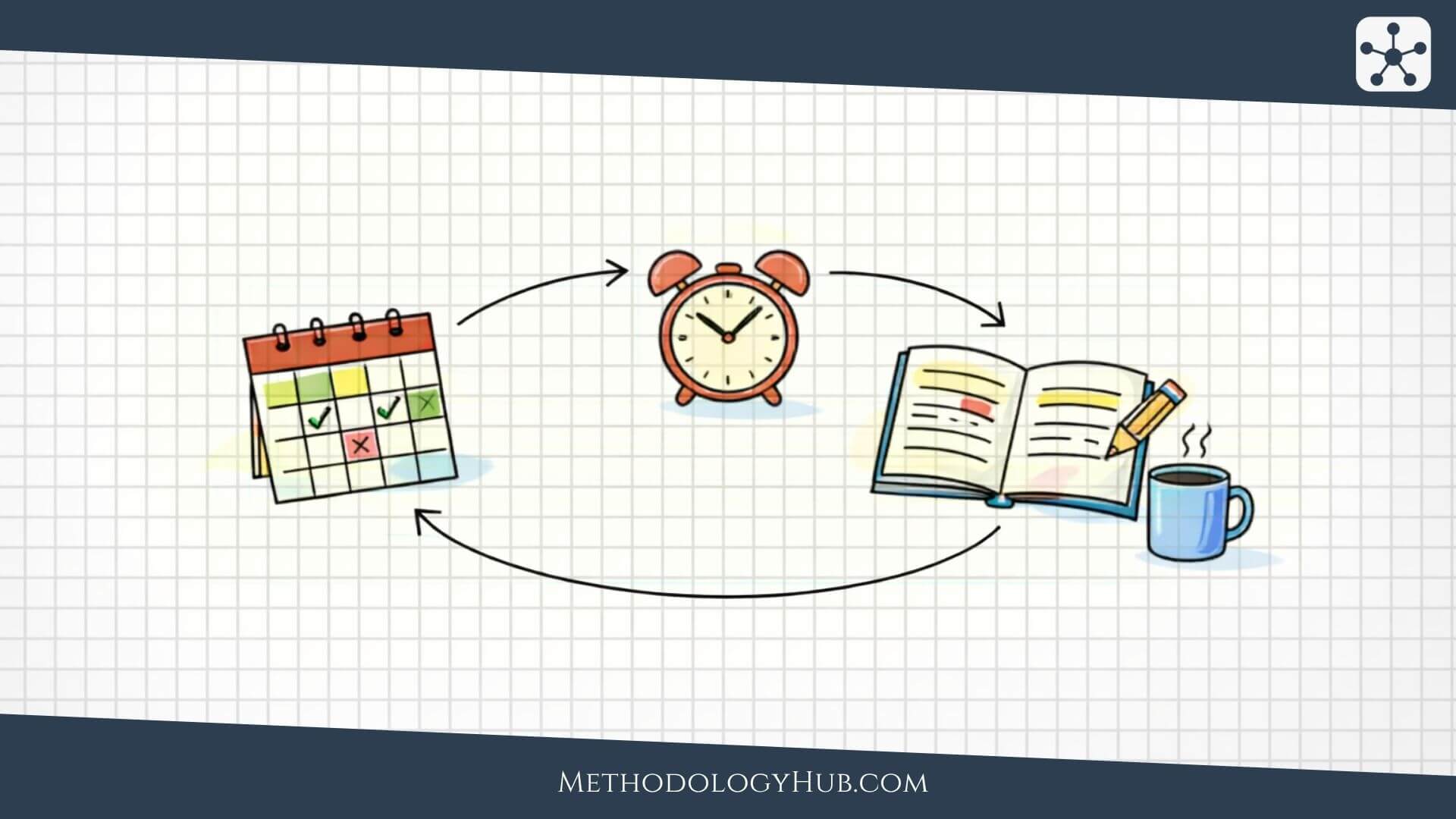
Time Blocking is a planning method that gives work a place on the calendar before the day starts slipping away. Instead of carrying a list of good intentions and hoping the right tasks happen at the right time, you decide in advance when deep work, admin, study, breaks, and small routine jobs will be done. The point is not to make the day look efficient. It is to stop important work from being left to whatever energy and time happen to be left over.
This article explains what time blocking is, why it works, who it helps most, how to start using it, and which versions of the method fit different kinds of work.
What is time blocking?
Time blocking is a planning method in which you assign parts of the day to specific kinds of work before the day gets crowded. A task list tells you what exists. A time block tells you when you will deal with it. That difference matters because many people are not short of intentions. They are short of protected time. They know what needs doing, but the work that matters keeps being pushed behind messages, low-effort admin, and the strange pull of whatever feels easiest to start.
At its simplest, time blocking means looking at the day or week and reserving time for the work that should happen. That could mean blocking 9:00 to 10:30 for writing, 11:00 to 11:30 for email, 2:00 to 3:00 for revision, and 4:00 to 4:30 for planning tomorrow. Some people use narrow, specific blocks. Others use broader labels such as “deep work”, “admin”, “reading”, or “meetings”. Both approaches can work. What matters is that the calendar begins reflecting priority rather than leftovers.
The method is often associated with productivity, but its real value is simpler than that. It reduces uncertainty. When a task has a place, you do not have to renegotiate with yourself every half hour about whether now is the moment to begin. You may still resist the work. Time blocking does not remove human nature. But it does remove some of the fog around what should happen next.
It also exposes reality very quickly. A to-do list can hold thirty tasks without blinking. A calendar cannot. The moment you begin assigning blocks, you can see whether your plan fits the week you actually have. That makes time blocking useful even when the schedule is imperfect. It forces contact with limits. If everything matters, the calendar will show that everything cannot happen in the way you first imagined.
What time blocking is not
It helps to clear away a few misconceptions. Time blocking is not a promise that every hour will unfold exactly as planned. It is not a rigid script in which one delayed phone call ruins your identity as an organised person. It is also not the same as stuffing every minute with activity. People sometimes assume the method is about squeezing more work into less time. Used well, it is often the opposite. It is a way of giving meaningful work enough space and giving the day enough shape that panic does not make all the decisions.
It is also not a requirement that every block contain one perfectly specified task. In real life, broader blocks often work better. A person may block “client work” or “revision” rather than writing a miniature screenplay for every fifteen minutes. Some jobs need that degree of detail. Many do not. The calendar is supposed to support action, not become another document you must maintain to feel productive.
Why time blocking works so well
Time blocking works because many daily problems are not really problems of knowledge. They are problems of structure. People often know what matters. They know the report needs writing, the chapter needs revising, the proposal needs attention, the reading needs to happen, and the forms still need to be submitted. The trouble is that all of those tasks are left sitting together in one mental pile. Without a structure, easier or noisier tasks often win by default.
A block changes that by turning intention into placement. Once the work lives somewhere concrete, it is harder for it to remain a vague moral burden hanging over the day. A calendar entry is not magic, but it creates a stronger agreement than a loose wish. The work has moved from “I should get to this at some point” to “this is what this part of the day is for.”
Another reason the method works is that it reduces decision fatigue. Small decisions are not harmless when they happen constantly. If you keep asking yourself what to do next, whether to start now, whether something smaller should come first, or whether you should reply to that message before doing the hard thing, you burn energy before the real work has even begun. Time blocking removes many of those micro-negotiations. The schedule is already answering some of the questions that normally clutter the start of a session.
It also protects focus by reducing context switching. A day built around random reactions asks the brain to keep changing mode. You might move from a creative task to two emails, then to a quick call, then back to the creative task, now slightly colder than before. The shift looks small on paper. In practice it leaves residue. Time blocking works best when it reduces those unnecessary resets and lets you stay in one kind of work long enough to become useful at it.
It makes the cost of tasks more visible
One quiet advantage of time blocking is honesty. Once you start scheduling work in actual chunks of time, you become harder to fool. A task that seemed small when it sat on a list starts showing its real size when it needs ninety minutes of calendar space. Repeatedly missing blocks also teaches you where your estimates are inflated or your habits are less reliable than you thought. That feedback is useful. It gives you something firmer than vague guilt.
The method can help emotionally as well. A calendar that has already made room for a task often calms the background pressure around it. The task is still there, but it is not floating loose. When email has a slot later, it is easier not to peck at it all morning. When revision is blocked tomorrow, it does not have to keep following you around as unfinished business. Time blocking does not remove responsibility. It reduces the feeling that every responsibility is demanding attention at the same time.
It works because it is visible
Some planning methods stay abstract. They exist in ideas, categories, or ranked lists. Time blocking is harder to ignore because it is visible. The week begins to show you what you are trying to do. Empty space becomes visible. Overpacked days become visible. Repeatedly avoided blocks become visible too. That visibility can feel uncomfortable at first, but it is part of why the method helps. A visible plan is easier to correct than a vague one.
A practical way to think about it: time blocking does not create discipline out of nowhere. It makes the next useful choice easier to see and easier to protect.
Of course, the method is not self-running. A person can build a beautifully blocked calendar and ignore it by 10:00 a.m. Time blocking works when the blocks reflect real priorities, realistic estimates, and enough flexibility to survive ordinary life. When those conditions are missing, the system starts to look strict while behaving like fiction.
Who time blocking helps most
Time blocking is not only for executives, students, or productivity hobbyists. It helps anyone whose day tends to fill itself before the important work begins. Still, some people benefit from it more immediately than others.
It is especially helpful for people whose workload contains different kinds of effort. If your day includes concentration-heavy work, meetings, messages, errands, reading, admin, and planning, the risk is not only that you will be busy. The risk is that the easiest category will leak into every open gap. Time blocking helps because it separates those categories and gives each one a container.
Students often benefit quickly from the method because studying competes badly with everything else when it is left vague. Revision, problem sets, reading, and essay work rarely shout as loudly as social media, tiredness, domestic chores, or last-minute errands. A blocked study session gives academic work a real claim on the day instead of letting it drift into whatever time is left after everything more immediate has happened.
Remote workers and freelancers also tend to find time blocking useful. When there is no strong external structure, the day can blur. Home and work start rubbing against each other. You can spend an hour being available without moving anything meaningful forward. Blocks help because they create internal structure where the environment may not provide much of it.
People who procrastinate can benefit too, though not always in the polished way they expect. Time blocking does not cure avoidance, but it can shrink the moment of decision that procrastination feeds on. The block says what this part of the day is for. That will not always make starting pleasant. It often makes starting less ambiguous, which is still useful.
When it feels hard at first
Some people resist time blocking because it feels restrictive. That reaction is understandable. If you already feel controlled by deadlines, messages, and obligations, adding blocks to a calendar can look like one more layer of pressure. In those cases the problem is often how the method is introduced. If every block is treated like a legal contract, the system becomes brittle and joyless very quickly. A better entry point is to block only the few parts of the day that genuinely need protecting and leave the rest looser.
It can also feel frustrating for people with unpredictable schedules, caring responsibilities, reactive roles, or chronic interruptions. Time blocking still helps there, but the form has to change. Broader blocks, floating blocks, buffer blocks, and smaller protected windows often work better than minute-by-minute plans. The method survives best when it bends around reality instead of trying to deny it.
So the short answer is simple. Time blocking helps most when your days contain enough freedom or enough chaos that important work can vanish unless you actively give it a place.
How to start time blocking
People often make time blocking harder than it needs to be. They imagine a system with coloured calendars, perfect estimates, and beautifully balanced weeks. That is one way to do it, but it is not a good starting point. A better beginning is much plainer. Look at what needs doing, notice what kind of effort it requires, and decide where in the day it will live.
The first useful step is to gather your work into categories rather than staring at a long, shapeless list. You might have focused work, meetings, admin, study, errands, communication, exercise, and recovery. Categories matter because they make the calendar easier to read and easier to build. If you try to schedule fifteen tiny fragments separately at the start, the system quickly becomes exhausting.
The second step is to estimate with more honesty than optimism. Most people are much kinder to their future selves than reality permits. They assign forty-five minutes to a task that usually takes ninety. They forget transition time. They ignore mental fatigue. They assume the hardest block will happen at a level of concentration they rarely possess at that hour. Honest blocking begins when you stop rewarding fantasy with calendar space.
Then comes placement. Put the work that matters most into the week before the less important pieces begin colonising the open areas. If your best mental energy happens in the morning, protect that period for the hardest work. If you know your attention is poor after lunch, place lower-cognitive tasks there on purpose rather than acting surprised each day. Time blocking gets stronger when it follows your real pattern of energy instead of your idealised one.
Once the main blocks are in place, add buffers. This part is easy to skip because blank space can feel wasteful. It is not wasteful. It is what keeps the plan alive when something runs long or life behaves like life. A schedule that has no spare air in it often collapses after the first delay.
Start small enough to trust yourself
A useful beginner mistake to avoid is overcommitting on day one. If you go from no structure to a fully blocked week with no margin, you will probably spend the first few days breaking your own system. That teaches the wrong lesson. The lesson becomes “time blocking does not work for me” when the real problem was an overbuilt first draft.
A smaller and better start is to protect only two or three important blocks per day and give the rest of the schedule a looser frame. That may not look impressive, but it is more likely to survive contact with reality. Once you trust the method, you can build more detail into it.
It also helps to distinguish between recurring blocks and one-off blocks. Many people benefit from giving certain categories a repeating place. Email at 11:30. Planning at 4:30. Weekly review on Friday afternoon. Recurring blocks reduce setup work because you are no longer making the same decision from scratch every day.
How to implement time blocking in your study routine
Time blocking is especially useful for study because studying rarely wins on urgency alone. Unless an exam is tomorrow morning, there is usually something louder nearby: a message, a chore, a friend, a scroll, a sudden desire to reorganise your desk, or the noble-sounding plan to “start properly later”. A blocked study session turns academic work from a vague obligation into a timed commitment with a doorway.
The simplest study version begins by separating types of study instead of treating all academic work as one undifferentiated block. Reading, active recall, essay writing, note consolidation, problem practice, and revision do not ask for the same kind of energy. If you label every session simply as “study”, you make it easier to drift because the session starts too vaguely. A clearer label makes the beginning more concrete.
It also helps to place subjects according to mental demand. Harder material deserves better hours when possible. A dense subject that requires reasoning and memory usually belongs in a stronger attention window than low-pressure review or formatting notes. Many students do the opposite because they start with easy work to warm up. The warm-up quietly becomes the day. Time blocking can correct that by protecting the stronger part of the day for the harder material before fatigue starts making decisions.
Another practical habit is to block study in shorter units than you first imagine. People often schedule four heroic hours of revision and then feel guilty when the block dissolves. In reality, two good ninety-minute sessions with a break may do more than one giant block that never fully gets traction. The right size depends on the task, but the general rule is to choose a block length that you can enter with seriousness instead of drama.
Weekly and daily study blocking
Study blocking works best on two levels. At the weekly level, you decide where the major sessions will sit. This gives revision a skeleton. At the daily level, you decide exactly what the current block is for. This gives the session a spine. Without the weekly layer, study keeps getting displaced. Without the daily layer, the session starts vaguely and burns time on uncertainty.
A weekly plan might place maths practice on Monday and Thursday mornings, reading-heavy work on Tuesday afternoon, essay drafting on Wednesday, and mixed review on Sunday. Then, inside the Wednesday essay block, the daily plan might specify “draft introduction and first section” instead of “work on essay”. The weekly block protects the time. The daily instruction makes the time usable.
Breaks matter in study blocking too. Students sometimes treat breaks as weakness, then wonder why the third hour becomes dull and passive. Planned breaks protect quality. They also help the session feel psychologically manageable. When you know there is a real pause coming, it is easier to commit to the current stretch of effort.
A study rule worth keeping: block the method, not only the subject. “Biology – flashcards and retrieval practice” works better than “Biology” if you want the session to start with less drift.
During exam periods, study blocks often need to become more frequent and more specific. Earlier in the term, broader weekly blocks may be enough. Closer to deadlines, it helps to assign blocks to exact chapters, past papers, essay sections, or revision goals. The closer the pressure, the more useful concrete blocks become.
At the same time, students should be careful not to let time blocking turn into moral theatre. A calendar full of blocks is not proof of learning. What matters is whether the sessions contain real effort, retrieval, practice, and adjustment. A modest blocked plan that is actually followed beats a perfect revision calendar that functions like wall art.
Time blocking methods
Time blocking is not a single rigid technique. It is a family of ways to assign time on purpose. The best version depends on the kind of work you do, how predictable your days are, and how much detail helps rather than harms you. Some people need a tighter frame. Others need a looser structure that can absorb interruptions without shattering. The point is not to find the most impressive method. It is to find the one that stays useful after real life pushes back.
Fixed time blocks
Fixed time blocks are the clearest version of the method. A given part of the day is repeatedly reserved for a certain kind of work. Monday to Friday from 9:00 to 11:00 is writing. Every weekday at 4:30 is admin. Saturday morning is revision. The value here is stability. Repetition reduces setup and helps the routine become normal rather than negotiable.
This approach works well when your schedule is fairly predictable or when a certain kind of work is important enough to deserve a standing appointment. It is especially helpful for deep work, study, exercise, and recurring maintenance tasks that otherwise keep drifting.
The downside is obvious. Fixed blocks can become awkward when life is volatile. They also create frustration if the recurring time slot is too idealised. A person may keep reserving 7:00 a.m. for complex work because it looks disciplined while repeatedly showing up half-awake. Fixed blocks help most when they are built around patterns you actually have, not a fantasy version of yourself.
Flexible time blocks
Flexible blocks protect the category of work without tying it to one immovable slot. Instead of saying “this task must happen from 2:00 to 3:00”, you may decide that it needs one block somewhere in the afternoon, or two blocks before Thursday. This version helps people whose schedules shift frequently or whose days include too many variables for minute-level planning to survive.
Flexible blocks still require boundaries. Without a limit, flexibility turns back into vagueness. The block must still have a window and a purpose. The difference is that it can move inside that window when necessary.
This approach is useful for caregivers, reactive roles, students with fluctuating timetables, and anyone whose day regularly changes shape. It protects the work while admitting that rigid placement is sometimes unrealistic.
Priority-based time blocking
Priority-based blocking starts with importance rather than convenience. Before you place tasks on the calendar, you decide which work deserves the best part of your attention. Then those blocks go in first. Everything else is fitted around them.
This is one of the strongest versions of the method because it corrects a common failure. Many people block the week in the order tasks come to mind or in the order other people demand things. Priority-based blocking flips that. The report, revision, proposal, design work, or difficult decision goes in before email, tidying, and the lesser debris of the day.
It works best when you are honest about what really counts as high-priority work. Some people secretly protect the work that feels safest rather than the work that matters most. The calendar can expose that if you let it.
Time blocking by task type
This method groups blocks by the kind of work being done. Communication lives in one block. Admin in another. Deep project work in another. Reading, planning, and errands each have their place. It is closely related to task batching, but it works at the level of calendar design rather than only grouping tasks on a list.
Blocking by task type helps because each category asks for a different mental posture. If you keep sliding between them without a plan, the day becomes more tiring than it looks. By putting similar work together, you reduce restart costs and make it easier to stay in one mode long enough to get traction.
This is often the most practical entry point for beginners because categories are easier to estimate than dozens of tiny isolated tasks.
Energy-based time blocking
Energy-based blocking matches the block to the kind of attention you are likely to have at that time of day. When energy is high, you schedule demanding work. When energy is lower, you place routine, admin, or socially responsive tasks there instead.
This sounds obvious, yet many people do the reverse. They spend their best hours on shallow tasks because those tasks are easier to complete quickly, then try to squeeze difficult thinking into the leftovers. Energy-based blocking is valuable because it respects the fact that not all hours are equally useful for all kinds of work.
It requires observation. You need to notice when your mind is actually sharp, when you tend to fade, and which tasks reliably deteriorate when placed at the wrong time. That self-knowledge makes the blocks more durable.
Day theming
Day theming is a larger version of time blocking in which whole days or large parts of days are reserved for a dominant category of work. One day may lean toward meetings, another toward creative work, another toward operations or study. The advantage is depth. Instead of fragmenting the week into tiny pieces, you reduce switching by letting a day keep one general identity.
This can work extremely well for managers, creators, freelancers, and students who have enough control over their schedule to shape days differently. It can also be easier to maintain than detailed hourly blocking because the rule is broader. Tuesday is for client work. Friday afternoon is for planning and review.
The trade-off is that theming is less precise. You still need smaller blocks within the day, especially if the themed area contains several different tasks. But as a top-layer structure, it can make the week feel far less fragmented.
Buffer blocks
Buffer blocks are reserved stretches of time for overflow, catch-up, transitions, or the ordinary unpredictability that ruins overpacked plans. They often look unproductive from the outside, which is why people skip them. That is a mistake. A schedule without buffers assumes a fantasy world where meetings end cleanly, tasks match estimates, and no one interrupts you with anything real.
Buffer blocks are what make time blocking resilient. They absorb spillover. They give delayed tasks somewhere to go. They stop one mistake from polluting the rest of the day. In some roles, buffers are not optional. They are the reason the system works at all.
Eisenhower-informed time blocking
This method combines prioritisation with scheduling. First you sort tasks using the logic of the Eisenhower Matrix – urgent and important, important but not urgent, urgent but less important, neither. Then you block time based on that judgment. Important but not urgent work should receive protected blocks before it becomes a crisis. Urgent but low-value tasks are contained, delegated, or placed in smaller admin windows.
This version is powerful because it stops the calendar from being captured entirely by urgency. It helps especially when your workload contains many incoming demands that look pressing but are not equally meaningful. The matrix gives you a filter. Time blocking then gives the filtered tasks a home.
Hybrid blocking
In real life, many people end up using a hybrid. They may have fixed blocks for recurring priorities, flexible blocks for shifting project work, energy-based placement for deep tasks, and buffer blocks to keep the structure alive. That is often the healthiest version because it borrows enough rigidity to create shape and enough flexibility to remain believable.
The main point is that time blocking is not a religion. If one version makes you spend more time managing the calendar than doing the work, it is the wrong version for you. A useful system should reduce friction, not create a second workload around planning itself.
How to build a time blocking schedule that actually works
A working schedule is different from an attractive schedule. Attractive schedules are usually tidy, full, and unrealistically confident. Working schedules make room for delay, doubt, fatigue, and tasks that turn out to be larger than they first looked. If you want time blocking to survive beyond a few optimistic days, the structure has to be honest enough to live in.
The first principle is to block less than you think you can. Most people plan with their most ambitious self in mind and then judge the method when ordinary life fails to match that picture. A stronger approach is to protect fewer blocks and make them more credible. It is better to complete three serious blocks and leave the day feeling coherent than to watch eight blocks collapse into a mess of rescheduling and self-reproach.
The second principle is to protect the hardest work first. If you know one task truly matters, do not place it in the thin air left after meetings, calls, and energy drain. Give it a block when your attention is more likely to hold. This sounds obvious, yet many schedules still hide important work inside the weakest part of the day because the earlier hours were spent on what felt immediately manageable.
The third principle is to plan for movement. A block missed at 10:00 should not have to disappear from the week entirely. Working schedules usually contain somewhere a block can slide, shrink, or be replaced. This is why weekly planning matters. The day is often too narrow a frame to rescue lost work gracefully. The week gives you more room to recover.
It also helps to define what counts as success inside a block. If a 90-minute writing block has to produce a finished section every time, you may start avoiding it. If the block is considered successful when real progress happened, even if the piece is still rough, it becomes easier to keep showing up. Blocks need standards, but the standards should match how real work behaves.
Another practical point is to avoid making every block equally precise. Overprecision can make the schedule feel fragile. Some sessions benefit from a narrow instruction. Others work better as broader containers. The art is deciding which is which. If vague blocks let you wander, tighten them. If overly scripted blocks make you rebel, loosen them.
Finally, review matters. A schedule only becomes intelligent when it learns from your actual week. Which blocks were repeatedly interrupted? Which categories took longer than planned? Which times of day consistently held up well? Which blocks looked good but got ignored? Without review, time blocking stays static. With review, it becomes more tailored and more believable.
Common time blocking mistakes
Most failures with time blocking do not come from the basic idea. They come from how people interpret it. The calendar ends up carrying fantasy, guilt, or excessive control rather than a workable plan.
Overpacking the day
This is the classic mistake. Every hour is spoken for. Breaks are symbolic or absent. Tasks are estimated with impossible optimism. The schedule looks strong at 8:00 a.m. and becomes fiction by noon. Overpacking usually comes from wanting to feel in control. In practice it creates a day that cannot absorb anything real.
Making blocks too specific or too vague
Both extremes cause trouble. A block titled “finish the entire presentation, answer all messages, and plan next week” is not a block. It is a threat. On the other hand, a block labelled simply “work” may be too empty to start cleanly. Good blocks give enough direction to act and enough space for work to unfold without becoming mechanical.
Ignoring transition time
Many calendars pretend the mind can change gears instantly. Meetings end at 11:00 and deep work begins at 11:00. The call finishes and high-quality writing starts at once. In real life there is friction, residue, and often a need to reset. Ignoring that makes the schedule look more efficient than it is.
Using the calendar as moral theatre
Some people become better at designing blocked weeks than living them. The system becomes a performance of seriousness. Colour-coded blocks multiply, but the follow-through stays thin. This mistake is easy to make because planning feels cleaner than work. The cure is simple and slightly uncomfortable: judge the system by what gets done, not by how satisfying it looks while empty.
Refusing to adapt
A block is not a courtroom order. If a pattern keeps failing, the system should change. Some people keep forcing the same impossible morning routine or the same unrealistic block length because changing it feels like weakness. It is not weakness. It is learning. A time blocking system that cannot adapt will train you to distrust it.
Conclusion
Time blocking works because it answers a question that ordinary to-do lists often leave open: when is this actually going to happen? That question sounds simple, but it changes a lot. Once work has a place, it is harder for the day to be built entirely out of reaction, convenience, and shallow urgency. The block does not remove resistance, distraction, or fatigue. It gives those forces less empty ground to spread across.
The method becomes most useful when it stays practical. Protect the work that matters. Match blocks to your real energy. Leave room for delays. Use tighter blocks where clarity helps and looser ones where reality demands flexibility. Learn from the blocks that fail instead of treating failure as proof that the whole idea is too rigid for you.
In the end, time blocking is not about controlling every minute. It is about deciding where attention will go before the day starts bargaining with you. That is why a modest blocked schedule that reflects real life is more valuable than a perfect one that exists only in theory.