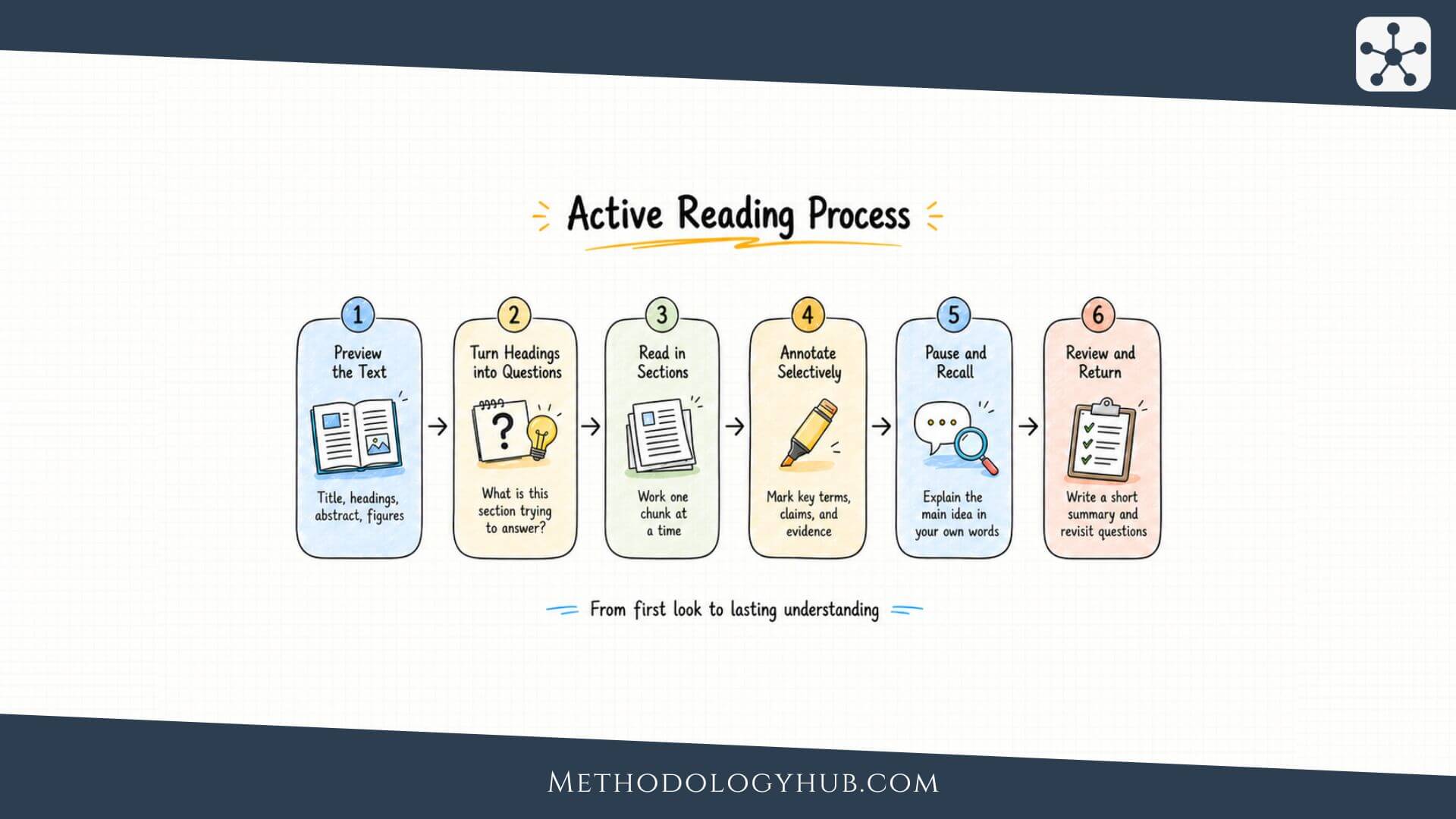
Active Reading is a way of reading that keeps the reader mentally involved before, during, and after the text. Instead of moving through pages and hoping the meaning will settle on its own, an active reader previews the structure, asks questions, marks carefully, pauses to check understanding, and returns to the material when the first reading is no longer enough.
This article explains what active reading is, how it works, how to use it with academic texts, which strategies are most useful, where the approach needs adjustment, and which mistakes turn it into busy work rather than better understanding.
What Is Active Reading?
Active reading is the habit of working with a text instead of simply looking at it. The reader does not wait until the end of a chapter to find out whether anything has been understood. They start building meaning early. They notice the title, headings, terms, claims, examples, diagrams, and transitions. They ask what the text seems to be doing. They check whether each section has answered the question that brought them into it.
That does not mean reading every sentence slowly or filling the page with notes. Active reading is not a punishment for difficult material. It is a way to give reading a shape. A student reading a textbook chapter, a researcher reading a journal article, or a class preparing for discussion all face the same basic problem: words can pass by smoothly while understanding stays thin. Active reading makes that gap harder to ignore.
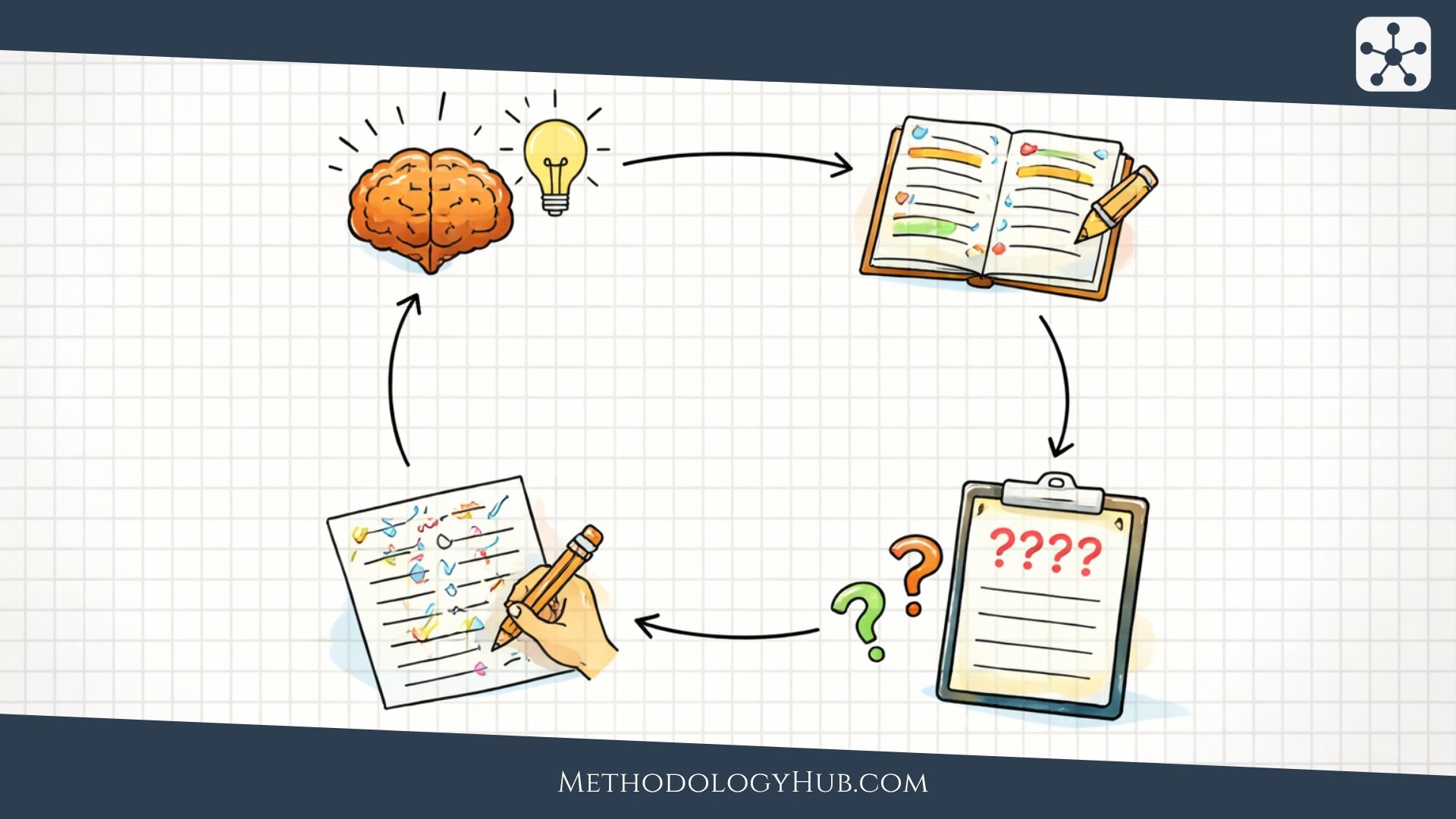
The easiest way to see the difference is to compare two reading sessions. In the first, the reader starts at the first line, highlights anything that sounds important, reaches the end, and feels vaguely familiar with the topic. In the second, the reader previews the chapter, turns headings into questions, reads one section at a time, writes short notes in their own words, and tries to explain the main point before going on. The second session takes more intention, but it gives the reader more evidence about what was actually understood.
Active reading definition
Active reading is a purposeful reading process in which the reader interacts with a text through previewing, questioning, annotating, summarising, checking comprehension, and reviewing. It is used to improve understanding, retention, analysis, and later use of written material.
The word active can be misleading if it is taken too literally. The reader does not need to do something visible every few seconds. Sometimes the most important activity is mental: noticing confusion, connecting a definition to an earlier idea, predicting what a section will explain, or deciding that a paragraph is support rather than the main claim. Underlining and note-taking can help, but they are tools, not the whole method.
In practice, active reading usually includes several small moves:
- previewing the text before close reading
- asking questions that give each section a purpose
- marking only the parts that will help later
- writing brief notes in your own words
- pausing to recall the main idea without looking
- reviewing the text after the first reading
These moves are simple, but they change the reading session. The text stops being a stream of sentences and becomes something to inspect, organise, and test. That is especially useful in academic reading, where understanding often depends on structure as much as individual facts.
How Active Reading Works
Active reading works because it changes the reader’s relationship to the text. Instead of treating understanding as something that either happens or does not happen, it treats understanding as something that can be built, checked, repaired, and strengthened. That may sound formal, but the process is often quite natural once the reader gets used to it.
Most weak reading sessions fail quietly. The reader is not confused enough to stop, but not clear enough to explain the section either. The text feels familiar while it is visible, which creates a false sense of progress. Active reading adds small interruptions to that smoothness. It asks the reader to predict, select, restate, and recall. Each interruption gives the reader a chance to notice whether the text has become usable knowledge or only passing recognition.
It gives the reader a frame before detail
One reason active reading helps is that it begins before close reading. A quick preview gives the reader a sense of the shape of the material. Headings, abstracts, introductions, summaries, diagrams, and section breaks all tell the reader what kind of text they are about to enter. That first frame does not solve the text, but it gives details somewhere to go.
Without that frame, details can arrive as separate pieces. A definition appears, then an example, then a contrast, then a figure, and the reader has to guess how they belong together. With a frame in place, the reader can begin sorting those pieces earlier. This is one reason active reading often feels calmer than ordinary rereading. The reader is not waiting for meaning to appear at the end. They are arranging it as they go.
It turns attention into a task
Attention is easier to maintain when it has a job. A heading such as “working memory and comprehension” can be read as a label. A question such as “How does working memory affect comprehension?” gives the section a purpose. That small shift can change the whole feeling of the page. The reader is no longer passing through a block of text. They are looking for an answer.
This is especially helpful in long academic readings. Many assigned texts are not written to entertain. They build ideas slowly, repeat terms, refer to prior research, and assume patience. Questions keep the reader from drifting through that density without a target. They also help decide which parts deserve closer attention and which parts are only background.
It checks memory before the end
A useful reading session should include moments when the text is not visible. That is uncomfortable at first, but it is one of the cleanest checks on understanding. If you can cover the page and explain the section in plain language, the material is becoming available. If you cannot, something needs another pass.
This does not have to be dramatic. After a subsection, the reader can look away and ask: What was the point? Which terms were introduced? What example carried the explanation? How did this section connect to the previous one? Even a thirty-second recall attempt can show more than five minutes of passive rereading.
It separates useful marking from page decoration
Highlighting is often associated with active reading, but highlighting alone is weak. A marked page can look productive while the reader has done very little thinking. Active reading changes the role of marking. The reader marks because something answers a question, defines a term, gives evidence, sets up a contrast, or will need to be found again.
Good marking is selective. It leaves most of the page untouched. That restraint is part of the skill. When too much is marked, nothing stands out. When marking is tied to questions and later recall, it becomes a navigation system instead of decoration.
How to Use Active Reading
Active reading becomes easier when it is treated as a flexible process rather than a strict ritual. The same routine will not fit every article, textbook chapter, essay, or primary source. A short reading for discussion may need only a light version. A difficult theoretical chapter may need a slower one. The aim is not to perform every possible strategy. The aim is to stay engaged enough that the text can be understood, remembered, and used.
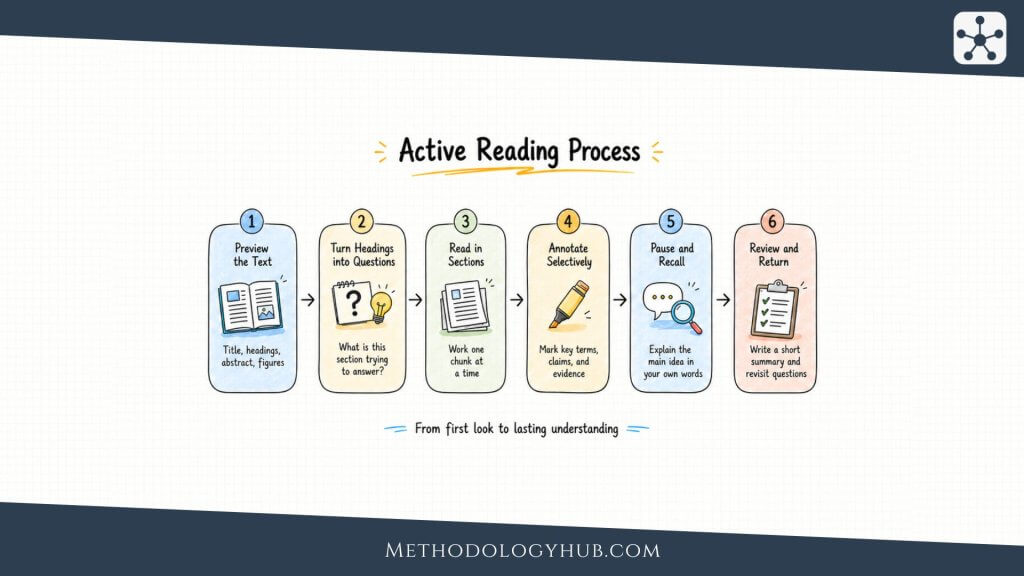
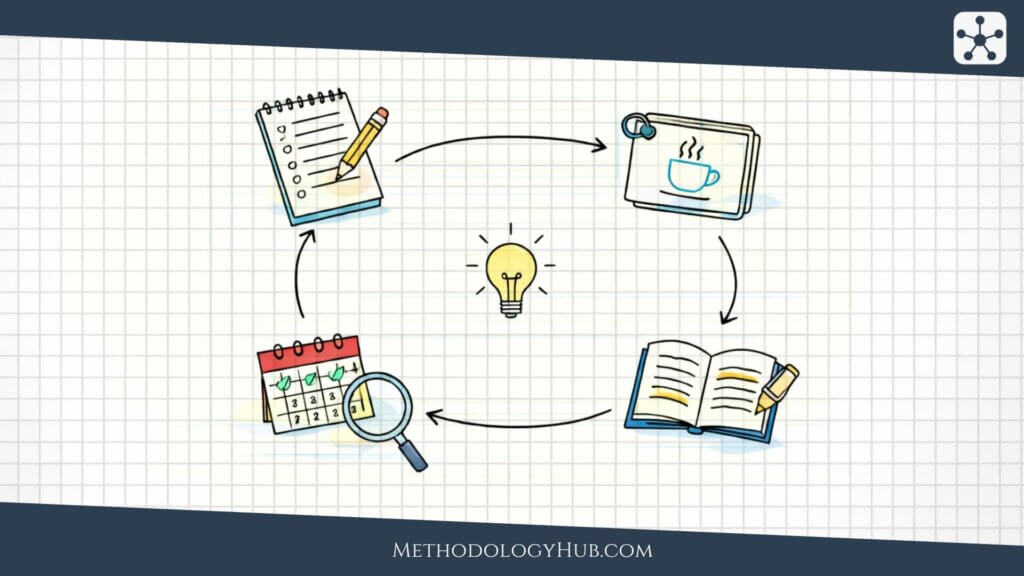
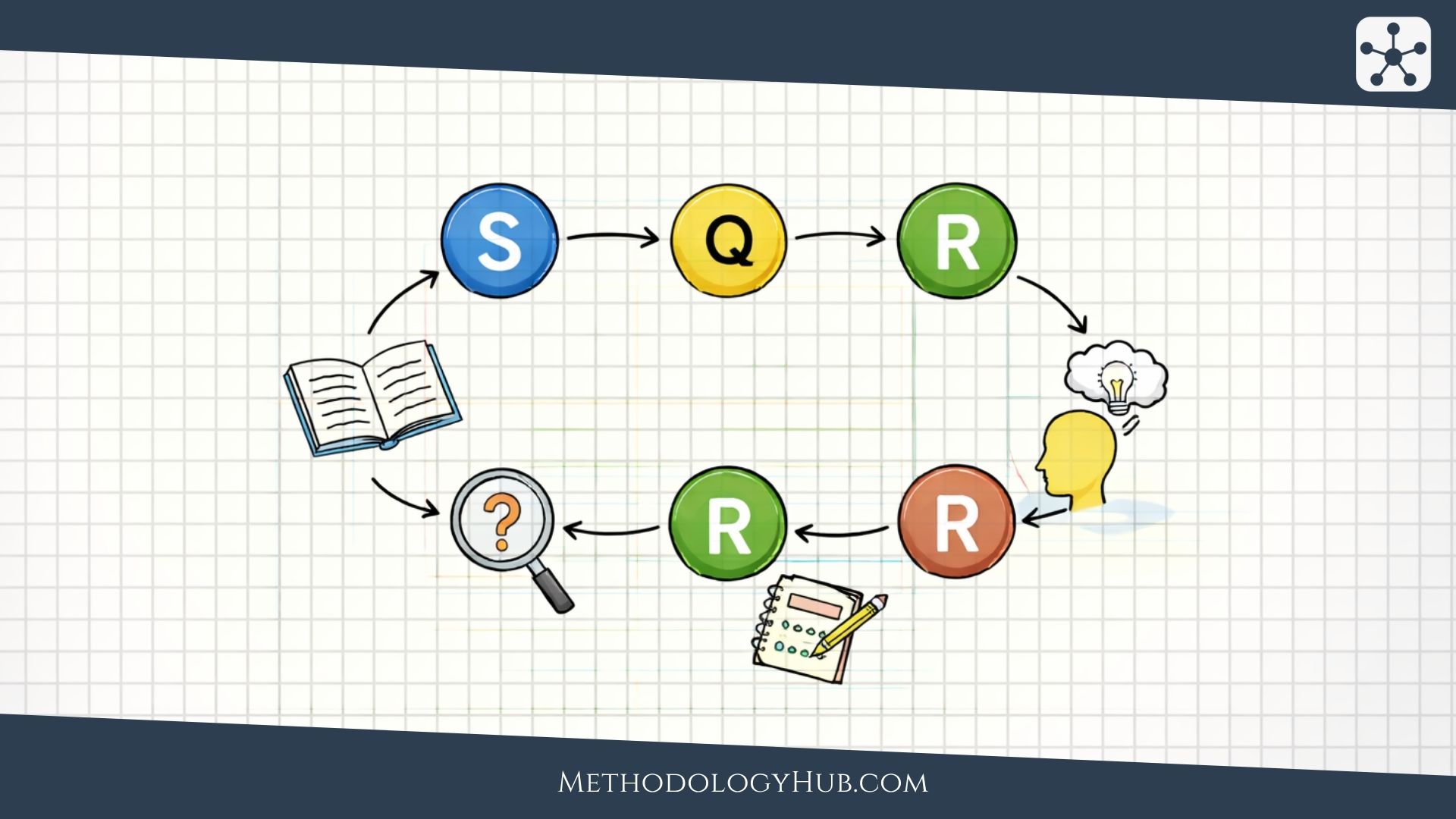
A practical active reading session can be built around six steps: preview, question, read in sections, annotate selectively, pause to recall, and review. These steps do not need to feel mechanical. With practice, they begin to blend into a normal reading rhythm.
Step 1 – Preview the text before close reading
Begin by looking at the title, headings, introduction, conclusion, abstract, figures, summary sections, and any visible structure. This first pass should be quick. You are not trying to understand the whole text yet. You are trying to work out what kind of reading you are about to do.
In a textbook chapter, the headings may reveal the sequence of ideas. In a journal article, the abstract and section headings may show the purpose, method, findings, and interpretation. In a theoretical essay, the introduction and conclusion may show the claim before the middle pages complicate it. That early orientation prevents the first page from carrying too much weight.
- look at the title and section headings
- read the introduction and conclusion lightly
- notice figures, tables, bold terms, and summaries
- ask what the text seems to be explaining or arguing
Step 2 – Turn headings and goals into questions
Once you have a rough map, give the reading a few questions. These questions do not need to be elegant. They need to be useful. A heading can become a question. A course objective can become a question. A confusing term can become a question. The point is to create a reason to read each section.
For example, a heading such as “limits of working memory” can become “What limits working memory during reading?” A section on “methods” in a research article can become “How did the researchers collect and analyse the data?” A chapter on historical causes can become “Which causes does the author treat as central, and how are they connected?”
Questions also make later review easier. Instead of returning to a page full of disconnected notes, the reader returns to prompts. Each prompt asks for an answer, and each answer shows whether the reading has stayed available.
Step 3 – Read in sections, not in one long push
Many readers lose control of a text because they treat the whole assignment as one continuous block. Active reading works better in smaller units. Read a section, pause, check the question, and decide what the section added. Then move on.
The right section size depends on the text. In a textbook, one heading may be enough. In a dense article, a few paragraphs may be plenty. In a familiar topic, several pages may be manageable. The test is simple: stop at a point where you can still say what has happened. If you wait until everything blurs together, the next step becomes harder.
Step 4 – Annotate selectively
Annotation should help future thinking. It should not become a second copy of the text in the margin. Mark definitions, central claims, evidence, contrasts, examples, and points of confusion. Write short notes that say what a paragraph is doing or how one idea connects to another. Use question marks when something needs repair. Use brief summaries when a paragraph has finally become clear.
Good annotation often sounds plain. “Definition of retrieval practice.” “Example of subgroup difference.” “Author’s main objection.” “This evidence is narrower than the claim.” Notes like these are useful because they tell you how to return to the text. They are not trying to impress anyone. They are trying to make the reading usable.
Practical rule: mark the sentence because it does a job, not because it sounds important.
Step 5 – Pause and recall in your own words
After a section, look away from the page and answer your question. Say the point aloud, write a two-line summary, or explain the idea as though a classmate had asked for help. The wording should be yours. If your explanation still sounds like copied textbook language, the idea may not be fully yours yet.
This step is where active reading often becomes honest. It is easy to recognise a sentence when it is visible. It is harder to produce the idea without support. That difficulty is useful. It shows the exact place where rereading, clarification, or a better note is needed.
Step 6 – Review before the material goes cold
Review does not mean rereading everything. It means returning to the questions, notes, and marked sections after a delay. Start by recalling before looking. Then check the text. Strengthen weak areas. Add a missing connection if a section now makes more sense. Remove or ignore notes that turned out to be less useful than they first seemed.
A short review later the same day can be enough for ordinary readings. For exam material or research writing, another review after a day or two is often useful. The delay is part of the process because it shows what survived the first session.
Active Reading Strategies
There is no single active reading strategy that works for every text. Some readings need questions. Some need diagrams. Some need margin notes. Some need slow translation into simpler language. The best strategy is the one that fits the task in front of you and produces a clearer grasp of the text.
Still, several strategies appear again and again because they solve common reading problems. They help readers enter a text, stay with it, identify what is important, and check whether the ideas can be used later.
Previewing for structure
Previewing is useful when a text feels large or unfamiliar. Before reading closely, look at how the material is arranged. Notice whether the text moves from definition to example, problem to solution, claim to evidence, chronology to interpretation, or method to findings. That structure gives the reader a first path through the material.
Previewing is especially helpful with textbooks and journal articles because those texts often announce their organisation openly. Headings, abstracts, tables, and summaries are not decorations. They are clues about how the author expects the reader to move.
Questioning before and during reading
Questioning is one of the most flexible active reading strategies. It can be used before reading, during reading, and after reading. Before reading, questions prepare attention. During reading, they keep the reader from drifting. After reading, they become review prompts.
The best questions are specific enough to guide attention. “What is this section about?” is sometimes too loose. “What distinction is the author making between recognition and recall?” is stronger. “Which evidence supports the claim?” is stronger still when the text is argumentative or research-based.
Annotating with restraint
Annotation can turn reading into thinking, but only when it is selective. A useful annotation tells you what a part of the text does. It may identify a definition, question an assumption, mark a connection, or record a short summary. A weak annotation simply repeats the text or marks so much that the page becomes noisy.
One way to keep annotation under control is to use a small set of purposes. Mark only definitions, main claims, evidence, questions, and connections. That limited system is usually enough. It also prevents the common habit of treating every polished sentence as equally important.
Summarising in plain language
Summarising is where the reader finds out whether the text has been understood well enough to compress. A useful summary is not a shortened copy. It is a translation. The reader states the point in simpler language while keeping the meaning accurate.
Short summaries are usually better than long ones. At the end of a section, write one or two sentences. What was the section trying to explain? What did it add to the larger text? Which term, claim, or example would be needed later? If the summary becomes a paragraph of copied phrases, it may be hiding uncertainty rather than solving it.
Mapping relationships between ideas
Some texts are difficult because the ideas are related in several directions at once. In those cases, a concept map or simple outline can help. The reader can show how a definition leads to a distinction, how a cause connects to an effect, or how evidence supports a conclusion.
Mapping is especially useful in theoretical chapters, literature reviews, and texts with many categories. It slows the reader down enough to see relationships that might otherwise remain buried in paragraphs. It also helps with writing later because the reader already has a rough structure for explaining the material.
Self-explaining while reading
Self-explanation means stopping to explain a sentence, paragraph, example, or diagram to yourself. It is useful when a text sounds clear but still feels slippery. The reader asks: What does this mean? How does it connect to the previous point? What would be an example? What would be a non-example?
This strategy is quiet but powerful. It prevents the reader from borrowing clarity from the author’s wording. If a passage cannot be explained in simpler terms, it probably needs more work.
Using rereading carefully
Rereading is not useless. It becomes weak when it is the only strategy. Active rereading has a purpose. The reader goes back to answer a question, clarify a term, check evidence, repair a summary, or connect two sections. That kind of rereading is different from starting over because the first pass was too passive.
Before rereading, name the problem. Are you confused by a term, a sentence, a structure, a method, or a claim? Once the problem is named, the second pass becomes targeted. Without that target, rereading may feel safe while adding little.
Active Reading vs Passive Reading
Active reading vs passive reading is one of the simplest ways to understand why two people can spend the same amount of time with a text and leave with very different results. One reader moves through the pages smoothly, recognises the topic, and feels that the material was mostly clear. Another reader keeps stopping, asking questions, marking only what helps, and checking whether the main idea can be explained without looking back. The difference is not effort alone. It is the way attention is used.
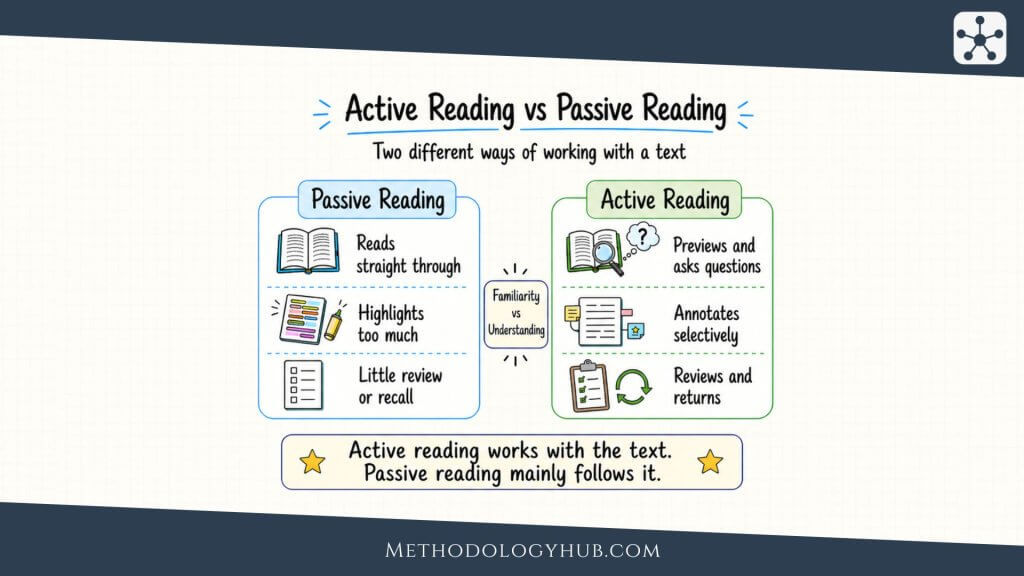
Passive reading is often the default. The reader begins at the first line, follows the text in order, and assumes that understanding will collect gradually by the end. Sometimes that is enough. A short announcement, a simple set of instructions, or a familiar explanation may not need much more. But academic reading usually asks for more than recognition. It asks the reader to remember, compare, discuss, cite, apply, or question the material later. That is where passive reading begins to show its limits.
Active reading changes the task. Instead of waiting for the text to become clear on its own, the reader gives the reading a job. They preview the structure, turn headings into questions, read in sections, annotate selectively, summarise in their own words, and return to the material after the first pass. The text is no longer treated as something to get through. It becomes something to work with.
What passive reading looks like
Passive reading is not laziness. Many careful students read passively because it feels natural and because school often rewards finishing assigned pages. The reader may sit quietly, move through every paragraph, and highlight sentences that sound important. From the outside, the session looks serious. The problem appears later, when the reader tries to explain the chapter and realises that the clearest parts were clearest only while the book was open.
This happens because passive reading can confuse recognition with understanding. A sentence may feel familiar the second time it appears. A definition may seem obvious while it is printed in front of the reader. A paragraph may feel convincing because its wording is smooth. None of that proves that the reader can recall the idea, connect it to another concept, or use it in a discussion.
Passive reading often includes habits such as:
- starting the text without previewing its structure
- reading from beginning to end without clear questions
- highlighting broad passages instead of selecting key ideas
- copying notes without changing the wording
- reaching the end without checking recall
- reviewing only when the material already feels distant
The difficulty is that passive reading can feel comfortable. There is little friction. The reader does not have to stop, decide, summarise, or test memory. But the comfort can be misleading. Academic texts often need small interruptions, because those interruptions reveal whether the text is becoming clear enough to use.
What active reading looks like
Active reading is more deliberate, but it does not have to be slow or complicated. The active reader begins by looking at the shape of the text. They notice the title, headings, abstract, introduction, figures, conclusion, and any repeated terms. That first look gives the reading a rough frame. Then the reader creates questions that guide attention. A heading becomes something to answer rather than a label to pass.
During the reading itself, the active reader works in manageable sections. They pause after a subsection or a few paragraphs and ask what has been added. If the answer is unclear, they slow down before the confusion spreads. Annotation stays selective. A note may capture a definition, a claim, a piece of evidence, a contrast, or a connection to another reading. The point is not to decorate the page. The point is to leave useful marks for later thinking.
After reading, the active reader checks memory. They may close the text and write a two-sentence summary, answer the questions they created earlier, or explain the section aloud in plain language. This step can feel less pleasant than rereading, but it is often where the real difference appears. If the idea cannot be stated without the page, the reader has found something worth repairing.
The main difference is control
The strongest difference between active and passive reading is control. Passive reading lets the text set the pace and shape of the session. Active reading gives the reader more control over purpose, attention, selection, and review. That control does not make the reader independent from the text. It simply means the reader is no longer carried along by it.
Active reading also helps with memory because it brings recall into the session early. Passive reading often postpones the test until much later, sometimes until an exam, seminar, or essay deadline. By then, weak understanding is harder to fix. Active reading checks sooner, when the text is still fresh and the reader can repair gaps with less effort.
Active Reading for Academic Texts
Academic reading often asks more from the reader than ordinary informational reading. The text may contain definitions, theories, evidence, methods, qualifications, counterarguments, and references to other work. It may also assume background knowledge that the reader does not fully have. Active reading helps because it gives the reader a method for handling density without pretending that every sentence deserves the same kind of attention.
The form of the text should shape the way active reading is used. A textbook chapter, a journal article, a theoretical essay, and a historical primary source do not invite exactly the same approach. They can all be read actively, but the reader should look for different things.
Textbook chapters
Textbook chapters usually have a visible structure. They often include headings, learning objectives, bold terms, figures, examples, summaries, and review questions. These features can make active reading more efficient. Start with the learning objectives if they are present. Turn headings into questions. Treat bold terms as possible anchors for later review.
During reading, avoid the temptation to highlight every definition. Instead, connect terms to examples. A term is easier to remember when it is tied to a case, diagram, process, or problem. At the end of each section, write a short summary that explains what the section added to the chapter as a whole.
Journal articles
Journal articles need a different path. Reading from the first word to the last is not always the best starting point. Many readers begin with the title, abstract, introduction, headings, discussion, and conclusion before reading the method and results more closely. This gives a sense of the research question and overall claim before the technical details arrive.
Active reading of journal articles often means asking a small set of questions: What is the study trying to find out? What gap does it address? What did the researchers do? What did they find? What limits do they acknowledge? What does the evidence allow them to claim, and what would be too much?
Useful habit: when reading a journal article, separate the research question, method, findings, and interpretation before judging the whole article.
Theoretical texts
Theoretical reading can be slow because the difficulty often sits in relationships between ideas, not in isolated facts. A paragraph may define a term, challenge an earlier view, and introduce a distinction that controls the next ten pages. Active reading helps by making those moves explicit.
With theoretical texts, margin notes should often describe what the author is doing: defining, extending, objecting, qualifying, comparing, or reframing. It also helps to build a small glossary of terms in your own words. If a term changes meaning across the text, note that change. A theoretical text can become much easier once its central terms are no longer floating.
Historical and primary sources
Primary sources require careful reading because the reader must understand both content and context. The question is not only “What does this text say?” but also “Who wrote it, for whom, under what conditions, and with what possible purpose?” Active reading here means noticing voice, audience, assumptions, genre, and what the source leaves unsaid.
It is useful to annotate in two layers. The first layer records the content: claims, events, descriptions, and terms. The second layer records context: audience, position, tone, and possible limits. Those layers keep the reader from treating a source either as a transparent record or as a puzzle with no stable meaning.
Research notes and literature reviews
When reading for a research project, active reading should support comparison. The reader is not only trying to understand one text. They are trying to see how several texts speak to one another. This makes notes especially important.
A useful research note should include the author’s main claim, the kind of evidence used, a few useful terms, one or two passages worth returning to, and the relation to other sources. That last part is easy to skip, but it often becomes the most useful part later. Does this source support another one, challenge it, extend it, or use a different method?
Active Reading in Print and Digital Texts
Active reading can happen on paper or on a screen, but the medium changes the experience. Paper makes some actions simple: writing in margins, flipping between pages, seeing where an idea sits physically, and spreading materials across a desk. Digital reading makes other actions easier: searching terms, storing notes, following references, zooming figures, and collecting excerpts. Neither format automatically produces better reading. The reader’s habits make the difference.
The real question is how to reduce friction. A tool that supports attention can help. A tool that keeps pulling the reader away from the sentence can make reading worse. Active reading in digital environments needs special care because the same device may hold the text, notes, messages, browser tabs, and other distractions.
Active reading on paper
Paper reading gives the reader a stable surface. Many readers find it easier to underline, circle, draw arrows, and write quick notes by hand. The physical page also helps location memory. A reader may remember that a definition sat near the top of the left page or that an example appeared beside a diagram.
Paper can also encourage messy but useful thinking. A margin note does not need to fit a template. A question can be squeezed beside a paragraph. A diagram can be drawn across a blank space. This flexibility is helpful when the reader is still figuring out what the text is doing.
Active reading on screens
Digital reading can be excellent when the tools are used carefully. Search functions help readers find repeated terms. Digital highlights can be organised by colour or exported. Notes can be linked to pages, tags, or research folders. PDFs allow comments, bookmarks, and quick movement between sections.
How to keep digital reading focused
Before reading digitally, set up the workspace. Open only the text, notes, and any required reference material. Decide where annotations will go. Use a small number of highlight colours, or none at all. If every colour means something different, the system may become harder to maintain than the reading itself.
It also helps to separate reading time from research wandering. Looking up one unfamiliar term is useful. Following five related links before finishing the section may scatter attention. A good compromise is to keep a small “check later” list. That way, the reader does not lose the question, but also does not abandon the text too quickly.
Choosing the right format
The best format depends on the task. Print may be better for slow reading, difficult theory, and texts that need heavy annotation. Digital formats may be better for searching, comparing sources, working with many articles, or reading while writing a literature review. Hybrid reading can also work: print a difficult article, but keep a digital copy for searching and citation management.
What should not change is the active reading logic. Preview, question, annotate, summarise, recall, and review. The medium can change the method’s shape, but it should not remove the reader’s responsibility to think through the text.
Where Active Reading Works Well
Active reading is most useful when the text is important enough to be understood beyond the first impression. That includes texts that will be discussed in class, used in an essay, cited in research, tested in an exam, or needed for later problem solving. It is less necessary when the task is only to find a simple fact or follow a short instruction.
The method has a clear strength: it turns reading into preparation. Instead of arriving at a seminar, exam, or writing session with only a loose memory of the text, the reader has questions, notes, summaries, and points of uncertainty already in view.
Assigned academic reading
Assigned readings are a natural fit because they are rarely assigned for casual exposure. A chapter or article is usually meant to support class discussion, lecture content, written analysis, or assessment. Active reading helps students arrive with more than a general impression.
For assigned reading, the best starting question is often: What will I be expected to do with this text? If the answer is discussion, focus on claims, questions, and examples. If the answer is an exam, focus on definitions, processes, and recall. If the answer is an essay, focus on arguments, evidence, and passages worth returning to.
Exam preparation
Active reading is useful for exam preparation because it builds recall into the reading process. A student who only rereads may become familiar with the material without being able to produce it. A student who pauses to recall after each section gets earlier practice at bringing ideas back from memory.
The best exam notes are often question-based. Instead of writing “chapter 4 notes” and copying material, turn sections into prompts. “What are the stages of this process?” “How do these two theories differ?” “What example shows the concept?” Those prompts can later become self-testing material.
Writing essays and research papers
Reading for writing requires more than comprehension. The reader also has to decide how a source may be used. Does it provide a definition, a method, a counterargument, a useful distinction, or a piece of evidence? Active reading helps because it records the role of the source while the source is still fresh.
When reading for writing, each note should make later use easier. A useful note might say, “Good definition of metacognition for introduction,” or “This article challenges the assumption in Smith.” Notes like this save time because they do not merely describe content. They begin placing the source inside the writer’s own project.
Dense or unfamiliar material
Dense texts are often where active reading pays off most clearly. A difficult paragraph may need to be read twice, but the second reading should be guided by a question. Which term caused trouble? Which sentence carried the main claim? Which example clarified it? Which connection to earlier material was missing?
When a topic is unfamiliar, it may help to do a light first pass before heavy annotation. The first pass gives orientation. The second pass can then focus on structure and meaning. Trying to annotate deeply before knowing the shape of the text can make the page crowded too early.
Group discussion and seminars
Active reading also prepares readers for discussion. A good seminar contribution often comes from a marked question, a tension between two passages, a puzzling example, or a connection to another reading. Those observations are easier to bring into conversation when they were noticed during reading rather than invented under pressure.
For discussion, it helps to finish with three things: one sentence that states the main idea, one passage worth discussing, and one question that remains unresolved. That small set is usually enough to enter the room prepared.
Where Active Reading Needs Adjustment
Active reading is useful, but it should not become heavy for every text. Some readings are short, simple, familiar, or meant mainly for pleasure. Some texts need flow before analysis. Some tasks require quick location of information rather than deep engagement. The method works best when it is adapted with judgment.
The mistake is not using active reading. The mistake is using the same version every time. A five-page article for tomorrow’s seminar and a one-paragraph announcement do not deserve the same treatment. Neither do a poem, a statistical report, and a methods section.
Short or simple texts
For short texts, a full active reading routine may be too much. You may not need a separate preview, question list, annotation system, and review session. A lighter version is enough: identify the purpose, read carefully, mark one or two useful points, and check whether the text has done what you needed.
Using the full method on very simple material can make reading feel clumsy. It can also train the reader to treat active reading as paperwork. The method should reduce confusion, not create extra tasks for their own sake.
Literary reading
Literary texts can be read actively, but not always in the same way as textbooks. A poem, novel, or short story may need a first reading that preserves rhythm, voice, and surprise. Heavy annotation too early can flatten the experience.
A useful approach is to read once for movement and impression, then return for closer attention. On the second pass, annotation can focus on imagery, voice, structure, tension, repeated words, and shifts in perspective. The active part is still there, but it respects the kind of text being read.
Very technical material
Technical texts often require background knowledge before active reading can fully work. If every sentence contains an unfamiliar term, the reader may need to build a glossary, consult lecture notes, or review prerequisites before judging the larger argument. Otherwise, the reading session can become a series of interruptions.
Here, active reading should slow down and narrow its goals. Instead of trying to understand the whole section at once, identify the central terms, work through one example, and check one process. Technical reading often improves when the reader accepts smaller units of progress.
Reading under time pressure
Time pressure does not remove the need for active reading, but it changes the scale. When time is limited, preview more sharply, choose fewer questions, and focus on the sections most relevant to your task. It is better to read the most important parts actively than to skim everything without a plan.
A time-limited version might include five minutes of previewing, two guiding questions, selective reading, and a short final summary. That is still active reading. It is simply adapted to the situation.
Fair expectation: active reading improves how you work with a text. It does not remove the need for background knowledge, time, or later practice.
Conclusion
Active reading lasts as a useful study habit because it responds to a common problem: reading can feel productive even when understanding remains fragile. A page can be finished, highlighted, and recognised without being ready for use. Active reading adds the missing checks. It asks the reader to enter with a purpose, work in sections, make selective notes, explain ideas in their own words, and return before the material fades.
That does not make the process complicated. In its simplest form, active reading is a rhythm: look ahead, ask, read, mark, pause, recall, and review. The rhythm can be light or detailed depending on the text. The important question is whether the reader can think more clearly after the reading than before it.
For academic work, that difference is important. Texts are not only meant to be seen. They are meant to be discussed, questioned, compared, cited, remembered, and sometimes challenged. Active reading gives the reader a way to do that work with more control. It does not promise effortless comprehension, but it does make weak comprehension harder to miss.
FAQ about active reading
What is active reading?
Active reading is a purposeful way of reading in which the reader previews, asks questions, annotates selectively, summarises, checks recall, and reviews the material after the first pass.
How is active reading different from passive reading?
Passive reading mainly follows the text from beginning to end. Active reading adds a purpose, questions, notes, pauses, and recall checks so the reader can see whether the text has actually been understood.
What are the best active reading strategies?
Useful strategies include previewing the structure, turning headings into questions, annotating selectively, writing short summaries, self-explaining difficult ideas, mapping relationships, and reviewing after a delay.
Does active reading mean highlighting everything important?
No. Highlighting can support active reading, but only when it is selective. If too much is highlighted, the page becomes harder to use later. Good marking identifies claims, definitions, evidence, questions, and connections.
Can active reading be used for journal articles?
Yes. For journal articles, active reading usually means identifying the research question, method, findings, interpretation, limitations, and relation to other sources before deciding how the article should be used.
Is active reading useful on screens?
Yes. Active reading can work on screens when digital tools are used with purpose. Search, bookmarks, comments, and highlights can help, but the reader still needs questions, summaries, recall, and review.