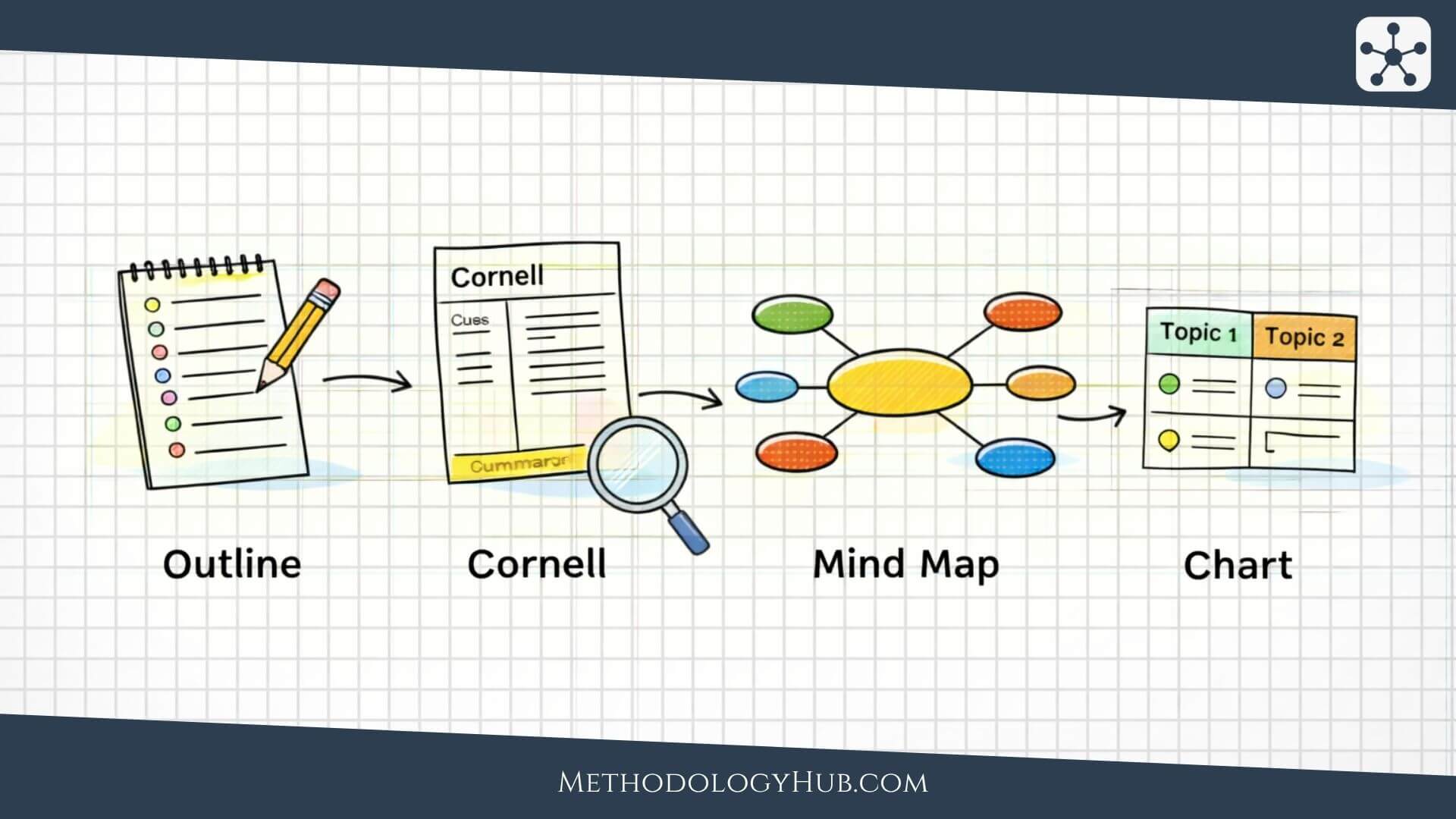
Note-Taking Methods are the practical systems people use to capture, sort, and revisit information while they learn. A good note-taking method does not just leave you with a fuller notebook. It leaves you with notes you can actually use later, whether that means recalling a lecture, preparing for an exam, writing an essay, or making sense of a dense reading.
This article explains what note-taking methods are, how the main methods differ, where each one works best, where each one tends to fall apart, and how to choose a system that fits the material in front of you.
What are note-taking methods?
Note-taking methods are repeatable ways of recording information while listening, reading, watching, or reviewing. They are not just styles. They shape what you notice, what you leave out, how clearly the page is organised, and how easy it is to come back later and understand what you meant.
That last point matters more than students sometimes expect. A page of notes can look busy and still be hard to use. It can feel thorough and still be useless a week later. The method underneath the page makes a real difference. Some methods are good at preserving order. Some are better for comparison. Some help you see links between ideas. Some make review easier. Some are quick in the moment but messy afterward.
In practice, the best note-taking methods are usually the ones that match the structure of the material. A history lecture with causes and consequences does not ask for the same page layout as a biology unit full of systems and pathways. A statistics chapter with repeated formulas and conditions does not ask for the same format as a literature seminar built around themes and quotations. When students struggle with notes, the problem is often not effort. It is mismatch.
What good notes need to do
A good note-taking method helps with at least four jobs. It helps you capture the main point while the material is moving. It helps you separate big ideas from supporting detail. It leaves you with a page you can scan later without having to decode your own shorthand. And it gives you some way to review, test, or rebuild the topic after the first pass.
That is why note-taking is never just about getting words onto paper. The method decides how much thinking happens while you write, how much gets postponed until later, and how much revision work you create for your future self. A tidy page is not always a smart page. A messy page is not always a bad one either. What matters is whether the notes still do the job when the lecture ends and the textbook closes.
How note-taking methods help learning
Students often talk about note-taking as if the benefit were obvious: you write things down, so later you can look at them again. That is true, but it is only the surface of it. Different note-taking methods shape learning in different ways while the material is still arriving. Some slow you down enough to paraphrase. Some help you sort information into levels. Some force comparison. Some make later review much cleaner because the page was built with retrieval in mind from the start.
This matters because note-taking is doing two jobs at once. There is the live job of keeping up with the material, and there is the later job of giving you something worth returning to. Many weak note-taking habits solve only the first problem. They leave you with a record, but not with much clarity. You can tell that a lecture happened, but you cannot quickly tell what mattered, what connected, or what you were supposed to remember.
A stronger method reduces that problem by giving the page some logic. It might be the logic of hierarchy, as in outlining. It might be the logic of cues and summaries, as in Cornell. It might be the logic of categories, as in charting. It might be the logic of relationships, as in concept mapping. Once the page has that logic, review becomes less like rereading a transcript and more like re-entering a structure you already built.
Better notes do not always mean more notes
One reason students get stuck is that note-taking feels measurable in a misleading way. A thick notebook feels like evidence. A document full of pages feels reassuring. But amount and usefulness are not the same thing. In fact, some of the weakest notes are long because they never made hard choices. Nothing was reduced. Nothing was grouped. Nothing was turned into a prompt, a category, or a comparison. The notes stayed close to the source, which means the student has to do most of the thinking later.
Good note-taking methods usually ask for a little more decision-making up front. You decide what belongs under a heading, what belongs in a cue column, what belongs in a branch, what belongs in a comparison cell, or what deserves its own colour in a review pass. Those decisions can feel effortful, but they often save time later because the page is already doing part of the organising work.
Review is where many note-taking methods prove their value
A note-taking method can feel fine in class and still fail during revision. That is an important distinction. Plenty of systems are easy while the teacher is talking and frustrating when you return to them later. The opposite is also true. A method may feel slower in the moment and turn out to be much easier to study from a week later.
This is why it helps to judge note-taking methods by delayed usefulness, not only by live comfort. When you come back after a few days, can you scan the page quickly? Can you see the main structure? Can you turn the notes into questions, flashcards, a summary, a chart, or a short explanation without rebuilding everything from scratch? If not, the notes may have served the lecture better than they served your learning.
Cornell Method
The Cornell Method is one of the best known note-taking methods because it separates capture from review on the same page. Instead of filling the whole sheet with one stream of writing, you divide it into three parts: a wide notes area, a narrower cue column, and a short summary section at the bottom.
That layout matters because it changes what the page can do later. During class or reading, the main notes area handles the raw material. Afterward, the cue column becomes the place for questions, triggers, or keywords, and the summary forces you to state the point of the page in a few lines. Done properly, the page is no longer only a record. It becomes a built-in revision tool.
For that reason, the Cornell Method works especially well for lecture-heavy subjects, textbook chapters, and topics with a clear line of development. It is less comfortable in chaotic sessions where the speaker jumps between points and you barely have time to keep up. In those cases, the structure can feel slightly slower than a simple running list.
Students often like Cornell because it gives them a second pass without demanding a full rewrite. When you return later, you can cover the main notes and try to answer from the cue column. That turns the page into a rough self-test with very little extra preparation.
The catch is simple. If you never add the cues and never write the summary, the method collapses into an ordinary page inside a Cornell template. The benefit comes from completing the cycle, not from drawing the lines.
Used well, Cornell notes are usually calm, compact, and easy to revisit. They suit students who want structure now and a cleaner review process later.
Mapping Method
The Mapping Method is a visual way of taking notes that starts with a main topic and branches outward into subtopics, examples, and supporting detail. It works best when the material naturally spreads from one central idea instead of moving in a rigid straight line.
This method is useful because it makes relationships visible very quickly. When one idea leads into another, the page can show that movement directly. You are not forced to keep everything in a strict top-to-bottom order, which helps when the topic involves categories, causes, stages, or connected themes.
Students who think spatially often find mapping easier to scan later than dense paragraphs of notes. A good map can show grouping, priority, and flow on the same page. That is helpful in subjects where seeing the shape of a topic matters almost as much as remembering the details.
A simple rule for mapping: if a branch is so long that it starts reading like a paragraph, the page is probably losing the main advantage of the method.
Still, mapping can become messy fast. If you try to force too much detail onto one page, the branches start colliding, the arrows stop helping, and the page becomes harder to read than a plain outline. The method rewards short phrases and selective detail, not full transcription.
It is also worth separating useful visual structure from decoration. Colour, arrows, and shapes can help, but only when they carry meaning. A map with five colours and no clear logic is still a confusing page.
For that reason, the Mapping Method is often strongest when you already have a rough grasp of the topic and want to show how the parts hang together.
Concept Mapping
Concept Mapping looks similar to the Mapping Method at first glance, which is why the two are often mixed together. The real difference is that concept maps are more explicit about relationships. Instead of only branching outward, they label the links and show how one concept affects, depends on, contrasts with, or leads to another.
That makes concept mapping especially useful when understanding the logic of a topic matters as much as remembering the parts. In biology, it can show how systems interact. In sociology, it can show how concepts overlap. In philosophy, it can reveal where one claim supports another or where two ideas are in tension.
Because of that, concept mapping is usually slower than simple mapping. You cannot just scatter keywords around the page and hope the structure will explain itself later. You have to decide what the actual relationship is. That extra effort is exactly why the method can be so revealing. When the link label feels hard to write, the understanding is often still thin.
- Simple map: mainly shows grouping and broad structure.
- Concept map: shows structure plus the meaning of the connections.
- Best moment to use it: after first exposure, during review, or while untangling a difficult chapter.
Concept maps also work well in revision. Once you already know the key terms, the real question is often whether you can hold the topic together in a usable way. A concept map exposes weak links quickly because disconnected facts are much harder to hide on that kind of page.
The drawback is pace. In a very fast lecture, concept mapping can be too slow to build properly. It often works better after class, when you can organise the page without the pressure of live note-taking.
When the topic is dense and relationship-heavy, though, few formats make confusion as visible as this one does.
Outlining Method
The Outlining Method is one of the cleanest and most durable note-taking methods because it turns information into levels. Main ideas sit at the top level, subpoints sit underneath, and examples, evidence, or definitions sit under those. The page shows hierarchy without needing much extra decoration.
This is why outlining works so well for lectures and chapters that follow a clear line of thought. If the material already has themes, arguments, stages, or sections, an outline can mirror that structure almost immediately. Later, that makes the page much easier to scan because the logic of the topic is already built into the indentation.
During revision, that clarity becomes even more useful. A good outline is easy to shrink into a shorter summary, easy to turn into flashcards, and easy to use as the skeleton of an essay plan. It also exposes weak structure. If one branch grows wildly longer than the others, or details are floating without a clear parent point, the topic may not yet be organised in your head.
The method is less helpful when the lecture is highly visual or when the material moves in loops rather than in a clear order. It can also tempt students into writing too much if they treat every sentence as a new subpoint. The outline stays sharp only when each level has a clear job.
Even so, for many students, outlining is the safest default. It is flexible, readable, and easy to maintain across a whole course.
Charting Method
The Charting Method turns notes into a grid. Instead of writing in one running stream, you divide the page into columns headed by categories such as date, theory, cause, evidence, theme, or outcome. As information appears, you place it into the relevant column.
This method is especially strong when the material repeats the same kinds of information across several items. History comparisons, research studies, legal cases, biological classifications, and literary themes can all suit charting because the categories stay stable while the examples change. That makes comparison fast.
When charting works, it saves a lot of time later. Instead of hunting through paragraphs to compare two thinkers or four historical periods, the relevant details sit next to one another. That is useful not only for learning but also for writing, because the comparisons are already half-built.
- Good chart columns are stable categories you know will keep repeating.
- Weak chart columns are vague headings that only fit one part of the material.
- Best use is when comparison is likely to matter in revision, discussion, or writing.
The weakness is rigidity. Charting usually requires some prediction, because you need to know the categories in advance or at least have a strong guess. If the lecture takes an unexpected turn, the grid can start fighting the material instead of helping with it.
For that reason, many students use charting after class rather than during the first pass. They collect rough notes first, then rebuild the topic as a chart once the structure is clearer. That slower approach is often more realistic than trying to design a perfect comparison grid live.
When the topic naturally repeats across the same categories, though, charting is one of the clearest note-taking methods available.
Digital Note-Taking
Digital Note-Taking is less a single format than a wider environment for working with notes. The main appeal is flexibility. Digital notes can be searched, tagged, moved, duplicated, shared, and reorganised without rewriting the page from the beginning. For students managing several subjects at once, that convenience is hard to ignore.
There are different ways to do it. Some students type linearly in a document. Some use digital handwriting on a tablet. Some build linked notes in an app that lets them connect topics across modules. The tool changes, but the real question stays the same: does the setup help you think more clearly, or does it only make it easier to collect more material?
That question matters because digital note-taking can quietly encourage overcollection. When storage feels endless, it becomes easy to save everything, clip everything, and export everything. The result can look organised while still being hard to learn from. Searchable clutter is still clutter.
On the other hand, digital notes are excellent for systems that need movement. You can merge lecture notes with reading notes, pull repeated themes into one file, attach images or audio, and connect scattered topics across a semester. For subjects with a lot of material spread across weeks, that is a real advantage.
Digital note-taking also suits collaborative work. Shared documents and synced folders make group revision easier than passing one notebook around. Accessibility can improve too. Larger text, audio tools, colour coding, and quick reorganisation can make notes easier to use for many students.
Still, digital note-taking is not automatically better than handwriting. Some students think more clearly by hand. Others work faster and revise better on screen. The useful question is not which one looks more modern. It is which one leaves you with better notes and better recall.
For many people, the best answer is mixed. Rough notes might begin by hand, then move into a digital system later. Or live notes might be typed quickly, then reduced into a shorter handwritten review page.
Black-Red-Green Method
The Black-Red-Green Method is slightly different from the other note-taking methods in this guide because it is less about recording a lecture from scratch and more about breaking down a task, prompt, or revision target so that nothing important slips past you. It is often used with essay questions, exam prompts, and revision planning, where the real problem is not missing information but misreading what the task is asking for.
The basic idea is simple. You mark different parts of the prompt in different colours. Black is for the direct instruction. Red is for the content, concepts, or references you must bring in. Green is for the subtle wording that affects scope, emphasis, or angle. Once the prompt is marked up, your notes or plan can follow the same colour logic.
Seen that way, the method sits between note-taking and task analysis. It is useful when your notes need to turn into an answer, not just into a record. Students who rush into writing often find that this method slows them down just enough to notice what the question is really asking.
Good sign: if the colour coding changes what you plan to include or leave out, the method is doing its job.
It is not the best method for ordinary lecture capture. If you tried to use it for every page of class notes, it would probably feel forced. Its real value appears when notes have to serve a second job, such as planning an essay, shaping a response, or revising around likely exam demands.
For revision, the method can also help with prioritising. A page becomes more useful when the central instruction, the necessary content, and the easy-to-miss angle are all visible at once.
If your main weakness is not knowledge but interpretation, this method can be much more helpful than a prettier page of ordinary notes.
Sentence Method
The Sentence Method is one of the simplest note-taking methods you can use. Each new point goes on a new line, often with a number or bullet, and the goal is speed. You do not pause too long to sort, map, or compare. You catch the information as it comes and keep moving.
That makes the Sentence Method useful in fast lectures, live talks, or first exposures to unfamiliar topics where trying to force perfect structure would only slow you down. It is also a good emergency method. If you walk into class without a prepared layout and the speaker starts quickly, a sentence list is usually better than a page of scattered fragments.
The weakness is obvious too. Because the notes are mostly linear, relationships between ideas can stay hidden. The page may capture a lot, but it may not explain how the pieces fit together. That is why the method often works best as a first draft rather than as a finished system.
- Leave space so later additions do not turn the page into a block of text.
- Number the lines if the lecture is moving quickly and sequence matters.
- Rewrite later when the topic is important enough to deserve more structure.
Students who use the Sentence Method well usually accept that the notes will need a second pass. They are not aiming for elegance in the moment. They are protecting capture first and organisation second.
That is not a flaw when speed is what the situation requires. Problems only appear when raw capture is mistaken for finished understanding.
Used with that distinction in mind, the Sentence Method can be much more useful than its plain appearance suggests.
How to choose the right method
Choosing between note-taking methods starts with the material, not with aesthetics. Before picking a system, ask what the subject is asking you to do. Are you following a clear hierarchy? Are you comparing repeated categories? Are you trying to see relationships? Are you trying to survive a fast lecture? Are the notes mainly for capture, or mainly for later review?
Once you ask those questions, the choice becomes much less random. If the topic is linear and structured, outlining or Cornell often works well. If the topic branches, mapping may fit better. If the topic depends on links between ideas, concept mapping is stronger. If you are comparing cases across fixed criteria, charting usually makes the most sense. If the class moves too quickly for high-quality organisation on the first pass, the Sentence Method may be acceptable as long as you plan to rework it later.
It also helps to think about your real weak point. Some students miss information because they spend too long making notes pretty. Others capture plenty but cannot revise from their pages later. Others end up with digital notes everywhere and no review habit at all. The right method is often the one that fixes your most common failure, not the one that looks nicest online.
Another useful rule is to separate first-pass notes from finished notes. Many students assume a note-taking method has failed if the page is rough during class. That is not always fair. Some methods are designed for live capture, others for later organisation, and some work best as a pair. A rough sentence page may become an excellent chart. A messy lecture page may become a strong Cornell summary once the session ends.
In practice, many students do best with a small combination. You might capture in sentences during class, then rebuild into Cornell after class. You might read with an outline, then convert the main theories into a concept map. You might keep your master notes digitally, but do review pages by hand. Good note-taking often comes from using the right format at the right stage rather than trying to force one method to do everything.
Common mistakes with note-taking methods
Most note-taking problems do not come from choosing the wrong named method once. They come from weakening any method until it stops doing real work. The page may still look productive, but the thinking underneath it gets thinner.
Copying instead of processing
This is the biggest problem across almost every method. Students copy full sentences, slides, or textbook lines because it feels safe. The notes get longer, but not sharper. Whether you are typing, outlining, or filling a Cornell page, copying too closely can leave you with notes that look complete without showing much understanding.
Using one method for everything
No note-taking method suits every task. Charting is great for repeated categories and poor for flowing argument. Mapping can show big structure and miss detail. The Sentence Method is fast and weak for later revision. The mistake is not in using one of them. The mistake is assuming one format should fit every lecture, chapter, and subject without adjustment.
Making notes attractive before making them useful
Neat notes are fine. Overdesigned notes are often a time trap. The problem is not colour or clean spacing. The problem is spending so much energy on layout that review, testing, and actual learning get pushed aside. A page that looks polished but never gets used again has not done much for you.
Never revisiting the notes
Notes are rarely strongest at the moment they are first written. Their value grows when they are revisited, shortened, questioned, reorganised, or tested. Students who skip that second stage often end up blaming the method when the deeper problem was that the notes were treated as an endpoint.
Keeping too much and deciding too little
Especially in digital systems, students can fall into hoarding. Every slide, every reading extract, every screenshot, every copied definition stays in the folder. The problem is not lack of material. It is lack of choice. Good note-taking methods reduce and sort. They do not just collect.
Conclusion
Note-taking methods matter because they change what kind of thinking happens while you learn. A method can slow you down in a good way, help you sort faster, make revision easier, or show you where the structure of a topic actually sits. It can also leave you with pages that look full but are awkward to study from. That is why the question is not simply whether you take notes. It is how your note-taking method shapes the work.
For most students, the answer is not to hunt for one magical format and use it forever. It is to get better at matching method to material. Use Cornell when review matters. Use outlining when hierarchy matters. Use charting when comparison matters. Use mapping or concept mapping when structure and relationships matter. Use the Sentence Method when speed matters, but do not confuse raw capture with finished study notes. Use digital systems when organisation and access matter, but give those systems some discipline.
Once that shift happens, note-taking stops being a background habit and becomes a deliberate part of studying. That makes a real difference. You spend less time producing pages you never use and more time building notes that actually help you remember, connect, and return to what you learned.