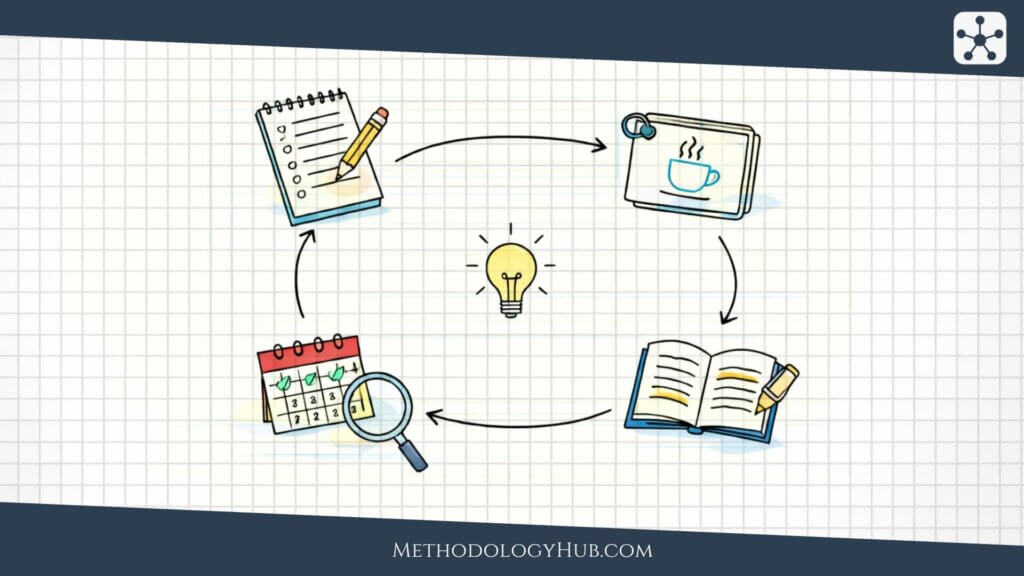
Retrieval Practices are study methods that ask you to pull information out of memory instead of just putting your eyes back on the material. That sounds simple, but it changes the whole job of studying. Instead of rereading a page and feeling as if you know it because it looks familiar, you try to recall, explain, write, answer, or rebuild the idea without the answer sitting in front of you.
This article explains what retrieval practices are, why they tend to work better than passive review, how the main retrieval-based methods differ, where each one works best, where each one starts to fail, and how to choose a method that fits the task in front of you.
What are retrieval practices?
Retrieval practices are learning methods built around one basic move: you try to remember something before you see the answer again. That might mean answering a question from memory, filling a blank sheet with what you know, explaining a concept aloud, labelling a diagram, or taking a practice test. The exact format changes, but the common feature stays the same. The information is not supposed to sit in front of you while you work.
That point matters because a lot of ordinary studying does the opposite. Rereading, highlighting, and watching the same explanation again can make material feel smoother and more familiar, but familiarity is not the same thing as recall. The page can look increasingly comfortable while the actual memory trace is still weak. Retrieval practices cut against that illusion. They make you try to produce the answer instead of recognize it.
In practice, that means retrieval has a slightly uncomfortable feel that passive review often lacks. You pause. You hesitate. You reach for a term that feels close but not quite there. You notice where the idea breaks apart halfway through. That friction is not always a sign that the method is failing. Very often it is the sign that the method is finally showing you the truth about what is and is not available in memory.
That is also why retrieval practices are not a single technique. They are a family. Active recall is the broadest version. Blurting is a rougher, faster version that works well for dumping what you know before checking the source. The Feynman Technique turns retrieval into explanation. Practice testing turns retrieval into formal questions and answer conditions. Different tasks ask for different forms.
What retrieval practices are really for
A good retrieval practice method does more than help you remember isolated facts. It gives you feedback about the shape of your knowledge. You find out which terms are missing, which steps you reverse, which causes you confuse, and which ideas only feel obvious when the textbook is still open. That kind of feedback is hard to get from passive review because the source keeps covering the gaps for you.
Retrieval also changes the way later review works. Once you have already tried to pull something out of memory, the next encounter with the correct answer tends to land differently. You are not just seeing it again. You are correcting a failed attempt, sharpening a shaky one, or reinforcing something that almost slipped away. That makes review more specific and less foggy.
How retrieval practices help learning
Students sometimes hear about retrieval practices as if the point were simply to make studying harder. That misses the point. The value is not hardship for its own sake. The value is that retrieval asks the mind to produce something. That production changes both learning and revision because it stops you from outsourcing the job to the page.
During early learning, retrieval forces a rough first reconstruction. Even if the answer comes out incomplete, the attempt matters. You have to decide where a process begins, what the main term is, how one idea connects to another, and which detail really belongs under the heading. That is a different mental job from rereading the paragraph and nodding along. One is reconstruction. The other is exposure.
During revision, retrieval helps for a second reason. It gives you a cleaner signal. Instead of asking, do I remember seeing this, you ask, can I actually bring it back and use it? That signal is much more useful when exams are getting close. Recognition can feel comforting right up until a blank answer box proves otherwise. Retrieval practices make that problem visible sooner, which is far better than discovering it during the real thing.
There is also a practical side to this. Retrieval usually makes later study more targeted. Once you can see that you remember the broad theory but keep forgetting the three exceptions, or that you know the pathway but not the enzymes, or that you can explain the concept but not apply it to a case, your next session gets sharper. You stop doing another vague sweep of the whole topic and start fixing something specific.
Why knowing the page is not the same as knowing the topic
One of the strangest parts of studying is how easily familiarity can masquerade as knowledge. A chapter can look deeply familiar by the fourth pass. The headings seem friendly. The diagrams look recognizable. The sentence that once felt dense now feels smooth. Yet when the book closes, the answer still does not come. That gap between smooth reading and actual retrieval is where a lot of wasted revision time lives.
Retrieval practices are useful precisely because they puncture that feeling. They turn a general impression into a more honest test. Not an official test, necessarily, but a real one. Can you define the term without peeking? Can you list the stages in the right order? Can you explain why one case belongs in one category and not another? Can you write down the argument without the paragraph sitting there to guide you?
That honesty can be annoying in the moment. Passive review is easier on the ego. It lets you stay inside the warm sense that you are being productive. Retrieval is less flattering. It shows what falls apart. But from a learning point of view, that is exactly the information you need.
Active Recall
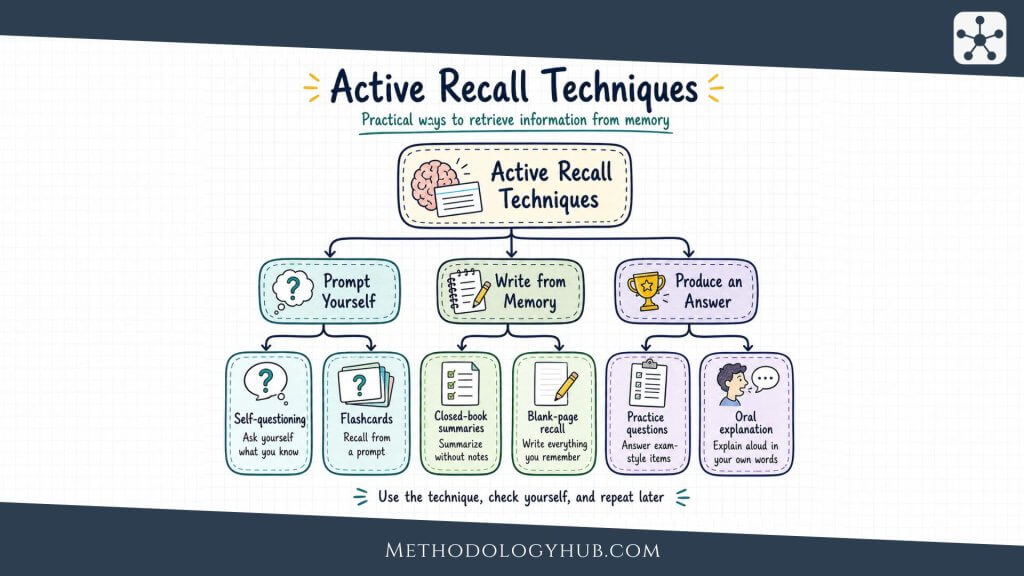
Active recall is the broadest and most useful of the retrieval practices because it describes the basic act behind almost all of them. You remove the answer, then try to bring it back. That can happen through questions, flashcards, blank-page summaries, diagram labelling, self-quizzing, or short written responses. The format matters less than the rule underneath it: do not let yourself look while you are supposed to be retrieving.
That sounds almost too obvious, which is one reason people misuse it. Students often say they are doing active recall when they are really doing guided review. They read a paragraph, glance away for three seconds, say a rough version, then look straight back. Or they keep the notes open “just in case” and check every line before the struggle has had time to happen. At that point the retrieval demand is so weak that the method loses much of its bite.
Used properly, active recall is flexible enough to fit almost any subject. In history, it can mean answering a question such as, what were the main causes of the 1848 revolutions, and which ones were immediate rather than long-term? In biology, it can mean drawing the nephron from memory and labelling the flow of filtrate. In law, it can mean stating a rule, then applying it to a short scenario without the case notes open. In literature, it can mean reconstructing the argument around a theme before checking the quotations.
One reason active recall works well is that it is easy to weave into ordinary study without rebuilding your whole life around a new app or system. You can turn chapter headings into questions. You can cover one side of a diagram. You can end a lecture review by writing the three biggest ideas from memory. You can close the notebook after ten minutes and ask, what would I still be able to say right now if someone put me on the spot?
A useful rule for active recall: the answer should be absent long enough for you to feel the search. If the source is always half-open, you are mostly reviewing, not retrieving.
Where active recall tends to work best is in day-to-day study, especially when the material is broad and still settling into memory. It is less a one-off technique than a habit of posture. Instead of asking, how many times should I read this, you start asking, how quickly can I test whether anything is actually staying with me?
The weakness is that active recall is so broad that it can become vague. People like the phrase, but phrases do not study for you. If active recall is not tied to a concrete action, it stays motivational wallpaper. You still need a real form: questions, prompts, blank pages, verbal explanations, diagrams, or mini-tests.
It is also possible to make active recall too shallow. Pulling up a term is helpful, but many subjects ask for more than that. You may need causes, comparisons, mechanisms, exceptions, interpretations, or worked steps. Strong active recall questions usually ask for something that resembles the real demand of the course, not just a label.
Still, as a general study move, active recall is hard to beat because it is portable, cheap, and adaptable. It does not depend on one tool. It depends on whether you are willing to let memory try first.
Blurting Method
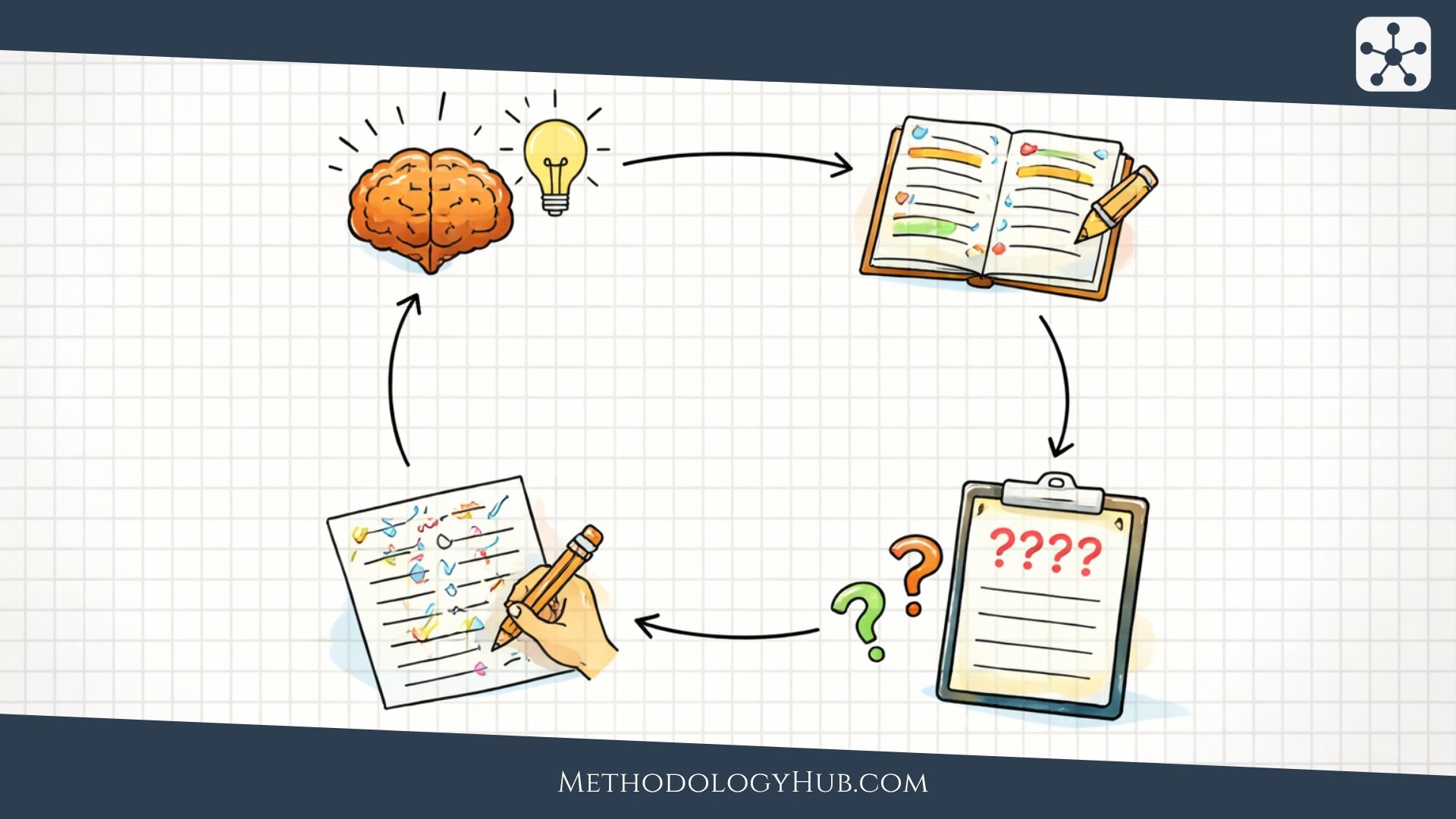
The Blurting Method is a more specific form of retrieval practice, and its appeal is obvious the first time you use it. Instead of answering one prompt at a time, you take a blank page and dump out everything you can remember about a topic before checking the source. You are not trying to sound polished. You are trying to empty the drawer and see what is actually inside it.
That makes blurting especially good for chapter review, unit review, and pre-exam sweeps. If you have finished a lesson on the digestive system, a sociology theory set, or a cluster of historical events, blurting lets you test the whole chunk in one pass. You very quickly find the missing sections. Maybe the opening definition is fine but the later detail vanishes. Maybe the broad process is intact but the exceptions have fallen out. Maybe the whole middle of the topic is just gone. A blank page is brutally clear about that.
Many students like blurting because it feels less fiddly than flashcards and less formal than a full practice test. It also creates visible progress. Your first page may be thin, shaky, and full of arrows pointing nowhere. A later page on the same topic often looks fuller, more ordered, and less dependent on rescue from the notes. That contrast can be motivating in a way that ordinary rereading rarely is.
What makes blurting useful: it shows the shape of your memory, not just whether one isolated answer pops out.
At the same time, blurting is easy to romanticize online. Some students turn it into a performance of messiness instead of a study method. The page fills with colours, circles, and decorative panic, but the checking stage stays weak. The method only works if the brain dump is followed by honest comparison. The point is not to produce chaotic pages. The point is to reveal the weak points and then repair them.
Blurting works best when the topic has enough internal structure to spill onto the page in chunks. Processes, frameworks, causes and effects, stages, comparisons, and topic summaries suit it well. It is less efficient for tiny paired facts, precise quotations, or subjects where answer format matters more than broad recall. If your exam depends on handling exact multiple-choice traps or writing under time pressure, blurting should probably sit beside another method, not replace it.
It can also go wrong when students start checking too early. The whole benefit depends on staying with the empty page long enough to exhaust the easy answers and push a little further. If you look back after every second line, the page turns into guided copying with gaps.
Another common problem is mistaking quantity for success. A long blurt is not automatically a good one. Sometimes students pour out twenty lines of familiar but low-value detail while still missing the one distinction the course keeps testing. After checking, it helps to ask not just what was missing, but what mattered most among the missing parts.
Used well, blurting is one of the cleanest ways to turn vague confidence into visible evidence. Either the page comes out, or it does not. Either the structure holds, or it buckles halfway through. That is useful information.
Feynman Technique
The Feynman Technique is often described in overly romantic terms, as if simply explaining something in simple language automatically proves deep understanding. The real value is narrower and more practical. It turns retrieval into explanation. Instead of asking, can I remember the term, you ask, can I walk someone through this idea in plain words without leaning on the source?
That shift matters because many students can retrieve fragments long before they can explain the whole thing. They know the heading, maybe the definition, and a few familiar phrases around it. But once they have to state what the idea does, why it matters within the topic, or how one step leads to the next, the explanation starts to wobble. The Feynman Technique is good at exposing that wobble.
It works especially well for concept-heavy subjects. If you need to explain mitosis versus meiosis, negative externalities, attachment theory, judicial review, or the function of the loop of Henle, teaching the idea aloud or on paper can reveal whether the links actually hold together in your head. The method is less about sounding clever and more about stripping away the support language that hides weak understanding.
That said, a lot depends on how honestly you use it. If the notes are open and you are just paraphrasing them in a friendlier tone, you are not really using the method. If you explain only in generalities and never test the exact trouble spots, you can produce a smooth but hollow explanation. The technique needs real retrieval pressure. It also needs a later check, because confident simplification can easily slide into confident error.
- Weak explanation: repeats the right words but cannot show how the idea works.
- Stronger explanation: states the idea plainly, links the steps, and holds up when you ask follow-up questions.
- Best use: when a topic must be explained, applied, or distinguished from something similar.
The Feynman Technique is also useful because it exposes where language itself is doing too much work. Students sometimes memorize textbook phrasing that feels solid because it sounds formal. The moment they try to restate it simply, they realize they do not actually know what the sentence means. That is valuable. Once the borrowed wording is gone, you can see what is left.
Another strength is that this method can reveal hidden sequencing problems. A process that looked fine in notes may come out in the wrong order when you have to explain it from memory. A concept that seemed understood may turn out to depend on a missing prior idea. A distinction that looked obvious on the page may vanish when you try to say it cleanly. All of that helps.
The method is less efficient for very broad memorization. If you have to learn two hundred definitions, the Feynman Technique is too slow to use on everything. It is better reserved for high-value ideas, stubborn concepts, mechanisms, arguments, or topics where the course expects explanation rather than simple recall.
A good stress test for the Feynman Technique: after your explanation, ask yourself one short follow-up question. If the whole explanation collapses, the understanding was probably thinner than it sounded.
When used properly, the Feynman Technique is less about teaching an imaginary child and more about forcing yourself to stop hiding behind the textbook’s wording. That is often where the real learning begins.
Practice Testing
Practice testing is the most formal of the retrieval practices in this guide because it turns recall into recognizable question formats. That might mean short-answer quizzes, multiple-choice questions, flash tests, past papers, timed section drills, or full mock exams. The common feature is that you retrieve in response to an external demand rather than a self-made summary prompt.
Its main advantage is simple. Exams do not usually ask, do you sort of remember seeing this? They ask you to answer. Practice testing gets you closer to that demand. It trains retrieval under structure, under wording, and sometimes under time. That makes it especially useful later in the study cycle, when broad understanding is no longer enough and performance format starts to matter.
Practice testing is also one of the best ways to discover whether your knowledge survives small changes in wording. Students often know a definition in one form but miss it when the phrasing shifts. Or they can explain a process in notes but misread the question when it is attached to a case. A decent practice test shows whether the memory is flexible enough to respond to the way the course actually asks.
There is another benefit too. Practice tests make weak areas harder to avoid. In free review, students drift back toward comfortable topics and familiar chapters. A question set has no such loyalty. It will bring up the section you hoped not to see. That can be irritating, but it is also useful because neglected material stops being invisible.
Still, practice testing is not automatically the best starting point for every topic. If you have barely met the material, a full test can feel like being pushed into deep water before you have learned how to kick. In that case, a smaller retrieval method may work better first. Active recall or blurting can build the topic up enough that later testing becomes productive rather than just discouraging.
It also matters what kind of test you use. Multiple-choice can be useful, but it can also slide toward recognition if you only judge yourself by picking an answer. Short-answer and worked responses usually demand more genuine retrieval. Past papers are especially valuable because they test both memory and interpretation, which is often where students lose marks. The best question format is the one that matches the eventual demand most closely.
Another common mistake is treating practice tests as scoreboards rather than tools. Students take a test, see a number, feel either pleased or crushed, and move on. But the real value is in the post-test review. Why was the answer wrong? Missing term, wrong distinction, incomplete process, careless reading, or weak application? Without that second step, practice testing becomes performance theatre.
Used properly, though, practice testing is one of the clearest bridges between revision and performance. It stops revision from staying abstract and pushes memory into action.
How to choose the right method
Choosing between retrieval practices starts with the task, not with what looks smartest online. Ask what you need the study session to do. Are you trying to check broad recall across a whole topic? Are you trying to explain a difficult concept in plain language? Are you trying to see whether you can survive exam-style questions? Are you trying to diagnose gaps fast before a longer revision session? Once that is clear, the choice gets easier.
If you need an all-purpose daily habit, active recall is usually the best base. It is broad enough to fit almost anything and light enough to use often. If you need a fast whole-topic sweep, blurting is often more revealing because it shows the structure of your memory in one shot. If you keep running into the problem that you know the words but cannot explain the idea, the Feynman Technique is a better choice. If exams are close and wording, timing, or application matter, practice testing should move higher up the list.
It also helps to think about your usual failure point. Some students are too passive. They reread nicely but rarely force memory to produce. For them, almost any retrieval method is an upgrade. Some students retrieve plenty but never review the mistakes carefully. For them, the checking stage matters more than the method name. Some students are fine with facts but weak with explanation. Others can explain broadly but keep missing specific terms. The right method is often the one that fixes your most common leak.
Another useful rule is not to expect one method to do every job. Retrieval practices combine well. A session might begin with blurting, move into targeted active recall questions, then finish with a few practice-test items. Or you might use the Feynman Technique for the hardest concepts and reserve practice testing for the sections likely to appear on the exam. The real aim is not loyalty to one brand of retrieval. It is using the right form at the right moment.
In practice, students often do best when retrieval gets easier to start and harder to avoid as the exam gets closer. Early on, a light active recall habit can keep new material moving into memory. Midway through a unit, blurting and explanation can reveal what still has weak structure. Later, practice testing shows whether that knowledge holds up under pressure. That progression usually makes more sense than doing nothing but past papers from week one or nothing but casual self-quizzing right before the exam.
Common mistakes with retrieval practices
Most problems with retrieval practices do not come from choosing the wrong method once. They come from sanding down the method until it stops asking memory to do real work. The surface still looks active, but the demand is gone.
Checking too early
This is probably the most common mistake. Students begin a retrieval attempt, hit a rough patch, and immediately look back. The discomfort lasts two seconds, then the source rescues them. That rescue feels efficient, but it often cuts off the very part of the process that would have shown what memory could do on its own. A little struggle is not the enemy here.
Confusing recognition with retrieval
Seeing the answer and thinking, yes, I knew that, is not the same as producing it. This is the trap behind a lot of passive review and a lot of weak multiple-choice practice. The answer feels familiar, so the mind claims ownership too quickly. Retrieval practices help only when you make the answer absent long enough for recognition to stop carrying the whole load.
Using questions that are too easy
Students sometimes build retrieval around the safest possible prompts: one-word definitions, obvious labels, tiny fragments that barely resemble the course demands. Those questions are not useless, but they can create a false ceiling. If the exam asks for explanation, comparison, application, or sequence, then at least some retrieval practice should ask for that too.
Treating mistakes as proof that the method failed
Retrieval can feel discouraging precisely because it reveals errors. But wrong answers are often the point. A weak blurt page, a broken explanation, or a bad quiz score is not always a sign that the method is poor. It may be the first honest picture you have seen of the topic. The question is what you do next with that picture.
Doing retrieval once and calling the topic done
One successful recall attempt can create a false sense of closure. The answer came out, so the topic feels finished. But memory changes over time. Something that feels available today can be gone three days later. Retrieval practices usually show their value when they return after a delay, not only when they happen right after studying.
Letting retrieval become mechanical
There is also a duller version of failure. The routine stays active on paper, but the mind starts going through the motions. Flashcards are flipped without thought. Practice questions are answered from pattern recognition. Explanations become memorized speeches. Once that happens, it helps to change the prompt, mix the question order, widen the answer demand, or switch the method entirely.
Conclusion
Retrieval practices matter because they force a cleaner kind of honesty into studying. They stop you leaning so heavily on the page. They show what comes back, what falls apart, and what only looked familiar because the answer never really left your sight. That can feel less pleasant than passive review, but it is usually far more useful.
For most students, the goal is not to become loyal to one named method. It is to get better at choosing the right retrieval move for the job. Use active recall when you need a flexible daily habit. Use blurting when you need a quick whole-topic check. Use the Feynman Technique when explanation is the weak point. Use practice testing when the real assessment format starts to matter. And when a topic is important, combine them instead of expecting one method to carry everything.
Once retrieval becomes part of the way you study, revision often changes character. It feels less like grazing through material and more like testing, repairing, and strengthening memory on purpose. That is the real shift. You stop measuring revision by how long you stared at the notes and start measuring it by what you can still do when the notes are gone.