Editing is the final stage of the writing process where a writer improves the language, accuracy, consistency, and presentation of a text after the larger work of revision has been done. It comes near the end of the process, but it is not a quick spelling check. A good editing pass helps the final version feel clear, controlled, and ready for the reader.
This article explains what editing is, how it fits after revising, what writers should edit first, and how sentence and paragraph editing work.
What Is Editing?
Editing is the work of improving a text at the level of language, accuracy, and presentation. The writer reads the draft slowly, not to rethink the whole argument from the beginning, but to make sure that the wording now says what the draft intends to say. At this stage, a paragraph may stay in place while its sentences become clearer, less repetitive, and more precise.
In academic writing, editing often happens after the draft has already gone through revision. The main claim, structure, paragraph order, and evidence should be settled enough that the writer can give close attention to the surface of the text. Surface does not mean shallow. A sentence that is vague, crowded, or grammatically confusing can hide a good idea from the reader. Editing removes that kind of interference.
Editing definition
Editing is the stage in the writing process where a writer checks and improves sentence clarity, word choice, grammar, punctuation, citation details, formatting, and consistency before the final text is submitted.
This definition places editing near the end of the process, but not outside it. Writers sometimes edit while drafting or revising because small improvements are hard to ignore. That is normal. The more useful distinction is one of emphasis. During drafting, the writer is trying to get the text onto the page. During revising, the writer reshapes meaning and structure. During editing, the writer asks whether the final wording is accurate, readable, and consistent.
What happens during editing
An editing pass may begin with a quiet reading of the whole piece. The writer watches for places where the language slows the reader down. A sentence may contain too many ideas. A paragraph may repeat the same phrase several times. A source may be introduced clearly but cited inconsistently. A term may appear in two forms, such as “peer feedback” in one section and “peer-feedback” in another. Editing notices those small differences because they affect how finished the text feels.
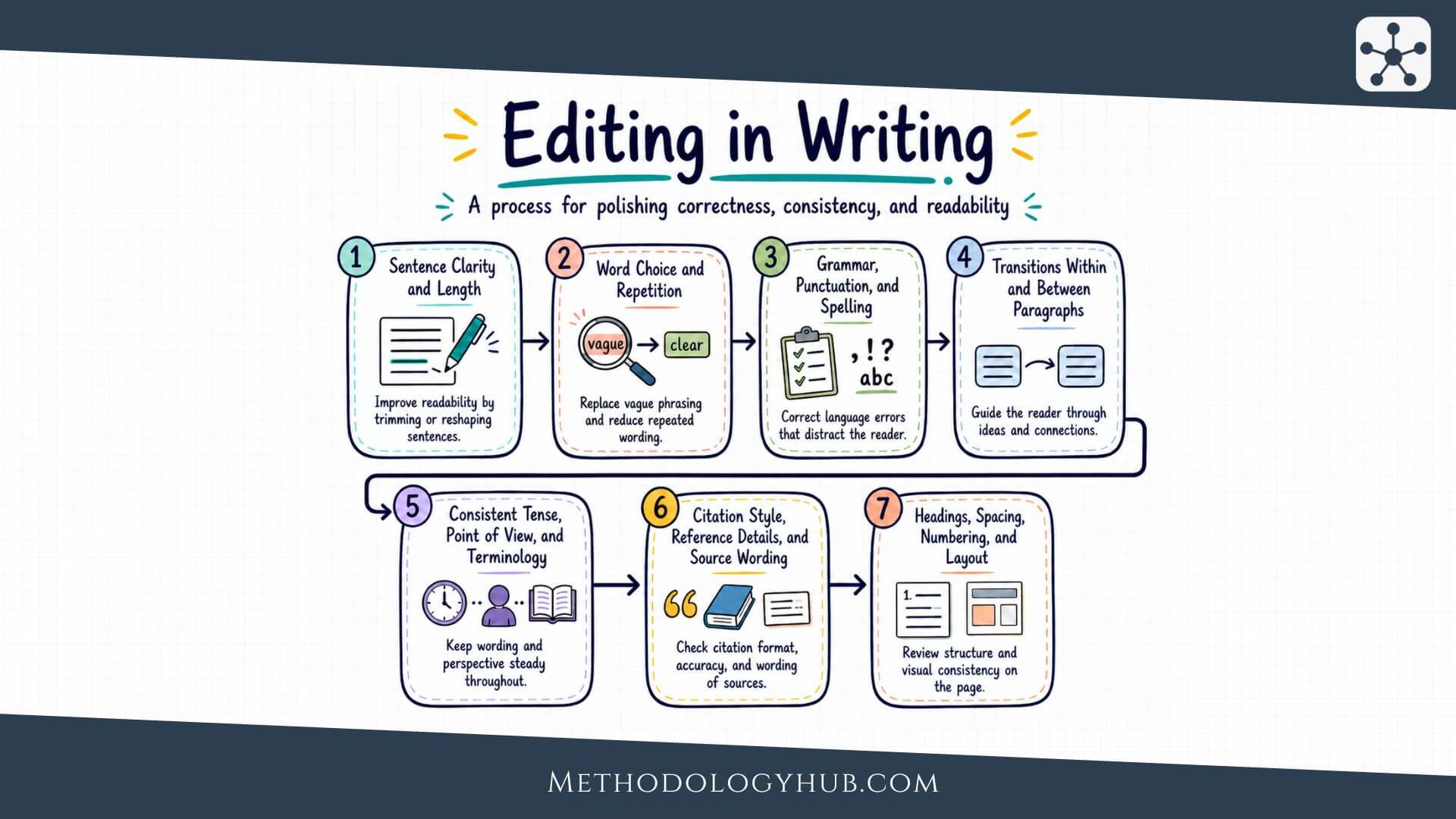
Writers often work on several details during editing:
- sentence clarity and sentence length
- word choice, repetition, and vague phrasing
- grammar, punctuation, and spelling
- transitions within and between paragraphs
- consistent tense, point of view, and terminology
- citation style, reference details, and source wording
- headings, spacing, numbering, and layout
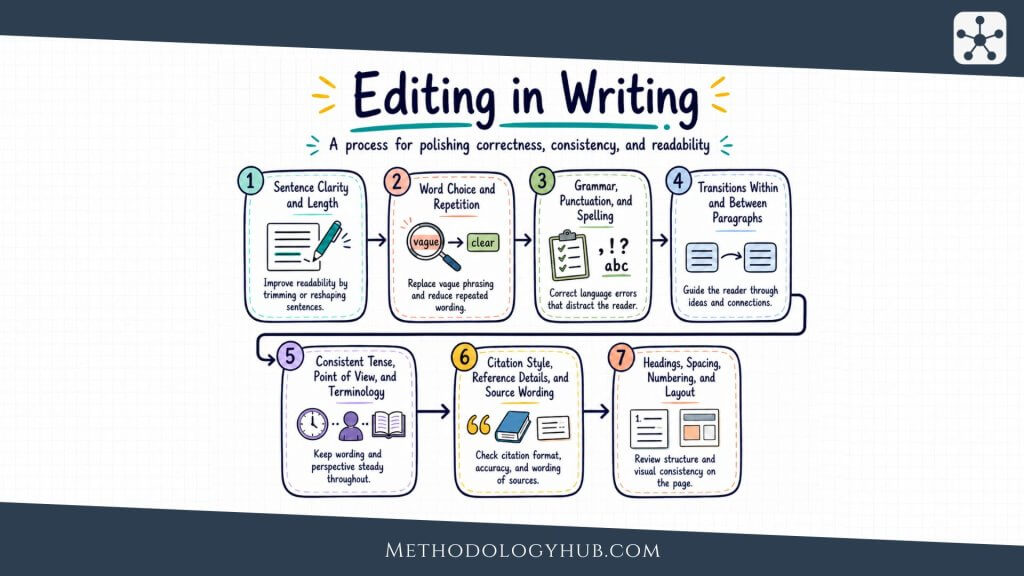
These tasks are easier when they are not all handled at once. A writer may first edit for clarity, then for grammar, then for citations. Another writer may begin with the most visible issue, such as paragraph flow, before moving to commas and formatting. The order can change, but the purpose stays the same: make the final draft easier to read and harder to misunderstand.
Editing is not only correction
Many writers treat editing as a hunt for errors. That is part of it, but it is not the whole stage. Editing also improves rhythm, proportion, and tone. A sentence can be grammatically correct and still be clumsy. A paragraph can contain no spelling errors and still feel heavy because every sentence has the same shape. A paper can cite sources accurately and still confuse the reader if source material takes over the writer’s own explanation.
Good editing therefore has two sides. It corrects what is wrong, and it improves what is merely weak or unclear. The writer does not need to make every sentence decorative. In academic writing, plain language is often the strongest choice. The aim is not to sound impressive. The aim is to help the reader understand the idea without unnecessary strain.
Editing in the Writing Process
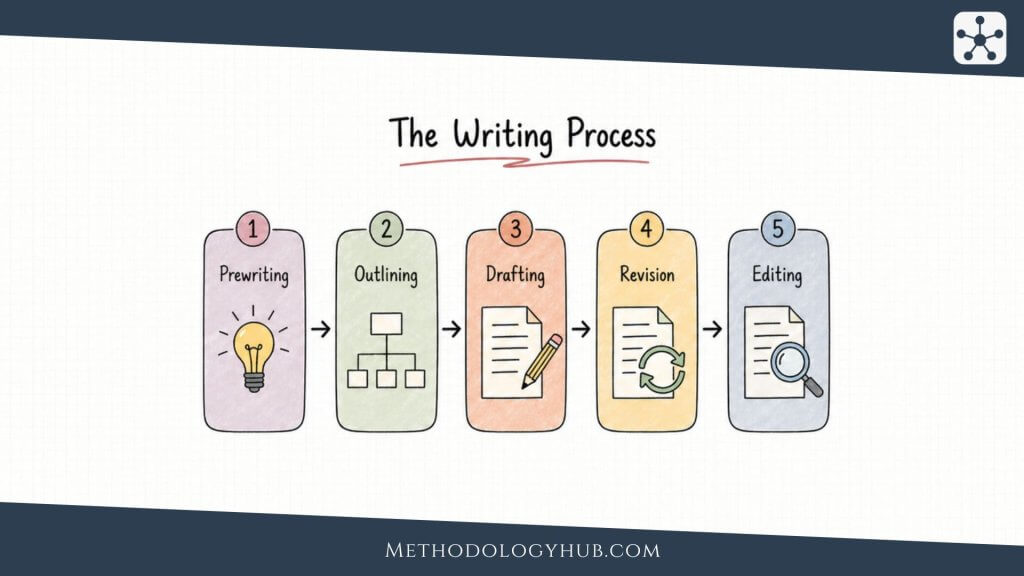
Editing belongs near the end of the writing process because it depends on the work that came before it. Prewriting helps the writer gather material. Outlining gives that material a structure. Drafting turns the structure into paragraphs. Revising reshapes the draft so it makes better sense. Editing then works on the language that remains.
This order helps because many editing choices depend on earlier decisions. A transition cannot be final if the paragraph may still move. A citation may need to change if the evidence is replaced. A carefully polished sentence may disappear during revision. When the writer edits too early, the work can become inefficient and frustrating.
How editing follows revising
Revising and editing are close enough that they are often confused. A writer may revise a paragraph and edit a sentence in the same sitting. Still, their main jobs are different. Revising asks whether the draft works as a piece of writing. Editing asks whether the final language helps the reader move through that piece smoothly.
For example, during revision a student may decide that a paragraph about peer feedback belongs earlier in the essay. During editing, the same student may tighten the paragraph’s opening sentence, remove repeated wording, and correct the citation. The first task changes the structure. The second task improves the wording after the structure has settled.
Editing may send a writer back to revision
Editing sometimes reveals that the draft is not as stable as it seemed. A sentence may be hard to edit because the idea is not clear. A transition may be awkward because two paragraphs do not really belong next to each other. A citation may be difficult to place because the source has not been explained. When this happens, the writer should not force a surface solution. The draft may need a small return to revision.
This movement is part of normal writing. A final editing pass can expose deeper problems precisely because the writer is paying close attention. The useful response is to fix the deeper problem and then return to editing. A clean sentence cannot fully repair a confused relationship between ideas.
What to Edit First
Editing is easier when the writer starts with the most disruptive language problems before moving to tiny details. A missing comma is worth fixing, but it should not distract from a paragraph full of unclear sentences. A citation style issue should be corrected, but not before the writer knows that the source is placed accurately and explained well.
A useful editing order moves from meaning to wording, then from wording to mechanics. The writer first checks whether sentences can be understood. Then the writer improves word choice and flow. Only after that does the writer move into punctuation, spelling, formatting, and final consistency.
Read for clarity before correctness
The first editing pass should ask whether the text is easy to follow. This does not mean that every idea must be simple. Academic writing often deals with complex material. It does mean that the language should not create unnecessary difficulty. If a reader has to reread a sentence because the grammar is tangled, the sentence needs editing.
One method is to mark any sentence that causes a pause. The writer does not need to fix the sentence immediately. The first pass can simply identify the trouble spots. After that, the writer can return to each one and ask what creates the problem. Is the subject too far from the verb? Are there too many clauses? Does a pronoun have an unclear reference? Is the sentence trying to define, compare, and evaluate all at once?
Check repetition and unnecessary words
Many drafts repeat themselves because the writer was thinking through the idea while drafting. Editing can keep the useful thinking and remove the excess. Repetition may appear as repeated words, repeated sentence openings, or repeated explanations. Some repetition is helpful when a term must stay precise. Other repetition slows the reader.
Unnecessary words often appear in phrases that sound formal but add little. A sentence such as “It is possible to see that the results are showing” may become “The results show”. A phrase such as “in order to” may become “to”. Editing is not about making every sentence short. It is about removing words that do not help the sentence do its work.
Edit transitions after sentence clarity
Transitions should be checked after individual sentences are readable. At that point, the writer can see whether the paragraph moves well from one idea to the next. A transition may be a word, but it may also be a full sentence that explains the relationship between two points. If the paragraph jumps from a definition to a study result, the reader may need a bridge.
Editing transitions does not mean adding “however” or “therefore” wherever the draft feels rough. The writer should first name the relationship. Is the next sentence giving an example, adding evidence, qualifying the claim, or turning toward a different explanation? Once the relationship is clear, the wording can be chosen with more control.
Save final details for a separate pass
Grammar, punctuation, spelling, and formatting should receive careful attention, but they are easier to check after the larger sentence work is complete. A writer who fixes punctuation before rewriting may have to fix it again. A reference list may need checking after in-text citations are settled. Headings may need formatting after section titles stop changing.
A separate final-details pass gives the writer a narrower task. Instead of asking whether the whole text is good, the writer checks one layer: commas, verb agreement, spelling, citations, headings, or spacing. Narrow attention is one of the best tools in editing.
Editing Sentences for Clarity
Sentence editing is the centre of editing in writing. A draft may have a strong structure and good evidence, but the reader still meets the text one sentence at a time. If the sentences are crowded, vague, or inconsistent, the reader has to work harder than necessary. Editing gives each sentence a clearer job.
The goal is not to make every sentence short. Short sentences can become choppy when they appear one after another. Long sentences can be clear when their parts are controlled. The useful question is whether the reader can identify the main idea of the sentence without getting lost in extra material.
Find the main action
A clear sentence usually has a visible subject and a visible action. When the main action is hidden inside a noun, the sentence can feel heavy. For example, “The revision of the paragraph was conducted by the writer” is slower than “The writer revised the paragraph.” Both sentences are grammatical, but the second sentence lets the reader see who did what.
This does not mean that passive voice is always wrong. In a methods section, “The samples were coded independently” may be appropriate because the process is more central than the person doing it. Editing asks for judgment, not a blanket rule. The writer should choose the structure that makes the sentence’s focus easiest to follow.
Control sentence length
Long sentences often become unclear when they include several actions, examples, and qualifications at once. The writer may be trying to show careful thinking, but the reader receives too much in one breath. A long sentence can often be split where the idea changes direction.
Consider a sentence that defines editing, contrasts it with revision, gives an example, and comments on proofreading. That sentence is probably carrying too much. Editing can divide it into two or three sentences. One sentence can define the term. Another can explain the contrast. A third can show the example. The reader then receives the idea in steps.
Use precise words without making the sentence heavy
Precise wording helps academic writing because it reduces guessing. If a paragraph says “things improved,” the reader may not know whether the writer means sentence clarity, evidence use, test scores, or reader response. A more precise sentence names the change. “Students revised more topic sentences after peer comments” gives the reader something clearer to understand.
Precision does not require difficult vocabulary. Often the simpler word is better. “Use” may work better than “utilize.” “Show” may work better than “demonstrate” when no technical distinction is needed. Editing should protect the meaning, but it should not add weight simply to sound academic.
Vary sentence rhythm
Sentence rhythm affects readability. A paragraph where every sentence has the same length and pattern can feel mechanical, even when the content is accurate. A paragraph with only long sentences can feel dense. A paragraph with only short sentences can feel abrupt. Editing can create a more natural mix.
One useful method is to read the paragraph aloud. If the voice keeps falling into the same pattern, the writer can vary the structure. A short sentence can follow a longer explanation to give the reader a pause. A longer sentence can connect related details when the relationship is clear. Rhythm should support understanding, not draw attention to itself.
Clarify pronouns and references
Pronouns such as “this,” “it,” and “they” can be useful, but they become unclear when the reader cannot identify what they refer to. A sentence like “This improves writing” may need a noun after “this.” Does “this” refer to editing, peer feedback, revision, or a specific classroom activity? Editing can turn the sentence into “This editing routine improves sentence control” or “This feedback process helps writers notice unclear paragraphs.”
The same issue appears with words such as “former,” “latter,” “these,” and “such.” They save space only when the reference is obvious. If the reader has to look back and guess, the edit has not saved time. It has moved the work onto the reader.
Remove inflated language
Academic writing does not improve when every idea is described as dramatic, central, or far-reaching. Editing should remove inflated language unless the evidence really supports it. A sentence that says “Editing completely transforms the academic journey” sounds broad and vague. A better sentence can be more modest: “Editing helps writers make the final draft clearer and more consistent.”
This kind of restraint is part of good academic style. The writer does not need to announce the importance of every point. The explanation, evidence, and careful wording should do the work.
Editing Paragraphs and Flow
Editing often begins with sentences, but paragraphs also need close attention. A paragraph may have been revised into the right place and still need editing so that its sentences move cleanly. The writer checks whether the paragraph opens clearly, develops the point in a readable order, and ends in a way that prepares the next movement.
Paragraph editing is different from paragraph revision. Revision may decide that a paragraph should be moved, cut, expanded, or split. Editing assumes that the paragraph belongs there and asks how the language inside it can be improved.
Edit the opening sentence
The opening sentence of a paragraph helps the reader enter the point. It does not always need to state the whole argument, but it should give enough direction. If a paragraph begins with a pronoun, a vague phrase, or a detail whose purpose is not clear, the reader may feel dropped into the middle.
During editing, the writer can compare the opening sentence with the paragraph’s actual work. If the paragraph explains how students use peer comments during revision, the opening should point toward that work. If the opening promises a broad discussion of feedback but the paragraph focuses only on grammar comments, the sentence should be narrowed.
Check the order inside the paragraph
Paragraphs often need an internal sequence. A definition may come before an example. A source may need to be introduced before it is discussed. A claim may need explanation before the writer adds a qualification. Editing helps the writer notice whether the reader receives information in the right order.
A helpful method is to write a short label beside each sentence: claim, explanation, evidence, example, interpretation, transition. If the paragraph jumps from evidence to a new claim without interpretation, the writer may need to add or move a sentence. If a sentence repeats the previous one, it may need to be cut or combined.
Edit transitions between paragraphs
Transitions between paragraphs should show movement without sounding forced. A new paragraph may extend the previous point, contrast with it, give an example, shift to a new section, or return to the main claim. The transition should help the reader understand that relationship.
Sometimes the best edit is at the end of the earlier paragraph. A final sentence can explain why the next point follows. Other times the next paragraph needs a stronger opening. If no transition works, the problem may not be wording. The paragraphs may still need revision in their order or purpose.
Keep paragraph length readable
Paragraph length affects how the page feels. A very long paragraph may contain a strong point, but the reader may not see its parts clearly. A series of very short paragraphs may make the text feel scattered. Editing can adjust paragraph length by combining related points, splitting crowded paragraphs, or tightening sentences that make the paragraph longer than it needs to be.
There is no single correct paragraph length. A short explanatory article, a literature review, and a thesis chapter may use different proportions. The paragraph should be long enough to develop its point and short enough for the reader to follow the movement.
Editing Academic Style and Source Use
Academic editing asks the writer to balance clarity with discipline-specific expectations. The text should sound careful, but not inflated. It should use evidence, but not hide the writer’s own explanation behind a chain of quotations. It should follow citation rules, but still read as a connected argument or explanation.
This balance can be difficult because academic writers often learn that formal writing must sound distant or complicated. Editing can correct that assumption. A careful academic sentence can be direct. A useful paragraph can explain a source in plain language. A strong paper can sound controlled without sounding stiff.
Edit for tone
Tone is the attitude the writing creates. In academic writing, the tone is usually measured, specific, and evidence-aware. The writer should avoid exaggeration, casual phrasing that does not fit the task, and language that makes claims stronger than the evidence allows. A sentence such as “This proves that peer editing always improves writing” is usually too broad. A more careful sentence might say, “In this study, peer comments helped some writers identify unclear explanation.”
Editing tone often means making claims more exact. The writer does not weaken the paper by being careful. The writer shows control by matching the claim to the evidence.
Edit source integration
Source integration is one of the most important parts of academic editing. A source should not appear as a sudden block of borrowed material. The writer should introduce it, present it accurately, and explain how it connects to the paragraph. This is true for quotations, paraphrases, data, examples, and findings from published studies.
When editing a source-based paragraph, the writer can check three moments. Before the source, is the reader prepared for why it appears? During the source, is the wording accurate and clearly attributed? After the source, does the writer explain what the reader should take from it? Many paragraphs improve when the writer adds the after-source explanation that was missing from the draft.
Edit quotations and paraphrases
Quotations should be used when the exact wording is needed. If the original language is not especially important, a paraphrase may be clearer. Editing helps the writer decide whether a quotation is doing real work or only filling space. A paragraph with too many quotations can begin to sound like a collection of sources rather than the writer’s own discussion.
Paraphrases need equal care. A paraphrase should not be a lightly changed version of the original sentence. It should restate the idea accurately in the writer’s own structure while keeping the source clearly cited. During editing, the writer should compare paraphrases with the original source to check both accuracy and independence.
Edit citation and reference consistency
Citation editing is not only a final technical task. It protects the reader’s ability to trace the evidence. In-text citations should match the reference list. Dates should be consistent. Page numbers should be present when the citation style requires them. The spelling of author names should not change from one section to another.
A useful editing habit is to check citations in pairs. Every in-text citation should have a reference-list entry, and every reference-list entry should be cited in the text unless the style guide says otherwise. This pass can catch missing sources before the final proofread.
Editing Grammar, Punctuation, and Mechanics
Grammar, punctuation, and mechanics are sometimes treated as the whole of editing. They are only one part, but they are still important. Errors can distract readers, change meaning, or make a final draft look unfinished. The aim of this stage is not to make the writer anxious about every rule. It is to give the text a careful final shape.
This work is easier when the writer edits one type of detail at a time. Grammar, punctuation, spelling, capitalization, abbreviation style, and formatting each require slightly different attention. A single overloaded pass often misses small errors because the reader’s mind begins to fill in what should be there.
Grammar checks
Grammar editing should begin with patterns the writer knows tend to cause difficulty. One writer may need to check subject-verb agreement. Another may need to check article use, verb tense, sentence fragments, or run-on sentences. A multilingual writer may need to compare prepositions or noun forms carefully. A writer working under time pressure may need to look for sentences that changed halfway through revision and now no longer fit together.
Grammar tools can help, but they should not replace judgment. A tool may flag a sentence that is acceptable in context, or it may miss a sentence that is grammatical but unclear. The writer should treat suggestions as prompts for attention, not automatic corrections.
Punctuation checks
Punctuation guides the reader through the sentence. Commas, semicolons, colons, and parentheses are not decoration. They show how parts of the sentence relate. A misplaced comma can make a sentence harder to read. A missing comma after an introductory phrase may be minor in one sentence but confusing in another.
During editing, the writer can pay special attention to long sentences. If punctuation is doing too much work, the sentence may need to be divided. If the punctuation is correct but the sentence still feels hard to read, rewriting may be better than adding another comma.
Spelling, capitalization, and abbreviations
Spelling errors can remain hidden because the writer knows what the sentence is supposed to say. Spell-check tools catch many errors, but not all. They may miss correctly spelled words used in the wrong place, such as “form” instead of “from”. A slow proofread is still needed after editing.
Capitalization and abbreviations also need consistency. A term such as “writing center” should not become “Writing Center” unless it is the official name of a specific place. An abbreviation should be introduced before it is used repeatedly. If the text uses APA, MLA, Chicago, or another style, the writer should follow that style’s rules for titles, headings, and reference details.
Consistency across the document
Consistency is one of the quiet strengths of a well-edited text. The reader may not notice it directly, but inconsistency is easy to feel. If headings change format, terms shift spelling, or tables and figures use different labels, the text feels less controlled.
A consistency pass can check repeated items: heading levels, capitalization, numbers, hyphenation, table titles, figure captions, citation style, and spelling variants. This pass is especially helpful in long documents because details may have been written on different days or copied from different notes.
Self-Editing and Peer Editing
Editing can be done by the writer, by a peer, by a teacher, by a supervisor, or by a professional editor. Each kind of editing offers a different view of the text. Self-editing gives the writer direct control. Peer editing gives the writer a reader’s response. Teacher or supervisor feedback may connect the text to assignment or discipline expectations.
Writers often need more than one view because they become used to their own sentences. After reading a draft many times, a writer may stop seeing gaps, repeated words, and unclear references. A second reader can notice places where the text asks the reader to guess.
Self-editing
Self-editing begins with distance. A break between drafting, revision, and editing can make the draft feel less familiar. Even a short pause helps. When the writer returns, the page is easier to read as a reader would read it.
Several self-editing habits are useful. Reading aloud can reveal heavy sentences. Changing the font or spacing can make errors more visible. Editing from the last paragraph to the first can help the writer focus on sentences without being carried along by the argument. Searching for repeated words can show patterns that normal reading misses.
Peer editing
Peer editing works best when the peer has a clear task. A vague request such as “tell me what you think” may produce vague feedback. A focused request is more useful: check whether the introduction prepares the reader, mark sentences that are hard to follow, identify places where sources need explanation, or look only at paragraph transitions.
The writer should also decide what kind of comments are welcome. Early peer editing may focus on clarity and organization. Later peer editing may focus on sentences, citations, and mechanics. The closer the text is to submission, the narrower the feedback should usually become.
Using feedback during editing
Feedback should be read as information, not as an order to change everything. A peer may identify a real problem but suggest a solution that does not fit the writer’s purpose. Another reader may focus on a sentence that is correct but difficult. The writer should look for the concern behind the comment.
If several readers mark the same paragraph as confusing, that paragraph deserves attention. If one reader dislikes a word but the word is required by the discipline, the writer may keep it. Editing with feedback means weighing comments against purpose, evidence, genre, and reader needs.
From Edited Draft to Final Submission
The move from edited draft to final submission should be slow enough to catch remaining problems and calm enough to avoid creating new ones. At this stage, the writer should not be changing the whole structure unless a serious problem appears. The task is to confirm that the text is ready for its reader or evaluator.
A final submission pass should include the document as a whole: introduction, conclusion, headings, references, page layout, title, file name, and any submission instructions.
Use a final checklist
A checklist helps because final editing can feel repetitive. The checklist should match the assignment or publication requirements because a school essay, a journal manuscript, and a dissertation do not need the same final review.
A practical final checklist may include:
- the title matches the content of the paper
- the introduction prepares the reader for the actual discussion
- headings follow one format
- citations and references match
- tables, figures, and appendices are labelled correctly
- required formatting and word count instructions have been followed
- the file name and submission format are correct
Leave time for a last read
A final read works best after a short break. Even a few hours can help the writer see the text more clearly. Reading from beginning to end lets the writer notice whether the piece now feels complete. This last read should not become a new drafting session. It is a final check for readability, consistency, and remaining errors.
When the final read produces only small corrections, the draft is probably ready. When it produces major concerns, the writer should decide whether they can be fixed safely before the deadline or whether the project needs more revision time.
Conclusion
Editing is the stage where a revised draft becomes cleaner, clearer, and more consistent. It happens between revising and submitting. It works between those stages, shaping the language after the larger structure has become stable.
A strong editing process moves in layers. The writer first checks whether sentences are clear, then works on word choice, transitions, source integration, tone, grammar, punctuation, citations, and formatting. The work can feel detailed, but it is not separate from meaning. Clear language helps the reader understand the thought behind the draft.
Editing also teaches writers about their own habits. A writer may notice repeated sentence openings, vague verbs, unclear pronouns, or source paragraphs that need more explanation. Those discoveries can improve the current text and make future drafting and revision easier.
FAQs on Editing
What is editing in writing?
Editing is the stage where a writer improves sentence clarity, word choice, grammar, punctuation, citation details, formatting, and consistency after the larger revision work has been completed.
What is the difference between revising and editing?
Revising focuses on the draft’s meaning, structure, paragraph order, evidence, and development. Editing focuses on the final language, including clarity, style, grammar, punctuation, consistency, and presentation.
What should I edit first?
Start by editing for clarity. Mark sentences that are hard to follow, then check word choice, repetition, transitions, source integration, grammar, punctuation, citations, and formatting in separate passes.
How can I edit my own writing more effectively?
Give yourself some distance from the draft, read slowly, edit one layer at a time, read difficult sentences aloud, use a checklist, and ask a peer to check specific parts when another reader’s view would help.