Revising is the stage of the writing process where a draft is read again, rethought, and reshaped before final editing. It comes after a working version exists, but before the writer starts treating every sentence as finished. A revised draft should look cleaner, but it should also make better sense to a reader.
This article explains what revising is, how it works inside the writing process, what to revise first, how to improve structure and paragraphs, and how to move from a revised draft into editing without confusing the two stages.
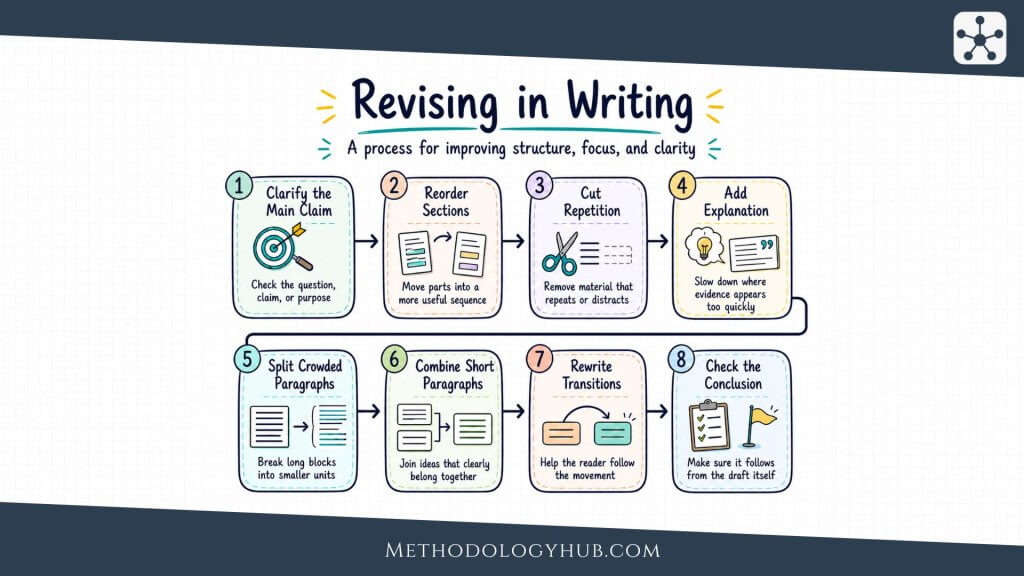
What Is Revising?
Revising is the work of looking at a draft again and changing it so the text better serves its purpose. The word itself suggests seeing again, and that is a helpful way to understand the stage. A writer returns to the draft with fresh attention and asks whether the text says what it needs to say, whether the order helps the reader, and whether the paragraphs have enough development.
In academic writing, revising usually reaches beyond small corrections. A student may change the thesis after discovering that the body paragraphs point in a different direction. A researcher may move a section because the literature review needs a clearer sequence. A teacher may ask a writer to expand analysis after the evidence has been placed but not explained. These changes are not cosmetic. They affect how the text works.
Revising definition
Revising is the stage in the writing process where a writer improves a draft by rethinking focus, structure, development, evidence, paragraph order, and reader understanding. It comes after drafting and before final editing, although writers often move back and forth between stages as the text develops.
This distinction is useful because many writers begin revising with the wrong scale of attention. They correct a comma, replace one word, and fix a spelling error while the argument itself is still unclear. Those details will need attention later. At the beginning of revision, however, the larger questions usually deserve the first look.
What happens during revising
During revising, the writer reads the draft as a whole before treating it as a set of sentences. The first concern is not whether every line sounds polished. The first concern is whether the draft has a clear centre and whether its parts support that centre in a readable order.
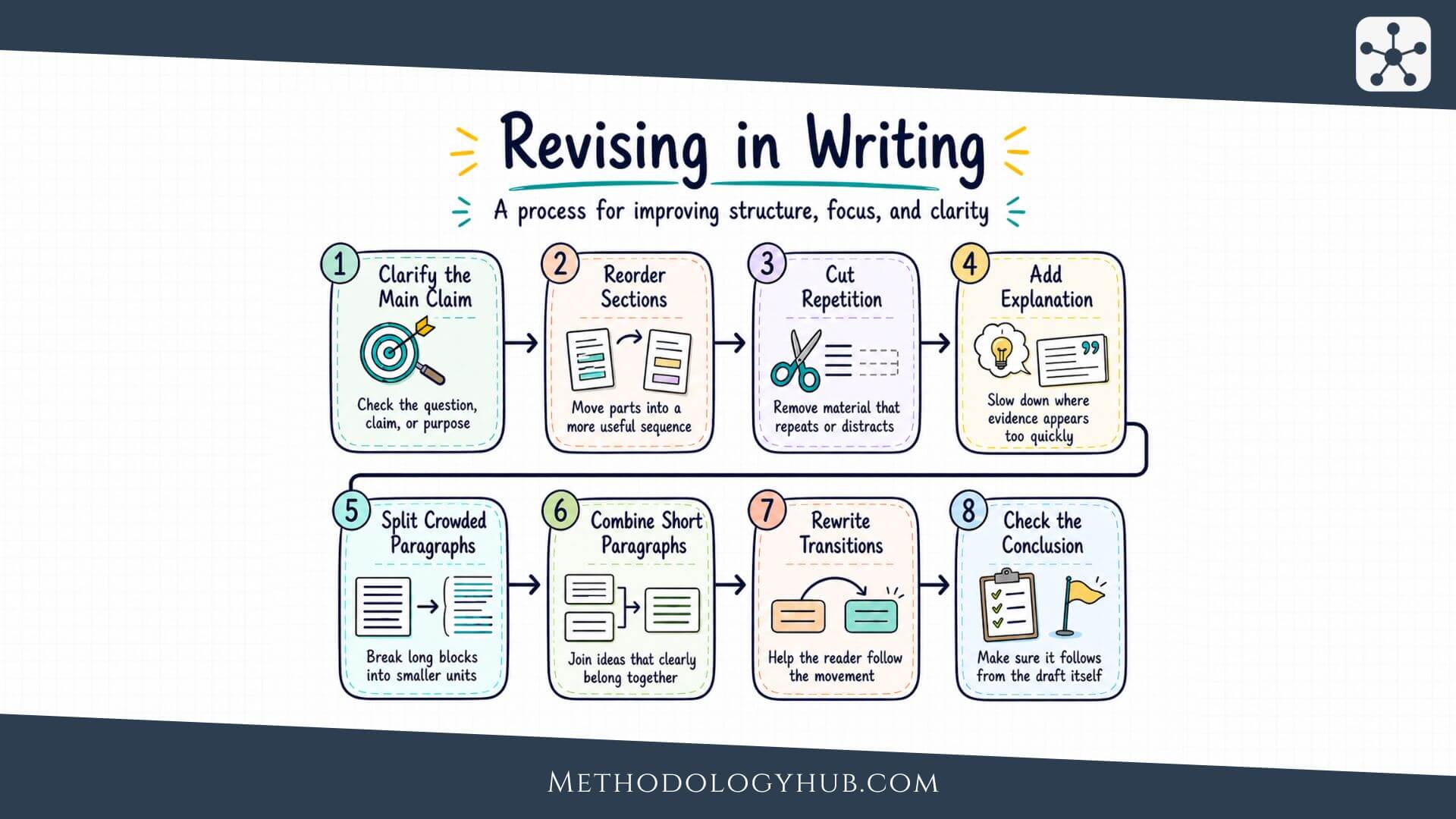
A revision pass may involve several kinds of work:
- clarifying the main claim, question, or purpose
- moving sections into a more useful order
- cutting material that repeats or distracts from the focus
- adding explanation where evidence appears too quickly
- splitting crowded paragraphs into smaller units
- combining short paragraphs that belong together
- rewriting transitions so the reader can follow the movement
- checking whether the conclusion follows from the draft itself
These tasks can feel slow because they ask the writer to question work that already exists. That is also why they are useful. A draft may look complete simply because it fills the page. Revising asks whether that page actually carries the reader through the intended thinking.
Revising vs Editing
Revising and editing often overlap in ordinary conversation, but they solve different problems. Revising asks whether the draft works. Editing asks whether the language is clean, accurate, and consistent. A writer may revise by moving a paragraph, adding a source explanation, or rewriting an introduction. The same writer may edit later by correcting punctuation, tightening a sentence, or checking citation style.
Keeping the two stages separate prevents wasted effort. If a paragraph is going to be cut, there is little value in polishing every sentence inside it. If the section order is still uncertain, transitions may need to be rewritten more than once. Revision gives the draft its shape. Editing cleans that shape once it has become stable enough to trust.
Revising in the Writing Process
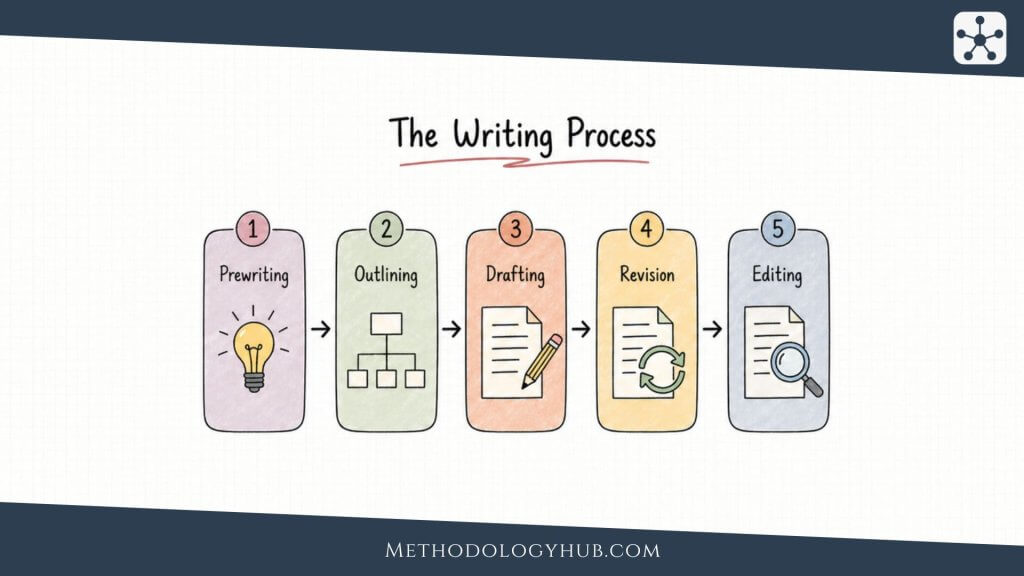
Revising usually follows drafting. Once the writer has a first full or partial version, the text can be read, tested, and reshaped. Before drafting, the writer may have notes, an outline, and a possible thesis. After drafting, the writer has something more revealing: an actual sequence of paragraphs.
That sequence rarely matches the plan perfectly. A section that looked small in the outline may take up too much space in the draft. A claim may appear later than it should. A source may be useful, but not where it was first placed. Revising is the stage that allows these discoveries to change the document instead of staying as private frustration.
How revising follows drafting
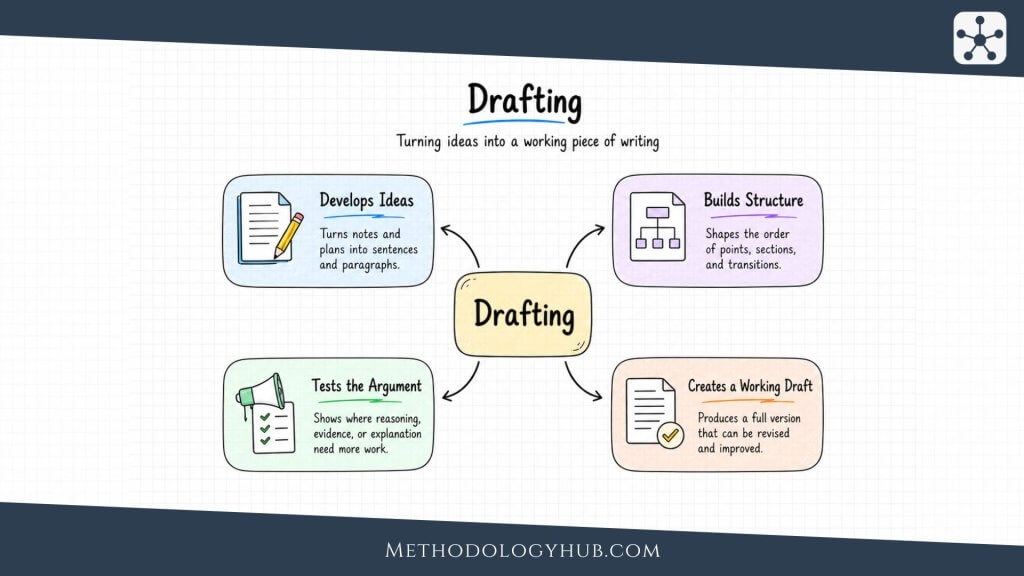
Drafting turns a plan into prose. Revising studies that prose and asks what the draft has become. This is why a rough first version should not be judged only by polish. Even a rough draft can tell the writer which ideas are strong, which paragraphs are thin, and which parts need to move.
For example, a student writing about peer feedback may draft an introduction that promises a broad discussion of classroom response. After reading the body paragraphs, the student may notice that the draft is really about how writers use comments during revision. The revised introduction should then narrow to that focus. The draft has taught the writer what the paper is actually doing.
How revising sends writers back to earlier stages
Revision sometimes sends a writer back to prewriting or outlining. A paragraph may need more explanation, so the writer freewrites for ten minutes to find clearer language. A section may be out of order, so the writer builds a reverse outline. A claim may be too broad, so the writer returns to the assignment prompt and narrows the purpose.
This movement is not a failure of process. It is part of how writing improves. Writers often learn what they need only after the draft makes the problem visible. Revising gives them permission to respond to that knowledge instead of forcing the original plan to remain unchanged.
How revising prepares editing
Editing becomes more productive when revision has already settled the larger questions. The writer can then check sentence clarity, grammar, punctuation, references, formatting, and style without worrying that whole sections may still be moved or cut.
This does not mean that the revised draft must be perfect. It means the draft should be stable enough for line-level attention. The main focus should be clear. The paragraphs should follow a reasonable order. Evidence should be placed and explained. Once those larger elements are in place, editing can do its own work without trying to rescue structure at the same time.
Revising is recursive
A writing process diagram may show revising as one step between drafting and editing, but real writing usually moves in loops. A writer may revise the introduction, return to the body, adjust the thesis, add a paragraph, revise the conclusion, and then read the whole piece again. Longer academic projects may go through several full revision rounds before editing begins.
It helps to name the purpose of each round. One pass might focus only on structure. Another might focus on evidence and explanation. A later pass might focus on paragraph transitions. When revision is divided this way, the writer does not have to notice everything at once.
What to Revise First
The first revision pass should usually begin with the largest parts of the text. A writer can ask whether the draft has a clear purpose, whether the main sections are in a useful order, and whether the reader receives enough guidance. Small errors can be marked, but they should not take control of the first pass.
This approach saves time because many local details depend on larger decisions. A transition cannot be final if the paragraph order may change. A polished topic sentence may need rewriting if the paragraph gets split. A neat conclusion may no longer fit if the argument becomes narrower during revision.
Read the whole draft before changing it
When possible, the writer should read the whole draft once before making large changes. This reading does not need to be slow proofreading. It is more like listening to the draft from beginning to end. The writer watches where the focus becomes clear, where the movement slows, and where the reader may need help.
Some writers make margin notes during this first read. The notes can be simple: “claim appears here”, “needs source”, “repeats paragraph 3”, “good example”, “unclear transition”, or “move earlier”. These notes create a map of the draft before revision begins. The writer is less likely to fix one sentence while missing the larger pattern.
Check the focus
After the first reading, the writer should check whether the draft has a clear focus. In an essay, this may mean checking the thesis. In a report, it may mean checking the purpose and scope. In a literature review, it may mean checking the organising question or theme. In a proposal, it may mean checking whether the research problem and planned method still match.
A useful test is to write one sentence that says what the draft is really about. If that sentence is difficult to write, the draft may need more thinking before sentence editing begins. If the sentence can be written, the writer can compare it with the introduction and headings. The draft and the promise made to the reader should point in the same direction.
Look for gaps before polishing style
Many drafts contain gaps that do not look like gaps at first. The writer knows what a point means, so the missing explanation may be invisible. A reader, however, may need a definition, a transition, a source connection, or an example before the idea can be understood.
Gaps often appear between evidence and interpretation. A quotation may be placed into a paragraph, but the writer may not explain how it supports the claim. A data point may be named, but not connected to the research question. A source may be summarised, but not related to other sources. Revising adds the thinking that helps the reader see the connection.
Decide what should stay
Revising is not the same as adding more. Sometimes it means removing material that no longer belongs. A paragraph may be interesting but unrelated to the focus. A source may be accurate but not useful for the argument. A long background section may delay the point the reader needs sooner.
Cutting can be easier if the writer saves removed material in a separate document. The paragraph is no longer in the draft, but it is not lost. This small habit can make revision less tense, especially when the writer has spent time building a section that finally does not fit.
Revising Structure and Organisation
Structure is one of the first things a reader feels, even if the reader does not name it. A clear structure makes the draft easier to follow because each section prepares the next. A weak structure forces the reader to guess why ideas appear where they do.
Revising structure does not always mean rebuilding the whole paper. Sometimes one paragraph needs to move earlier. Sometimes an introduction needs a narrower promise. Sometimes two sections need to change places. The goal is to make the order serve the reader rather than preserve the order in which the writer happened to draft.
Use a reverse outline
A reverse outline is made from an existing draft. Instead of planning what the text should do, the writer records what each paragraph actually does. This can be done in the margin, in a table, or on a separate page. Each paragraph receives a short note such as “defines peer feedback”, “summarises study one”, “explains student response”, or “returns to thesis”.
Once the paragraph notes are visible, structure becomes easier to judge. The writer may see that two paragraphs do the same job, that a definition appears after it is needed, or that the strongest claim is buried near the end. A reverse outline turns a long draft into a set of manageable parts.
Check section order
Academic texts often need a sequence that feels natural to the reader. Background usually comes before analysis. Definitions often come before technical discussion. Methods usually appear before findings. A literature review may move by theme, debate, method, or chronology, but the chosen order should be clear enough that the reader understands the reason for movement.
If the order feels confusing, the writer can ask what the reader must know first. A section may be well written but placed too early. Another section may work better as a bridge between two larger ideas. Revising structure is often less about finding a perfect universal pattern and more about finding the order that best serves this particular draft.
Adjust proportion
Proportion is the amount of space each part of the draft receives. A minor example should not take more space than a central claim. A short definition should not turn into a long detour. A source summary should not take over a paragraph that is supposed to develop the writer’s own point.
To revise proportion, the writer can compare section length with section function. If the introduction is almost as long as the body, the draft may be slow to begin. If one source receives three paragraphs while the central analysis receives one, the balance may need work. Proportion tells the reader what the text values. Revision makes that signal more accurate.
Revisit the introduction and conclusion together
The introduction and conclusion should feel connected. The introduction prepares the reader for the journey. The conclusion returns to the main line of thought after the evidence and explanation have done their work. If the body changes during revision, both ends of the text may need adjustment.
A useful method is to read the introduction, then the conclusion, without the body in between. If they seem to belong to different papers, the draft has shifted. That shift may be good. The introduction may simply need to catch up with the stronger argument the body has developed.
Revising Paragraphs
Once the overall structure is clearer, revision can move to paragraphs. Paragraphs are more than blocks of text. Each one should do a piece of work for the larger draft. A paragraph may define, explain, compare, support, qualify, or connect. When that role is unclear, the reader may feel that the text is drifting even if the sentences are grammatically correct.
Paragraph revision works best when the writer asks what each paragraph contributes. The answer does not need to be complicated. If a paragraph cannot be named in one simple phrase, it may contain too many jobs or no clear job at all.
Give each paragraph a clear job
A paragraph job is the task a paragraph performs. In an essay, one paragraph might explain a concept that the argument depends on. Another might show how a source supports the claim. Another might address a limit in the evidence. A paragraph should not feel like a storage box for everything related to the topic.
During revision, the writer can write a short label beside each paragraph. If two labels are the same, one paragraph may be repeated or the two may need to be combined. If one label contains several actions, such as “defines term, introduces study, gives example, changes topic”, the paragraph may need to be split.
Develop the point before moving on
A paragraph can have a clear topic sentence and still feel unfinished. This often happens when the writer states a point and then moves immediately to the next one. Academic readers usually need more than a claim. They need explanation, evidence, interpretation, and a reason to see how the paragraph connects to the larger text.
Revision can strengthen development by asking what the reader needs after the topic sentence. Does the paragraph need a short definition? A source? An example? A comparison? A sentence that explains the evidence? A link back to the thesis or research question? The answer depends on the paragraph’s role, but the question keeps the paragraph from ending too soon.
Integrate evidence instead of dropping it in
Evidence needs a role inside a paragraph. A quotation, statistic, observation, or source summary should not appear as a sudden interruption. The writer should prepare it, present it, and then explain it. This is especially necessary in academic writing, where readers expect to see how evidence supports the reasoning.
A paragraph that uses a source can be revised by checking three places. Before the source, does the writer explain why it is being introduced? During the source, is the quotation or paraphrase accurate and relevant? After the source, does the writer interpret it instead of assuming that the connection is obvious? Strong revision often adds the after-source sentence that was missing in the first draft.
Strengthen transitions between paragraphs
Transitions are more than words such as “however” or “therefore”. They are relationships between ideas. A weak transition may show that the next paragraph appears without a reason. The writer can revise by making the relationship clearer: cause, contrast, example, extension, qualification, sequence, or return to the main claim.
Sometimes the best transition is not a single phrase but a new sentence at the end of the previous paragraph. Other times the next paragraph needs a stronger opening. If the transition still feels forced, the problem may be order rather than wording. Two paragraphs may need to change places.
Revising Sentences Without Editing Too Early
Sentence work belongs in revision too, but timing is important. A writer does not need to wait until editing to improve clarity or rhythm. At the same time, heavy sentence polishing too early can slow down larger changes. The best moment for sentence revision usually comes after focus, structure, and paragraphs are mostly settled.
At this stage, sentence revision is less about correcting every small error and more about making the draft readable. The writer looks for sentences that are too long, vague, repetitive, or difficult to follow. The goal is not decorative style. The goal is clear movement.
Revise for clarity
Clarity begins with knowing what a sentence is trying to say. If the main idea is buried under too many phrases, the reader has to work harder than necessary. The writer can revise by placing the main subject and action closer together, cutting repeated wording, and replacing vague phrases with more exact ones.
For example, a sentence that says “There are several aspects of the issue that can be seen as connected to revision practices” can become clearer: “Several parts of the issue connect to revision practices.” The revised sentence is shorter, but the improvement is more than length. The relationship is easier to see.
Revise for rhythm
Readable academic prose needs variation. If every sentence has the same length and pattern, the paragraph can feel mechanical. If every sentence is long, the reader may lose the main point. If every sentence is very short, the paragraph may feel choppy. Revision can adjust rhythm by mixing sentence lengths and placing emphasis where it helps understanding.
Reading aloud is useful here. The writer can hear where a sentence runs too long, where a phrase repeats, or where the paragraph needs a pause. This is not performance for its own sake. It is a practical way to notice what the eye skips on the screen.
Cut repetition carefully
Repetition is not always bad. Sometimes a repeated term keeps the subject clear. Academic writing often needs stable wording for central concepts. But repeated phrases can slow a paragraph when they do not add meaning. Revising should remove repetition that dulls the prose while keeping the terms the reader needs.
One useful habit is to look for repeated openings. If several sentences begin with “This shows”, “This means”, or “The writer”, the paragraph may need more variety. The writer can revise by combining sentences, changing the order, or naming the specific relationship more clearly.
Leave proofreading for later
Proofreading is still necessary, but it belongs closer to the end. During sentence revision, the writer may notice spelling or punctuation errors and mark them. The final careful check should wait until the sentences are no longer changing heavily.
This sequence prevents double work. A writer who proofreads early may correct a sentence that later gets rewritten. Revision should make the writing clearer and more coherent. Proofreading should then make the final version clean.
Revising with Feedback
Feedback can make revision more precise because another reader sees the draft from outside the writer’s own thinking. A writer may know what a paragraph was meant to say, but a reader sees only what the paragraph actually says. That difference is valuable.
Feedback is most helpful when the writer treats it as information about reader experience. A comment such as “unclear” does not mean the writer has failed. It means the reader needed more guidance at that point. The writer’s task is to decide what kind of revision will solve the problem.
Ask for feedback at the right stage
Different stages need different kinds of feedback. A rough draft may need comments on focus, order, evidence, and paragraph development. A later draft may need comments on clarity, style, and citation consistency. Asking for detailed grammar correction too early can distract both the reader and the writer from larger revision needs.
Before sharing a draft, the writer can give the reader two or three questions. For example: “Does the order make sense?” “Where does the evidence need more explanation?” “Does the introduction prepare the body?” Focused questions usually produce more useful feedback than a general request to read the paper.
Read feedback in patterns
Not every comment needs the same response. Some comments point to local confusion. Others reveal a larger pattern. If one reader struggles with one sentence, the writer may revise that sentence. If several comments point to unclear paragraph order, the structure needs closer attention.
It helps to sort feedback before changing the draft. The writer can group comments into focus, structure, evidence, paragraph development, sentence clarity, and editing. This prevents revision from becoming a scattered reaction to comments in the order they appear.
Use peer feedback carefully
Peer feedback is useful because peers often notice reader problems that the writer has missed. They may identify a confusing transition, a claim that needs support, or a paragraph that seems to arrive too suddenly. Peer response also helps writers learn revision by reading other drafts as well as their own.
Peer feedback works best when it focuses on specific reader experience. Comments such as “good” or “fix this” are too general. More useful comments explain what the reader understood, where the reader became uncertain, and what kind of addition might help. A peer does not need to rewrite the draft. The peer can show where revision is needed.
Use instructor feedback as a revision plan
Instructor feedback often identifies priorities. A teacher, professor, or supervisor may point out that the thesis needs narrowing, the evidence needs interpretation, or the section order does not fit the assignment. The writer should read these comments as a guide for the next revision round, not as a list of isolated repairs.
A practical method is to turn feedback into revision tasks. “Develop analysis” becomes “add two explanation sentences after each major quotation.” “Clarify structure” becomes “make a reverse outline and move the background section before the first claim.” This translation helps the writer move from comment to action.
Revising Different Academic Texts
Revising changes shape depending on the type of academic text. The general stage remains the same, but an essay, research paper, literature review, proposal, report, thesis, or dissertation places pressure on different parts of the draft. A short essay may need sharper paragraph movement. A research paper may need better source integration. A proposal may need stronger alignment between question and method.
The writer should therefore revise with genre in mind. A draft is judged by more than general clarity. It is judged by how well it performs the work its genre requires.
Revising essays
Essay revision usually begins with the thesis and body paragraphs. The writer should ask whether the thesis names the argument the essay actually develops. If the body has shifted, the thesis should shift too. If the thesis is clear but the paragraphs do not support it, the body needs revision.
Essays also depend on paragraph order. Each body paragraph should develop one part of the argument and prepare the next move. During revision, the writer can read the topic sentences in order. If they do not form a clear sequence, the essay probably needs structural work before editing.
Revising research papers
Research paper revision often focuses on evidence and source use. A draft may contain many sources but still feel weak if those sources are only summarised. The writer should check whether each source has a role: context, definition, evidence, contrast, method, or support for a claim.
Revision should also strengthen the writer’s own voice between sources. A research paper should not read as a chain of article summaries. The writer needs to explain how sources relate to the research question and to one another. This is where revision often adds synthesis rather than more quotation.
Revising literature reviews
A literature review usually needs revision at the level of grouping. If the draft moves source by source without showing relationships, the reader may see summaries but not a review. Revising can reorganise the text by theme, method, debate, finding, or gap in the literature.
The writer should check whether each paragraph shows a relationship between studies. Do the sources agree? Do they use different methods? Do they define the concept differently? Do they point toward a question the current project will address? Revision turns collected sources into a readable scholarly map.
Revising proposals and reports
Proposals and reports often have expected sections, but that does not remove the need for revision. A proposal should show a clear link between the problem, research question, method, and scope. If those parts do not fit, the proposal may feel uncertain even when each section is well written.
Reports often need revision for section control. Results should not be over-interpreted before the discussion. Methods should be detailed enough to follow. Headings should match the content below them. In these genres, revising often means putting information in the section where readers expect to find it.
Revising theses and dissertations
Long academic projects need several layers of revision. A writer may revise a chapter, then a section, then a paragraph, then the whole document. The challenge is consistency across distance. A term introduced in chapter one should be used consistently later. A research question should guide the findings and discussion. A chapter conclusion should prepare the next chapter rather than feel disconnected.
Reverse outlining is especially helpful for long projects. The writer can summarise each chapter in a few sentences, then each section inside the chapter, then difficult paragraphs inside those sections. This creates a map that helps revision stay organised across many pages.
From Revised Draft to Editing
At some point, revision needs to give way to editing. This does not mean the draft is perfect. It means the major decisions are settled enough that line-level correction will not be wasted. The writer can now move from shaping meaning to cleaning language and presentation.
This handoff is sometimes difficult. Writers may keep revising because more changes are always possible. A draft can nearly always be improved, but deadlines and reader needs require a final version. The task is to know when revision has done enough for editing to begin.
Signs that the draft is ready for editing
A draft is ready for editing when the focus is clear, the section order is stable, the paragraphs have defined roles, and the evidence is placed and explained. There may still be awkward sentences, spelling errors, and formatting details. Those are editing tasks. The larger route should no longer be in question.
One practical test is to read the headings, topic sentences, or paragraph notes in order. If they form a clear path, the draft is probably ready for sentence-level work. If they feel scattered, the writer should revise structure again before editing.
Build a final revision checklist
Before editing, the writer can make one final revision checklist. This checklist should stay focused on meaning and movement, not grammar. It can include the specific needs of the assignment, such as thesis clarity, use of sources, section order, paragraph development, or connection between results and discussion.
A useful final revision checklist might ask:
- Does the introduction prepare the reader for the actual draft?
- Does each main section have a clear role?
- Does each paragraph develop one central point?
- Are sources introduced, explained, and connected to the writer’s purpose?
- Does the conclusion follow from the discussion rather than introduce a new main idea?
- Are any placeholders, missing examples, or unresolved notes still present?
Let editing do its own work
Once the draft moves into editing, the focus changes. The writer checks grammar, punctuation, citation style, formatting, headings, link accuracy, spacing, and consistency. Editing should not have to rebuild the argument. It should refine a draft that revision has already shaped.
This separation gives both stages more value. Revising can be bold because it is allowed to move, cut, and add. Editing can be careful because it works on a settled text. When the writer respects the difference, the final draft usually becomes both clearer and cleaner.
Conclusion
Revising is the stage that turns a draft into a stronger version of itself. It asks the writer to step back from the page and look again at focus, structure, evidence, paragraphs, and reader understanding. The work can involve small changes, but its purpose is larger than correction.
The best revision usually begins with the whole draft. The writer reads for direction before polishing wording, checks structure before tightening transitions, and develops paragraphs before proofreading. This order prevents small corrections from hiding larger needs. It also makes editing more useful because the final language is applied to a draft that has already been shaped.
For students, teachers, researchers, and academic writers, revising is a practical habit as much as a stage. It teaches writers to see the difference between what they intended to say and what the draft actually says. Once that difference is visible, improvement becomes possible.
- Read the draft as a whole before making small corrections.
- Revise focus, structure, and evidence before editing sentences.
- Use reverse outlining to see what each paragraph does.
- Turn feedback into concrete revision tasks.
- Move to editing only when the larger shape is stable.
In that sense, revising is not a sign that the first draft was weak. It is the stage that gives the draft room to become clearer, more developed, and easier for a reader to follow.
FAQs on Revising
What is revising in writing?
Revising is the stage where a writer rereads and reshapes a draft to improve focus, structure, evidence, paragraph development, and reader understanding before final editing.
What is the difference between revising and editing?
Revising focuses on meaning, order, development, and coherence. Editing focuses on sentence clarity, grammar, punctuation, formatting, consistency, and final presentation.
What should I revise first?
Start with the largest parts of the draft: the main focus, section order, paragraph roles, evidence, and explanation. Save final proofreading for the editing stage.
How does a reverse outline help with revising?
A reverse outline records what each paragraph in an existing draft actually does. It helps writers see repetition, missing steps, weak order, and paragraphs that need to be moved, cut, split, or developed.
When is a draft ready for editing?
A draft is ready for editing when the main focus is clear, the order is stable, paragraphs have defined roles, evidence is explained, and no major section still needs to be rebuilt.