Content analysis is a method for examining recorded communication in a systematic way. Researchers identify relevant features of documents, speech, images or other material, then organise those features into categories they can interpret, count or compare. The method can answer questions about what a message contains, how a subject is represented and how that representation varies across sources.
This article explains content analysis, its definition, key characteristics, the difference between manifest and latent content, and the decisions needed to carry out a study. Each distinction answers a different question about the analysis; they need not compete for the same place in a single list.
What Is Content Analysis?
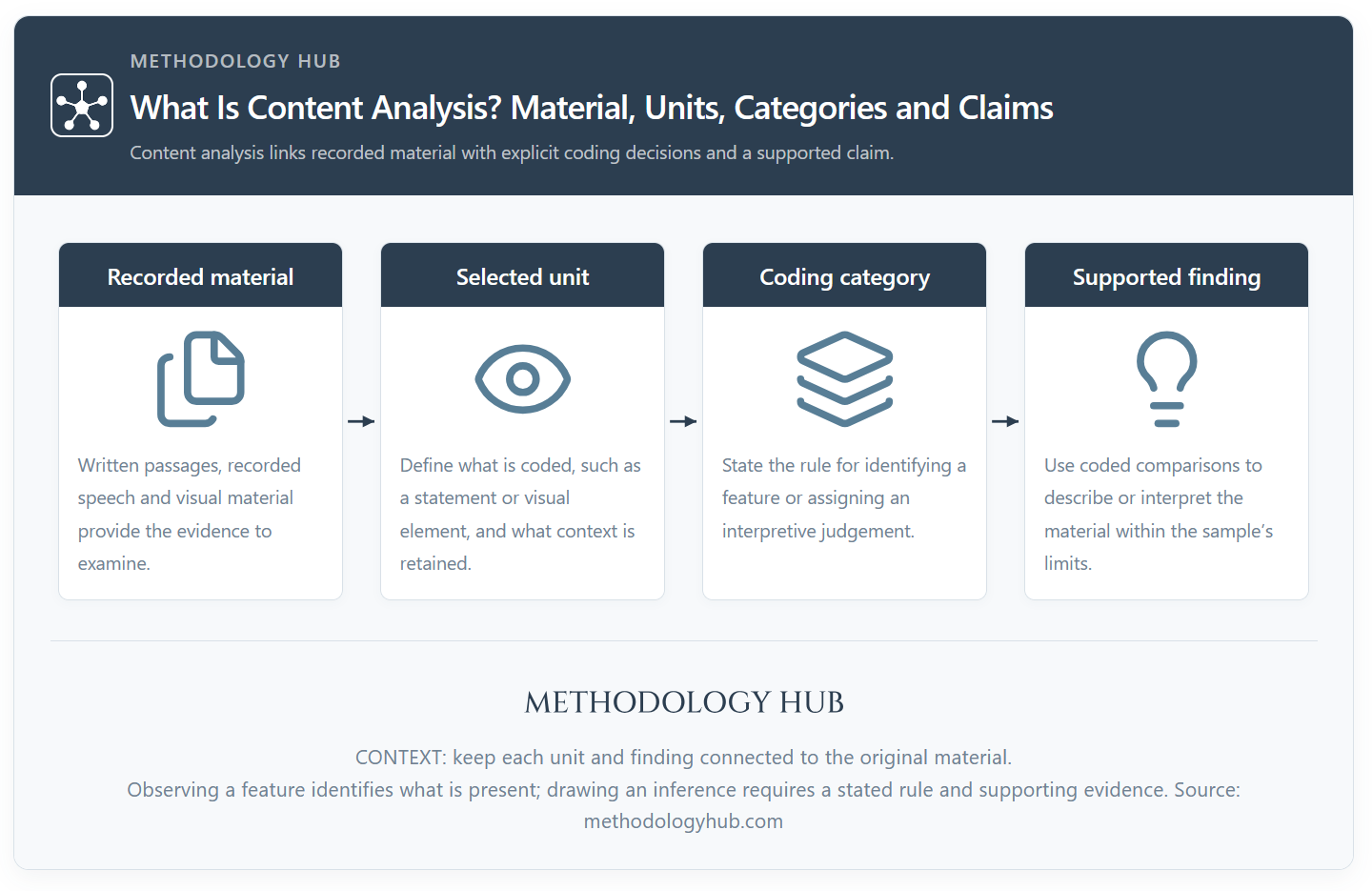
Content analysis examines recorded material by defining what to look for, identifying it consistently and drawing conclusions that the material can support. It can describe how often a feature occurs or explain how a category is expressed in context. Either way, the researcher must be clear about the material selected and what the categories mean.
Definition of Content Analysis
The material might be a set of newspaper articles, interview transcripts, campaign posters or videos. A researcher specifies a unit, such as a whole article or a particular statement, then applies a coding scheme to the relevant features. An interpretation follows from the coded material and the question being asked. A word count by itself is an observation; content analysis also requires a defensible account of what that observation represents.
Purpose and Key Characteristics
Researchers use content analysis to describe communication, compare groups or periods, and investigate what meanings appear in a body of material. One study may compare the issues emphasised by two newspapers. Another may examine how interviewees describe seeking medical help. A third may measure the presence of different claims in a sample of advertisements.
The common features are explicit selection of material, attention to its context, and a stated basis for classifying relevant content. Categories may be prepared before coding or developed as the study progresses. The resulting claims need to remain proportionate to the evidence: identifying a claim in a speech does not prove its audience accepted it.
Content Analysis in Research
Content analysis can be qualitative, quantitative, or mixed. It can for example support qualitative analysis when the aim is to interpret meanings through categories. Content analysis in Quantitative research on the other hand might use coded features as variables for counts, comparisons or statistical analysis. Mixed methods research projects combine these purposes, for example by measuring how often a portrayal appears and then examining what that portrayal means in selected passages.
The research question determines what belongs in the sample and whether the findings can speak about a larger population of messages. A complete set of documents from one organisation can support conclusions about that set. Claims about national media coverage need a sampling design suited to that wider claim.
| Material | Possible unit | Research application |
|---|---|---|
| Interview transcripts | Account of an experience | Compare explanations of a shared situation. |
| News articles | Article or individual claim | Compare subjects or portrayals across outlets. |
| Social media posts | Post, image or comment | Examine recurring references or reactions. |
| Political speeches | Passage or argument | Investigate stated priorities and implied meanings. |
| Images and video | Frame, scene or visual feature | Classify representations and compare their use. |
What Materials Can Be Analyzed?
Any recorded communication with features relevant to the question may be examined. Written words are common, but an image, audio recording or video can also be divided into meaningful units. Researchers must retain enough context to interpret what a feature does within the original material.
Types of Content Analysis
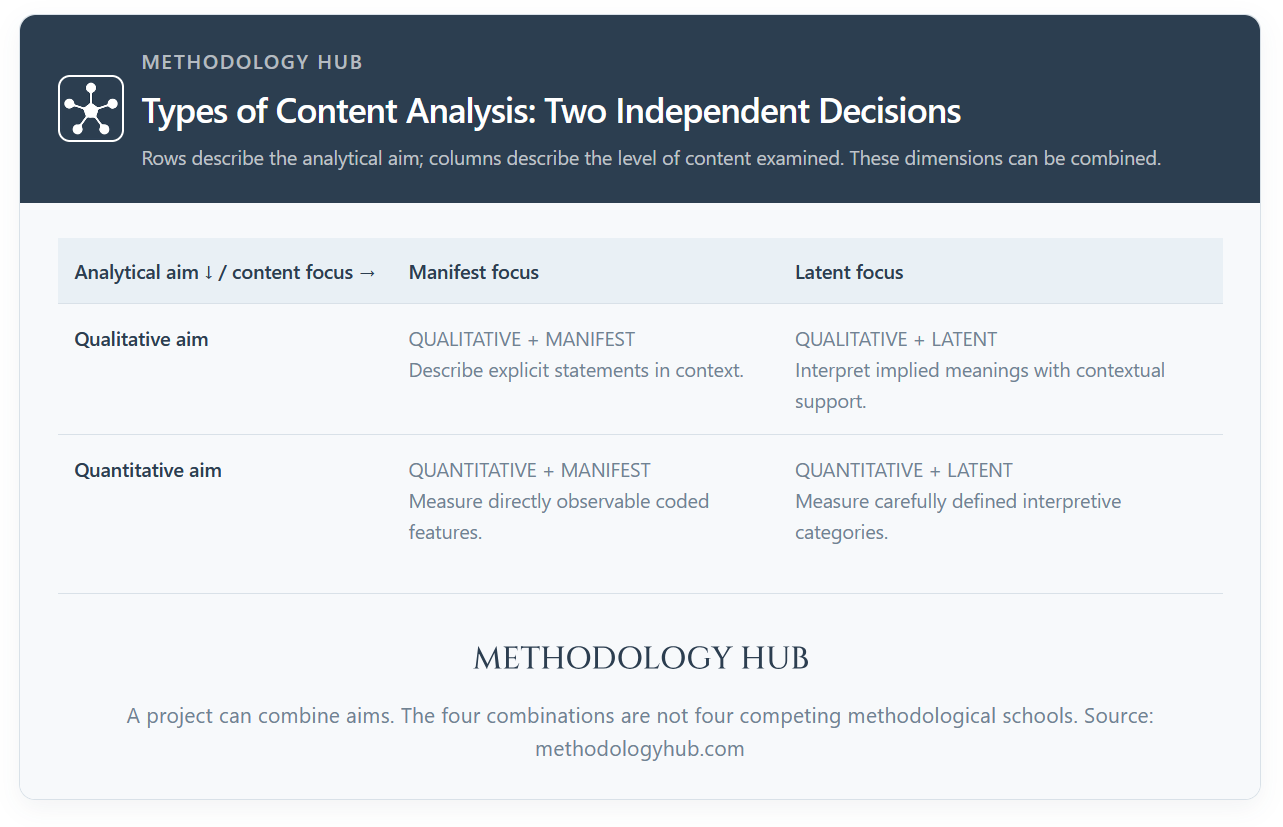
Content analysis can be qualitative or quantitative, and it can focus on manifest or latent content. The first distinction concerns the kind of answer the study seeks; the second concerns what the researcher is identifying in the material. A study can therefore be quantitative and latent, or qualitative and manifest.
Qualitative Content Analysis
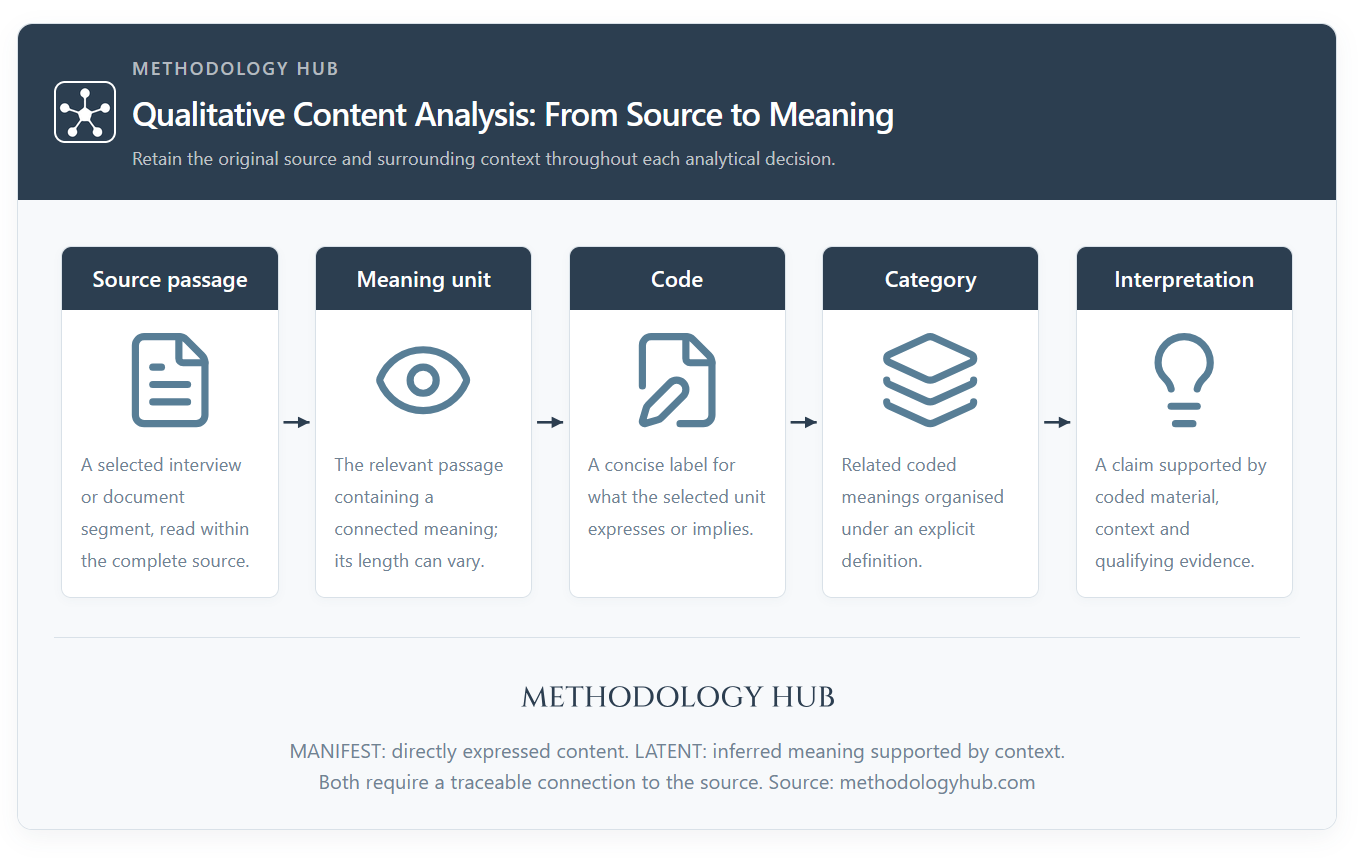
Qualitative content analysis develops categories to describe or interpret meaning. A researcher may compare what speakers say about a problem, how their accounts differ and what circumstances give those accounts significance. The categories may emerge from close reading, follow prior concepts or develop through a combination. Counting categories can be useful, but qualitative findings need an explanation of their meaning.
Quantitative Content Analysis
Quantitative content analysis classifies a defined sample according to coding rules and analyses the resulting measurements. The unit might be a news article, an advertisement or a statement within a speech. Researchers could record whether a particular claim occurs, compare its prevalence between outlets or test an association between message characteristics. Sampling, category definitions and coding consistency are central when making numerical claims.
Manifest Content Analysis
Manifest content analysis identifies features that are directly observable, such as a named organisation, an explicit statement of cost or the presence of an image. The researcher still has to define the unit and decide what qualifies. A code for an exact word, a stated claim and a visual feature will each require different rules.
| Distinction | Main question | Possible finding |
|---|---|---|
| Qualitative | What meanings do the categories convey? | An interpretation of a category in context. |
| Quantitative | How common is each coded feature? | The proportion of documents assigned a code. |
| Manifest | What is directly present? | The presence of an explicitly stated claim. |
| Latent | What supported meaning is conveyed? | An inferred framing supported by a passage. |
Latent Content Analysis
Latent content analysis interprets meaning that is not stated in the form of a simple label or word. Identifying an implied justification or recurring framing requires evidence from the surrounding language and context. Latent categories can also be used in quantitative work if their coding rules are sufficiently clear for the intended comparison.
Manifest does not mean unimportant, and latent does not mean speculative. Both require decisions about what the material shows. The difference is how much interpretation is needed to identify the particular feature.
How to Conduct Content Analysis
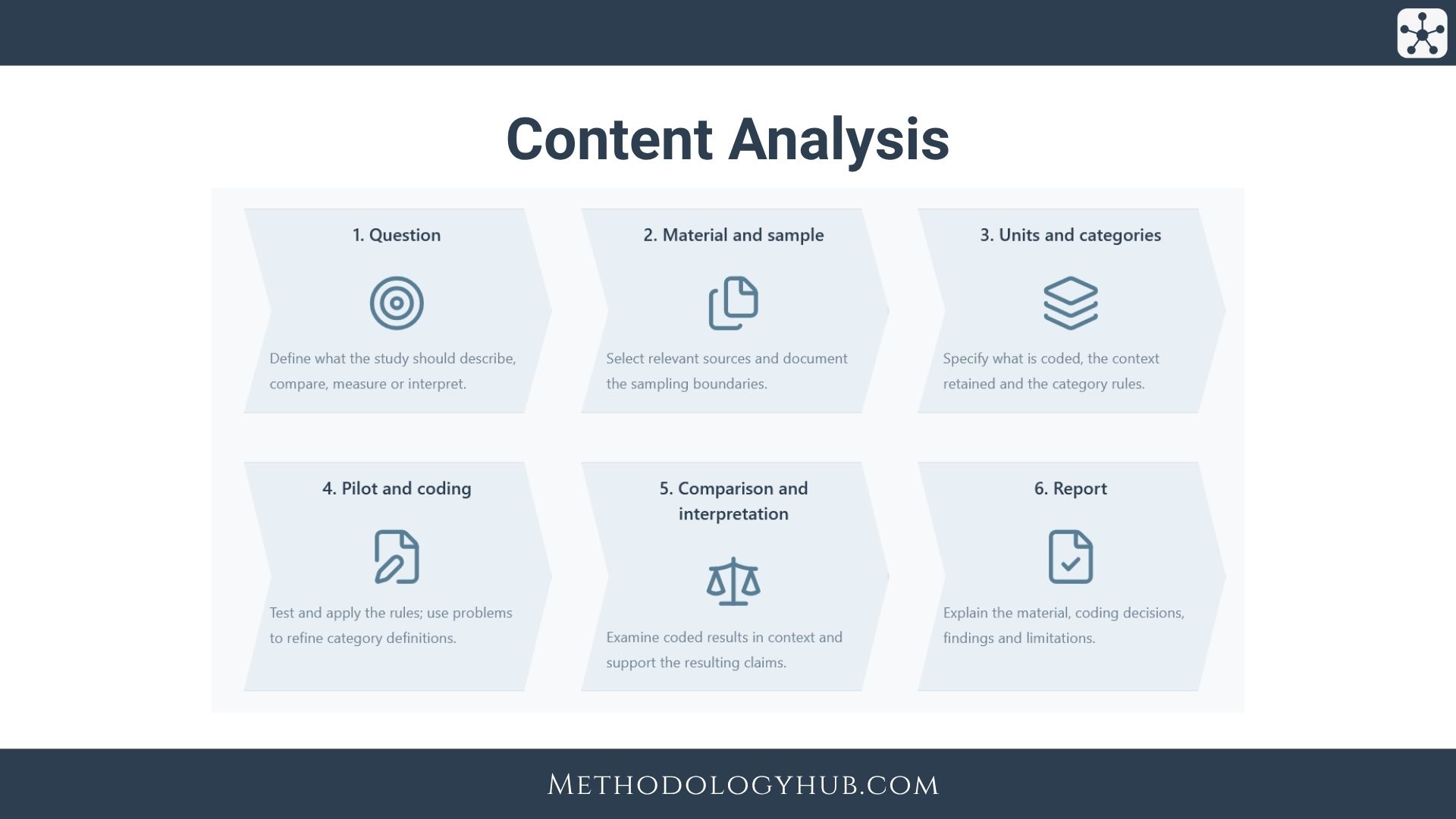
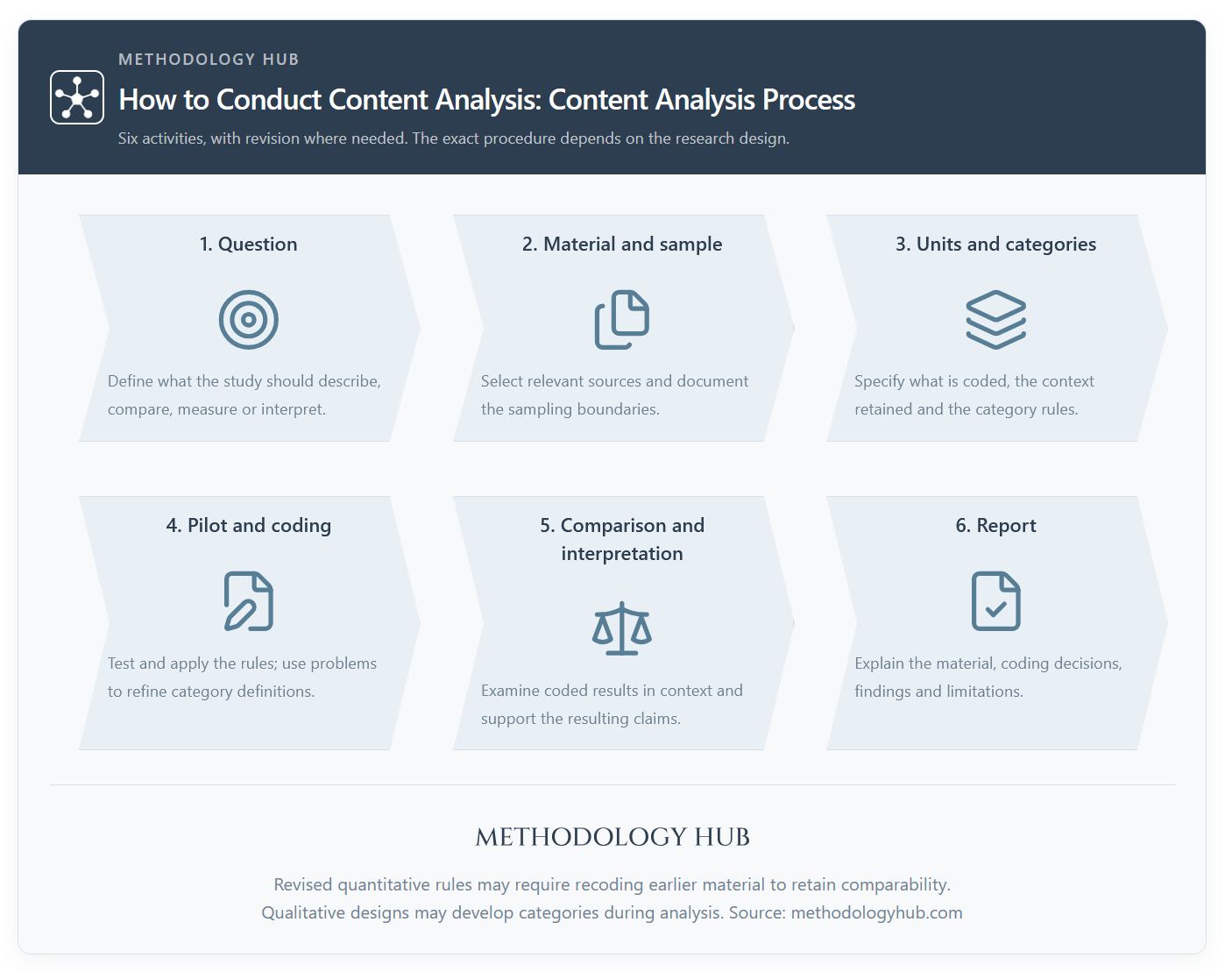
Conducting content analysis involves defining a question, selecting material, specifying units and categories, applying those categories, and interpreting the result. The order is a useful guide, but qualitative researchers may revisit earlier decisions as categories develop. Quantitative comparisons usually require a stable coding frame before the main dataset is classified.
Define the Research Question
State what the analysis should reveal. A question about how something is represented calls for attention to portrayals and context. A question about what proportion of documents contains a defined feature calls for a sample and a code for that feature. The question determines whether the work aims primarily to explain meaning, measure content or combine both.
Select the Research Material
Specify sources, dates and reasons for inclusion. An analysis of local news needs to say which outlets and publication period were examined. A qualitative study may select documents for their relevance to a question; a quantitative study seeking population estimates needs a sampling strategy appropriate to that claim. Retain source details so a coded passage can be read in context.
Define the Units of Analysis
Decide what counts as one case and what smaller part can receive a code. A study may sample 100 articles but code individual claims within each article. It must then distinguish an article count from a count of claims. Researchers may also preserve a larger context unit, such as the whole article, to interpret a short coded sentence. These choices affect the denominator and the meaning of the reported result.
Develop Coding Categories
Categories describe features relevant to the question. One code might identify an explicitly stated issue, while another concerns the way a subject is portrayed. Define each category, give examples in the coding guide, and state how to handle unclear or overlapping cases. Qualitative categories can develop during analysis; quantitative coding rules normally need testing and revision before the final round of measurement.
Code and Analyze the Material
Apply categories to the specified units and keep a route back to the source. Try the coding rules on a small selection first. If two coders classify a passage differently, examine why and revise an unclear rule where necessary. For quantitative work, assess coding agreement when it is relevant to the design. In qualitative work, document category changes and the interpretive choices behind them; numerical agreement is not a universal requirement.
Content analysis software can help retrieve coded material and compare categories across a large collection. The researcher still decides whether a passage belongs in a category and what the result means.
After coding, inspect the distribution and content of the categories. A spreadsheet may show how often a code appears by outlet; reading the passages shows whether apparently similar mentions serve the same purpose. A count cannot answer every question about meaning, and a few illustrative quotations cannot establish a population frequency.
Interpret the Findings
Explain what the coded material supports in relation to the question. Differences between outlets may reflect sampling, article type or editorial emphasis. An interpretation of latent meaning needs passages that demonstrate it, along with attention to alternative readings. Findings can describe communication; claims about an audience’s beliefs or behaviour require further evidence.
Report the Results
Describe the material, period, sampling, units, categories and how coding decisions were made. Quantitative reports should give counts with appropriate denominators and explain any coder-agreement checks. Qualitative reports should show how categories were interpreted using enough source context for readers to follow the claim. State where the study’s material limits the conclusion.
| Step | Decision to record | Purpose |
|---|---|---|
| Question and selection | Topic, sources, dates and sample | Set the scope of the claim. |
| Units | Case, segment and context unit | Make coded observations comparable. |
| Categories | Definitions and borderline cases | Make classification understandable. |
| Pilot and coding | Revisions, coded records and relevant checks | Apply the method consistently. |
| Interpretation and report | Patterns, exceptions and limits | Connect findings to the question. |
Content Analysis Software
Software can help researchers organise sources, apply categories and retrieve coded material. Established paid options include NVivo, ATLAS.ti and Dedoose. Open-source alternatives include Taguette, QualCoder and OpenQDA. See our independent content analysis software review and recommendations for comparisons.
Examples of Content Analysis
These examples use one fictional topic: a city’s proposed changes to bus routes. Interviews, news articles, social media posts and political speeches provide different kinds of material about the same proposal. Their findings cannot be combined as though they came from one sample; each answers a different question.
Qualitative Content Analysis of Interview Transcripts
A researcher interviews riders about the proposal and asks how they expect it to affect travel. One participant says, “The last bus would leave before my shift ends.” The passage could be coded as service hours conflict with work and compared with accounts of missed appointments or extra transfers. The resulting category might describe obstacles created by the proposed schedule. It does not establish how many residents would be affected unless the study gathered suitable evidence for that claim.
Quantitative Content Analysis of News Articles
A researcher samples 40 articles published about the proposal during a defined month. Each article is coded for whether it mentions service cost, accessibility and environmental effects. Suppose 24 mention cost and 13 mention accessibility; an article can receive both codes. The analysis can compare proportions across outlets if the sample and article classifications warrant that comparison. It cannot conclude that the public values cost more than access merely because one topic appears in more articles.
Manifest Content Analysis of Social Media Posts
In 50 public posts about the proposal, a researcher codes explicit mentions of “fare,” including a stated price or the phrase “bus fare.” That rule identifies observable content and permits a count of posts meeting it. Posts that discuss transport expense without using those expressions need a broader category if the question concerns cost generally. The choice of rule should be made clear before interpreting the count.
Latent Content Analysis of Political Speeches
A councillor describes the route change as “a more reliable service” and goes on to prioritise busy commuting hours over less-used evening routes. A latent reading might identify a framing of service reduction as improvement, but it would depend on the full argument and any passages that qualify it. The researcher should present the supporting language and acknowledge if another speech uses “reliable” to mean keeping evening buses on schedule.
| Research question | Material and approach | Illustrative finding |
|---|---|---|
| How do riders describe likely effects? | Interviews; qualitative categories | Work schedules make certain route changes difficult. |
| Which issues appear in coverage? | 40 news articles; quantitative codes | 24 articles mention cost; 13 mention accessibility. |
| Which posts explicitly mention fares? | 50 public posts; manifest code | A count of posts meeting a defined fare rule. |
| How is the change justified? | Speeches; latent interpretation | Reliability is linked to prioritising particular routes. |
One statement, different analytical questions
Fictional announcement: “The revised routes will make the service more reliable.” A manifest code can record the word “reliable.” A quantitative code can ask how many announcements explicitly claim improved reliability. A qualitative analysis can compare what “reliable” means in different documents. A latent interpretation can examine whether reliability is used to justify reducing some routes. That last claim needs support from the surrounding proposal; the sentence alone cannot establish it.
Content Analysis vs Other Methods
Content analysis differs from neighbouring methods in the question it asks of the material and how it supports an answer. The boundaries are not absolute. A researcher should specify the actual analytical procedure rather than assume that naming a method explains how codes or interpretations were produced.
Content Analysis vs Thematic Analysis
Thematic analysis develops patterns of meaning relevant to a research question. Content analysis often organises material through defined categories, which may support interpretation or measurement. Some forms of thematic analysis use structured codebooks, while qualitative content analysis can develop rich interpretations, so a simple “counting versus meaning” contrast is inaccurate. The practical question is whether the study aims to build themes, classify content under explicit categories or do both with a clearly described method.
Content Analysis vs Discourse Analysis
Discourse analysis asks how language works in its setting: for example, how a speech assigns responsibility or establishes one account as authoritative. Content analysis can classify what claims appear and may interpret how they are presented. Discourse analysis gives more sustained attention to wording, positioning, interaction and social context. If the research question turns on what a way of speaking accomplishes, a discourse approach may be more suitable.
Content Analysis vs Textual Analysis
Textual analysis is a broad label for examining written or other symbolic material; its procedures depend on the tradition using it. Close reading of one speech might trace imagery, argument and ambiguity without assigning a category to each passage. Content analysis makes the classification procedure more explicit, especially when comparing many documents. A study of one text can still be content analysis if its categories and analytical decisions are stated clearly.
| Method | Useful when asking | Characteristic output |
|---|---|---|
| Content analysis | What features or meanings occur, and how do they vary? | Defined categories with supported interpretation or measurement. |
| Thematic analysis | What patterns of meaning matter across accounts? | Developed themes and their interpretation. |
| Discourse analysis | What does language accomplish in a social setting? | An account of discursive practices and their effects. |
| Textual analysis | How does this text produce meaning under a specified tradition? | A close interpretation shaped by that tradition. |
When to Choose Content Analysis
Choose content analysis when the question concerns identifiable features of recorded material and a systematic set of categories will help answer it. It is useful for comparing portrayals across media, interpreting recurring concerns in interviews or measuring the occurrence of defined claims. Before committing, check that the available texts or recordings contain the evidence needed for the intended conclusion, and decide whether a qualitative, quantitative or combined design best serves it.
Conclusion
Content analysis makes recorded communication available for systematic description, comparison and interpretation. A study can measure coded characteristics, examine meanings within categories or combine those aims. Manifest and latent identify different levels of attention to content, while conventional, directed, summative and Mayring’s procedures offer different ways of developing qualitative analysis.
A sound study specifies its material, units, categories and basis for interpretation. Those decisions determine what the findings can say. When the question needs detailed treatment of one tradition, the specialised methods can take the analysis further.