Qualitative content analysis examines recorded material to explain what people say, how they describe an issue and what those accounts mean in context. Researchers identify meaning units, develop or apply categories, compare the material assigned to them and support their interpretations with evidence from the sources.
This article explains the main approaches, the decisions behind category development and a practical way to conduct the analysis. It then compares what four approaches reveal when applied to the same set of interview material.
What Is Qualitative Content Analysis?
Qualitative content analysis is a systematic way to classify and interpret meaning in text, speech and visual material. It asks what is expressed in a source and how that expression should be understood in its setting. Its categories give researchers a way to compare material without treating every passage as interchangeable.
Definition of Qualitative Content Analysis
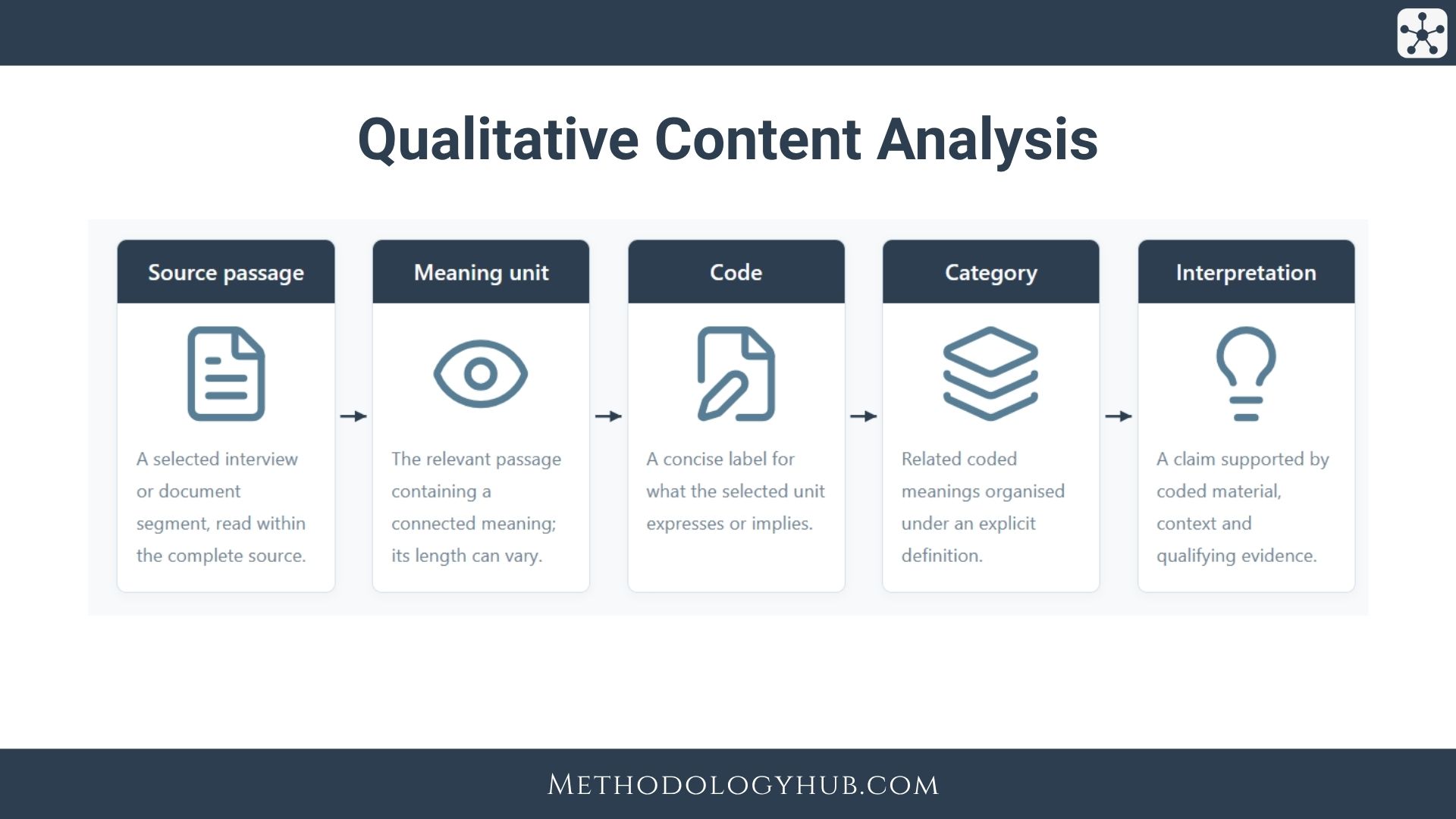
Researchers select material relevant to a question, decide which parts can carry meaning, and assign categories to those parts. They then examine what the categories contain, where they differ and how the surrounding material qualifies an interpretation. A category is an analytical claim about the material, so its meaning and use should be explained.
Purpose and Key Characteristics
The method can describe experiences, compare accounts or investigate how an organisation communicates about a subject. A researcher might ask which concerns appear in student interviews or how a policy document explains a change. The analysis retains links between categories and their source passages, allowing readers to see the basis for a finding.
Procedures vary, but a clearly stated question, transparent selection of material and careful category decisions are common concerns. The number of times a category appears may be informative; its significance also depends on who said it, under what circumstances and with what qualification.
Manifest and Latent Meaning
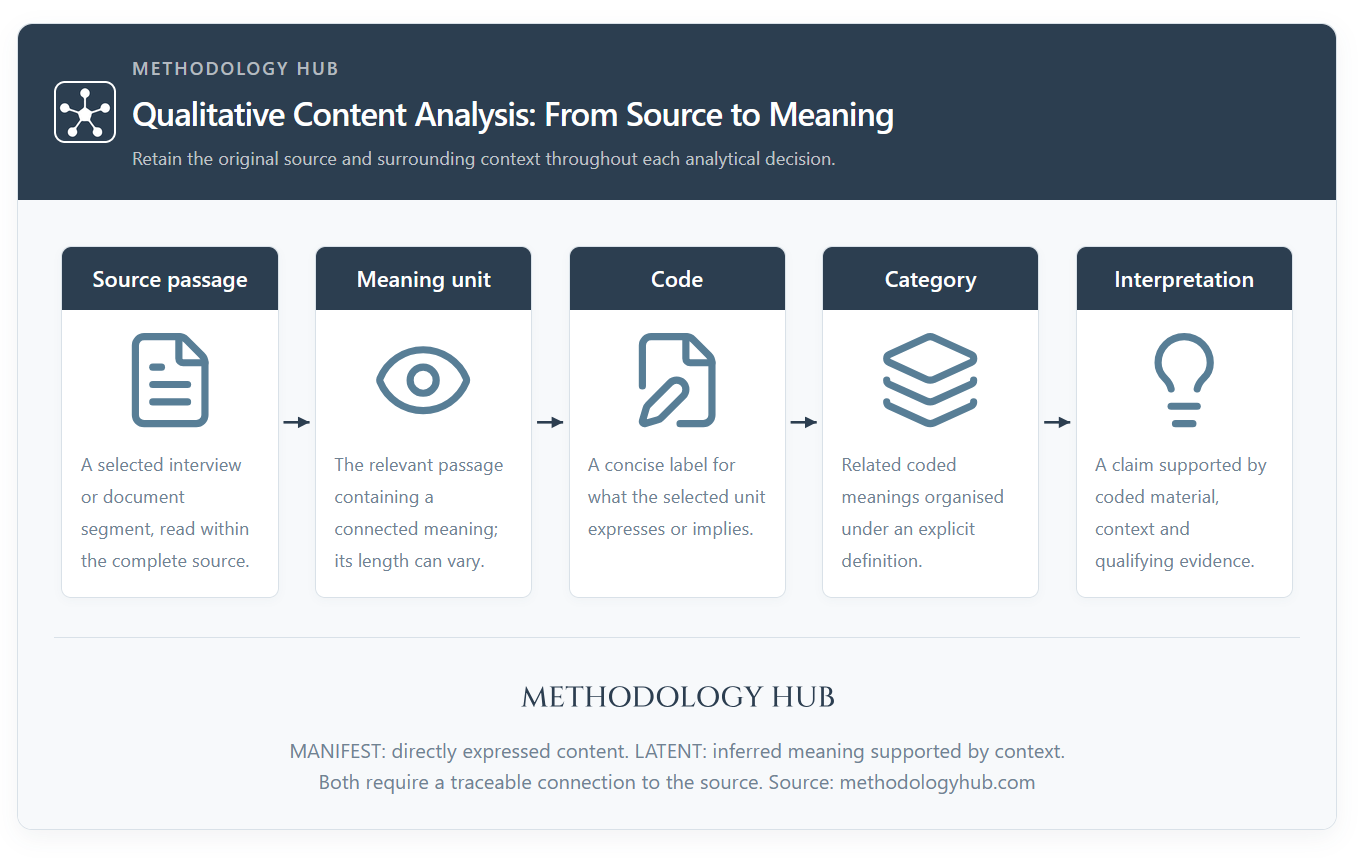
Manifest content concerns what is directly stated or shown. If a participant says feedback arrived two weeks after submission, the delay is explicit. Latent content concerns a meaning inferred from the account, such as a sense that feedback arrived too late to be useful. The latter needs support from the whole passage and should not be asserted from one phrase alone.
A study may attend to both. Manifest and latent identify the focus of a particular coding decision; they do not name two exclusive schools of qualitative content analysis.
Types of Qualitative Material
Interview transcripts, open-ended survey responses, field notes, meeting records, webpages and institutional documents are common sources. Photographs and video can also be analysed when the question concerns what is depicted or communicated. Describe what the source preserves and what it leaves out: a transcript captures words but may lose tone or gesture; a screenshot preserves an interface at one moment, not every way people used it.
| Decision | Qualitative analysis | Quantitative analysis |
|---|---|---|
| Main aim | Explain meanings and differences in accounts. | Measure and compare coded features. |
| Category work | Develop or adapt categories as interpretations are examined. | Set operational rules before the main measurement. |
| Typical result | An interpretation supported by passages and context. | Counts, proportions or statistical comparisons. |
| Quality question | Is the interpretation well supported and traceable? | Is the measurement consistent and suited to the sample? |
Qualitative vs Quantitative Content Analysis
Content analysis can be qualitative, quantitative, or mixed. The qualitative form develops an account of meaning through categories and contextual reading. Quantitative content analysis measures defined features across a sample and may compare their frequency or association. A qualitative project can report counts, and a quantitative project can use interpretive codes. The distinction lies chiefly in the claim the study is designed to make and the evidence required to support it.
Approaches to Qualitative Content Analysis
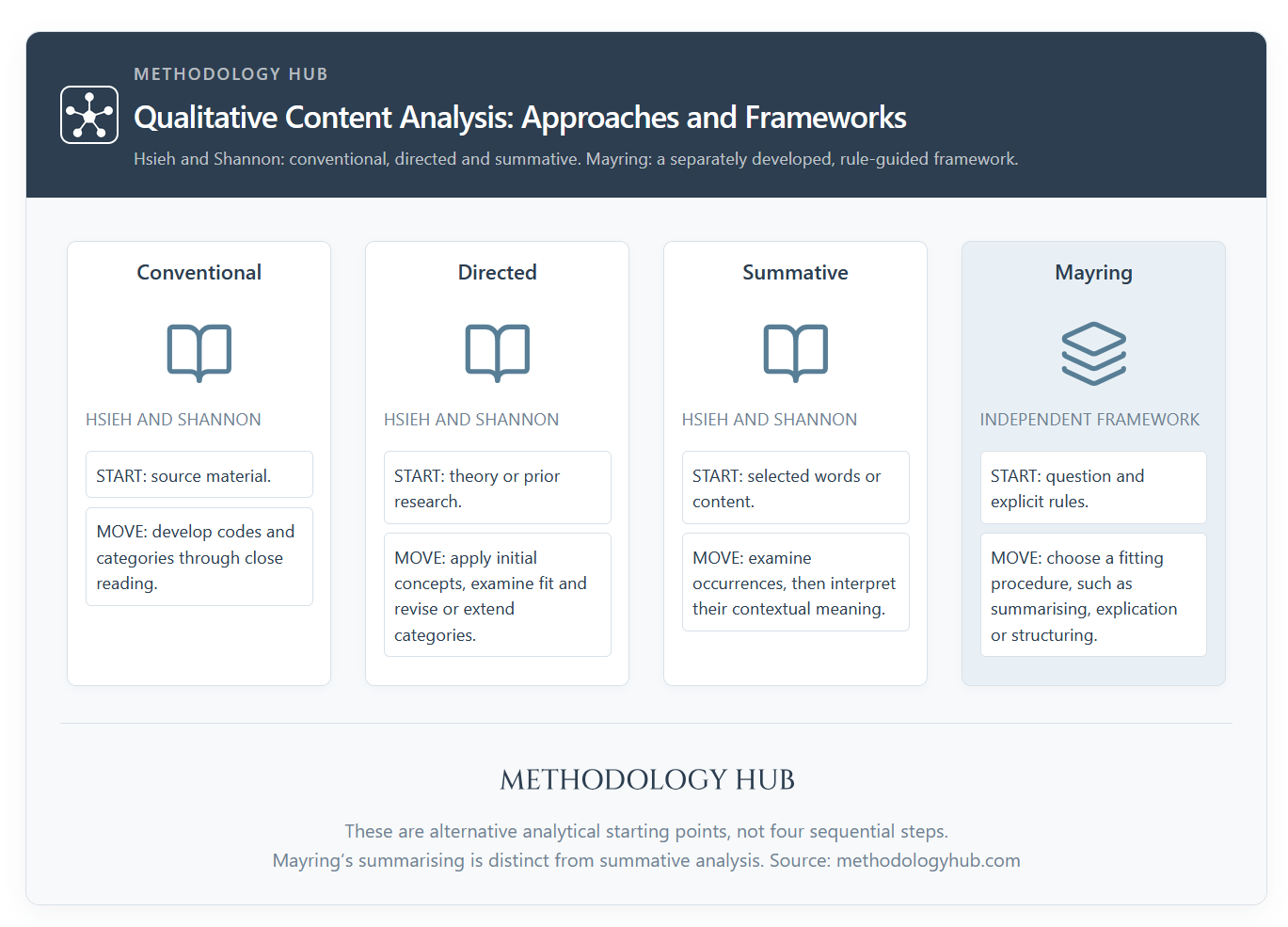
Approaches to qualitative content analysis differ mainly in how they begin and how categories are constructed. Hsieh and Shannon (2005) distinguish conventional, directed and summative approaches. Mayring’s qualitative content analysis is a separate methodological framework with several procedures, including inductive category formation and deductive category assignment.
Conventional Content Analysis
Conventional content analysis develops categories from close reading of the material. Researchers mark relevant passages, compare provisional codes and name categories that capture recurring or contrasting meanings. It is useful when existing concepts offer limited guidance or when the study seeks to describe how participants understand an experience in their own terms. Categories still reflect analytical choices; they do not simply emerge without a researcher making decisions.
Directed Content Analysis
Directed content analysis starts with a theory or earlier findings that suggest initial categories. The researcher specifies what each category would look like in the material, codes relevant passages and examines evidence that does not fit. It suits questions that extend or examine an existing explanation. A useful category frame leaves room for unexpected accounts instead of forcing every passage into an established concept.
Summative Content Analysis
Summative content analysis begins by identifying selected words or other content and often comparing their use across sources. It then interprets how the selected content functions in context. A repeated word can mean different things in a complaint, a joke and a policy notice. Counting is therefore an entry point to interpretation, not the completed qualitative finding.
| Approach | Starting point and theory | Category development and focus | Suitable question |
|---|---|---|---|
| Conventional | Close reading; prior concepts offer limited direction. | Develop categories from accounts; describe their meanings. | How do people describe an unfamiliar experience? |
| Directed | Theory or prior findings guide initial coding. | Apply, test and revise categories; examine mismatches. | How does an existing explanation fit these accounts? |
| Summative | Selected expressions or content guide the entry point. | Identify use, compare occurrences and interpret context. | How is a particular term used across accounts? |
| Mayring’s framework | Research question and chosen rule-guided procedure. | Use inductive or deductive categories to summarise, explain or structure material. | Which content dimensions should be systematically organised or condensed? |
Mayring’s Qualitative Content Analysis
Mayring’s framework calls for a question-led procedure and explicit rules for analysing material. Its procedures include summarising content, explaining unclear passages with contextual material and structuring material according to categories. Later formulations also distinguish inductive category formation and deductive category assignment, which may be combined for a particular question. Researchers specify units, category definitions and revision rules so another reader can follow the analytical decisions.
Mayring’s summarising procedure condenses material while preserving essential content. It is different from Hsieh and Shannon’s summative approach, which begins with the occurrence or use of selected content and then examines its context. Similar names should not be treated as equivalent procedures.
Key Concepts in Qualitative Content Analysis
Qualitative content analysis depends on defining what part of the material is being examined, what a code identifies and how related codes become categories. These decisions determine what can be compared and how much context remains available for interpretation.
Units of Analysis and Meaning Units
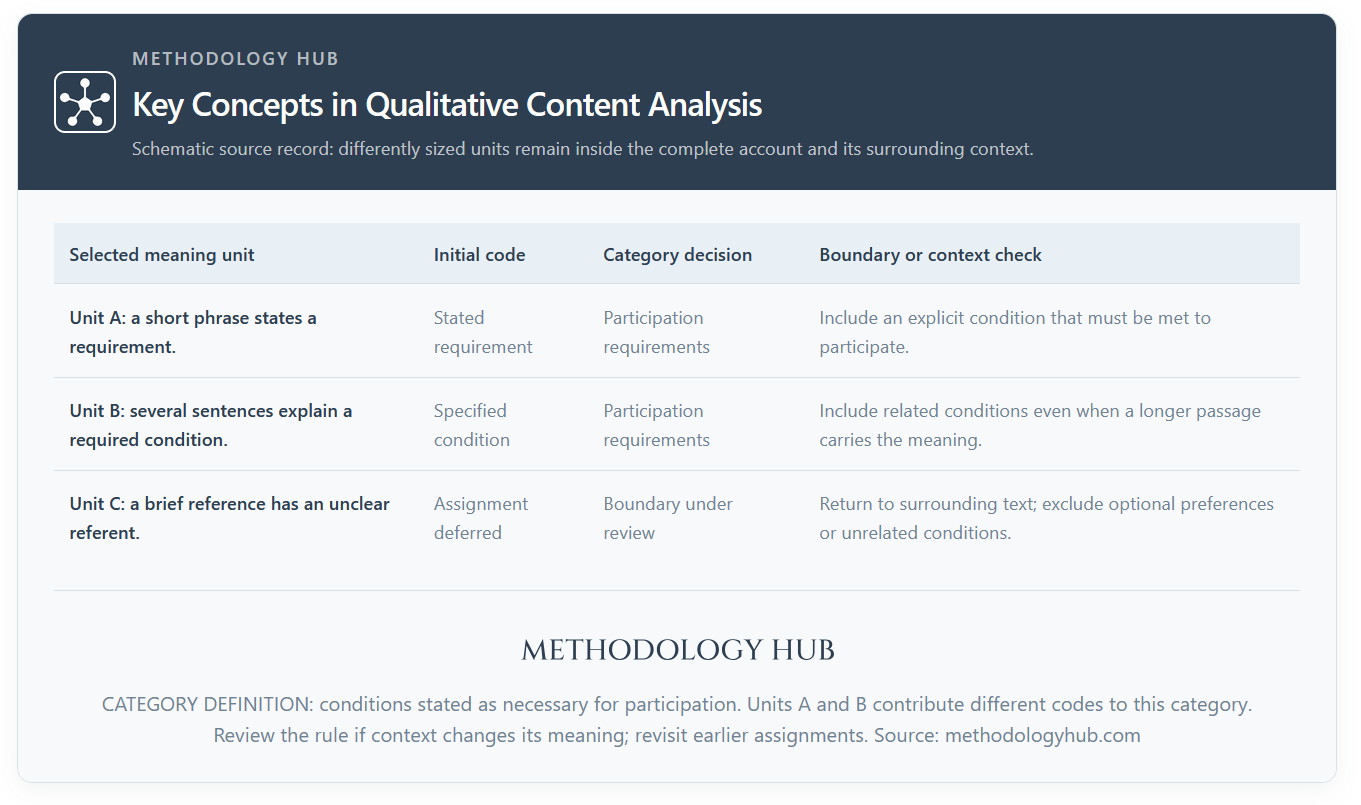
A unit of analysis identifies the case or portion to which an analytical decision applies. It might be an interview, one response or a passage. A meaning unit is a stretch of material that conveys a relevant point, such as a sentence about why a participant ignored written feedback. Its length should follow the meaning, not a fixed number of words. Define the larger context to consult when a short excerpt is ambiguous.
Codes and Coding Categories
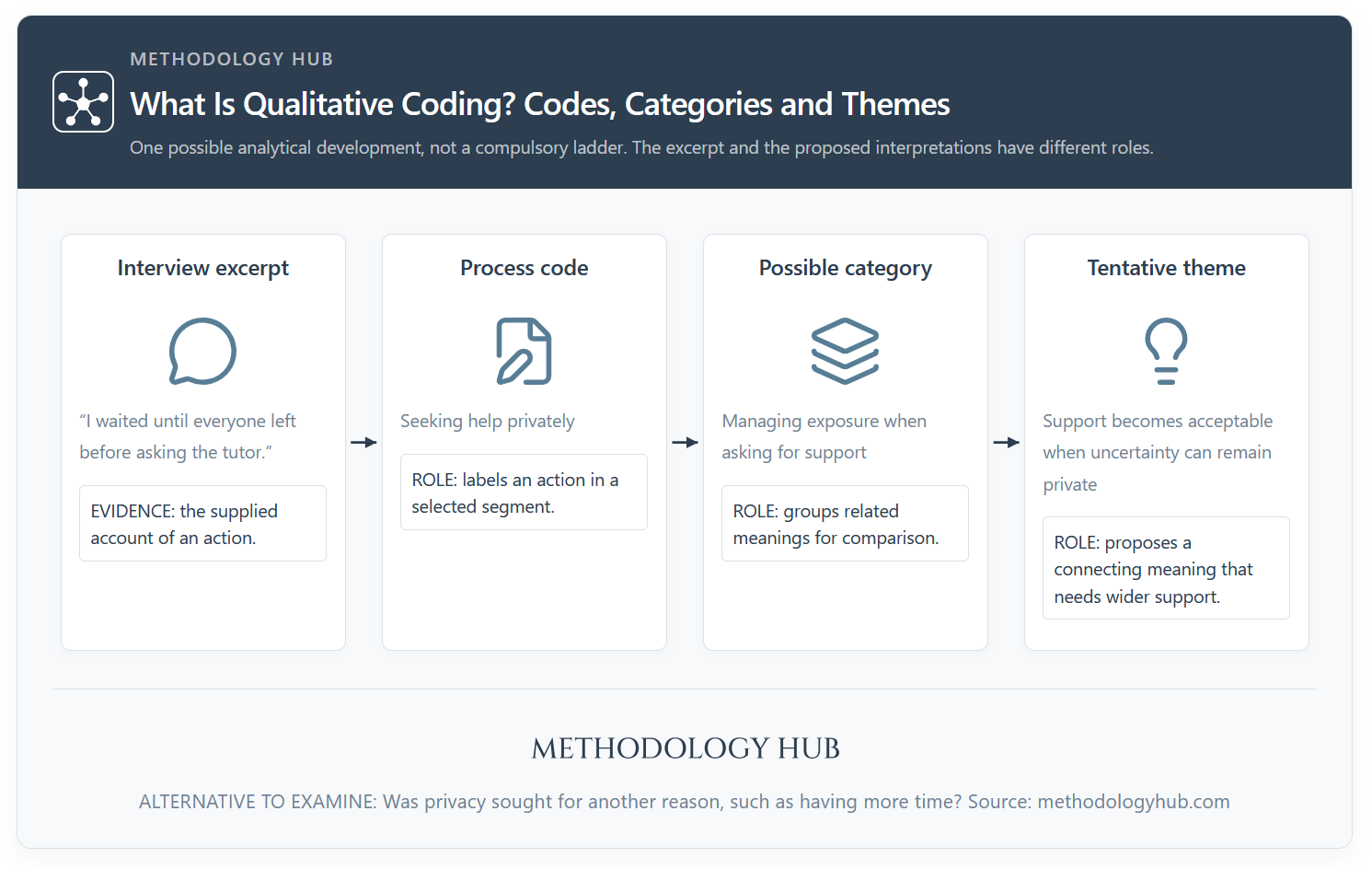
A code labels something relevant in a segment; a category groups material under a defined analytical idea. “Comment arrived after revision” could be a code. “Feedback timing limits use” could be a category that also includes other accounts of late advice. A category needs a stated scope and examples of what belongs in it. Qualitative coding covers the broader range of coding techniques across methods.
Inductive Category Development
Inductive category development begins with close examination of selected material. Researchers label relevant units, compare similar passages and revise category names or boundaries as differences become clear. “Inductive” does not mean having no question or prior knowledge. It means the category system is developed primarily through engagement with the material rather than imposed in full at the outset.
Deductive Category Application
Deductive application begins with categories derived from theory, prior research or a specified analytical interest. Define each category before coding, including what qualifies and what does not. Test those rules on some material and record whether a relevant passage needs a new category. Deductive work can be revised in response to evidence; otherwise the scheme may record only what it was built to find.
| Element | What it identifies | Illustration |
|---|---|---|
| Source | Material and its origin | Student interview transcript, participant S04 |
| Meaning unit | Passage expressing a relevant point | “I got the comments after the next assignment was due.” |
| Code | Feature marked in the passage | Comments arrive too late |
| Category | Broader analytical grouping | Timing limits use of feedback |
Category Systems and Coding Rules
A category system states how labels relate. It may contain broad categories and narrower subcategories, with examples and rules for overlap. Researchers should decide whether one passage may receive several categories and how to handle an account that changes direction halfway through. Keep a record of revisions, including which previously coded passages need to be checked again.
Context and Interpretation
Interpretation requires returning from the label to the source. A statement about “useful feedback” might refer to specific comments, a supportive tone or a grade that clarified expectations. The surrounding interview question, participant’s later explanation and study setting can change the meaning. Report the evidence that supports the category and discuss passages that do not fit a simple account.
The sentence about comments arriving after the next deadline supports a code about timing. When similar passages describe advice that cannot be used in later work, the researcher may group them under “timing limits use of feedback.” The wider transcript must still be checked: the participant might have used those comments for another purpose.
How to Conduct Qualitative Content Analysis
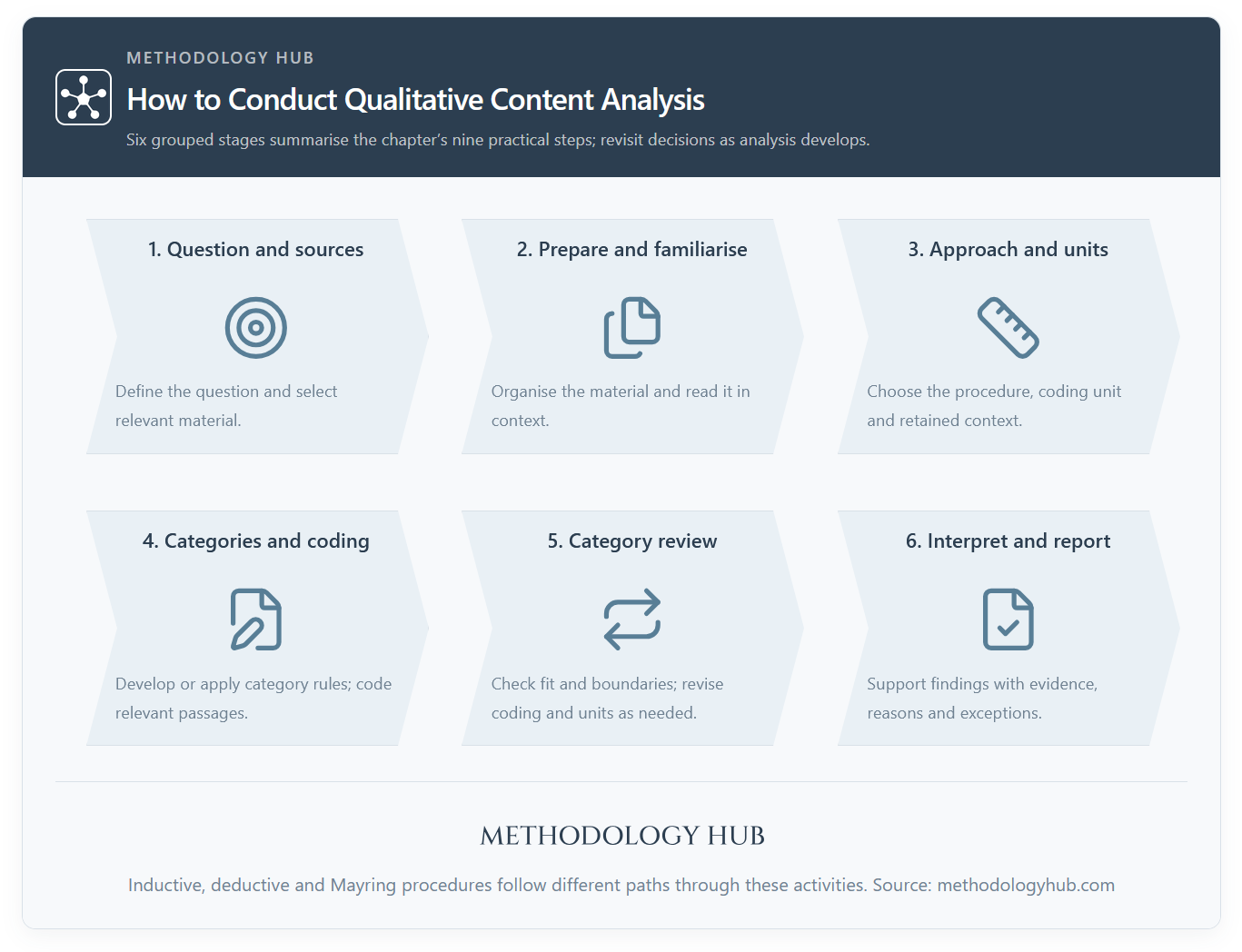
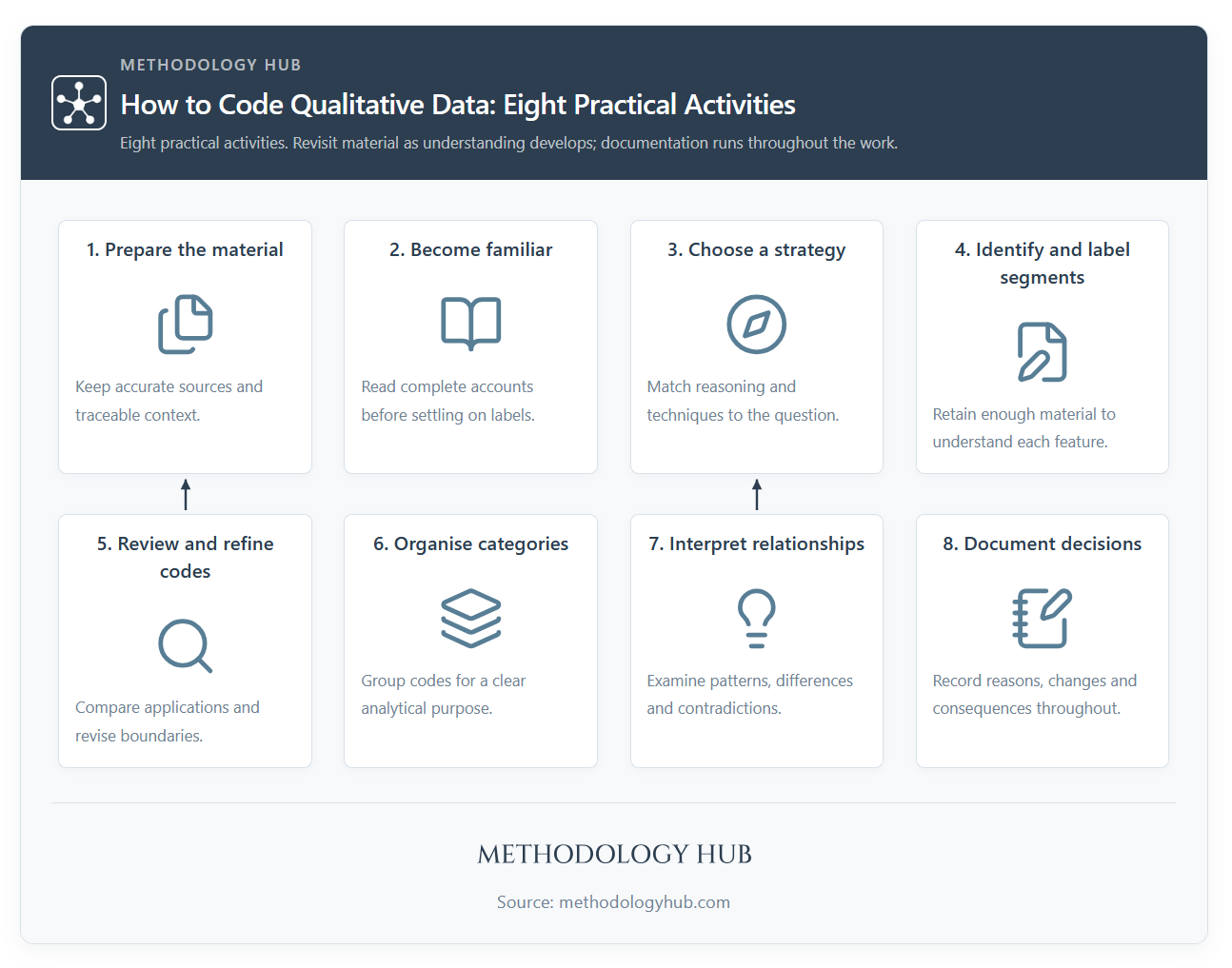
To conduct qualitative content analysis, define a question and material, choose an approach, specify units and category rules, code the sources, and interpret what the categories show. This is a practical outline rather than one mandatory sequence. Researchers often revisit earlier decisions when new material challenges an initial category.
Define the Research Question
Ask a question that the material can answer. “How do students describe the usefulness of academic feedback?” directs attention to their accounts and the meanings of usefulness. A question about how many students received feedback within ten days requires different evidence and may belong mainly to a quantitative design.
Select the Research Material
State which interviews, documents or other records are included, when they were produced and why they are relevant. Record the source of each item. If a study compares institutions or time periods, explain how the selection supports that comparison. Do not infer views of all students from a small set of interviews chosen for a different purpose.
Prepare and Become Familiar With the Data
Check transcripts against recordings where possible, mark uncertain words and use stable source identifiers. Read whole sources before extracting short passages. Note where a response answers a particular prompt or qualifies something said earlier. Qualitative data analysis covers the wider work of preparing, organising and reporting qualitative material.
Choose an Analytical Approach
Decide whether categories will be developed mainly from the material, guided initially by prior research, or used to examine selected expressions in context. If following Mayring, identify the particular procedure and its category rules. State the choice before describing results so a reader can understand how the analysis produced them.
Define the Units of Analysis
Specify what counts as a case, what can be coded and what surrounding material remains available for interpretation. One interview can contain several meaning units. A brief sentence may need the following explanation to make its sense clear. Record both the coded span and its source location.
Develop or Establish Coding Categories
For inductive work, compare preliminary labels across passages and define categories after seeing how they vary. For deductive work, write definitions, inclusion criteria and examples before applying the frame widely. A study can combine both if the chosen approach warrants it. Keep category names close enough to the material that a reader can tell what was classified.
Code the Material
Apply the categories to relevant units, retaining the passage and source identifier with each decision. Record uncertain cases and why they are difficult. If several people code, compare decisions against the agreed definitions and discuss disagreements. Whether numerical intercoder agreement is appropriate depends on the tradition and the purpose of the coding; a coefficient alone cannot establish a sound interpretation.
Review and Refine the Category System
Read the material collected under each category and check whether its members belong together. Split a category that combines distinct meanings, merge categories that cannot be distinguished usefully, and revisit earlier coding after a rule changes. Examine material outside the frame, especially accounts that contradict an emerging finding. Keep a dated record of changes.
| Decision | Practical objective | Record to retain |
|---|---|---|
| Question and material | Set the scope of the claim. | Question, source inventory, selection reasons |
| Approach and units | Decide how categories begin and where they apply. | Procedure, unit definitions, context rule |
| Categories and coding | Classify relevant material consistently. | Category definitions, coded excerpts, notes |
| Revision | Check category boundaries and exceptions. | Revised rules and recoding log |
| Interpretation | Explain patterns and variation in context. | Evidence, qualifications, reporting decisions |
Interpret and Report the Findings
Explain what each substantial category means, how it relates to the question and where the evidence varies. Use selected quotations or described visual details to show the reasoning. Give the sampling and analytical limits, including cases that complicate the conclusion. If counts are reported, define what was counted and avoid treating frequency as a direct measure of importance.
Qualitative Content Analysis Software
Qualitative content analysis software helps researchers keep passages, codes, categories and analytical notes connected. NVivo, ATLAS.ti and Dedoose are established paid options; Taguette, QualCoder and OpenQDA offer open-source alternatives. Our independent content analysis software review and recommendations compares these options.
Examples of Qualitative Content Analysis
Different qualitative content analysis approaches can produce different findings from the same interview material because they begin with different questions and category decisions. Consider a fictional study of how university students use written feedback on assignments. The excerpts and findings below are illustrations, not results from an actual study.
Suppose one student says, “The comments explained the problem, but they came after I had handed in the next essay.” Another says, “When the note said ‘develop this,’ I asked a classmate what that meant.” A third says, “I kept the comments for the next course, even though I could not use them this term.” The researcher has complete interview transcripts, the questions that prompted these answers and information about when the assignments were submitted.
Conventional Content Analysis Example
The researcher reads the transcripts without imposing a finished category list. Provisional codes include “advice arrives after deadline,” “asks peers to interpret comments” and “saves advice for later.” Comparing more interviews may lead to categories such as timing of use and making comments understandable. A finding could explain that students distinguish useful content from an opportunity to act on it. That conclusion would need corroborating and contrasting passages across the dataset.
Directed Content Analysis Example
Suppose earlier research distinguishes feedback that is clear, timely and actionable. The researcher uses those concepts as initial categories. The first excerpt concerns clarity and timeliness but also raises a question the initial frame may not capture: advice can remain valuable for a later course. The second shows peer interpretation as part of making feedback actionable. The researcher documents where the starting frame fits, where it fails and whether categories should be revised.
Summative Content Analysis Example
The researcher selects expressions such as “use,” “next” and “clear,” checks their occurrences and compares the passages in which they appear. “Next” might refer to an assignment, a semester or another course; a raw count would combine quite different time horizons. The qualitative finding would concern how students use these terms to describe opportunities to act on feedback, with surrounding sentences retained as evidence.
Mayring’s Qualitative Content Analysis Example
A Mayring-inspired study must name its specific procedure. For a structuring analysis, the researcher could define the dimensions timing, clarity and later use, write inclusion rules and examples, then apply and revise the category system against the transcripts. An inductive procedure could instead build categories from the material according to stated selection and abstraction rules. The finding might distinguish feedback that is unusable for the immediate assignment from feedback retained for later work. The procedure and rules, not merely that finding, identify the approach.
Comparing Findings Across Approaches
The approaches make different aspects of the same accounts visible. A conventional analysis follows categories developed from the interviews; a directed analysis examines an existing explanation; a summative analysis investigates how chosen expressions are used; and a specified Mayring procedure gives explicit rules for reduction or category assignment. None can claim that three short excerpts represent the entire student population.
| Approach | Question applied to the interviews | Category or decision | Illustrative interpretation |
|---|---|---|---|
| Conventional | How do students describe using comments? | Develop “timing of use” from accounts. | Useful advice can arrive too late for the next task. |
| Directed | Do clarity, timeliness and actionability explain use? | Apply initial frame; note delayed use beyond it. | The prior frame may need a longer time horizon. |
| Summative | How do students use “next” and “use”? | Locate expressions; distinguish their contexts. | The same term refers to different opportunities to act. |
| Mayring’s framework | Which aspects of use should be structured? | Define timing, clarity and later use with rules. | The category system separates immediate and later value. |
“The comments explained the problem, but they came after I had handed in the next essay.” The meaning unit contains both a positive judgment about clarity and a limitation about timing. A code such as “clear but too late” can inform a category about the conditions for using feedback. The finding should retain both parts; coding only “late feedback” would discard the participant’s qualification.
Conclusion
Qualitative content analysis connects systematic category work with interpretation of recorded material. Researchers can develop categories from sources, begin with earlier concepts, investigate selected content in context or follow a specified rule-guided procedure. The choice should serve the research question and be visible in the way units, categories and findings are reported.
The method is most convincing when readers can follow a claim back to the passage that supports it, understand how the category was defined and see how contrary or qualified accounts were handled. Its procedures organise interpretation; they do not replace it.