Naturalistic observation is an observational research method in which people, behaviour, interaction, and settings are studied where they normally occur. The researcher observes activity in its everyday environment rather than moving participants into a laboratory, artificial task, or highly controlled situation.
The method is used in qualitative research when the setting itself is part of the evidence. A classroom lesson, clinic waiting room, public park, community meeting, playground, workplace corridor, or online discussion space can shape what people do. Naturalistic observation helps the researcher study those actions while the context is still present.
Instead of treating behaviour as separate from place, time, objects, and routine, naturalistic observation asks what happens when people act in ordinary conditions. This guide covers the meaning of naturalistic observation, when to use it, how it compares with other observation types, how to plan a study, how to record field data, and how to analyse what was seen.
What is Naturalistic Observation
Naturalistic observation means observing behaviour in the setting where it normally happens. The researcher does not create a special task only for the study. They observe ordinary activity and record how people act within the natural conditions of that setting.
A researcher might observe how students use a school library during lunch, how patients move through a reception area, or how residents use a public square after work. In each case, the research interest is tied to the ordinary setting. The place, timing, routines, and other people nearby all help shape the data.
Naturalistic observation definition
Naturalistic observation is a research method in which behaviour, interaction, or activity is observed in its usual setting without the researcher creating a highly controlled situation. The method can be qualitative, quantitative, or mixed, depending on whether the researcher records rich descriptions, counts, time intervals, categories, or a combination of these.
In qualitative studies, naturalistic observation usually focuses on context and meaning. The researcher may write field notes about what happened, where people were positioned, how routines unfolded, which objects were used, and how people responded to one another.
What makes the setting natural?
A natural setting is not necessarily untouched by the researcher. The researcher may still be present, take notes, or use an observation schedule. The key point is that the activity itself is not invented mainly for the study. It belongs to the participants’ ordinary environment.
A classroom lesson taught as part of the normal school day is naturalistic. A staged classroom task created for a research session is more controlled. A park observed during its regular use is naturalistic. A park activity arranged by the researcher to compare reactions is more controlled.
What the method records
Naturalistic observation can record actions, movement, speech, timing, waiting, interruptions, seating, use of tools, informal rules, spatial patterns, and repeated routines. The record may be open and descriptive, or it may use a prepared observation sheet.
For example, a study of children’s playground interaction may record where children gather, which games begin without adult direction, who is included or excluded, how conflicts start, and when adults intervene. These details are part of the setting, not just background information.
Field reminder: in naturalistic observation, the setting is not a container for behaviour. It is part of what the researcher is studying.
What naturalistic observation does not promise
Naturalistic observation does not mean the researcher sees the full truth of a situation. People may still act differently when observed. The researcher may miss details, stand in a poor position, or interpret an action too quickly. The method gives access to everyday activity, but it still requires careful design and cautious analysis.
It also does not automatically explain motives. A researcher may see that a student avoids joining a group, but observation alone may not show whether the reason is shyness, conflict, preference, uncertainty, or an informal rule. In such cases, observation can be combined with interviews or informal conversations.
Research Questions for Naturalistic Observation
Naturalistic observation fits research questions about what happens in practice. It is useful when the researcher wants to understand everyday behaviour, routines, interaction, or use of space under normal conditions. The method is less useful when the research question requires tight control over variables or private accounts of memory and feeling.
A good naturalistic observation question often includes a setting and an activity. Instead of asking only how people feel about support, the researcher might ask how support is offered and taken up during normal classroom group work. Instead of asking only whether a public space feels welcoming, the researcher might ask how different people use or avoid the space during ordinary hours.
This type of question keeps the researcher close to observable evidence. It also helps define where to observe, when to observe, and what to record.
Questions about everyday routines
Naturalistic observation works well when the study concerns routines that are repeated but rarely explained. The researcher can observe how a meeting starts, how a teacher handles transitions, how staff prepare a service desk, or how people queue in a public building.
Routines often reveal informal order. Who arrives early? Who prepares the room? Who waits for instructions? Who acts without being asked? These details can show how a setting operates before participants turn it into a formal explanation.
Questions about interaction
Interaction is often easier to observe than reconstruct later. Naturalistic observation can show who speaks to whom, who is ignored, how disagreements are softened, how help is requested, and how people coordinate action across a space.
In a workplace, for example, observation may show that support is not requested through formal channels but through short side conversations. These small exchanges may be too ordinary for participants to mention in an interview unless the researcher asks about them directly.
| Question focus | Naturalistic observation can help by showing |
|---|---|
| Routine | Repeated practices, order, timing, and informal roles |
| Interaction | Turn-taking, support, avoidance, coordination, and conflict |
| Space | Movement, access, crowding, boundaries, and preferred areas |
Questions about space and objects
Naturalistic observation is also useful when space and objects shape activity. A waiting room, classroom, clinic counter, library zone, playground, or shared office can influence who speaks, who waits, who moves, and what becomes possible.
Objects can matter too. Forms, screens, doors, signs, chairs, bags, headphones, whiteboards, and tools can organise behaviour. Observation lets the researcher record how these objects are actually used, ignored, shared, or avoided.
Questions that need another method
Some questions need more than observation. If the researcher wants to know why people avoided a space, how they felt during a routine, or what they remembered from an earlier event, interviews may be needed. If the researcher wants short written responses from many people, open-ended survey questions may help.
Naturalistic observation can still support those studies. It can show what needs to be asked about, provide context for later interviews, or check whether accounts match visible practice.
Naturalistic vs Controlled Observation
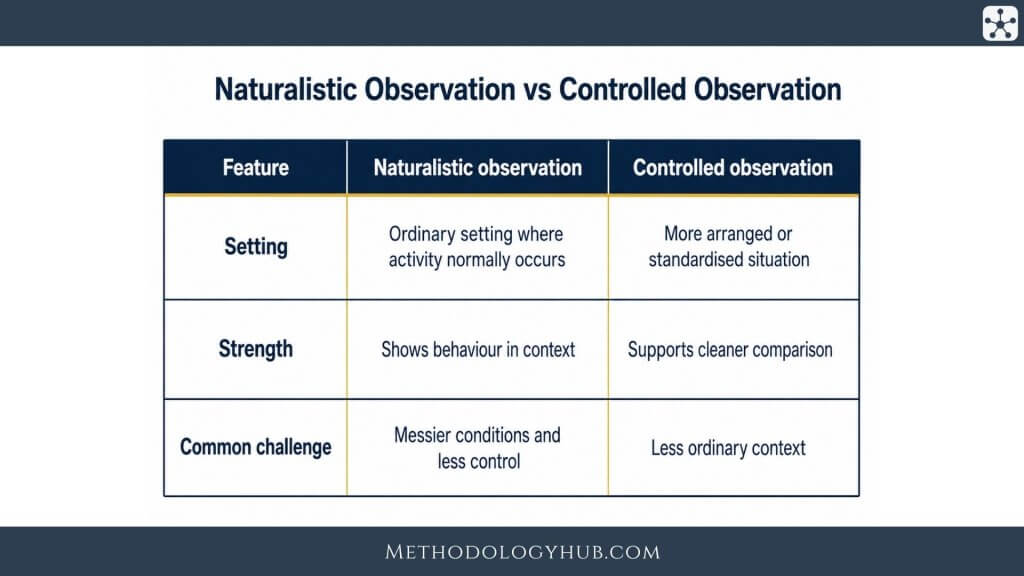
Naturalistic observation and controlled observation both involve watching and recording behaviour, but they differ in how much the research situation is arranged. Naturalistic observation studies ordinary activity. Controlled observation uses a more planned setting, task, or procedure.
This difference affects the kind of evidence the study produces. Naturalistic observation is stronger for everyday context. Controlled observation is stronger when the researcher needs the same task or conditions across participants or groups.
Ordinary setting or arranged task
In naturalistic observation, the activity exists before the researcher arrives. Students already use the library. Staff already hold meetings. Visitors already move through a reception area. The researcher studies the activity as it normally appears.
In controlled observation, the researcher may arrange the situation. Participants may complete the same task, respond to the same prompt, or be observed under the same time limit. The setting may still feel familiar, but the observation is more structured.
Context and comparison
Naturalistic observation gives rich context. The researcher can see how real conditions affect activity: noise, time pressure, social history, layout, interruptions, and competing demands. The trade-off is that comparisons may be messier because each situation can differ.
Controlled observation gives clearer comparison. If each group completes the same task, differences may be easier to examine. The trade-off is that the situation may not fully reflect everyday practice.
Choosing the better fit
The choice depends on the research question. If the study asks how people naturally use a shared workspace, naturalistic observation is likely the better fit. If the study asks how different groups respond to the same instruction under the same conditions, controlled observation may be more useful.
A project can also use both. The researcher might first observe ordinary group work in a classroom, then later observe several groups completing the same planned activity. The two forms of observation would answer different parts of the study.
| Feature | Naturalistic observation | Controlled observation |
|---|---|---|
| Setting | Ordinary setting where activity normally occurs | More arranged or standardised situation |
| Strength | Shows behaviour in context | Supports cleaner comparison |
| Common challenge | Messier conditions and less control | Less ordinary context |
Observer Role in Naturalistic Settings
The observer role can vary in naturalistic observation. The researcher may participate in the setting, remain outside the activity, or move between light involvement and distance. The role should fit the question and the setting.
For example, a researcher studying a community garden may join planting days to understand routines from inside. A researcher studying how people move through a train station may remain a distant observer. Both studies can be naturalistic because both observe ordinary activity in its usual setting.
Participant role
In participant observation, the researcher joins the setting to some degree. This can help the researcher understand informal rules, local language, and inside experience. Participation may be useful when learning through involvement is part of the research design.
The challenge is that participation can change what the researcher sees. If the researcher is busy helping with a task, they may miss what happens elsewhere. Field notes should therefore record both what others did and what the researcher did.
Non-participant role
In non-participant observation, the researcher observes without joining the activity directly. This can help when the researcher needs a wide view of the setting or when participation would interrupt the activity.
The limitation is that distance may reduce access to local meaning. The researcher may see a pattern but not know how participants understand it. Informal conversations or later interviews can help explain what observation alone cannot show.
Visible and less visible observation
Some researchers observe openly, with participants aware of the study. Others observe public behaviour in settings where individual interaction with participants is limited. The approach depends on the setting, the level of identifiability, and the research design.
Visibility should be handled carefully. In schools, workplaces, clinics, and organised groups, the researcher’s presence normally needs to be explained clearly. In public space studies, the situation may be different, but the researcher still needs a responsible plan for recording and reporting.
Recording role effects
Whatever role the researcher takes, field notes should include possible role effects. Did participants speak to the researcher? Did they explain what they were doing? Did anyone change behaviour when observation began? Did the researcher’s position block access to part of the setting?
These details help later analysis. They do not make the data unusable. They help readers understand how the data were produced.
Planning a Naturalistic Observation Study
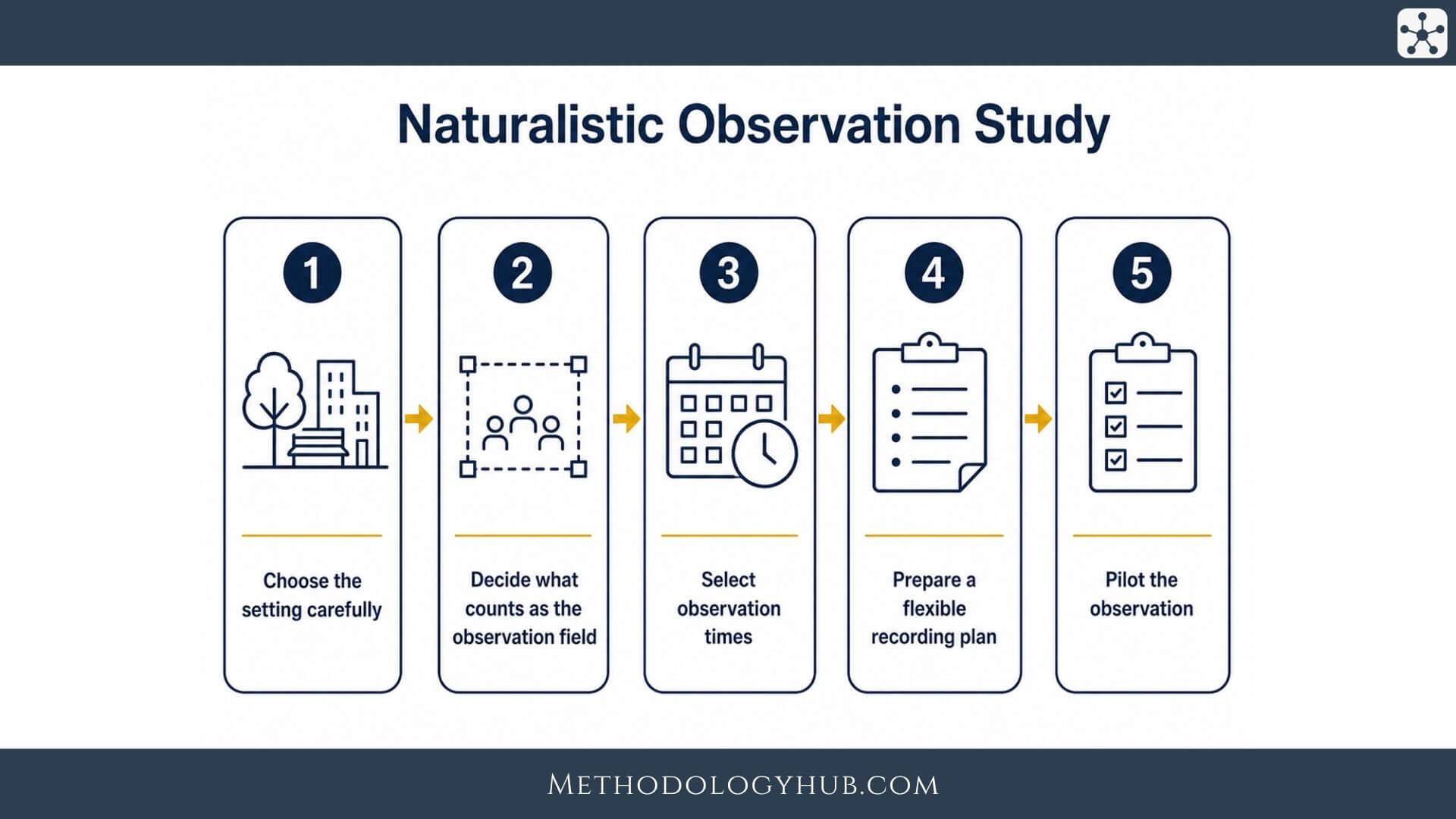
Planning a naturalistic observation study begins with choosing a real setting that fits the question. The researcher then decides what aspect of activity to observe, when to observe, how visible to be, and what kind of record will support analysis.
The challenge is focus. Natural settings are full of activity. A playground, clinic, classroom, or public square contains more than one researcher can record. The study needs a focus that guides attention without forcing the researcher to ignore unexpected details.
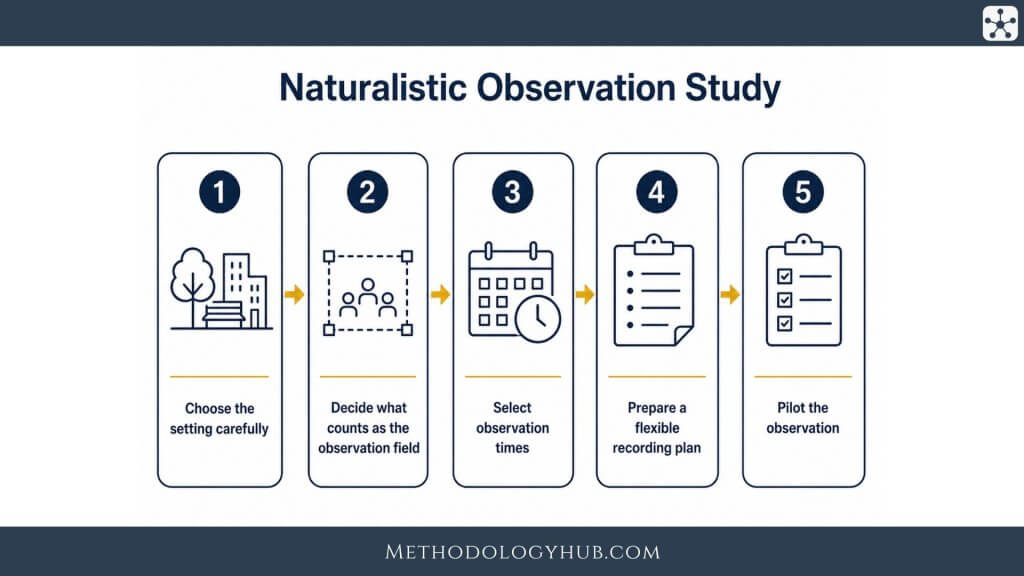
Choose the setting carefully
The setting should be chosen because ordinary activity there can answer the research question. If the study concerns student collaboration, the researcher should observe where collaboration actually happens. That may be a classroom, study room, hallway, online chat, or project space.
The setting should not be chosen only because it is easy to access. Easy access can help, but the site still needs to be relevant. A convenient setting that does not contain the activity of interest will produce weak data.
Decide what counts as the observation field
The field may be larger or smaller than the physical site. A study of a library may focus on one floor, one help desk, one study zone, or movement between zones. A study of a community event may include preparation, the event itself, and clean-up afterward.
Defining the field helps the researcher decide where to place attention. It also helps explain what was not observed.
Select observation times
Time selection should follow the activity. If the study concerns how people arrive, the researcher needs to observe arrival. If it concerns conflict during shared work, the researcher may need to observe busy periods rather than quiet ones.
Several observation times may be needed. A public space may look different in the morning, afternoon, evening, weekday, and weekend. A classroom may change before exams or when a substitute teacher is present.
Prepare a flexible recording plan
A naturalistic observation recording plan should be structured enough to guide attention and flexible enough to capture unexpected activity. The researcher may prepare prompts for setting, participants, sequence, interaction, space, and objects.
Some studies also use maps, seating plans, time intervals, or simple counts. These tools can support the field record, but they should not replace descriptive notes when context is important.
Pilot the observation
A pilot observation helps the researcher test whether the focus, position, and recording method work. It may show that the researcher cannot hear from a planned location, that the field is too wide, or that the chosen time does not contain the activity of interest.
The pilot can also reveal whether participants respond strongly to the researcher’s presence. If the first minutes of observation feel artificial, repeated visits may help the setting settle.
Recording Naturalistic Observation Data
Recording naturalistic observation data means preserving the detail of ordinary activity before it becomes blurred in memory. The researcher should capture what happened, where it happened, who was involved, what came before and after, and how the setting shaped the action.
Good records are specific. A note such as “the room was busy” is less useful than a note describing overlapping conversations, blocked pathways, people waiting near the door, and repeated interruptions at one table.
Descriptive field notes
Descriptive field notes record concrete details of the setting and activity. They include actions, speech, movement, layout, timing, objects, and sequences. The researcher should try to write what was observed before adding a broad interpretation.
Instead of writing “children were excluded,” the researcher might write that two children stood near the edge of the game, asked twice to join, and were not given a role. The interpretation can then be developed from the recorded detail.
Spatial records
Naturalistic observation often benefits from spatial records. Maps, sketches, or seating plans can show where people gathered, which areas were avoided, where objects were placed, and how movement occurred. These details may be difficult to capture through text alone.
A map of a waiting room might show that people avoid seats near a service counter because those seats feel exposed. A map of a classroom might show that teacher attention follows a repeated route through the room.
Time and sequence notes
Time notes help record the order and duration of events. The researcher may record when a queue formed, how long a transition lasted, when people left a space, or how often a routine repeated. Sequence can be central to analysis because meaning often depends on what came before.
For example, if a group becomes silent after one participant makes a suggestion, the timing of that silence is part of the evidence. A note that records sequence can support a more careful interpretation.
| Record type | Useful for | Example focus |
|---|---|---|
| Field notes | Action, speech, context, and sequence | How a group begins a shared task |
| Map or sketch | Space, movement, visibility, and access | Where people wait or gather |
| Time notes | Duration, order, repetition, and interruption | How long people wait before asking for help |
Reflective notes after observation
Reflective notes are written after or alongside descriptive notes. They record early interpretations, questions, doubts, surprises, and possible links to the research question. They should be kept separate enough that the researcher can still tell what was observed and what was inferred.
A reflective note might ask whether a doorway is being used as a boundary between insiders and visitors. That is not a direct observation by itself. It is an analytic idea that should be checked against further data.
Analysing Naturalistic Observation Data
Analysing naturalistic observation data means moving from field records to an interpretation of everyday activity. The researcher examines what happened, how it happened, where it happened, and how the setting shaped the behaviour. The analysis should keep context visible rather than stripping actions away from the conditions in which they occurred.
The field record is usually uneven. Some moments are detailed, others are thin. Some events were visible, others happened outside the researcher’s view. Analysis should include these limits instead of pretending that observation captured everything.
Begin with whole-setting reading
Before coding small fragments, the researcher should read the observation record as a whole. This includes field notes, maps, time records, sketches, schedules, and memos. Whole-setting reading helps the researcher understand the environment and how different parts of the activity connect.
For example, a note about waiting may make more sense after reading the map, the time record, and the description of staff movement. The action is not isolated. It belongs to a setting.
Code actions with context
Codes may focus on movement, waiting, turn-taking, help-seeking, avoidance, interruption, use of objects, boundary crossing, or repeated routines. The researcher should keep enough context around each code to avoid turning observation into disconnected labels.
A code such as “waiting” may need notes about who waited, where they waited, how long they waited, what happened before, and what happened afterward. Without that context, the analysis may become too thin.
Look for patterns across time and place
Naturalistic observation often becomes stronger when the researcher compares observations. Does the same pattern appear at different times of day? Does it appear in different rooms? Does it change when different people are present? Does it disappear when the setting is less crowded?
These comparisons help separate a one-time event from a recurring feature of the setting. They also help the researcher see how ordinary conditions change behaviour.
Use observation with other data
Naturalistic observation is often combined with interviews, documents, or short informal conversations. Observation may show what happens. Interviews in qualitative research can help explain how participants understood what happened. Documents can show how the setting was supposed to work.
The researcher should not force all sources to say the same thing. A difference between observation and interview data may be important. Participants may describe a routine as open and equal, while observation shows that some people have more access than others.
Write findings with enough scene detail
Findings from naturalistic observation should include enough detail for readers to understand the setting. A short scene, map description, or sequence of actions can help show how the interpretation was developed. The writing should not become a diary of everything observed, but it should keep the field visible.
Strong findings usually connect a pattern to evidence. Instead of saying that the space discouraged participation, the researcher might describe the seating, movement, delays, and repeated attempts to join an activity that support that interpretation.
Examples of Naturalistic Observation
Examples of naturalistic observation show how the method can be used when ordinary context is central to the study. In each example, the researcher observes an activity in the place where it normally occurs.
The examples below are not full research designs. They show how a naturalistic observation focus can connect a setting, a behaviour, and a possible interpretation.
Example 1: Student collaboration in a classroom
A researcher observes group work during normal classroom lessons. The focus is on how students divide tasks, ask for help, use materials, and respond when one group member does not participate. The researcher sits where they can see several groups without joining the activity.
The field notes may show that collaboration depends on seating, teacher movement, previous friendships, and who understands the task first. The setting is important because the activity cannot be separated from the ordinary classroom arrangement.
Example 2: Movement through a clinic waiting room
A health researcher observes a clinic waiting room during regular opening hours. Notes record how patients enter, where they pause, how they read signs, when they approach the reception desk, and how staff respond to repeated questions.
The analysis may show that confusion is not only caused by patient knowledge. It may be connected to unclear layout, competing signs, noise, and the position of the reception counter.
Example 3: Use of a public park after school
A researcher observes a public park in the late afternoon. The observation focuses on who uses different areas, how teenagers, parents, children, dog walkers, and older residents share the space, and which paths are avoided.
The notes may show that the park is not one shared space in practice. Different groups may use separate areas and follow informal time-based patterns. Naturalistic observation can capture those patterns as they unfold.
Example 4: Informal support in a workplace
A workplace researcher observes ordinary office routines to understand how staff ask for help. The researcher records short conversations, desk visits, pauses near shared equipment, and informal advice given during breaks.
The findings may show that support happens outside official channels and depends on proximity, familiarity, and timing. Observation is useful because these small exchanges may not appear in formal records.
Conclusion
Naturalistic observation helps researchers study behaviour, routines, interaction, movement, and use of space in ordinary settings. It is especially useful when the research question depends on context and when the researcher wants to see how activity unfolds under everyday conditions.
A strong naturalistic observation study needs a clear field focus, suitable observation times, a well-described observer role, detailed records, and analysis that keeps the setting visible. The method can stand alone, but it often works well with interviews, documents, and other qualitative materials that help explain what observation cannot show by itself.
FAQs on Naturalistic Observation
What is naturalistic observation?
Naturalistic observation is a research method in which behaviour, interaction, or activity is observed in the setting where it normally occurs. The researcher studies ordinary conditions rather than creating a highly controlled situation.
What is naturalistic observation in qualitative research?
Naturalistic observation in qualitative research uses detailed field records to study behaviour, routines, interaction, space, timing, and context in ordinary settings. The analysis focuses on how setting and action shape each other.
How do you conduct naturalistic observation?
To conduct naturalistic observation, choose a relevant setting, define the observation focus, decide observation times, choose the observer role, prepare a flexible recording plan, pilot the observation, collect field notes, and analyse patterns in context.
What is the difference between naturalistic and controlled observation?
Naturalistic observation studies ordinary behaviour in its usual setting. Controlled observation uses a more arranged situation, task, or recording procedure. Naturalistic observation is stronger for context, while controlled observation supports clearer comparison.
Can naturalistic observation be participant observation?
Yes. Naturalistic observation describes the ordinary setting, while participant observation describes the researcher’s role. A researcher can observe naturally occurring activity while taking part in the setting to some degree.
What should be recorded in naturalistic observation?
Researchers may record actions, speech, movement, timing, space, objects, seating, routines, interruptions, maps, sketches, time notes, descriptive field notes, reflective notes, and possible role effects.
How do you analyse naturalistic observation data?
Naturalistic observation data are analysed by reading the full field record, coding actions with context, comparing patterns across times and places, checking interpretations against recorded details, and writing findings with enough scene detail.