Participant observation is an observational research method in which the researcher studies a setting while taking part in it to some degree. Instead of watching only from the outside, the researcher enters the field, spends time with participants, joins selected activities, and records what is learned through presence, participation, conversation, and careful note-taking.
The method belongs within qualitative research because it is used to understand social life from close contact with a setting. A researcher may sit in community meetings, help at a local organisation, spend time in a classroom, join workplace routines, or attend events over a longer period. The aim is not only to see what happens, but to understand how everyday practice feels and works from inside the field.
Participant observation is closely connected to observational research, but it has a distinctive feature: the researcher’s involvement becomes part of the research situation. This article explains how participant observation works, when it is useful, how participation levels can vary, how researchers plan fieldwork, how field notes are written, and how participant observation data can be analysed.
What is Participant Observation
Participant observation combines two activities that can pull in different directions: joining and observing. The researcher participates enough to understand the setting from within, while also keeping enough analytic distance to record what is happening. This balance gives the method its value and its difficulty.
A researcher studying a youth theatre group, for example, might attend rehearsals, help set up chairs, talk with members during breaks, and observe how decisions are made. The data would not come only from formal interviews. It would also come from repeated presence, informal interaction, routines, spatial arrangements, jokes, tensions, and moments that participants may not mention because they seem ordinary.
Participant observation definition
Participant observation is a qualitative research method in which the researcher enters a social setting, takes part in selected activities, observes what happens, and records detailed field data for analysis. The method is used to study behaviour, interaction, meaning, routine, space, and social organisation in context.
The word “participant” does not mean the researcher must become a full member of the group. Participation can be light, moderate, or intensive. In some studies, the researcher mostly watches but joins occasional activities. In others, the researcher becomes deeply involved in everyday routines over a long period.
What makes it different from simply being present?
Participant observation is not the same as hanging around a setting casually. The researcher enters the field with a research purpose, writes records, reflects on their role, compares events over time, and connects field experience to analysis. The participation is used to learn, not only to build familiarity.
The method also requires attention to what participation changes. People may behave differently because the researcher is present. The researcher may also come to understand the group differently as relationships develop. These changes do not automatically damage the study, but they need to be documented and interpreted.
Data produced through participant observation
Participant observation usually produces detailed field notes, short jottings written during fieldwork, expanded notes written afterward, reflective memos, maps, timelines, photographs where appropriate, and sometimes interview or document data. Informal conversations may also become part of the field record.
The records often include details that would be hard to obtain from a single interview: how people arrive, where they sit, who is included in jokes, who cleans up afterward, which tasks are valued, and which routines appear without being announced.
| Field material | What it helps the researcher examine |
|---|---|
| Jottings | Brief reminders written during or soon after activity |
| Expanded field notes | Detailed accounts of events, interaction, setting, and sequence |
| Reflective memos | Early interpretations, role questions, surprises, and analytic ideas |
What the method can show
Participant observation can show how people carry out routines, learn informal rules, manage space, signal belonging, respond to pressure, and interpret events in everyday life. Because the researcher spends time in the field, the data can capture repetition and change rather than only one moment.
The method is especially useful for studying practices that participants do not usually explain. People may not describe how newcomers learn where to stand, who to ask, when to speak, or which tasks are respected. Participation can make those patterns visible.
When to Use Participant Observation in Research
Researchers use participant observation when a topic cannot be understood well from short answers or one-off accounts. The method gives access to how social life is organised over time: repeated routines, informal roles, shifting relationships, and small adjustments that happen during activity.
Participant observation is especially useful when the researcher needs to understand a setting from within. This does not mean accepting every participant’s view as complete. It means learning how the setting works through presence, participation, and detailed records.
To understand everyday practice
Everyday practice often contains details that people skip when asked to explain their work or community life. A participant may say, “We just help each other,” but fieldwork may show when help is offered, who asks for it, which requests are ignored, and how people learn the unwritten rules.
These patterns can be difficult to study from outside the field. By taking part, the researcher can see how routines feel in practice and how they are sustained across ordinary moments.
To learn informal rules
Groups often operate through informal rules. These rules may never be written down. They may concern how newcomers behave, who can interrupt, which tasks carry status, when humour is acceptable, or how disagreement is expressed.
Participant observation can reveal these rules because the researcher sees how people respond to behaviour. If a newcomer makes a mistake and others correct it gently, ignore it, or treat it as serious, the researcher learns something about the group’s expectations.
To follow change over time
Participant observation can show how a setting changes across days, weeks, months, or events. A single visit may show one performance of a routine. Repeated fieldwork can show what stays stable, what changes with different people present, and what shifts when pressure increases.
A researcher studying a community garden, for example, may learn different things during planning meetings, planting days, informal weekend visits, and conflict over shared tools. Time in the field helps connect these moments.
To connect action with local meaning
Actions often carry meanings that are specific to a setting. Sitting at a certain table, arriving late, volunteering for a task, or using a particular phrase may mean different things in different groups. Participant observation helps the researcher learn those meanings through repeated exposure.
This is why the method often works well with informal conversations. After observing an action, the researcher may later ask a participant what was happening. The explanation can help connect visible practice with local interpretation.
When another method may work better
Participant observation is not always the best choice. It can require time, access, trust, and sustained attention. If the study needs brief comparable answers, structured interviews may be more suitable. If the researcher cannot take part without disrupting the setting, non-participant observation may be a better fit.
The method also has limits when the research question depends on private memories or internal feelings that cannot be inferred from activity. In those cases, observation may need to be paired with interviews in qualitative research.
Levels of Participation in the Field
Participant observation is not one fixed position. Researchers can participate lightly, moderately, or deeply depending on the research question, the setting, and what access allows. The important point is to describe the role clearly rather than treat “participant observer” as a single identity.
A researcher in a community centre might sit in meetings without taking decisions, help prepare materials, attend informal gatherings, or volunteer regularly. Each role produces different access and different blind spots.
Observer with limited participation
In some studies, the researcher is mostly an observer but joins small parts of the setting. They may attend events, introduce themselves, answer questions, or take part in minor activities. This position can be useful when full participation would be inappropriate or distracting.
The researcher gains some familiarity while keeping more distance from the activity. The limitation is that deeper informal routines may remain hidden.
Active participant-observer
In a more active role, the researcher takes part in regular activities while recording observations. They may volunteer, join group tasks, attend meetings, or help with daily routines. This can provide strong access to informal interaction.
The challenge is time and attention. When the researcher is busy participating, they may miss details that would be easier to see from the edge of the room. Field notes written soon after activity become especially important.
Long-term immersed participation
Some projects involve long-term immersion. The researcher spends extended time in the field and learns the setting through repeated involvement. This is common in ethnographic work, where understanding culture, practice, and social organisation requires sustained presence.
Long-term participation can deepen understanding, but it also changes relationships. The researcher may become familiar to participants, develop loyalties, or stop noticing things that once seemed strange. Reflexive records help track these changes.
| Participation level | What the researcher does | Possible limitation |
|---|---|---|
| Limited participation | Mostly observes, with light involvement in the setting | May miss deeper informal practices |
| Active participation | Joins regular activities and writes field records | Participation may reduce what can be noticed in the moment |
| Long-term immersion | Spends extended time in the field and follows everyday life closely | Familiarity may make some details harder to notice |
Changing roles during the study
The researcher’s role may change. At the beginning, they may stand back to understand the setting. Later, they may be invited to join activities. In another study, the researcher may start as a volunteer and gradually take a more observational position during analysis.
These changes should be recorded. A field note can explain how the role changed, who invited the researcher into activities, which tasks were accepted or refused, and how those decisions shaped access.
Being clear about the role
Participant observation needs clarity about what the researcher is doing in the field. Participants should understand, in an appropriate way for the setting, that the researcher is present for research. The exact explanation may differ across settings, but the research role should not be hidden through vague language.
Clarity also helps analysis. If the researcher participated as a helper, volunteer, student, visitor, or temporary staff member, that position should be considered when interpreting the data.
Planning Participant Observation
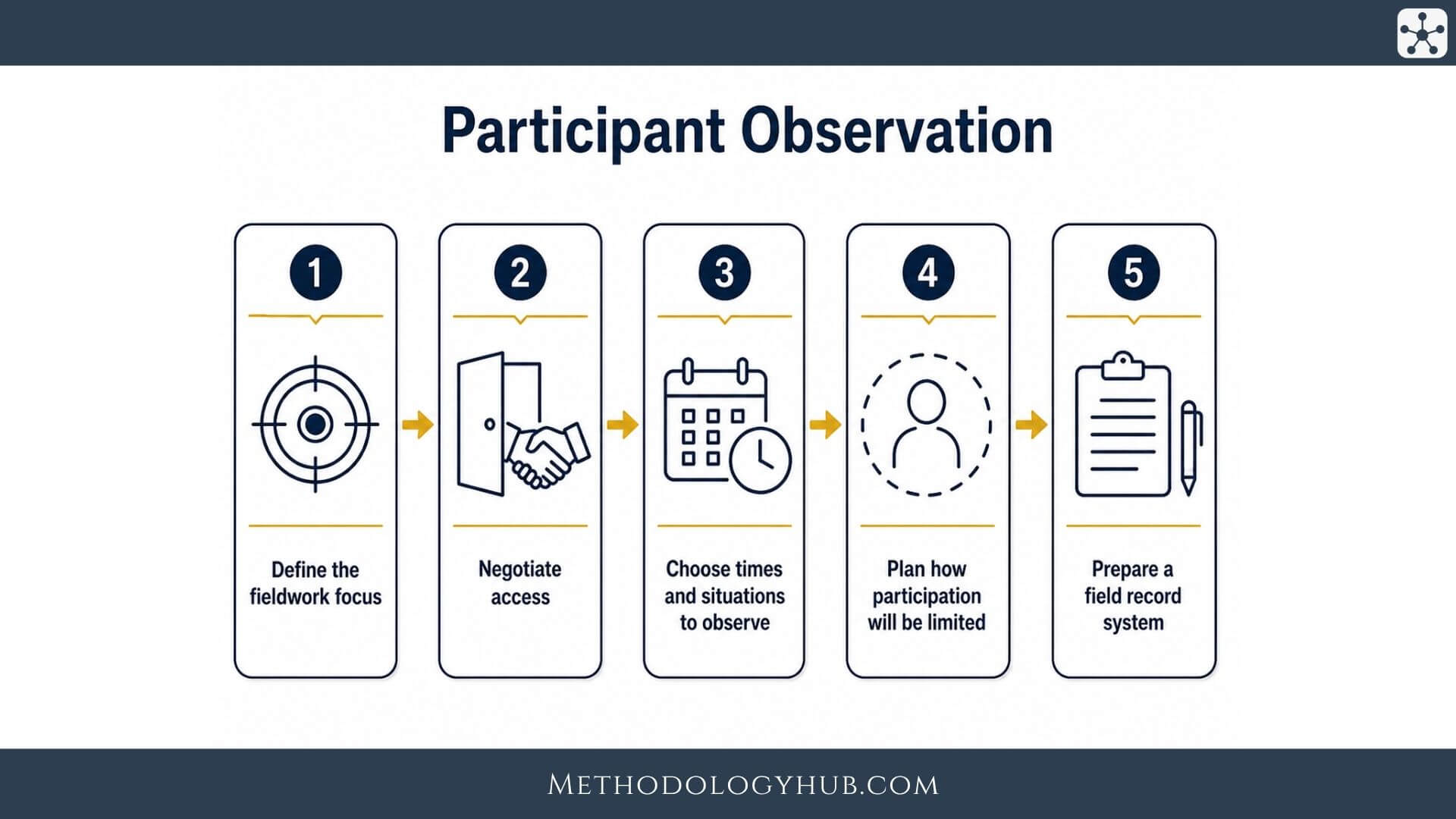
Planning participant observation means preparing for a fieldwork process that may change once the researcher enters the setting. The researcher cannot script every event, but they can make careful decisions about focus, access, role, time, recording, and how field decisions will be documented.
Good planning also protects the study from becoming too broad. Participant observation can produce a large amount of detail. Without a clear focus, the researcher may collect many interesting notes that do not answer the research question.
Define the fieldwork focus
The focus should identify what the researcher needs to understand through participation. It might be newcomer learning, informal support, decision-making, public space use, team coordination, or the practical use of a policy in daily work.
The focus can be broad at the start, especially in exploratory work, but it should not be empty. A researcher who wants to study “community life” may need to narrow the focus to participation in meetings, use of shared spaces, or how volunteers learn routines.
Negotiate access
Access is often a gradual process. The researcher may need permission from an organisation, a gatekeeper, a group leader, and individual participants. Formal permission may allow entry, but everyday access often depends on trust built in the field.
The researcher should not assume that one approval gives access to every part of the setting. Some spaces, conversations, documents, or moments may remain closed. These limits should be recorded because they shape the study.
Choose times and situations to observe
The timing of fieldwork affects what the researcher sees. A community organisation may look different during planning meetings, public events, quiet administrative hours, and conflict resolution. A school may look different before class, during lessons, after school, and during assessment periods.
The researcher should choose times that connect to the research focus. If informal learning happens during breaks, formal meetings alone may give a narrow picture.
Plan how participation will be limited
Participation needs boundaries. The researcher should decide which activities they can join, which they should avoid, and what they will do if asked to take on a role that changes the study too much. These decisions may need adjustment, but thinking about them beforehand helps.
For example, a researcher studying volunteers may help with practical tasks but avoid making decisions for the organisation. A researcher studying a classroom may join informal activities but not evaluate student work.
Prepare a field record system
The field record system should be practical. The researcher may use brief jottings during fieldwork, expanded notes afterward, separate reflective memos, maps, time logs, and document lists. The system should make it easy to separate description from early interpretation.
Field records also need dates, times, locations, and role notes. A note written after a meeting should show whether the researcher observed from the side, helped prepare materials, took part in discussion, or was asked for advice.
Writing Field Notes During Participant Observation
Field notes are the main record of participant observation. They carry the study from field experience into analysis. Without detailed notes, the researcher may remember the field vividly but lack enough evidence to support findings.
Writing notes during participant observation can be difficult because the researcher is often busy taking part. Some notes may be written in the moment. Others may be written immediately after an activity, during a break, or at the end of the day. The key is to record enough detail before memory fades.
Jottings during fieldwork
Jottings are brief notes written during or soon after field activity. They may include names or pseudonyms, keywords, short quotations, times, locations, or reminders of events to expand later. They do not need to be polished.
A jotting might read: “10:15, Sam jokes about ‘real volunteers’ while newcomers clean tables.” Later, the researcher can expand this into a fuller note about status, humour, newcomer roles, and task allocation.
Expanded notes after fieldwork
Expanded notes turn jottings and memory into a fuller record. They should describe what happened, who was involved, what was said, how people moved, what objects or spaces were relevant, and how the researcher participated.
Expanded notes should be written as soon as possible. A delay of even one day can make sequence, wording, and small details harder to recover. If full expansion is not possible immediately, the researcher should at least write a structured summary while the fieldwork is fresh.
Descriptive and reflective layers
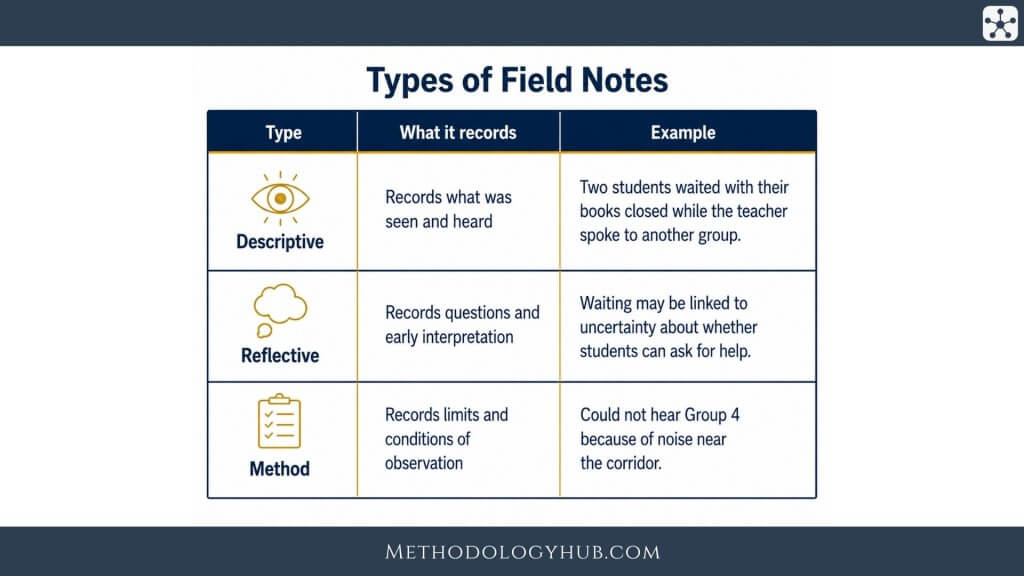
Useful field notes often have both descriptive and reflective layers. Descriptive notes record what happened. Reflective notes record the researcher’s questions, interpretations, uncertainties, and role concerns. Keeping these layers distinct helps the researcher avoid treating early interpretation as direct observation.
A descriptive note might state that three long-term members prepared equipment while two new members waited near the door. A reflective note might ask whether newcomers are waiting because they do not know what to do, because tasks are informally claimed by experienced members, or because they are being cautious.
| Note layer | What to include | Example wording |
|---|---|---|
| Description | Actions, speech, setting, objects, timing, movement | Two members moved chairs before anyone asked them to. |
| Reflection | Questions, early interpretations, role effects, uncertainty | Chair moving may signal who feels ownership of the space. |
| Method note | Access, role, recording limits, missed details | Could not hear the side conversation while helping at the front table. |
Recording participation itself
Participant observation notes should include what the researcher did, not only what others did. If the researcher joined a task, answered a question, helped a participant, or was asked for an opinion, that action is part of the field situation.
This does not mean the researcher becomes the centre of the study. It means the analysis needs to know how the data were produced. A researcher who helped newcomers complete forms may see different interactions from a researcher who sat quietly at the back of the room.
Linking notes to other data
Participant observation is often combined with interviews, documents, photographs, or meeting records. Field notes should make it possible to connect these materials. The researcher may note which document was used in a meeting, which participant later explained an event, or which activity led to a follow-up question.
This kind of linking helps analysis because fieldwork rarely produces one clean data source. The strength of participant observation often comes from connecting repeated observation with other forms of evidence.
Participant Observation vs Non-Participant Observation
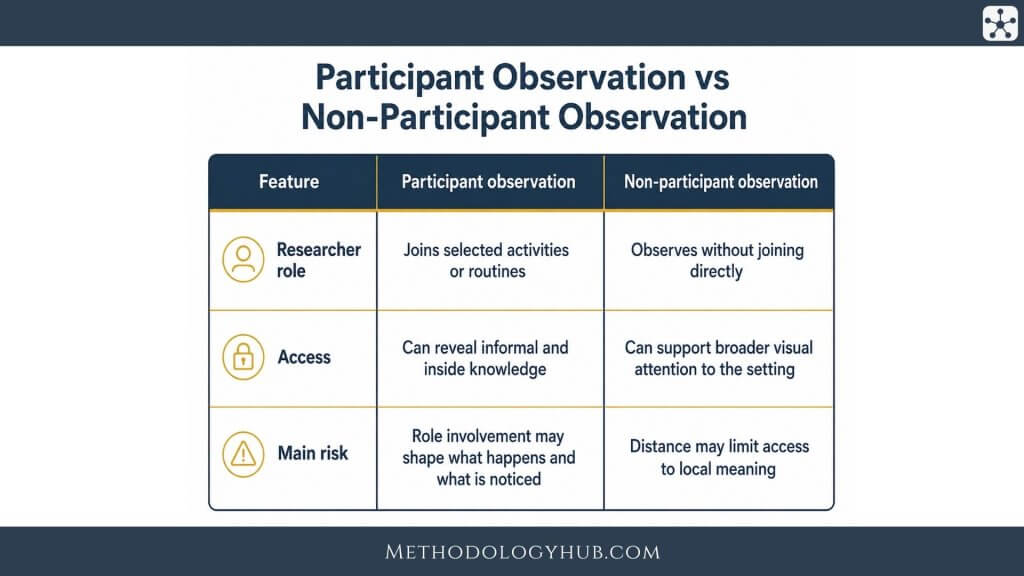
Participant observation and non-participant observation differ in the researcher’s role. In participant observation, the researcher joins the setting or activity to some degree. In non-participant observation, the researcher watches without directly joining the activity being studied.
The difference affects access, distance, interpretation, and field relationships. Neither method is automatically stronger. The better choice depends on what the researcher needs to understand and what role is possible in the setting.
Access from inside and outside
Participant observation can give access to informal knowledge. By joining activity, the researcher may hear side comments, learn routines through doing, and notice what it feels like to take part. This can be useful when the study concerns membership, learning, belonging, or practical work.
Non-participant observation can give more distance. The researcher may be better able to watch the whole scene, record details continuously, and avoid being pulled into tasks. This can be useful when participation would interfere with the activity.
Effect on the setting
Both approaches affect the setting in some way. A researcher standing at the edge of a room may still influence behaviour. A researcher joining the activity may influence it more directly. The issue is not whether influence exists, but how it is recognised and recorded.
Participant observation requires special attention to role effects. If participants begin treating the researcher as a helper, learner, insider, or evaluator, those role expectations may shape what is said and shown.
| Feature | Participant observation | Non-participant observation |
|---|---|---|
| Researcher role | Joins selected activities or routines | Observes without joining directly |
| Access | Can reveal informal and inside knowledge | Can support broader visual attention to the setting |
| Main risk | Role involvement may shape what happens and what is noticed | Distance may limit access to local meaning |
Choosing between them
Choose participant observation when involvement helps answer the research question. Choose non-participant observation when distance is more useful, safer, or less disruptive. A study of how volunteers learn routines may benefit from participation. A study of traffic flow in a waiting room may not need participation at all.
Some studies move between the two. The researcher may participate during community events but observe from a distance during formal meetings. The final method description should explain these changes rather than label the whole study too simply.
How to Analyse Participant Observation Data
Analysing participant observation data means working through field notes, role notes, memos, maps, documents, and sometimes interview data to understand patterns in a setting. The analysis needs to preserve both action and participation: what happened in the field and how the researcher was involved.
The data can be messy because fieldwork is not organised like a questionnaire. Events repeat, overlap, and change. A useful analysis process turns that field material into a clear account without losing the complexity that made fieldwork necessary.
Read field notes chronologically
Reading notes in chronological order helps the researcher see how the field relationship developed. Early notes may show confusion, distance, or access problems. Later notes may show familiarity, invitations, repeated patterns, or changes in the researcher’s role.
This first reading can help create a timeline of the fieldwork. The timeline may include entry, first participation, key events, conflicts, routine activities, role changes, and exit from the field.
Code actions and meanings together
Participant observation analysis often needs to connect what people do with what those actions mean in the setting. Codes may include tasks, roles, places, interaction patterns, informal rules, membership signals, humour, conflict, waiting, or learning.
Codes should not flatten the data into isolated labels. A task such as cleaning up after an event may be practical, but it may also signal belonging, seniority, gendered expectation, or informal hierarchy. The surrounding notes help interpret the action.
Use memos to track interpretation
Memos help the researcher develop ideas across the fieldwork record. A memo may explore a repeated routine, a puzzling event, a change in access, or a possible theme. It can also connect field notes with interviews or documents.
Memos are especially useful in participant observation because understanding often develops gradually. A detail that seemed minor in week one may become important after repeated visits.
Compare events, roles, and settings
Comparison helps the researcher avoid treating one event as the whole story. The analysis may compare formal meetings with informal breaks, newcomers with long-term members, quiet days with public events, or the researcher’s early role with later involvement.
Comparison can show where a pattern is stable and where it depends on situation. For example, a volunteer group may describe itself as informal, but hierarchy may become visible during busy public events.
Write from field evidence
Findings should use field evidence carefully. The researcher may include short field note excerpts, descriptions of repeated routines, small scenes, or summaries of observed patterns. The writing should show how interpretation grows from recorded detail.
The researcher should also show the scope of claims. A participant observation study usually offers a contextual interpretation of a setting, process, or group. It should not be written as if it represents all possible settings unless the design supports that wider claim.
Examples of Participant Observation
Examples of participant observation show how the method can be adapted to different settings. In each example, the researcher learns through a combination of taking part, observing, speaking informally, and writing detailed field notes.
Example 1: Volunteers in a community food project
A researcher studies how volunteers learn routines in a community food project. They attend weekly preparation sessions, help sort supplies, join clean-up tasks, and write notes after each visit. Over time, the researcher notices that newcomers are not trained through formal instruction but through watching, being corrected gently, and being trusted with small tasks.
The analysis may show how membership is built through practical work. Participation is useful because the researcher experiences the learning process instead of only asking volunteers to describe it later.
Example 2: Student life in a shared study space
A researcher spends several weeks in a university study space, using the room as students do while observing how people choose seats, form groups, manage noise, and signal whether they are open to conversation. Informal conversations help the researcher understand which areas are seen as social and which are treated as quiet zones.
The field notes may show that students use small objects, headphones, bags, and seating choices to manage interaction. These practices may be too ordinary for students to mention in a survey.
Example 3: Workplace onboarding in a small organisation
A researcher joins onboarding activities in a small organisation as a temporary observer-participant. They attend training sessions, shadow daily tasks, and join informal breaks. Field notes record who explains tasks, which mistakes are tolerated, and how new staff learn who to ask for help.
The analysis may show that onboarding happens less through formal documents than through informal correction, repeated observation, and social cues. Participant observation helps reveal the hidden learning process.
Example 4: Community arts rehearsals
A researcher studies a community arts group by attending rehearsals, helping with room setup, and observing how members negotiate creative decisions. The researcher records how ideas are introduced, who changes them, how disagreement is softened, and how newer members become more confident.
The study may show how creative authority is shared unevenly, even when the group describes itself as open. The method is useful because participation gives access to rehearsals, breaks, practical tasks, and informal conversation around the creative process.
Conclusion
Participant observation allows researchers to study social life through presence and involvement. It is especially useful when the research question concerns routines, informal rules, belonging, participation, learning, and the way people organise activity in a real setting.
A strong participant observation study needs a clear focus, negotiated access, a well-described researcher role, detailed field notes, reflexive records, and analysis that connects observed practice with local meaning. The method is flexible, but it should never be vague.
FAQs on Participant Observation
What is participant observation?
Participant observation is a qualitative research method in which the researcher studies a setting while taking part in it to some degree. The researcher observes, participates, records field notes, and analyses how social life works in context.
What is participant observation in qualitative research?
Participant observation in qualitative research is used to understand behaviour, interaction, routines, informal rules, and meanings through close involvement in a field setting. It often produces field notes, memos, maps, timelines, and informal conversation records.
How do you conduct participant observation?
To conduct participant observation, define the fieldwork focus, negotiate access, choose a participation role, spend time in the setting, write jottings and expanded field notes, record reflexive memos, and analyse patterns across the field record.
What is the difference between participant and non-participant observation?
Participant observation involves joining the setting or activity to some degree. Non-participant observation involves watching without taking part directly. Participant observation can reveal inside knowledge, while non-participant observation can provide more distance.
What are examples of participant observation?
Examples include volunteering in a community project while studying informal roles, joining study spaces to observe student routines, shadowing workplace onboarding, or attending arts rehearsals to understand group decision-making and creative practice.
What should be recorded in participant observation field notes?
Participant observation field notes should record actions, speech, setting, timing, movement, informal rules, the researcher’s participation, descriptive details, reflective thoughts, access limits, and early analytic ideas.
How do you analyse participant observation data?
Participant observation data are analysed by reading field notes chronologically, coding actions and meanings, writing analytic memos, comparing events and settings, and linking field evidence to supported interpretations.