
Effect Size Calculator (Cohen's d)
The Effect Size Calculator is used to compute Cohen’s d for independent groups or paired samples. The tool also provides an interpretation and a visual effect size scale.
Effect Size Calculator (Cohen’s d)
Use this tool to calculate Cohen’s d for independent groups or paired samples. You can enter raw data in a spreadsheet-style table or use summary statistics. The calculator returns Cohen’s d, a bias-corrected Hedges’ g, descriptive statistics, a results interpretation, and a visual effect size scale.
Choose your design and enter data
Pick independent groups or paired samples, then choose raw data or summary statistics. In raw-data mode you can paste one or two columns from Excel or CSV using Ctrl/Cmd + V. Decimal commas are recognized.
| # | Group 1 | Group 2 |
|---|
Effect size summary
Run the calculator to view Cohen’s d, Hedges’ g, group summaries, and a plain-language interpretation.
Interpretation
Effect size scale
Descriptive statistics
Calculation details
About the Effect Size Calculator
How to Use the Effect Size Calculator
To use the Effect Size Calculator, users can choose between independent groups or paired samples and then enter either raw data or summary statistics. Raw data can be pasted directly into the table, while summary inputs require group sizes, means, and standard deviations.
Once the data is entered, the Effect Size Calculator computes the effect size measures automatically. Invalid or incomplete entries are ignored to ensure that only valid observations are included.
When to Use an Effect Size Calculator
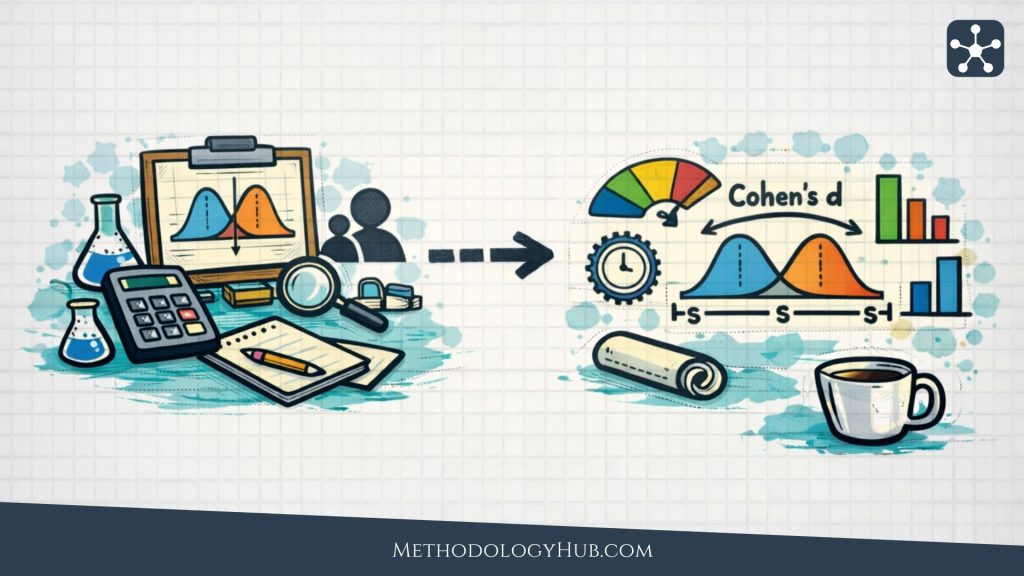
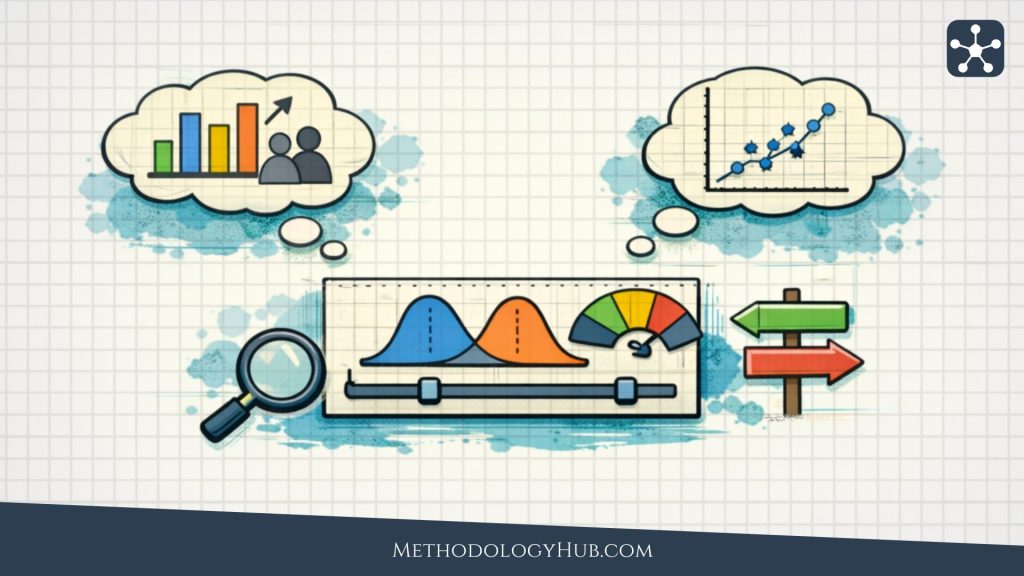
An Effect Size Calculator is used to quantify the magnitude of differences between groups, independent of sample size. It is commonly applied in research to complement statistical significance testing and provide a measure of practical importance.
In many academic contexts, an Effect Size Calculator is used alongside hypothesis testing to interpret whether observed differences are meaningful, rather than relying solely on p-values.
Effect Size Measures and Statistical Output
The Effect Size Calculator computes Cohen’s d as a standardised measure of group differences. In addition, it reports Hedges’ g, which corrects for bias in small sample sizes.
Alongside effect size estimates, the Effect Size Calculator provides descriptive statistics such as means and standard deviations. These outputs support a more complete understanding of the data.


Effect Size Calculator with Interpretation
The Effect Size Calculator includes a plain-language interpretation of the calculated effect size. Values are categorised into levels such as negligible, small, medium, or large.
This interpretation provided by the Effect Size Calculator helps translate numerical results into meaningful descriptions that can be used in reporting and discussion.
Visual Effect Size Scale
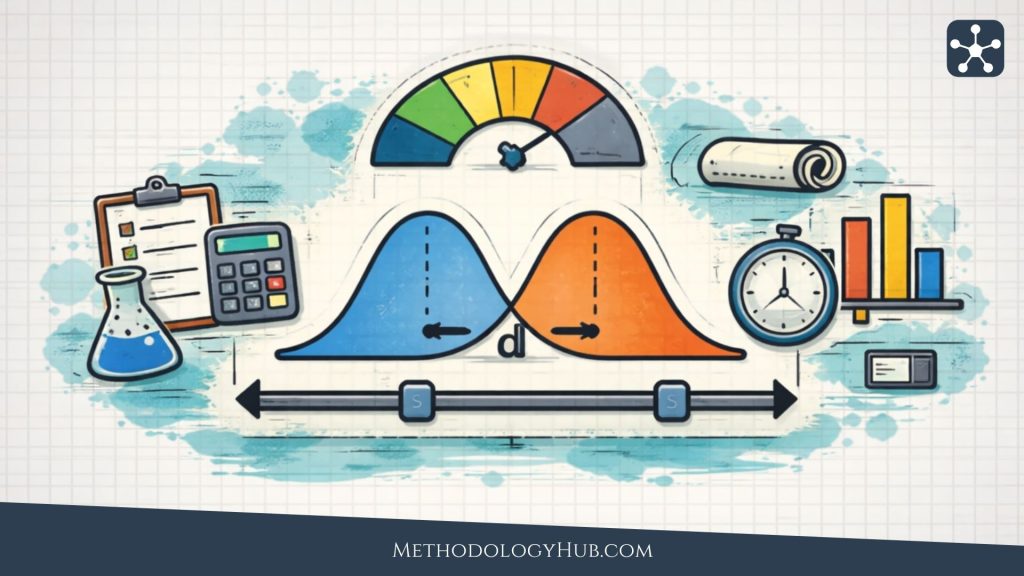
A visual scale is included to display the position of the calculated effect size. The Effect Size Calculator places the result along a continuum ranging from negative to positive values.
This visual representation in the Effect Size Calculator supports interpretation by showing both the magnitude and direction of the effect in a single view.

Privacy-friendly Effect Size Calculator
All computations in the Effect Size Calculator are performed locally within the browser. No data is uploaded, stored, or transmitted externally during use.
Because the Effect Size Calculator operates without AI or external processing, results are deterministic and based solely on the provided input data.
Other free statistical tools
These tools support common statistical tasks in research, from exploring relationships in data to estimating effects, building models, and planning studies.
Correlation Coefficient Calculator
Measure the strength and direction of relationships between variables with clear, easy-to-read results. Useful for exploratory analysis, hypothesis testing, and reporting findings.
Effect Size Calculator (Cohen's d)
Calculate effect size quickly to understand the practical magnitude of differences between groups. Ideal for research reports, study interpretation, and comparing results beyond p-values.
Linear Regression Calculator
Analyze how variables predict an outcome using straightforward regression outputs. Helpful for modeling trends, testing hypotheses, and interpreting statistical relationships.
Sample size calculator
Estimate the sample size needed for your study based on key statistical inputs. A practical tool for planning experiments, surveys, and research designs with adequate power.